It's the first time in the history of the world.
The text, web pages, videos and code often stop in a "half-finished" state: the poster text does not misspell, but squeezes out the page; the home screen is beautiful, the buttons are unresponsive; the footage in the video is created at a glance, but it loses its character and rhythm; the program has just repaired one module and another one returns.
The requirements in the complete work are intertwined, and the problems are often exposed after rendering, playback, or operation. The repair process requires positioning problems, local modification, and checking whether the modification affects other parts; the whole weight of the work will even change the content that has already been completed.
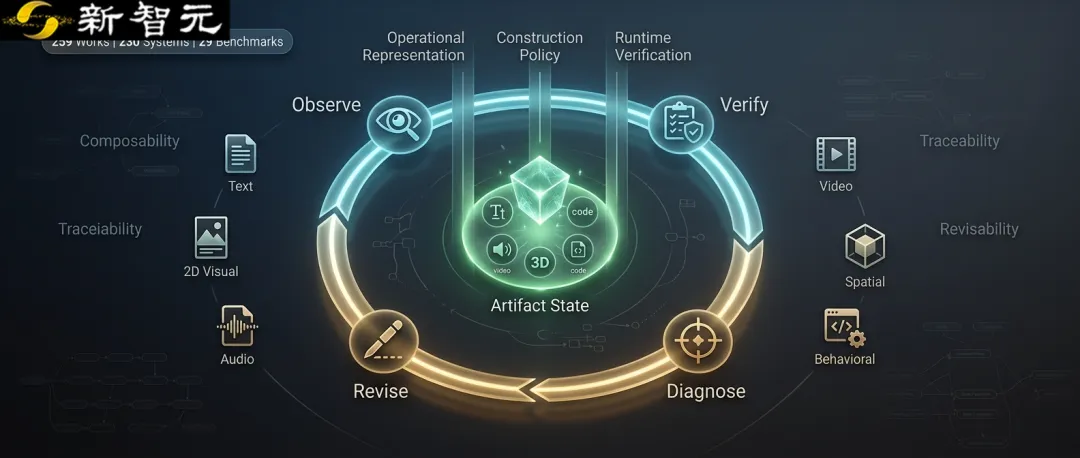
A research team from the Hong Kong University of Science and Technology, Guangzhou University, Zhejiang University, Chinese University of Science and Technology, Tsinghua University, University of Hong Kong, University of Sydney and Tsinghua University worked on 259 projects, including 230 systems and 29 related benchmarks, on the ongoing construction of the work as of August 20, 2026.

Link to the paper:https://arxiv.org/abs/2608.28122
The main page of the project:https://agentic-creation.github.io/
The GitHub project:
From generating results to continuing construction
Traditional generation systems mostly work along a one-way path: receiving instructions, generating results, and then finishing. When tasks are small enough, results are easy to check, this method is effective.
Documents, charts, and editions of a research poster must work together; the code, tests, and documents in the software repository must be consistent; the characters, narratives, and timelines in a long video cannot be separated. Modifying one of them may result in invalidity of the old inspection results. Changes in the document will squeeze the edition, data changes will stir the graphs and conclusions, and interface adjustments will allow the tests and explanatory documents to expire.
Agentic Artifact Creation is defined as an ongoing construction process: a system maintains an ever-changing deliverable object and decides what to generate next, where to modify it, and when to stop based on intermediate results.
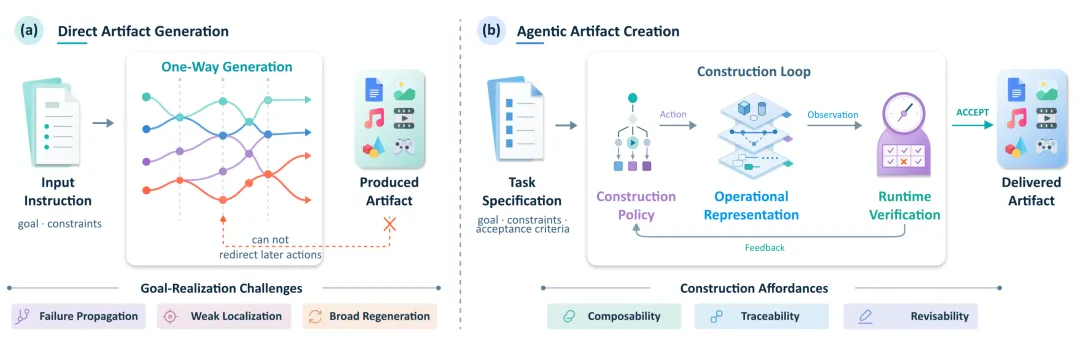
Figure 1 directly generates results along fixed paths; intelligent creativity connects the state of the work, inspection results and subsequent modifications into a cycle.
The functional architecture of the AI creation system
The paper will break down the construction process into three functional roles: representation of works, construction strategy and running time verification.
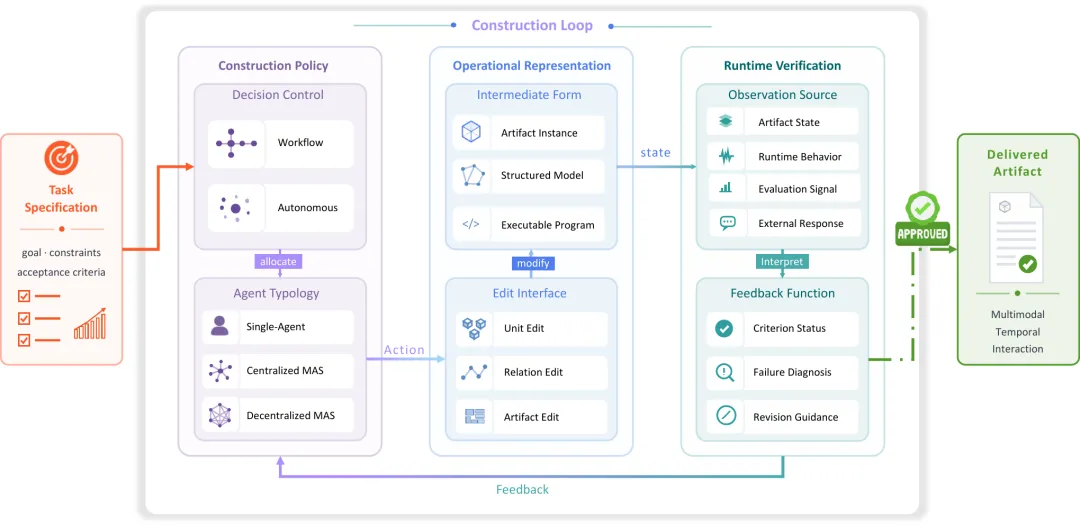
Figure 4 illustrates the functional architecture of Agentic Artifact Creation. The construction strategy selects actions, the works represent an editable intermediate form, the running time verification converts observations into feedback; the system delivers the works after the standards are met.
It can be a document, a scene map, an executable piece of code, or a structured representation with layers, nodes, and dependencies. Many problems are difficult to locate if the system can only see the final screenshot; localizable structures such as text blocks, page components, or scene objects can support local repair.
Construction Policy is responsible for deciding what to do next. It combines task requirements, current status and feedback already received, choosing to continue generating, modifying a location, calling tools, requesting artificial judgments, or stopping when evidence is sufficient.
Runtime Verification observes the results of recent actions. Text can verify references, pages need to be rendered and clicked, programs must be compiled and run tests, and audio videos must be played.
The three characters are cyclically coupled, and a repair is usually done:
Clear completion of the standard → Maintain a playable work status → Verify current results → Diagnostic problems → Constructing strategy selection actions → Perform local modification → Re-verification
The collaboration of three functional roles may support three capacities:
Compounded (Composability)Works can be broken down into clear boundary parts and joined by clear interfaces. Text, graphs, and editions can be produced separately, and the sequence can be changed or adjusted when necessary, and combined and checked for compatibility.
TraceabilityThe system records requirements, actions, the relationship between the state of the work and the results of the observation. When problems arise, the results can be traced to the relevant requirements, changes and evidence, and can explain how a decision is made.
Revisability (revised)The verification results can point to the affected parts, and the structural strategy chooses to modify the scope accordingly. After completion, the system re-examines the relevant dependencies and makes every effort to retain what has already been passed.
6 categories of works
The research team focused on the finished work and divided the existing work into six categories: text, 2D visual, audio, video, spatial works, and behavioural works such as software, websites, games, and simulations.
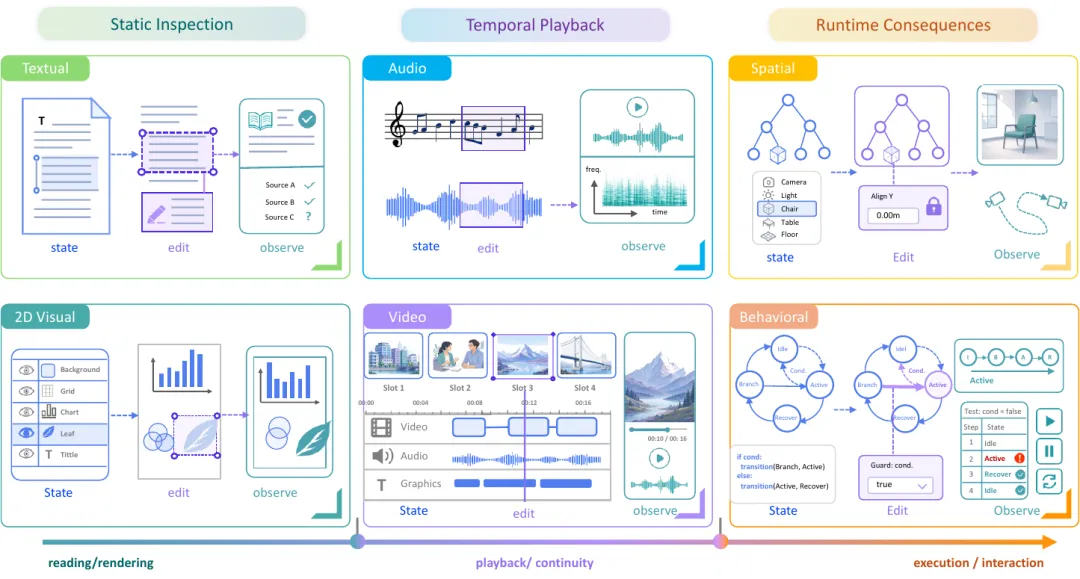
Text and visual works can be read or rendered directly; audio videos depend on the time of play; spatial and behavioural works often need to be run or interacted to judge.
Text and two-dimensional vision can usually be statically checked, and sentences, paragraphs, layers, and graphic markers are also easier to locate. The difficulty is long-distance consistency: modifying a fact from the preceding text may require updating the arguments, graphs, and citations from the latter.
Audio and video need to be checked in a time sequence. A single segment sounds fine and may break the rhythm when the entire sequence is returned. Video also deals with the relationship between images, sound, subtitles, and footage at the same time. Feedback usually occurs after playback or rendering.
Spatial works must maintain geometry, semantic components and physical constraints. Whether behavioural works qualify depends on how the code, application or simulation responds in an interaction process. The longer the execution path, the more expensive it is to obtain a representative set of observations, and the more difficult it is to trace failures to a specific state.
The structural difficulty of different works depends on three variables: the degree of correlation between the decisions, when errors are visible, and whether the system can be repaired locally under the assumption that the results have already been preserved.
Cost of multi-agent collaboration
Dividing complex tasks into sub-tasks can reduce single-step difficulty and increase coordination costs.
One agent modifies the text, another agent is in charge of the page, and a third agent checks the facts. If the text changes, does the agent know that the page has failed?
The difficulty of multi-agent systems lies in the shared status, dependence and completion of standards. The thinner the dismantling, coordination, conflict resolution, and reassembly costs. For short, easy-to-verify tasks, a single agent with a stable calling tool may be more suitable.
Shared work represents placing the work of each agent on the same verifiable, modifiable delivery and maintaining consistency between local results.
Total scores can't directly guide repair
Many generating systems conclude the assessment as a total score. The total score corresponds to the results of the comparison, but it is difficult to guide the correction: it does not usually explain where the problem arose, why it was caused, or give the next possible modification.
Diagnostic granularity must also be consistent with editing granularity. The examiner finds that the overall narrative is inconsistent, but the system can only rewrite the entire article; the evaluator finds that there are problems at the visual level, and the editing interface can only reproduce the entire picture.
The paper divides the subjects into three levels:
The first floor isFinal workRequirements: whether the requirements are met, whether the content is consistent, can not be completed for the intended purpose after being put into the real scenario.
The second floor isConstructing tracksError detection: not early enough, whether the repair is local, whether the part that has been passed has been preserved, how long it took the process, model calls and artificial supervision.
The third floor isThe Agent System itselfRepeat the same task: whether the same task is stable, whether a replacement start-point will fail, whether the user can modify the target and retain control, and whether the system returns after updating.
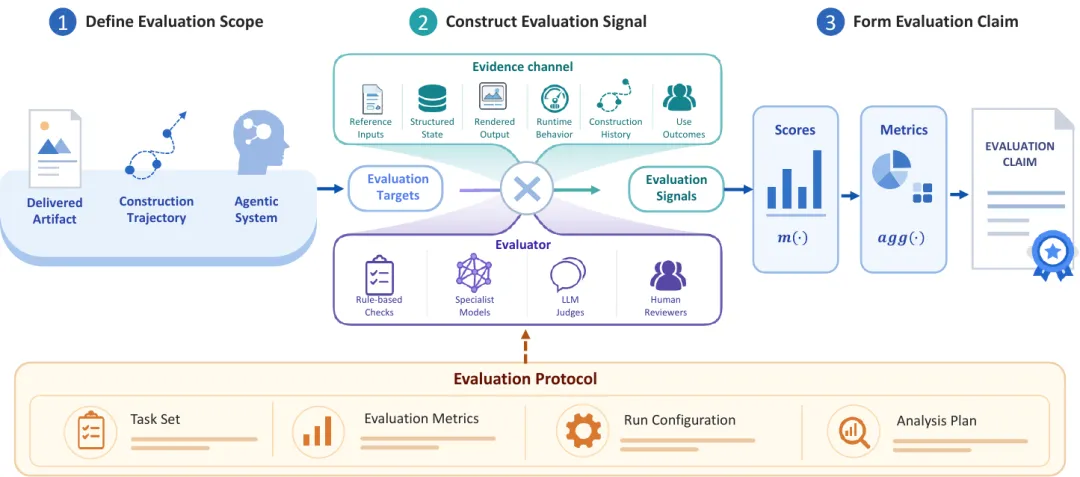
Figure 3 shows the evaluation of the final work, the construction trajectory or the Agent system, and what evidence is used, by whom it is judged, and under what protocol conclusions are drawn.
Generators and evaluation models may share knowledge gaps, aesthetic preferences, and blind judgment when they come from a close family of models. Increasing the number of LLM Judges does not guarantee that the evidence is independent of each other.
Source control, structured status, rendering results, operational behaviour, constructed history and user results belong to different evidence channels; rule checks, proprietary models, LLM Judge and artificial evaluation are different evaluators. A specific evaluation signal comes from a combination of evidence channels and evaluators.
Four design principles
First, write down the requirements that must be retained in the state of the work. Complete the standard to establish a connection with specific pages, paragraphs, footage, objects or tests in order to determine which commitments are affected by a modification.
The second is to define the boundaries of control. The execution capacity and decision-making power of the system are two things. Creative substitution, fact-confirmation, outsourcing and high-consequence operations require different levels of authorization, and trust cannot replace authority.
Third, to allow feedback to be directed toward modification. Feedback requires connecting evidence, diagnostics and executable actions; overall evaluation or a single overall score is difficult to get into the building process.
Fourth, the modification re-verifies the affected state after modification. The modification will make the old evidence obsolete. The system needs to be selectively re-checked according to the impact range, and the results of the verification will also be updated with the version of the work.
Control increases the cost of representation, verification and coordination. Constructed cycles require confirmation that intermediate observations can improve subsequent decisions and that modifications can retain accepted results.
Six directions for the future
Global consistencyRequires the system to reconnect once the work has been disassembled. When a role is set, design specifications or interfaces change, the effect may be across the whole work, and the system needs to explicitly maintain these dependencies.
Accurate repairRequiring the system to find the source of the failure and modify only the affected parts. Detecting abnormalities, locating causes and completing repairs are three different capabilities and cannot be replaced with an ultimate success rate.
The evolution of systemsFocus on the changes that remain between tasks. A single work modification changes only the current results; new strategies, tools or memories need to be independently verified, version managed and rolled back to become reusable.
Continued personalizationA distinction must be made between stable preferences, project commitments, temporary selections and uncertain inferences. Each record must be marked with status, scope and version, and allowing users to check, correct or withdraw. Preferences in one project should not be automatically transferred to another project.
Human decision-making powerSpecific actions need to be implemented: who can approve, under what conditions approval occurs, what level of authority the system gets.
Reliable assessment of open outcomesAcknowledge how many good answers a task can have. Evaluation protocols need to record which criteria are fixed at the beginning, which preferences arise after looking at the intermediate results, and who explains these changes.
Classification map of 259 works
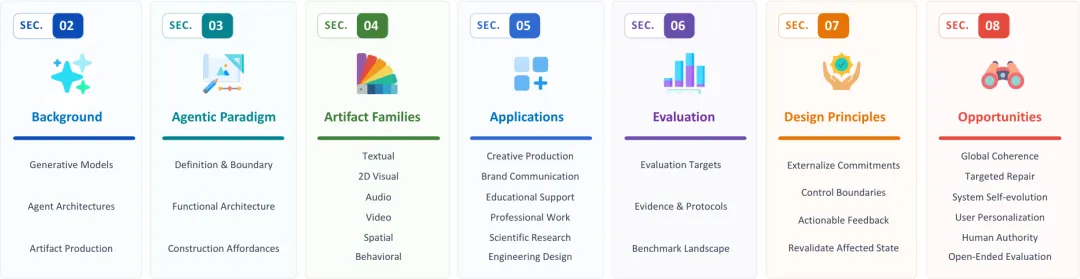
The paper's thought mapping is based on generating models and Agent architectures, and discusses the intelligent design paradigm, six categories of work, applications, evaluation, four design principles and six future directions.
The content includes 259 works: 230 systems and 29 benchmarks. In addition to the six categories of works, the research team also dismantled the application scenarios and evaluation methods into independent dimensions, avoiding mixing the work types, application scenarios and evaluation methods into the same set of categories.
Of these, 251 can be classified into a major work category; the other eight are multi-subject application workflow systems.
259 jobs = 230 systems + 29 benchmarks(251 entries in six categories of work views, another 8 for application workflow systems)
Applying scenarios to creative production, brand dissemination, educational support, professional work, scientific research and engineering design, with different acceptance requirements for works.
The work category answers "what ultimately delivers" and the application scenario focuses on "what purpose the work is used for, by whom it is accepted". The main acceptance is based on the experience of creators and audiences, gradually extending to brand requirements, learning outcomes, decision effectiveness, scientific evidence, and testing and physical effectiveness.
Supported Awesome projects can browse, cover code Agent, automation design, scientific writing, video production, 3D scenarios, games and simulations by type of work and application scenarios. When reading the related work, you can compare the status of the system-preserved work, the validation evidence used, misplacement methods, and the scope of repair work.
What is the meaning of this verse?
Delivery quality depends on whether the requirement can be continued to be met, whether the modification can be denied to a specific location, whether it can be repaired after failure, and whether the system can provide sufficient verification evidence.
Complex agents are used for intermediate observations that can alter follow-up actions, that can retain parts that have been completed, that the system has explicit tasks that stop with the switching conditions. The number of iterations cannot alone prove that the system has these capabilities.
Assessment simultaneously covers three layers of objects: whether the final work reaches the standard, whether the trajectory is constructed and whether the Agent system is reliable and controllable.