It's the first time in the history of the world.
It's just been a while since Cold War officially became the highest-ranking platinum member of the PyTorch Foundation!
A Chinese AI chip company has taken a seat on the board of the PyTorch Foundation.
In the room where the global AI development framework is directed, there is a Chinese chair.
And this chair is the seat of a Chinese chipmaker.
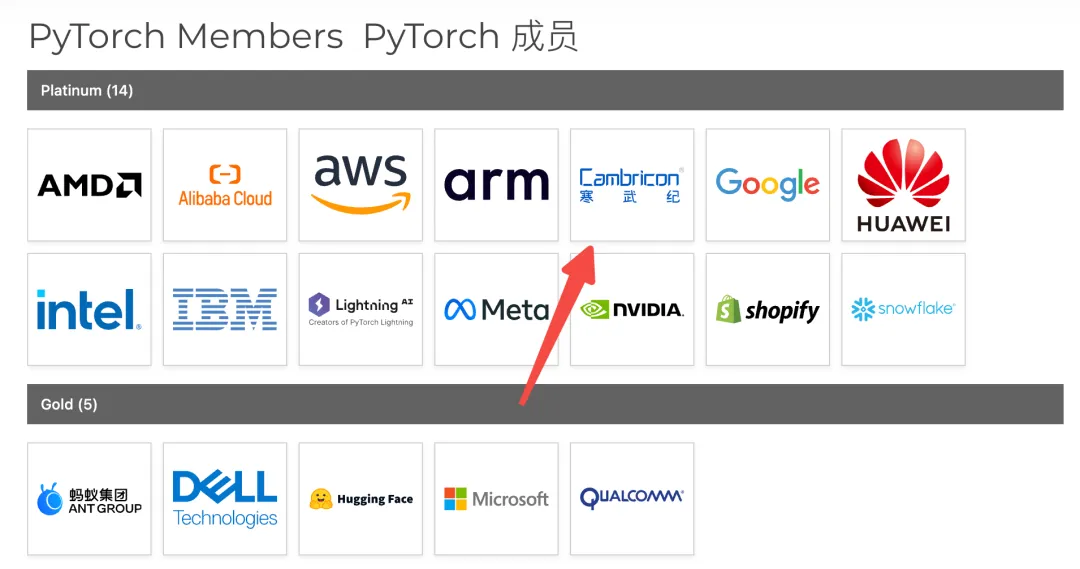
In May of this year, Ali became a Platinum member of the PyTorch Foundation.
Under a highly centralized model of AI chips globally, a Chinese chip company has entered the decision-making phase of the world's most important open source AI community.
It's worth a second look.
"Platinum" means what?Many people know about PyTorch but may not know about the PyTorch Foundation.
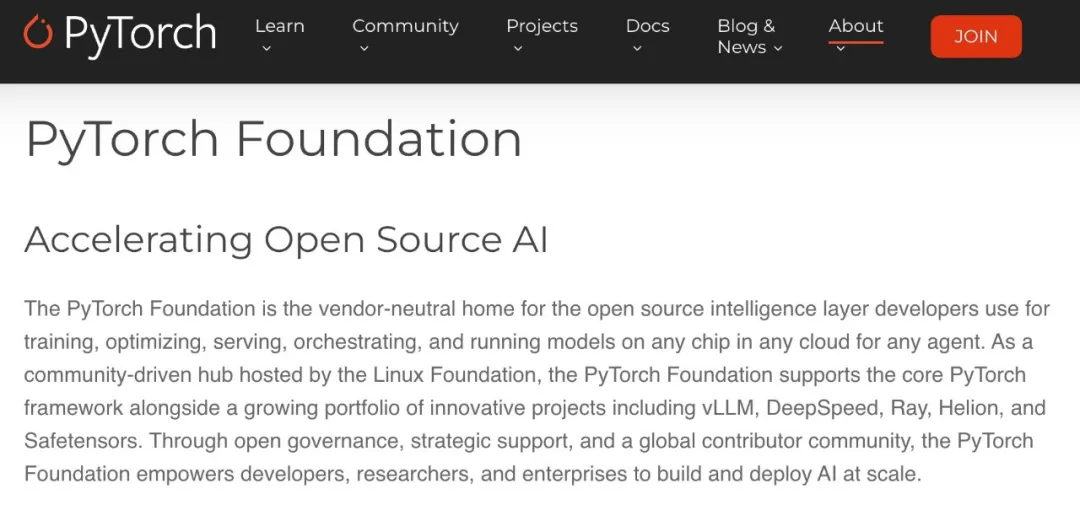
The PyTorch Foundation is a community-driven, open-source AI organization under the Linux Foundation that has PyTorch, vLLM, DeepSpeed, and Ray in its hands.
GPT, DeepSeek, Qwen, GLM, the names vary, but at the bottom of the page, many of them are on the same infrastructure: developing PyTorch and deploying it more and more on rationale engines like vLLM.
By 2026, the PyTorch community has gathered 12,000 contributors from more than 2,000 institutions. This toolkit is not the product of one company, it is the foundation of the entire AI industry.
The board of directors of the PyTorch Foundation is the person who gives the landscape map.
The council members did not discuss the abstract technological vision. It decided who PyTorch would prioritize next, how abstract the device interface would be, what capabilities would be dominant and which would be left to the manufacturers to solve themselves.
At the founding of the Foundation in 2022, the founding members of the Board were the world's biggest brands: Meta, AMD, AWS, Google Cloud, Microsoft, NVIDIA.
It is now the highest-ranking platinum-selling single of the Cold War era.
Who sits on the board is answering a particularly specific question on behalf of global developers:If you want to replace a chip, why not rewrite the code?
This is a question that Chinese AI chips have been asking for many years.
For many years, Chinese AI chips have been downstream.In fact, Chinese AI chips play a role in the global open source ecosystem, and in the long run, they are "adapters".
What's an adapter? Others write the framework, and we do the compatibility, the addition of the algorithms, the adjustment of the performance, and we try to get the old code that developers write to run on their own chips.
It's hard and tedious and unobtrusive. One version of the framework goes up and down; the hardware changes from generation to generation, the software changes from generation to generation.
I can use it.
You can use it, but you can't use it. You can run, but you can't run.
This is a common impression in the minds of developers of past domestic AI chips.
It's not up to you how to design the framework, how to define the interface, how to prioritize the next step in supporting whoever creates it.
In the Qing Dynasty, a different approach was chosen.
It has a principle calledUpstream FirstTo put it bluntly, the modification of PyTorch's public domain code is to submit it back to PyTorch, not to keep a copy in its own private branch.
This is a much slower road.
Giving homeowners code, going to community reviews, getting picked up, compromising on a bunch of different hardware demands, a patch grinding for months is commonplace.
But the cost is that every time PyTorch's upstream moves, you have to replenish your own part once and for all.
The Qing Dynasty chose the difficult path.
In recent years, the code submitted by the Qing Dynasty has covered PyTorch'sThe seven main dry modulesTorch compiler: torch.compile; Eager mode algorithm; when the device is running; distributed computing; automatic mixing accuracy; data loader; and Profiler performance analyzer.
Simply put, how the model is compiled, how the data is entered, how the mixed accuracy is stored, how the two cards communicate, how the performance cards are checked at what step.
It's not "compatibility", it's "co-building". The difference is that the former patches on someone else's code and the latter participates in writing the code itself.
At the same time, the Qing Dynasty was moving along the same line in the vLLM.
It works closely with the vLLM community to make DeepSeek-V4 and GLM-5 the mainstream open-source models.Day 0 is adaptedThis is the first time that a new model has been released, and it can be run on a card from the Cold War.
For those in the rush to launch a product, the middle three months is often the deadline for a product window.
There are two people on the board who write the code.In general, a company joins a foundation and is sent by a business or executive.
King is coming in.He is the senior director of the AI Framework for the Qing Dynasty and has joined the board of the PyTorch Foundation on behalf of the Qing Dynasty. His team focuses on software support for efficient reasoning and large-scale model training, business scenarios covering big language models, search advertising and recommendations, reinforcement learning, and customers in the Internet and financial industries.
What's the matter?A core supporter of PyTorch during the Cold War, he joined the Foundation's Technical Advisory Council. He worked closely with the frontline developers around the back-end integration mechanism PrivateUse1 of PyTorch, building the Torch-MLU expansion that allows users to have a native PyTorch development experience on Cold War products.
Two seats, one at the decision-making level and one at the technical level: the Cold War didn't just want to be "supported by PyTorch", it wanted to be involved in deciding how PyTorch would support everyone.
The cost of migration is the real threshold for hardware.Elton Gong, vice president of software engineering for the Cold War era, said: "A unified framework interface, which has lower migration costs for developers, is a more consistent tool and development experience. For PyTorch, more general equipment abstraction means fewer downstream branches and more sustainable maintenance".
He said that what the company needs to do is not only support PyTorch with its Cold War products, but also through ongoing mainstream collaboration, to push PyTorch to better support the multi-device backend, "so that PyTorch can have an open source development experience on a broader hardware platform".
This bill is at the heart of the hardware competition.
Developers change hardware, most fear code to be rewritten, tool chains to be re-educated, performance to be rearranged over and over again.
So in the Qing Dynasty, PyTorch was the main source of code, which was essentially to unify this layer, unifying it to change hardware like changing a device, rather than a different language.
Mark Collier, executive director of the PyTorch Foundation, said: "Any AI accelerator to scale and succeed must go through the entire lifecycle of AI development, from building and optimizing models using PyTorch to efficient deployments and services using vLLM".
He mentioned the ongoing contribution of the KMT to the upstream community, and also promoting the application of vLLM to KMT hardware, and welcomed it to join the Foundation.
From "We support you too".To "One of Us"He joined the PyTorch Foundation in the Qing Dynasty, and it was not a simple change of membership.
It is a landmark node in the Qing Dynasty from "domestic AI chip makers" to "global mainstream AI software ecosystem players".
It was founded in 2016 and has been making chips for a decade. In this decade, its products have become commercially available in smart conversations, intelligent AI, search advertising recommendations, and audio video generation.
Upstream First, seven core modules contributed, Day 0 adapted, two people joined the Council and the Technical Advisory Committee, which combined to give the Cold War a ticket:It's not about adapting to other people's rules, it's about being involved in making the rules.
Back in the Cold War, the focus was on compilation infrastructure optimization, enhanced CI/CD capabilities, and cross-device support for dedicated libraries in the PyTorch field.
Back to the bigger picture: The value of Chinese AI chips to the global open source community is changing from "we also support PyTorch" to "PyTorch's multi-device capabilities are part of us".
China's AI chips are already on the board.