It's the first time in the history of the world.
A Chinese company that was founded just four months ago has taken the world's first steps in building a full-atomic biobased model.
This company is calledIt's the first time I've ever heard of this.It's the first time we've released a self-developed generic biomolecular base model.Melo-1 Preview。
In the task of predicting complex molecular structures such as protein-polymers, protein-small molecules, Melo-1 has refreshed core indicators in several public Benchmarks; and has surpassed AlphaFold 3 in most of the rating indicators such as polymers, small molecules, antibodies, RNAs excluding DNA.
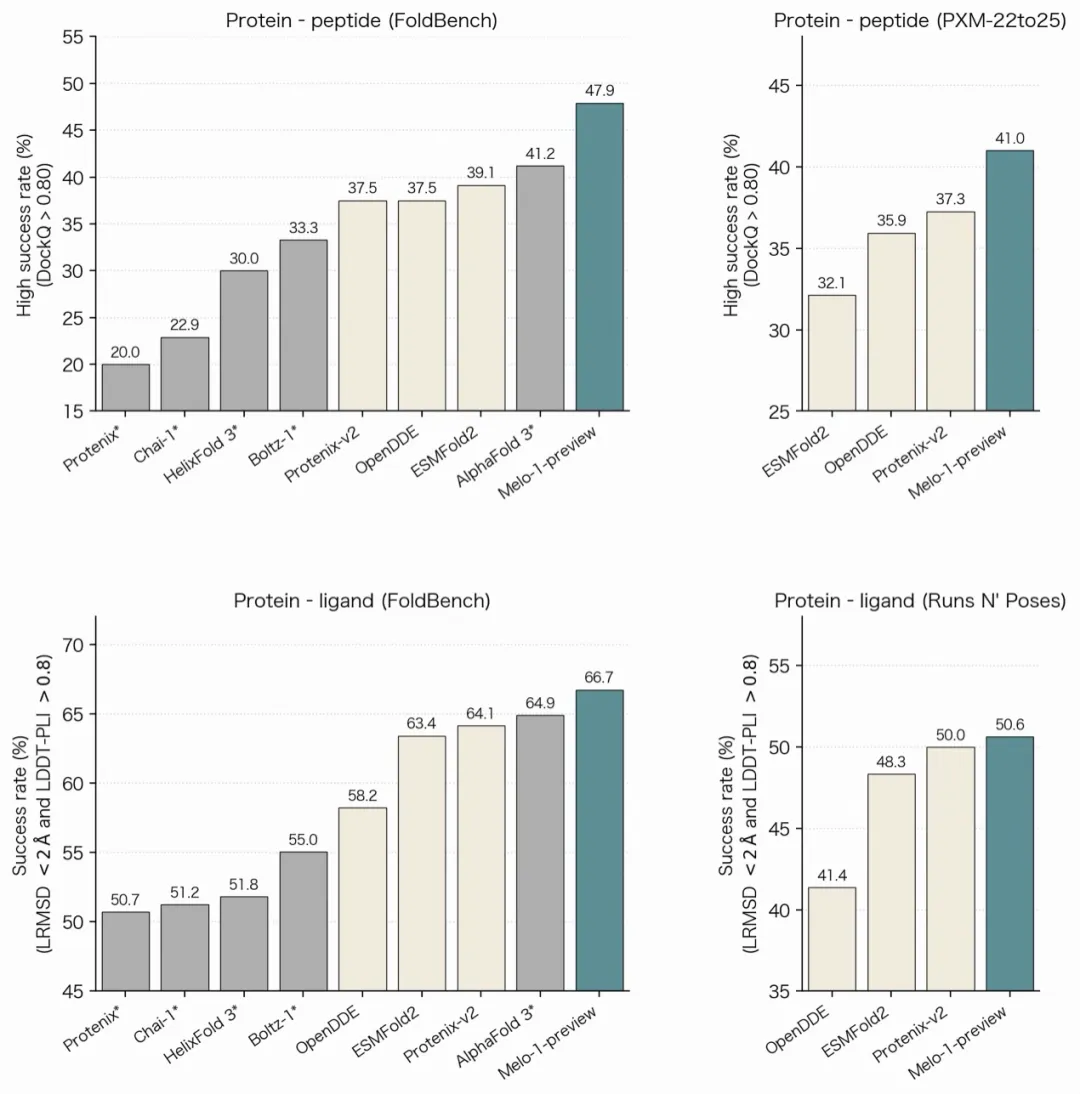
The Melo-1 preview version is the absolute leader in the Protein-peptide and Protein-ligand scenes.
As we have just said, the company is very special because of its "age".
Four months after its founding in Shenzhen, Shenzhen, the team focuses on AI-powered molecular novel drug discoveries, and hopes to further use the full-atom biological basis model in complex drug designs such as ringworms, antibodies.
While AlphaFold has taken the matter of predicting protein structure to a new height, now a number of Chinese startups are starting to continue drilling where it is more difficult.
In this deep whirlwind,Nuclear-scale drug design。
The hardest part of the bone.In order to understand what Melo-1 is doing, we need to understand why it's coming from within.Oh, my God.Put your hands down.
Over the past two years, the GLP-1-represented multivitamin has almost single-handedly reignited the global metabolic market.
But from a computational point of view, hydrogen is a very difficult thing.
It is intermediate in size between small molecules and large molecules, and has a very high flexibility. The composition of a small molecule has a relatively limited freedom; while a portion of a solution (especially a ring) often does not contain the only static composition, but a large group of compositions that switches back and forth in dynamic equilibrium.
It's something that's stuck in the mainstream model right now.
The full-atom model represented by AlphaFold 3 is fairly mature in the prediction of conventional single-unit proteins, common protein-protein complexes. However, the problem of inaccuracy and generalization is revealed once the object is replaced by a high-frequency polynomial complex, or a combination of structurally complex small molecules with point proteins.
Melo-1 was the cutting knife. What it did was to accurately model the three-dimensional structure and atomic-level interactions of protein-nitrogen complexes.
A polynomial cannot accurately bind to a point of focus, essentially dependent on its interaction at the atomic level in three-dimensional space: the shape of the interfaces between the interfaces is not mutually complementary, the bonding links are not matched, the drainage effect is insufficient, and there are a number of non-covalent interactions. All of these things occur at the atomic scale, and the sequence level is invisible.
The function of drug molecules is ultimately based on three-dimensional interactions on an atomic scale. The design goal is to move from producing a rational sequence of proteins to designing a functional molecule that can form the correct atomic-level interactions on the surface of the target.
So the logical chain behind what deep-spin technology is doing is clear, that only before it really understands "how many nodes and nodes are connected" can AI continue to analyze the key connections between nodes and mechanisms of action, and then guide sequence design, structural optimization, and kinetic engineering.
Melo-1 is not meant to push an indicator up and down a few points, but to lay a layer of structural infrastructure for AI to enter large-molecule drug design.
In addition, the legitimacy of the structure (Validity) is also one of the points of view of Melo-1.
Now some models have nice scores in public evaluation sets, but the generated structure comes out, the atoms and atoms collide, and the long-tail corners are numbers that are physically impossible to exist. This structure can score high on the list and does not exist at all in the real world.
Melo-1 integrates rigorous physical and chemical constraints deeply into early algorithmic architectural design to ensure that the output of the high-level structure is stable in real physical environments.
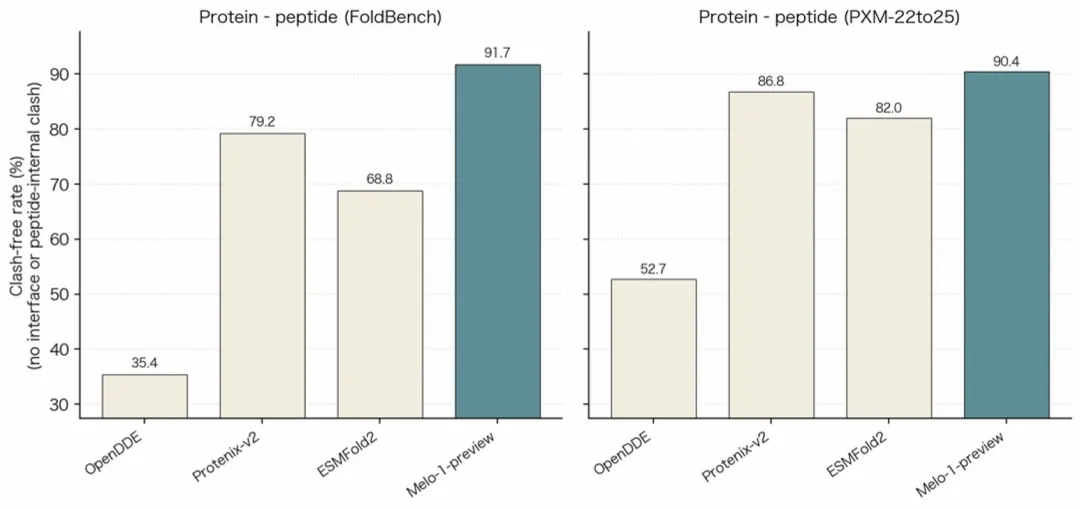
Melo-1 has more legitimacy
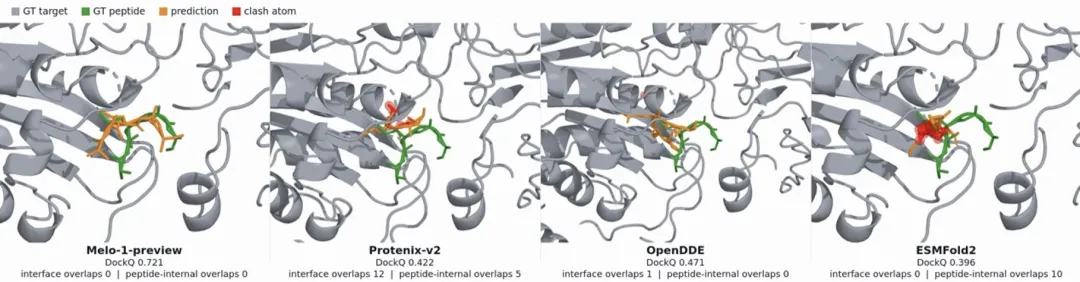
Melo-1 on PDB ID 8v3s has shown good legitimacy.
High accuracy and high legitimacy, two things that can be done at the same time, make the model really useful. With these two points, Melo-1 can eliminate a large number of ineffective test errors in the early stages of development and provide a truly potent molecular structure for wet experiments.
Another detail that can be easily overlooked, but has a big impact on long-term competition, is that it's not going to be easy.Through extreme engineering optimization, Melo-1 performed better under the same parametric conditions.
This means that the same results can be achieved with less training costs. In the field of monthly modeling, unit computation directly determines how many rounds a company can run, how many routes it can test. For a four-month-old startup, this is a question of whether it can continue to stay on the board.
In addition to the two main battlefields of polymers and small molecules, Melo-1 is also highly competitive in the nucleic acid and antibody scenarios.
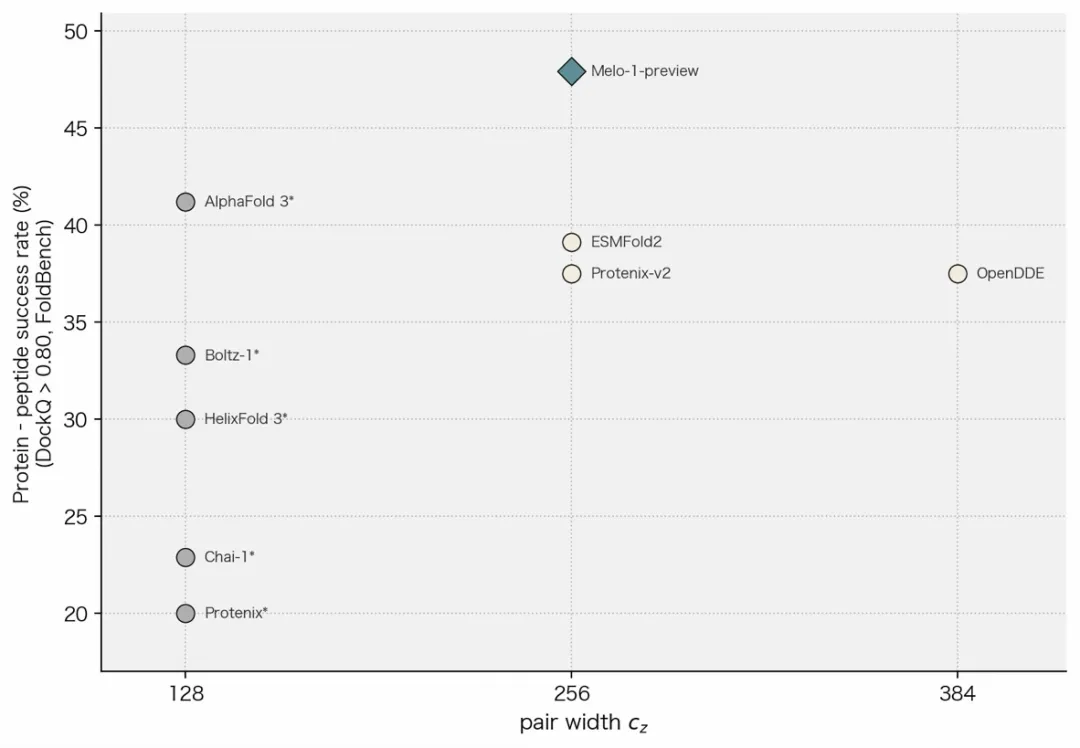
Melo-1 performs far better than other similar models under the same parameters.
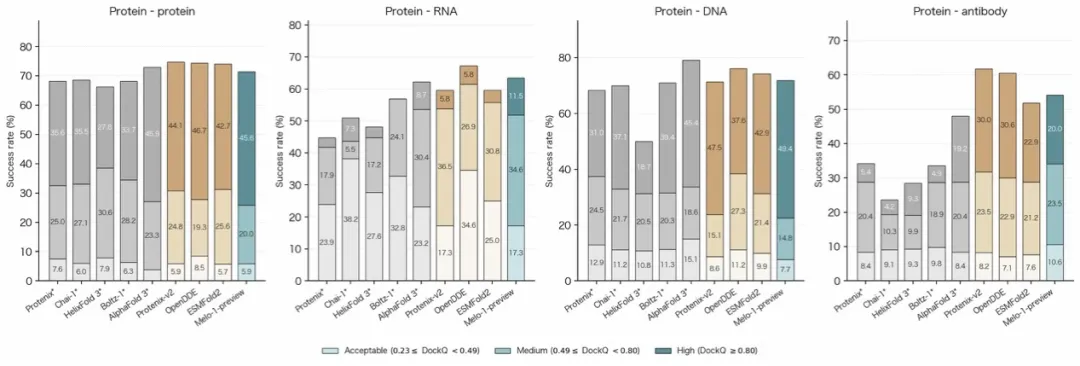
Nucleic acid and antibody scenarios Melo-1 preview version improves significantly, highlighting the potential of the model
Afterwards, Melo-1 is ready to continue to process more complex unnatural chemical spaces.
Existing AF3-like models have been able to represent many non-natural chemical entities in CCD, SMILES, modified residues and covalent bonds, but in such scenarios as D-amino acid, N-methylation, complex ringing, and side chain modification, the amount of data and structural diversity is significantly reduced. Models can read a chemical entity in, not as long as they have learned the geometric laws, stereochemistry, and compositional preferences behind it.
The company is only four months old.The core team has been working in depth for six years
After learning about Melo-1's technology, the question arises: How was it done in four months?
Maybe the answer is in the team.
Core members have successfully conquered more than 10 world-class high-difficulty sites such as GPCR (G-protein coupled receptors) using underlying AI technology, and have gained wet test validation of highly active polymerase molecules.
GPCR is one of the most important focus groups in today's pharmaceuticals, and recognized as one of the most challenging, with its complex transdermal structure, highly dynamic compositional changes, and a variety of compound coupling patterns that place extreme demands on both structural understanding and molecular design.
In addition to Zhang Shao Man, the founding team includes two very senior algorithm experts, Wang Xiaoming and Zhang Shao Man. Zhang Shao Man made a metaphor for this: Shen Shao Man is more like a team, with a division of labor and cooperation, with a common goal of winning.
While talking about long-term competitiveness, she gave a rather unexpected answer to the fearless ignorant:
Perhaps our team does have a bit of an ignorant feeling about traditional medicine research.
But from an innovation standpoint, this is not necessarily a bad thing.
Many innovations in themselves are bold ideas that arise in constant discussion and collision. In a mature large organization, an idea is likely to be quickly dropped because it is too premature, short-term and not realistic enough.
But boldness also means a higher probability of failure. A profound response is to constantly correct one's ideas and paths with the help of experience in traditional drug development. Zhang Shao men likened this mechanism to the reward function in model training: the reward function is well designed so that the model can turn in the direction you really want.
As for cross-disciplinary difficulties, her emotions are being refreshed:
At first, we felt that the intersection of AI and biology was already complex enough, but later we found much more: chemistry and biology needed to be intersected, as well as between different areas of disease within biology.
And this is what we're trying to build, an AI-derived drug discovery organization, as opposed to a traditional R&D model that relies on trial and error.
The hardest part of technologyIt's also the most valuable place in the trillionaire market.
Finally, one thing must be made clear: Melo-1 is a beginning, not an end.
Today, all full-atom models, first and foremost, are structural prediction models. To really do large-molecule drug design, it takes a revolving loop such as "generate → structure prediction → quality assessment → experimental verification → reproduction".
In other words, AI is now rebuilding the drug development process rather than replacing it. But from the market side, the urgency is much higher.
GLP-1 has pushed multi-channel to become a trillionaire circuit, which is widely regarded as another trillionaire circuit. This is precisely where the ability to eat "non-natural chemistry + complexity" is the weakest link in all the current mainstream models. The most technically difficult and commercially valuable parts of the circuit come together.
There is also an inescapable reality that the model weight of AlphaFold 3 is so far only open to non-commercial organizations. According to the terms of use published by DeepMind, only universities, non-profit organizations, institutes, educational, news and government agencies can use it for non-commercial purposes, and research conducted on behalf of commercial organizations is explicitly excluded.
This means that China's innovative pharmaceutical companies are unable to apply for an AF3-level full-atom model in a real commercial R&D scenario - either with a license-free open-source alternative or by making one themselves.
In the most difficult scenarios, the latter path, rather than a simple iteration, was chosen to outperform the existing mainstream model. A four-month-old Chinese company opted for a direct integration of technology and business.
According to Deep Throat Technology, this Preview version is just the first step in the Melo model, and the official version will be open to the public in the near future. The company also expressed its willingness to work in depth with the world's leading innovative pharmaceutical companies and research institutions to accelerate more first-in-class drugs to clinical use with Melo-1 as its engine.
From predicting, to designing, to making medicines. It's a long way to go, but the groundwork has been broken.
In addition to this, it is important to keep in mind that there is no such thing as a "free market" when it comes to automation.