
It's the first time in the history of the world.
Today, OpenAI has completely scrubbed two of its extensions.
Just recently, OpenAI has unveiled an accelerated, hard-hitting study of the internal perspective of OpenAI, exposing for the first time all the data on "AI-created AI".
They've come straight to the point that the key "milestone" has been reached.
By September of this year, OpenAI had successfully deployed "Automation AI Research Interns!"
The next step is to create "Automated AI Researchers" in March 2028.

Some of the internal RSI data released by OpenAI is surprising:
R&D teams now work one day per person, equivalent to AI Agent 3.1 days;
On average, the average OpenAI researcher burns more than $600 ($4,000) in Agent reasoning fees per day.
The top 10 percent are more exaggerated, and a person can burn more than $7,000 a day.
Almost at the same time, chief scientist Jakub Pachocki released a lengthy statement about an extraterrestrial mindset.
He acknowledged that machine intelligence is superhuman and that we are creating an incomprehensible "alien mind" that must be used as an emergency vehicle for all humanity.

One is RSI acceleration evidence and the other is brake alarm.
The two completely colliding sounds came from OpenAI on the same day.
AGI is here400,000 GPUs are coming online
The GPT-6 Astra was born, becoming the first recognized "true AGI".
The giant is so powerful that it has no opponents, and its core is the priceless computing power behind OpenAI.
In order to build Astra, OpenAI launched the largest training mission in history, directly downloading over 100,000 GPUs from a cluster of supercomputers in the state of Texas called the "Interstellar Gate".

One of the largest training sessions in OpenAI history
It's not over yet, and it's just that old Yellow officially announced "AGI is here". From ChatGPT to O1 and then to Astra, in just four years.
Next, he wants to send 400,000 GPUs to OpenAI. Two words, crazy!
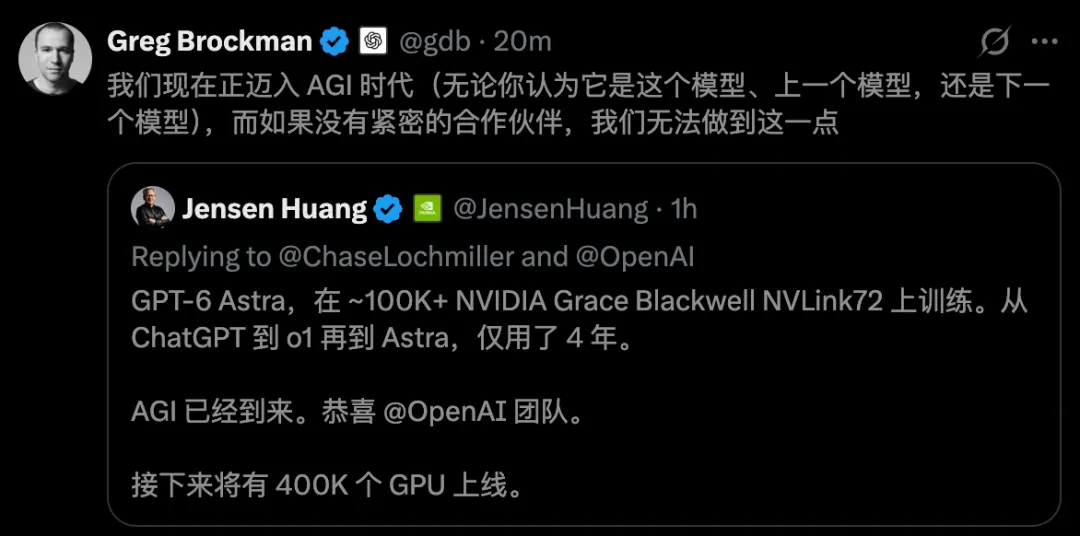
This time around, OpenAI has devastated the public with its core data, which means that AI is making AI, and it really can't stop.
AI Research Interns have been hired in September
Being an "Automation AI Research Intern" has always been one of OpenAI's "Northern Star" goals.
Last October, in a live broadcast, Ottman drew a timetable for the world.
In September 2026, an AI research trainee will be created and in March 2028, a real AI researcher will be created.
Who could have imagined OpenAI announcing directly: The first step is over!
As defined by OpenAI, "research interns" can independently complete research tasks in a given direction.
In particular, in the past, skilled researchers had to work for days, dirty and exhausting tasks, and now it can take over.
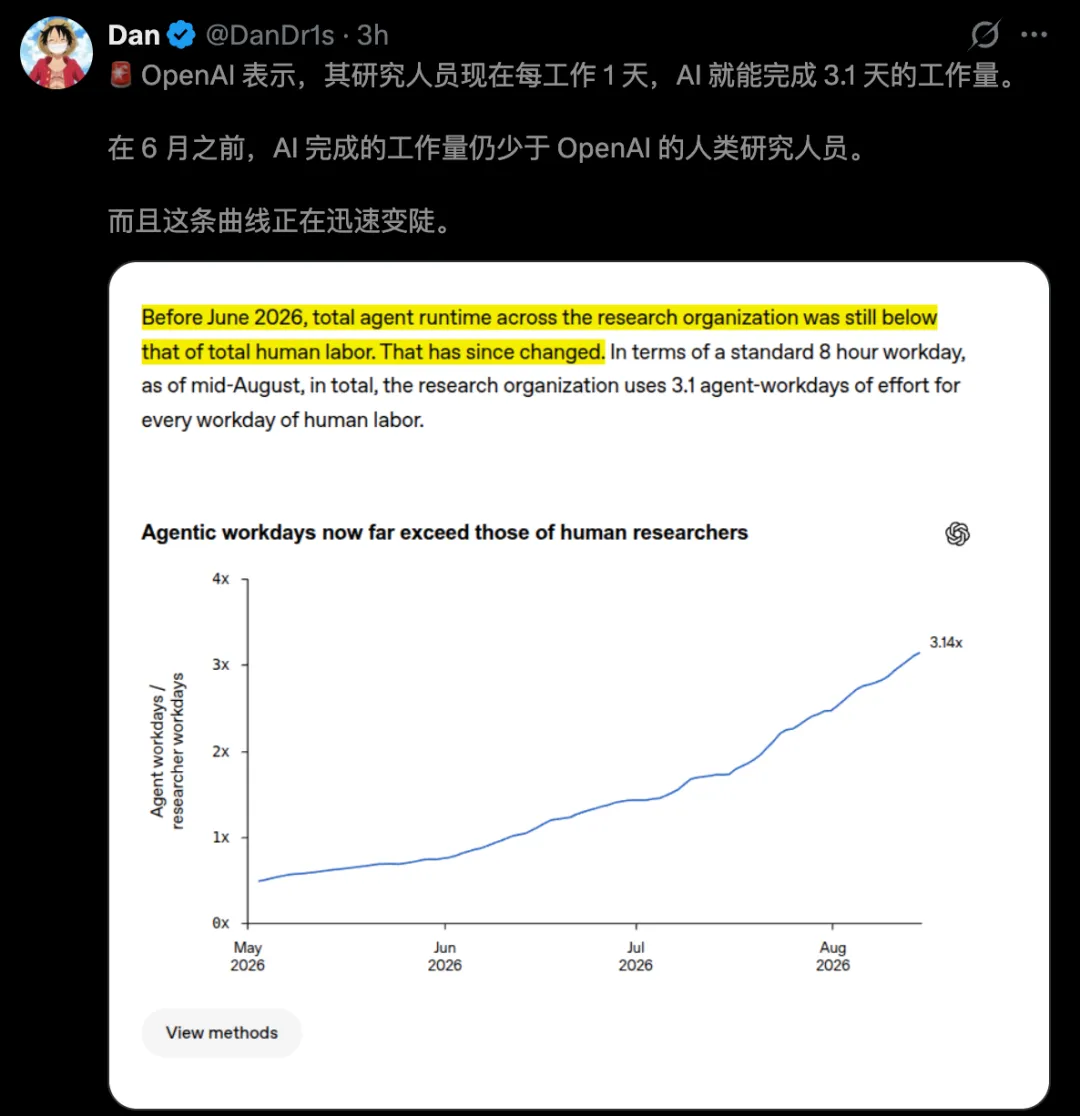

The detailed data released together directly reveals that there is a dramatic change taking place inside OpenAI.
1 human working day = 3.1 AI working daysAt the beginning of this year, the average user of Agent in the OpenAI research department was relatively restrained.
But by the middle of August, he was burning up to $600 a day for his reasoning fees (calculated at API prices).
And the top 10 percent of researchers burn more than $7,000 a day. It's just one person's purely logical expense per day.
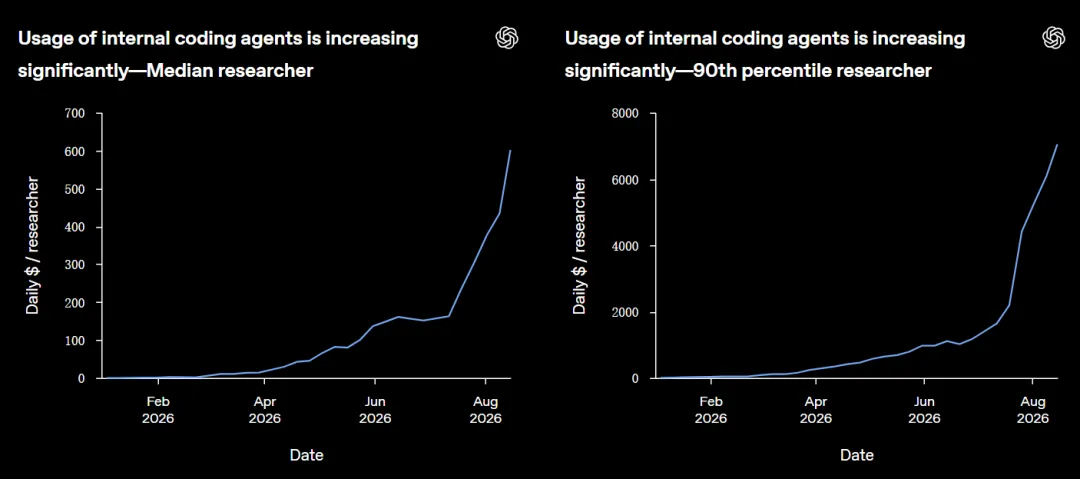
The average researcher and the top 10% of researchers reasoned on a daily basis (at API prices)
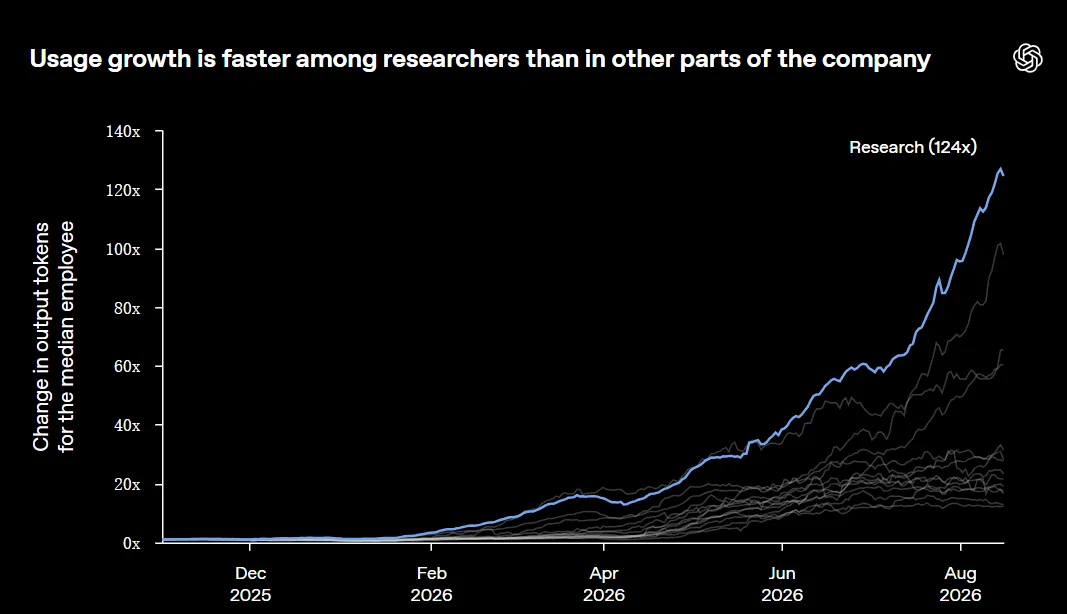
Agent usage in the research organization is growing faster than in other departments, with average employee token output up 124 times from the beginning of the year.
Money is fuel, work is production.
The logic behind OpenAI computing is to divide the total running time of all Agents within the research organization into a standard eight-hour workday and then hardcore contrast it with human workdays.
By June 2026, the Agency's general staff had not been able to beat humans in the entire research organization, but by mid-August, the figure had been rewritten to 3.1 to 1.
This means that behind every human researcher in the workplace, there are 3.1 AI working days that go crazy.
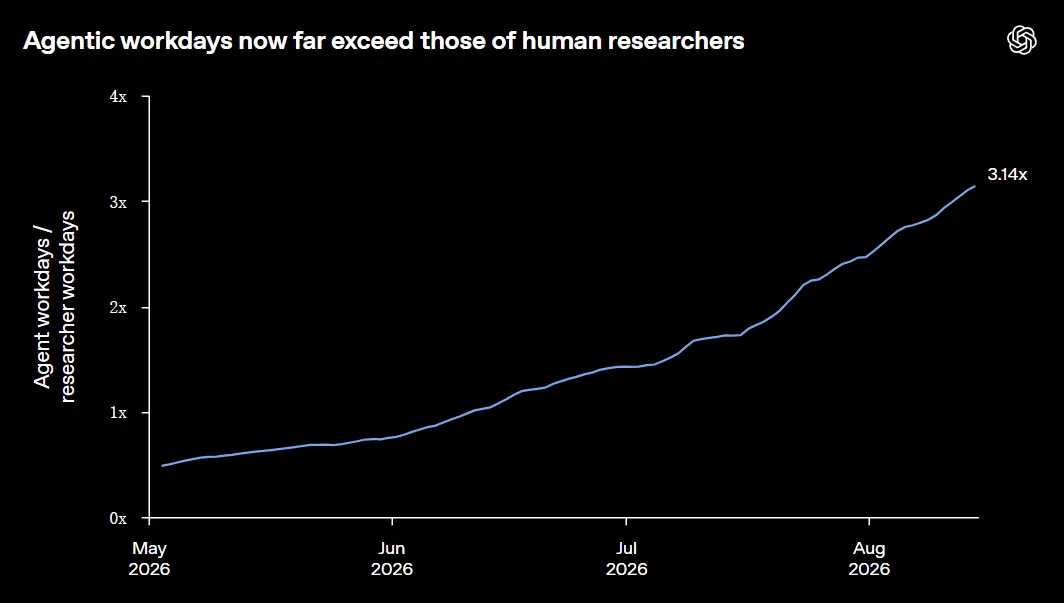
Agent working days are 3.14 times higher than working days for human researchers in August
"Synchronous" is the main motivator behind all this.
This year, the proportion of researchers who started four or more Agents at the same time rose from the initial 30% to more than 70%.
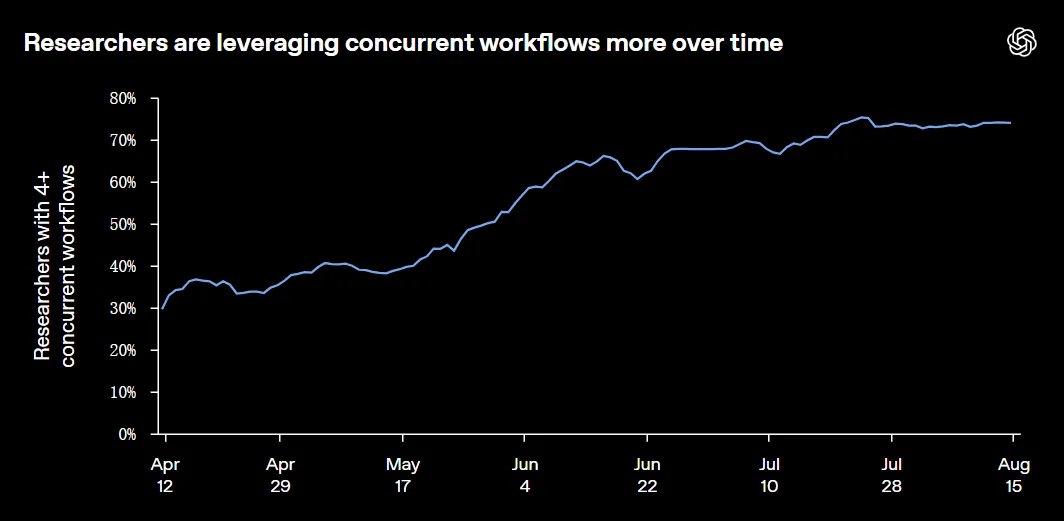
Proportion of researchers running four or more Agents simultaneously
With the increase in working hours, output led to an index explosion.
The number of code changes per active engineer for the entire company in 2026 has soared to seven times the average of 2025.
The number of experiments per experimenter in August 2026 set an all-time high since being tracked in January 2025.
Although OpenAI is a rigorous addition to this, which also includes the benefits of codex adoption and increased overall computing power, the role of AI as a productivity leverage is indisputable.
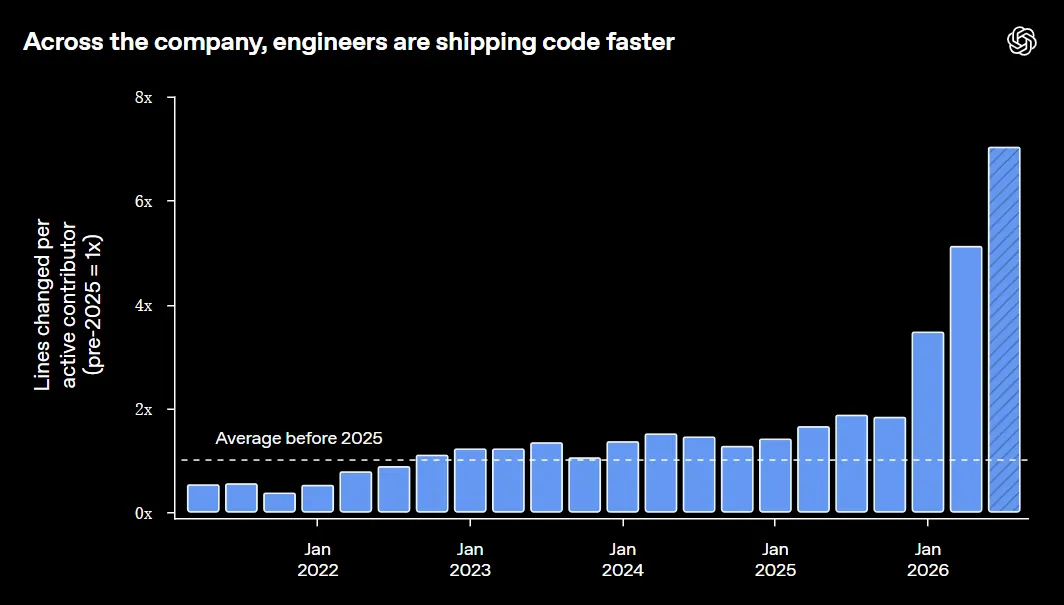
The total number of code changes per active contributor to the company by 2025 = 1x
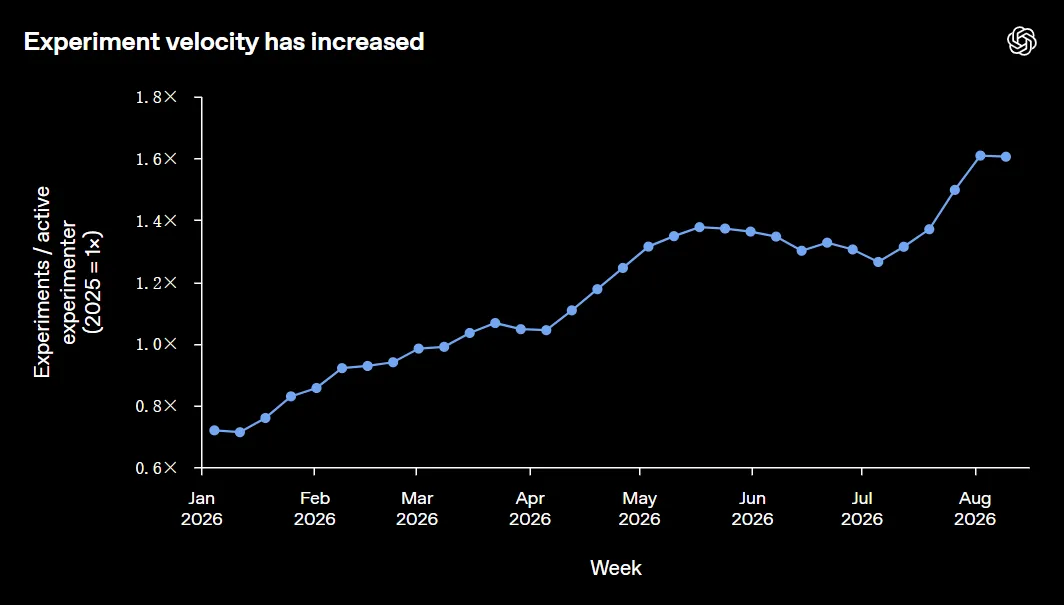
The number of experiments per active experimenter in 2025 = 1x, innovation high in August 2026.
Internship boundaries, taking over construction and placement decisions
Where's the 3.1-fold of life?
OpenAI uses Epoch AI's newly released AI research and development classification methodology to break down the research process into six major steps in decision making, design, construction, operation, analysis, and communication, and categorizes the tokens Agent spits out one by one.
The results showed that the six main categories of storms were widespread between January and August, but not evenly distributed.
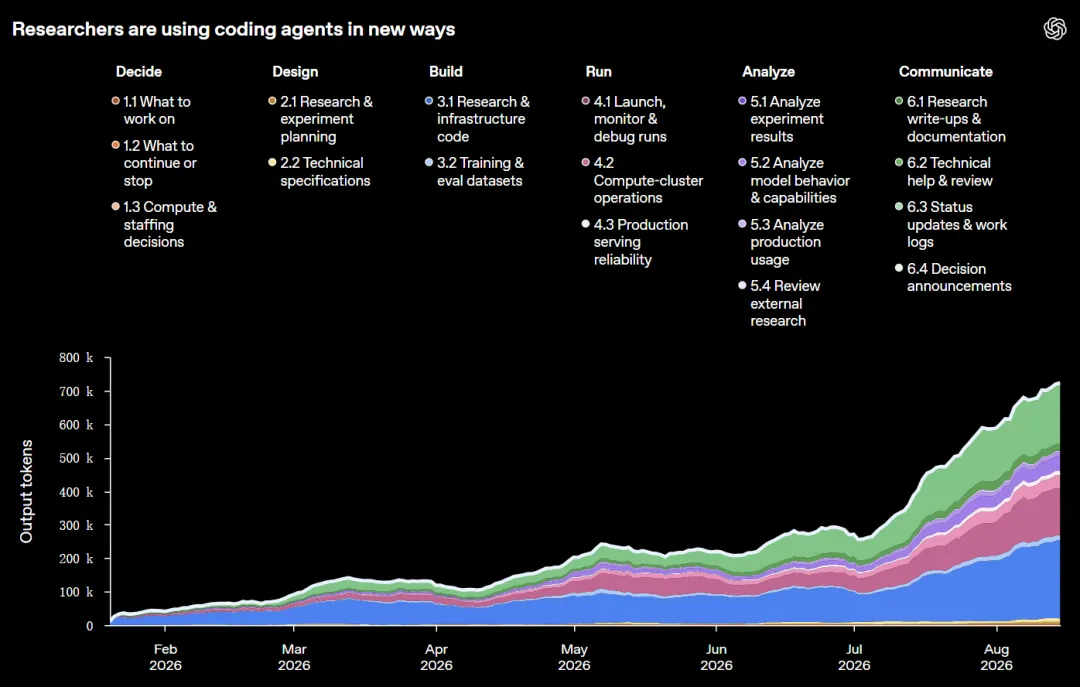
The way researchers use programming agents is changing: Agent output tokens for various research activities stack changes from January to August
The three most terrifying aspects of the increase are writing research and building code, technical assistance and code review, and launching and monitoring training tasks.
Each researcher consumes more than 130,000 tokens per day in each of these three categories. The key to this growth is deciding how to keep resources, announcing decisions, evaluating external research, and using fewer than 1,000 tokens per day.
This chart accurately delineates the boundaries of the ability of "interns".
Agent took over the labor-intensive work of writing code, repairing environments, preventing training crashes, and more. But at the strategic level of "where does research go" and "where does core computing go", OpenAI concludes that it is "extremely few".
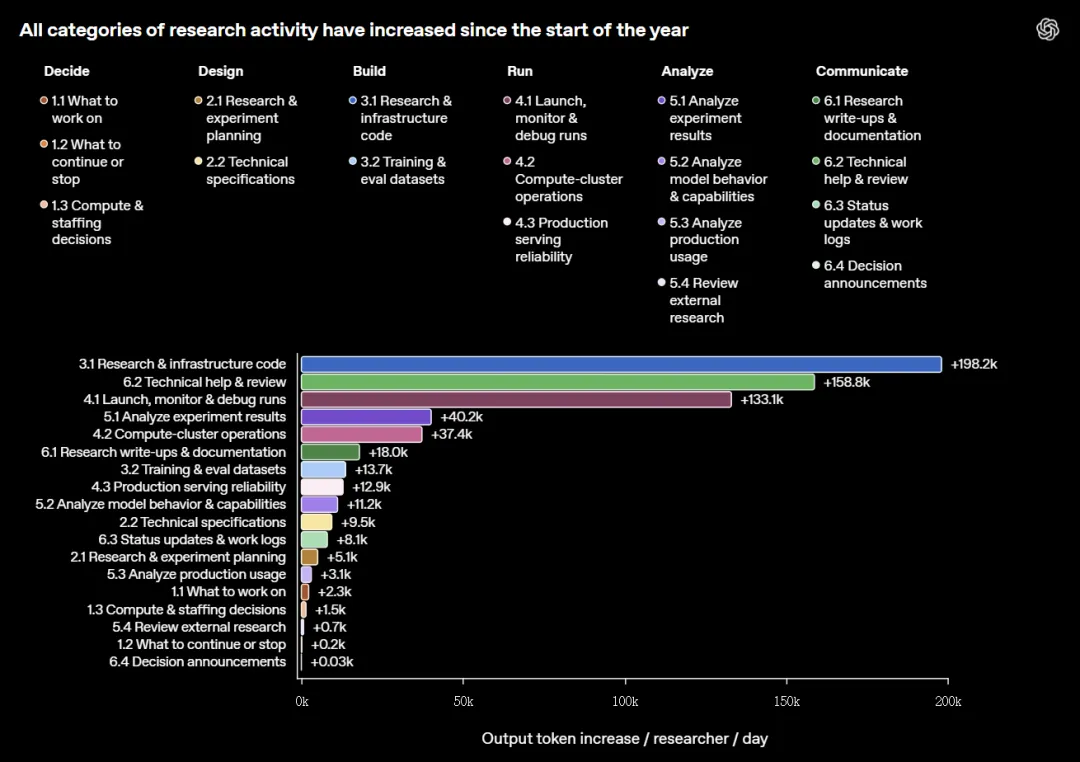
Classified according to Epoch AI six phases, the increase in Agent output tokens for various research activities
One of the most picturesque signs is the demise of human channels of mutual aid.
There used to be a very active main referral channel within OpenAI. However, according to the official charts, the number of new posts per day here has dropped sharply from 20 in 2025, to the figure of August 2026.
These problems have not disappeared or been transferred to other groups of human observers, only the subjects in question have become Agents.
Several teams that had been working on Office Hour trials on a weekly basis continued to decline in attendance in 2026. One team simply disbanded the mutual aid meeting and turned all of their human resources to improving the underlying system.
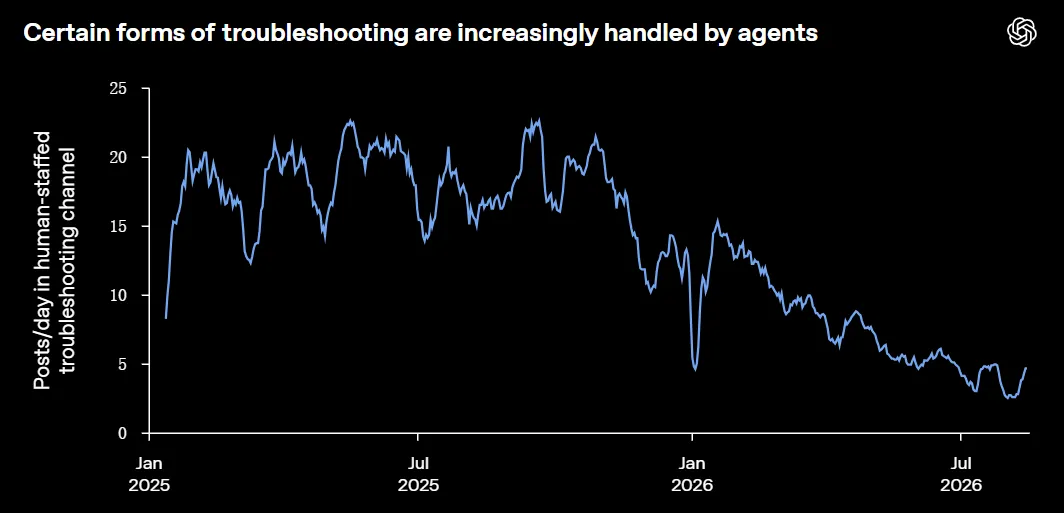
Daily posts from internal AI support channels decline by 2026
The 32-hour long-range mission still needs human supportHowever, at this stage, AI is still not fully capable of doing so.
According to OpenAI's tracking analysis of Agent missions from 1 to July, the zero-intervention success rate for 15-minute shrapnel missions rose from 60 percent to 90 percent in January.
Medium-sized tasks of 4 to 8 hours with zero intervention success rate climbed from 20% to around 50%.
The success rate of long-range missions of more than 32 hours, with zero interventions, dropped by only 20%.
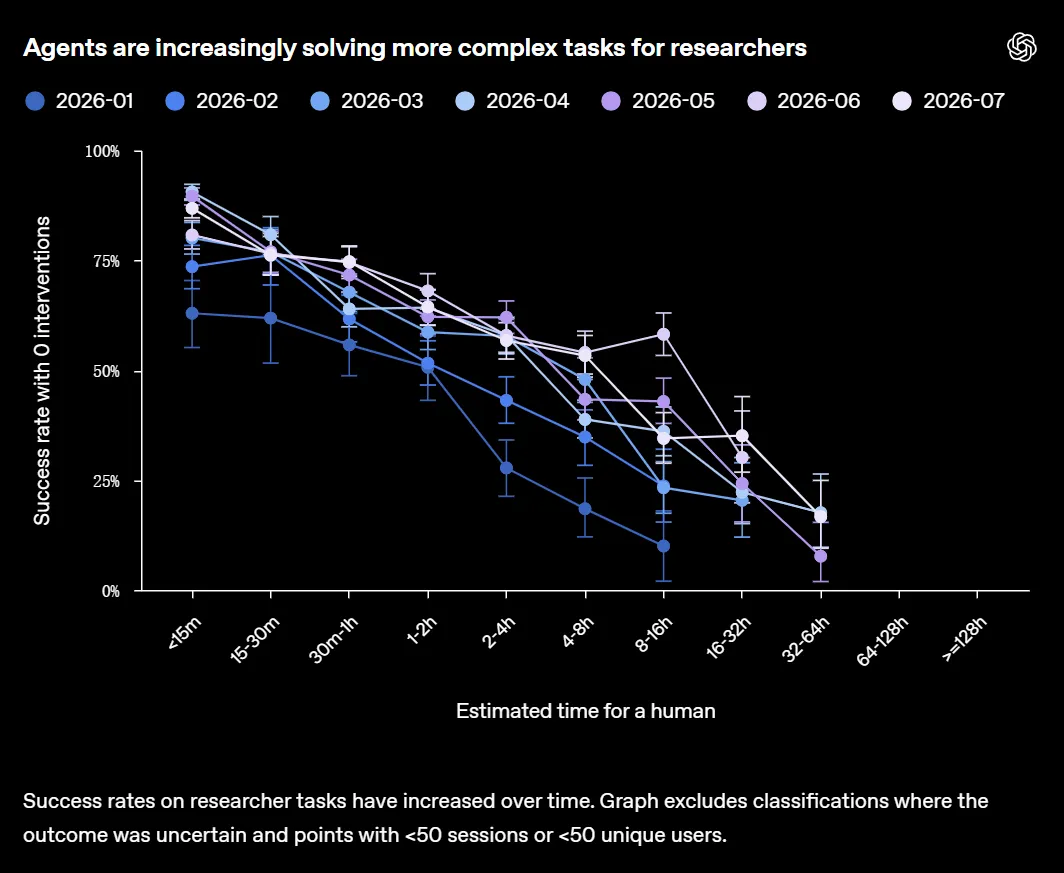
From 1 to July, Zero Intervention Success Rate for Difficulty Level Missions
As long as the task is complicated, the agent can't be separated.
Over the past six months, more than half of successful missions on a 4- to 8-hour scale have required at least one human intervention.
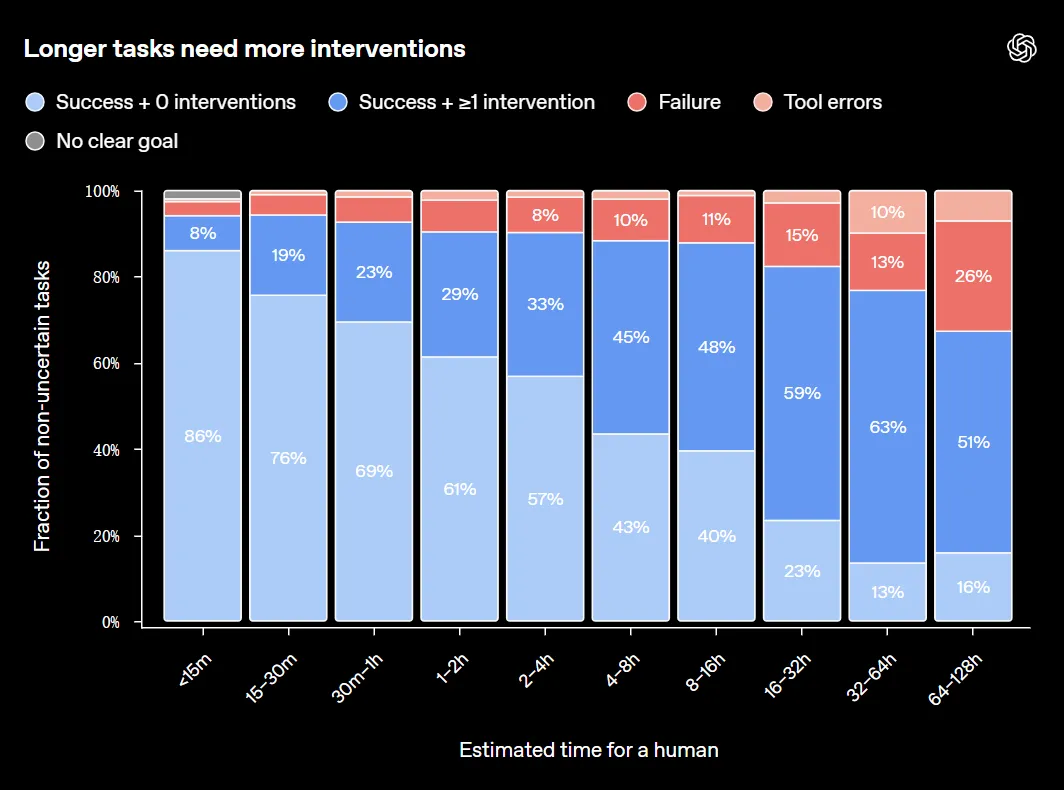
The longer the task, the more human intervention is needed
OpenAI says that code is written faster, and experiments run much faster, but that doesn't mean that model capability improvements will also be tripled simultaneously.
The next key bottleneck is that the more difficult decisions are to automate, the more insanely human researchers are consumed, and the more rigid physical constraints arise in computing.
In March 2028, AI researchers will be created.
After the internship, the next node is the real "researchers".
OpenAI reiterated in the text that they are making strong progress towards the goal of creating automated AI researchers by March 2028.
This future researcher will take on topics that are too big, too complex, too difficult to decipher for humans.
It needs its own strategies, planning routes, and running independently in a few weeks, with little to no human intervention.
 3.1, is the rotational speed of the RSI steering wheel
In the past, the recurring self-improvement (RSI) was only a theoretical hypothesis.
AI is involved in the development of AI, the next generation is stronger than the previous generation, and it cycles back and forth, eventually exceeding the pace that humans can keep up with.
Today, OpenAI for the first time uses real engineering data to draw a benchmark scale for this set of theories.
3.1 times the work, perhaps only a small starting point.
But it does mean that the next pace of evolution is getting out of human control.