It may not be difficult to make a machine fish, but it is difficult to make a machine fish that "can be arbitrarily magnified and scaled up".
In nature, this type of floating pattern can span a large body length, from small fish all the way to large fish, allowing them to adapt to very different habitats. But in the field of robotics, almost every imitating fish is "tailored" to a specific size, and a different body type has to be redesigned from scratch.
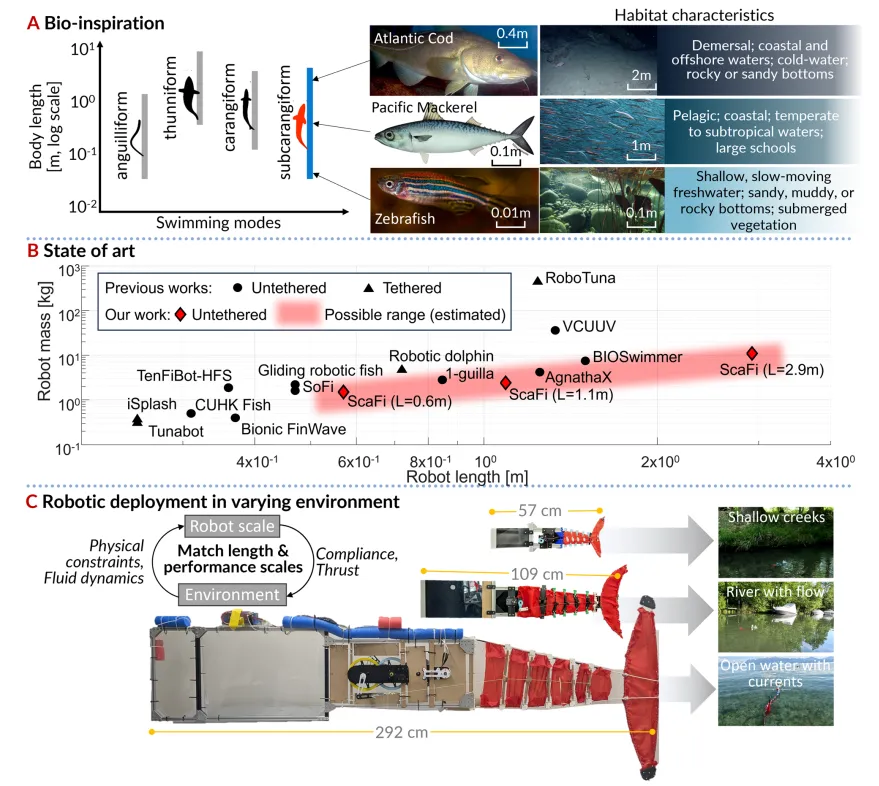
Recently, a team of researchers from New York University and the E.F.T. Lausanne (EPFL) published a proposal in the peer-reviewed journal Nature, npj Robotics, titled "ScaFi": a set of designs, a motor that can be enlarged from a few tens of centimeters to 2.9 meters in length, and the core movements (the shape of the tail swinging) are essentially consistent.
The team constructed three prototype tubes of different sizes of 0.6 m, 1.1 m and 2.9 m, weighing 1.5 kg, 2.4 kg and 11 kg respectively, and threw them into shallow streams, rivers and lakes in Geneva for field testing.
01.
A motor + crosses the line, putting out an "S-shaped" tail.
ScaFi's body is divided into two parts: the rigid front is equipped with motors and electronics, and the soft back is made up of glass fiber rods (GFRP), which are responsible for storing energy and providing rigidity.
It imitates the subcarangiform floating pattern. The research team chose it because, in various fish floating patterns, the largest and most diverse habitats across the subcarangiform are suitable for "stretch size".
The key idea is to cross the line at the end of the tail.