This year's Fields Prize is considered to be the "last pure-blood" prize for possibly the next breakthrough study to be completed in conjunction with AI.
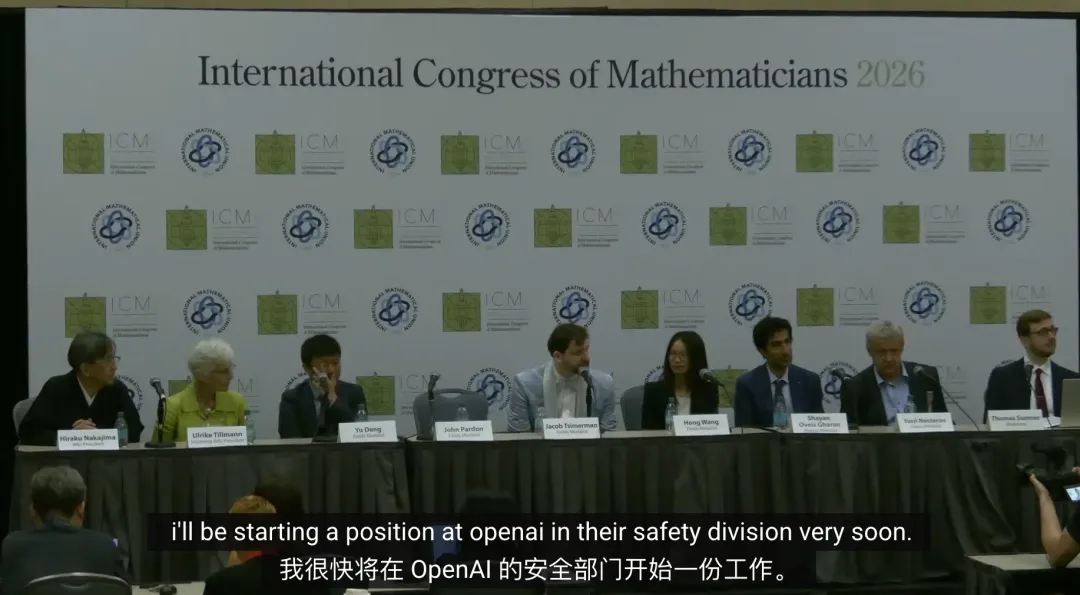
This transition may be faster than we thought: at a press conference at the Fields Awards, Canadian mathematician Jacob Tsimerman, one of the winners, was asked what his next job would be, and he said he had begun turning to AI security research and was soon going to work in OpenAI security.
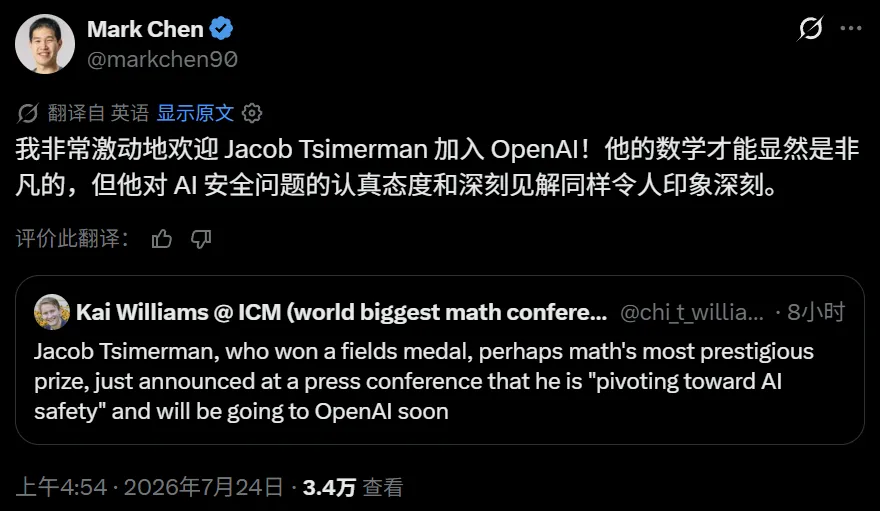
On the other hand, Mark Chen, Chief Research Officer at OpenAI, was immediately welcomed.
In the first half of this year alone, Nobel laureate John Jumper, economist Chad Jones, philosopher Harvey Lederman, and others joined Anthropic.
Behind this, top AI companies are also focusing in the same direction: they are inviting scientists to the site where AI is being developed. AI is being deeply integrated with cutting-edge science, turning from an option to a necessity.
On Thursday, the Seed Edge team launched the Seed STEM Scientists Program, which opens up 100 collaborative seats for scientists and PhD students in the cutting-edge fields of mathematics, physics, chemistry, biology, and other sciences, inviting them to work with Seed to explore unknowns in basic science.
In the second half of the big model, it's been a long time since the race.
In today's fast-paced competition on a day-to-day basis in the field of AI, deepening long-term fundamental AI research may be much less intuitive than refining coding capabilities and raising ratings: improving the latter's capabilities can quickly translate into product experience and business revenue, while fundamental research, AI acceleration, and the feedback cycle for scientific discoveries are much longer, and exploration pathways are uncertain.
But in turn, once a real breakthrough is made along this path, the paramount value it brings will also revolutionize far more than ordinary products.
The real challenge is to set the foundation for doing the right thing. This judgment echoes the long-standing view held by Anthropic CEO Darío that the core elements driving AI progress have always been arithmetic, data quality and scale, the duration of training, and scalable target functions, "all smart methods and techniques aren't really that important".
Looking back at Claude, Seedance, these real SOTA models, there are no shortcuts behind them, and the core has not been fixed sooner, and a lot of basic work has been done on the quality of data, the underlying architecture.
Anthropic focuses its resources heavily on improving the model's coding capabilities, enabling the model to autonomously understand and generate high-quality code through repetitive testing through reinforcement learning training, and to form self-accelerating evolutionary wheels based on user feedback.
In a field where video production is difficult to sustain in many large factories, Seedance is transforming AI video from "draw card" experiments to more controllable, more creative industrial production tools through innovative model architectures and precise data work.
As you can see, what really determines the limits of a model's capabilities is never a stack of skills, but rather the consolidation of data, the stabilization of infrastructure and the long-term goal of maintaining strategic stability and sufficient patience.
This is not easy in today's environment, but we can see that more and more companies are willing to take the hard and right path on the big model circuit at home.
This year, DeepSeek introduced the mHC (flow-bound hyperconnection) architecture, which is considered a breakthrough in the field of large model infrastructure. It is also one of the important architectural upgrades to DeepSeek V4, replacing traditional residual connections throughout the design of the entire model.
Prior to this, residual connectivity as the basic framework of the Transformer, widely regarded as the default configuration in the industry, was pioneered by HC, which broke this single-stream paradigm and significantly improved the characteristic expressiveness of the model on the premise of virtually no increase in computational quantity. From the pioneering HC to the engineering landscape of mHC, it became a shorthand for the Chinese AI team's technological innovation in the underlying architecture field, which was uncommon in the development of large model technology in the past.
Earlier this year, Byte Seed formed a team called Edge to work on topics that were not as definitive in the short term. In order to provide a stable environment, the researchers even adjusted the performance review cycle.
The team has been relatively low-key since its inception, and recently saw the release of EdgeBench, a collection of ultra-long range assessments on X, the first system in the industry to define Agent learning laws in a real environment, and the discovery of a new Scaling law for environmental learning dimensions, which sparked much discussion within the industry.
OpenAI is also said to be gaining access to the long-range capability of the assessment cluster to test its own models.
In the field of AI, people tend to focus on the big model itself, and building Benchmarks actually takes a long cycle and a lot of human resources to design advanced AI capabilities and open-source benchmarks testing, not only to measure their own progress, but also to guide the entire field in a more transparent and reliable direction by establishing industry standards and exposing model weaknesses.
OpenAI is an open-source framework for Evals, an industry-standardised tool for assessing large language models and LLM-based systems. OpenAI has also designed a range of specific benchmarks for specific front-end capabilities, including SimpleQA, BrowserComp, MLE-bench, and more.
Anthropic has done a lot of work around the SWE-bench, and they've clarified Claude's coding capabilities; they've also released the Terminal-Bench, which measures Agent's ability to complete long-link tasks in real-world command-line environments.
These evaluations, and the relationship between the models' capabilities and longboards, are not accidental.
It can be seen that the judgments of the leading AI teams for the path of development of AI have already been transformed, that the evolution of the capabilities of the big model has come out of the period of pre-training dividends that rely solely on parameters and data stacks, and that the core growth momentum for the next stage will inevitably come from the continuous interaction, feedback and autonomous evolution of the model in a real open environment.
At the forefront of basic science, it is the highest form of open unknown scenarios. The newly launched Seed STEM scientist program is designed to identify and break through research-level problems together with scientists, exploring the possibilities of AI accelerating scientific discovery.
Why Top AI Companies
They're all scientists in the field?
Why work with scientists? The answer is that the remaining "questions" are no longer difficult enough for the big model.
The mainstream model evaluation system today largely revolves around closed tasks with standard answers. There are definite solutions, fixed standards, and clear pathways to improving model capabilities. But true scientific research is a completely different logic: it lacks a clear pathway to solving problems, requires researchers to make assumptions, design verification schemes, handle abnormal and noise data, and derive underlying mechanisms, which are full of trial errors, repetition and uncertainty.
Real-world tasks are the ultimate criteria for testing the capabilities of AI models. After pre-training Scaling, Scaling when testing, the industry is generally looking for the next Scaling direction, "Continuous interactive learning in a real open environment" being one of the most viewed paths.
As a result, the world's top AI teams in the development of cutting edge models are no longer relying solely on AI teams to grind models, but are introducing top researchers from all disciplines to make real-world problems a driving force for the evolution of model capabilities.
In North America, many university researchers have recently joined Big Model companies. In early July, Berkeley EECS director Jelani Nelson announced an academic hiatus and joined Anthropic. Since this year, at least 22 professors and researchers have temporarily left or reduced their jobs at universities such as Stanford, Berkeley, and Harvard to move to OpenAI, Anthropic, DeepMind, and Meta. These four companies currently bring together at least 80 current or former university professors.
After the big cattle continued to join, there was also a systematic project.
In OpenAI, the Residency project has become an annual uptake channel for high-end talent from OpenAI, which specifically targets "people who are not currently focusing on AI as their main research direction", and allows participants to join OpenAI's cutting-edge application and research team directly from day one for hands-on collaboration. The project is equivalent to "accelerated doctoral training that can help interdisciplinary experts rapidly complete their subject convergence".
The STEM Fellows Program at Anthropic, which focuses on experts in science, technology, engineering and mathematics, is being systematized and massively expanded in 2026. The program, which lasts for several months, invites top experts in non-AI fields such as physicists, biologists, mathematicians, economists to enter Anthropic. They can bring unresolved puzzles or complex workflows in their fields directly using unpublished Claude models and internal assessment tools.
In this type of project, material scientists will build an exclusive assessment process for Claude to build stability reasoning, and climate scientists will explore the depths of professional atmospheric modeling tools and models. During the residency cycle, more than 80% of the researchers have produced high-quality academic results, and the feedback from real disciplines directly serves as a training signal for the model generation, which has also driven Claude's evolution in the use of scientific reasoning and complex tools.
The value of such projects has long surpassed the scientific research itself, and top AI companies have placed scientists in competitive fields in a position of equal importance to competitive computing.
For the scientific community, of course, collaboration is equally valuable. Big models are becoming a new research infrastructure: from formula derivation, numerical simulation to analysis of bulk literature and experimental data, AI is reshaping the paradigm of scientific research, making possible topics that were previously limited to human and computational difficulties.
Being invited to join a large model team to participate in on-site research is no less important than astronomers gaining the exclusive right to use the next generation of super space telescopes. Such projects can bring many advantages to scientists, not only in obtaining a lot of AI computing power and the experience of front-end models, but also in using AI as an "extra-brain" to transfer energy to the definition of the problem itself.
For the scientists who are flooding into Anthropic and OpenAI, this deep collaboration is both an amplifier of scientific efficiency and a lever for new discoveries. Now that we look back at the country, we find that the gap between AI and basic science is being filled by byte Seed.
The End of AI
It's long term.
When the winners of the Fields Awards decided to join OpenAI, as more and more STEM scientists began to join the model team, the next phase of AI was competing, moving from short-term product iterations, list runs and single-point tasks to longer, more complex, more forward-thinking underlying proposals.
Scientific research is crucial because it is itself at the forefront of human knowledge. If it can stand on its feet in such a highly complex open environment, it means that the next generation of AI truly has the ability to engage in truly complex tasks.
It's difficult to give a quick answer, and it's difficult to form a clear business closure in the short term. It's slow, heavy, uncertain. But it's also the best way to test whether a team is willing to really immerse itself in the foundation, in the front line.
The ultimate answer to the big model is whether it will be able to work with humans to solve problems that have not yet been solved.
The progress of science requires long-termism, and so does the realization of AGI.