One direct verification method is to lock in all the other conditions: in Monkey OCRv2's control experiment, different models used the same Qwen3-1.7B, the same training data, the same optimization settings and decoding process, and the visual encoder was all frozen. The only change occurred was the set of visions that the document showed before entering the language model. The result was that, on eight document understanding benchmarks, Monkey OCRv2-B scored 57.2 points, leading the way in controlling OpenVision-B's overall 13.2 points. This means that before LLM began understanding and reasoning, the visual encoder had already determined how much reliable data it could get.
MonkeyOCRv2: A visual-text foundation model for document AI
Address of the paper:https://arxiv.org/abs/2607.11562
GitHub:
What Monkey OCRv2 really proposes is not just a new OCR model, but a testable judgment: it can be reconstructed into document visual memory.
If you change your eyes, why would it be 13.2?
Documental visual language models are commonly understood as "visual coders plus LLM". However, in practical discussions, visual coders are often seen as a replaceable front end: CLIP, DINO, SAM or other general visual models compress pages into visual tokens before the backend language model completes identification, analysis, and reasoning.
This modular design is convenient, but it covers up a fact: once characters, numbers, formulas, or surface relationships are erased during the visual coding phase, the back end cannot read the original page again and can only be replenished according to the remaining clues. The stronger the language model, the more likely this replenishment is to be fluid, the easier it is to ignore exactly where information is lost.
Natural image pre-training pursues semantic immutability. The same vehicle changes context, lighting or perspective, and the model should still be represented in a close manner. The documentation requires another capability: a small dot, a number, an upside-down, or a table line may all change the final answer. For a natural image, ignoring the details may represent a stick; for a documentation, ignoring the details can be a fatal mistake. For example, 1.5 mg versus 15 mg, only a small dot, and the dose is 10 times different.
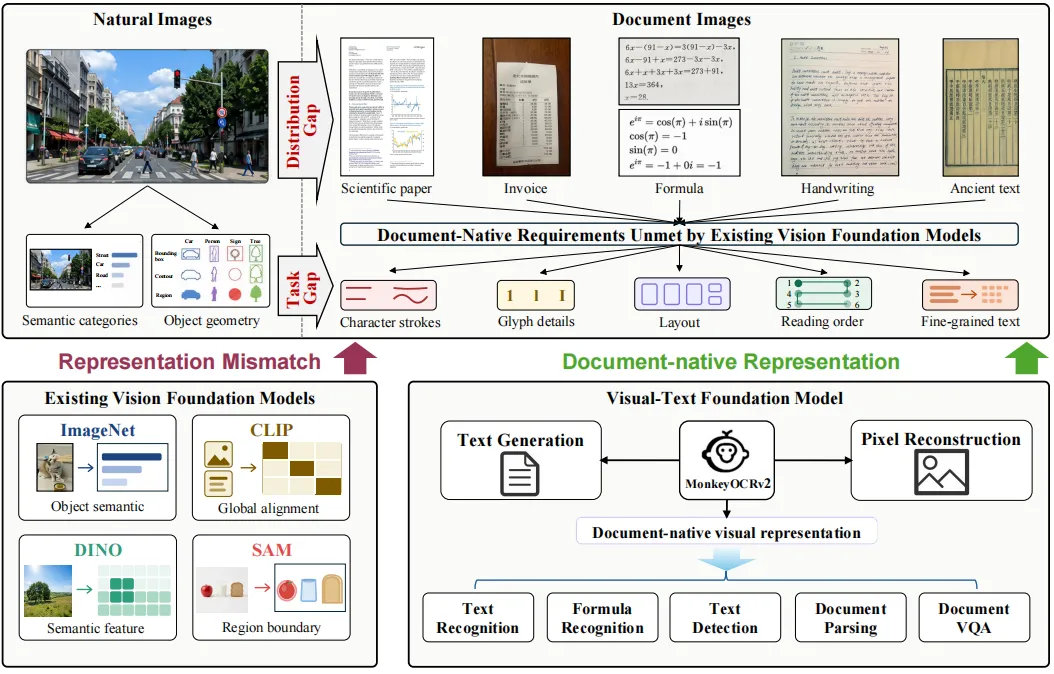
Figure 1: The basic model of natural image visual emphasizes object semantics, overall alignment or regional boundaries; document visual representation requires the preservation of character pencil, font, layout, reading order and fine-grained text.
"Visual memory" is not a metaphor, but an actionable definition.
Monkey OCRv2 uses images to generate text and reconstruct pixel-level documents at the same time. The two objectives seem to be common, but actually present different requirements to visual representations.
As long as the output of the final text is the same, different fonts, spaces, editions and even partial local differences can be considered irrelevant. The reconfiguration goal changes the "contract" training: the same set of visual tokens should not only support the creation of text, but also be able to restore the original page.
Therefore, what the paper says about "reconstructing document visual memory" is not to add an external memory module, nor is it to require a downstream system to permanently reconstruct an image. It is closer to a measurable definition: a set of visuals shows how much input information can be recovered and how much it retains when coding.
The value of this sense is that it transforms "whether the model sees" from an intuitive judgment into a question that can be trained, solved, and compared.
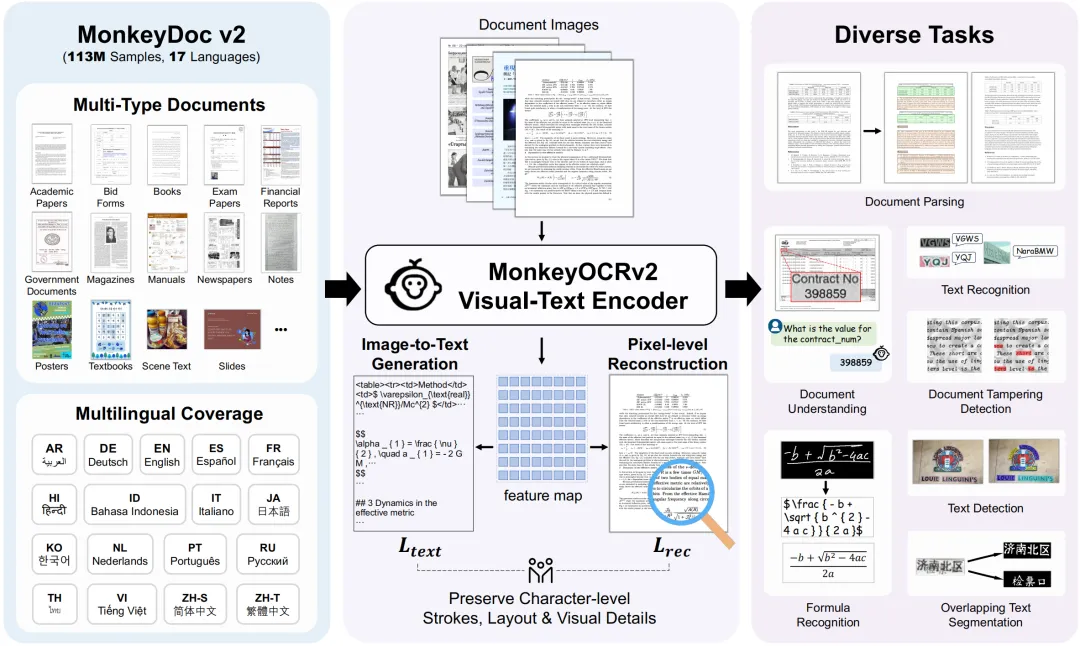
Figure 2: Image to text generation is responsible for semantic alignment, pixel-level reconstruction constraining visual information retention; downstream only uses visual encoders.
The first link in the chain of evidence: lock down all the back end variables
It is difficult to complete a system-level list of causative attributions. Different models typically change visual encoders, language models, training data, input resolution, post-training and coding strategies simultaneously. The final score is higher, not equal to a better visual encoder.
Monkey OCRv2 therefore designed a controlled comparison of encoders: all visual encoders access the same Qwen3-1.7B, use the same downstream data, optimize settings and decode processes, and the only intentionally altered component is the visual encoder.
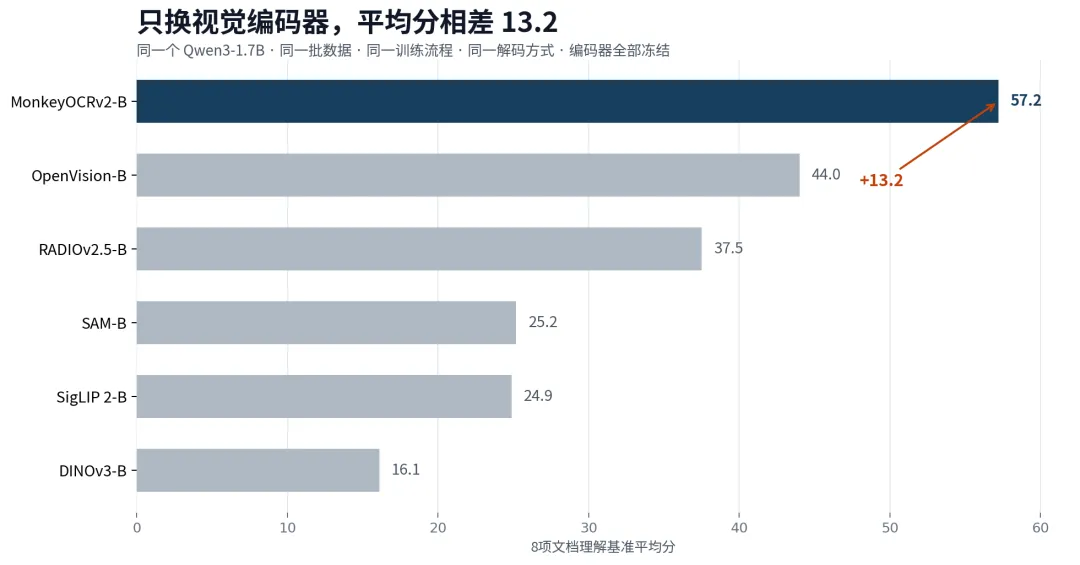
Table 1: Fixed language models, training data, optimization and decoding, replacing only control comparisons of frozen visual encoders.
This group of results supports a strong judgment: the visual input of a document model is not a preposterous module that can determine the two-digit capacity gap itself.
But it cannot alone prove that "the gap is all from rebuilding". Monkey OCRv2 also changes pre-training data, generating targets and model structures at the same time. To further narrow the cause down to the rebuilding targets themselves, it is necessary to look at the same architecture, the meltdown under the same data conditions, and how the model performs when language shortcuts fail.
The second link in the chain of evidence: Taking the most familiar shortcuts of language models
Conventional text has strong language rules. Even if the visual encoder does not read a character, the back end can replenish it according to common words and phrases. High accuracy thus blends two capabilities: visual recognition and language complementarity.
The experiment resulted in two versions of the same set of texts: a set that retained normal semantics, and a set that randomly disrupted the sequence of characters. After the characters were disrupted, the language context was essentially ineffective, and the model had to rely more on character-level evidence for the real existence of the page. Subsequently, the long-range resolution of the input image gradually decreased from 1288 to 448.
At minimum resolution, models that did not use image reconstruction had an accuracy rate of 55.4% for the recognition of distorted text; the accuracy rate increased to 72.1% after reconstruction, an increase of 16.7 percentage points. The accuracy gap between normal text and distorted text was also narrowed from 29.3 percentage points to 15.3 percentage points.
This result is not the same as "model hallucinations are solved". Character disturbance introduces distribution changes and may also affect semantics and decoding. But it provides a more rigorous observation than the average accuracy of natural text: when language models can't be easily replenished, and visual signals gradually weaken, rebuilt-trained character information can still be used in the back end.
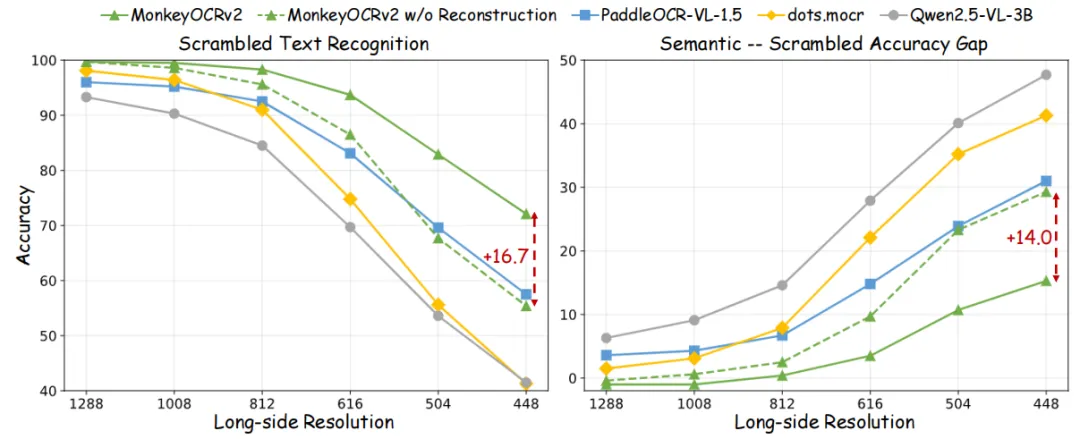
Figure 3: Rebuilding aims to significantly improve low-resolution recognition and narrow the gap between normal text and distorted text after language context is disrupted.
Third Circle of Evidence: When Language Common Sense Clashes with Pages
Confusing text testing is "whether it can be read without language assistance"; CHAOS-Bench testing is a more acute case: when page visual evidence conflicts with language common sense, the model ultimately believes who it is.
The benchmark will intentionally modify a character of a number of words in a page, turning it into a clearly visible but semantically unreasonable word. Models that rely on language precedent may automatically change the erroneous word back to the normal word; models that are faithful to the page should output the characters that are actually displayed as originally intended.
Monkey OCRv2-B-Parsing has an average page recall rate of 17.9, higher than Hunyuan OCR-1.5's 14.2, DeepSeek-OCR 2 and Miner U2.5-Pro's 6.3, and PaddleOCR-VL-1.6's 6.0.
The absolute value of the CHAOS-Bench remains low, indicating that "visual fidelity" is far from a solved problem. It is not meant to declare a victory, but to move evaluation from "if there is an ultimate answer yes" to "if the answer comes from the page evidence".
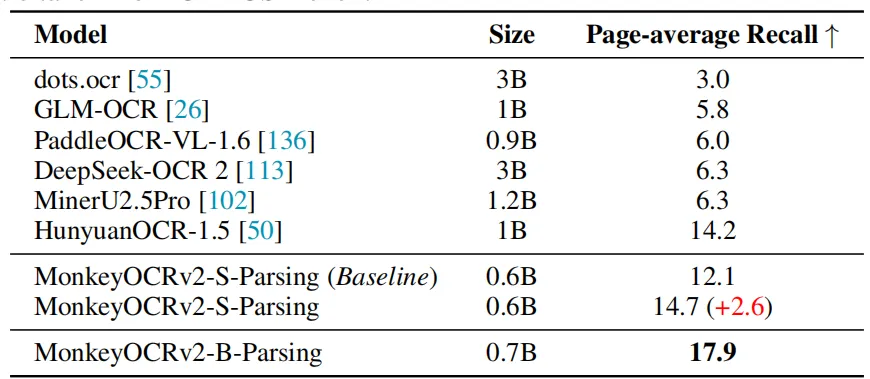
Figure 4: CHAOS-Bench allows page content to conflict with common language in order to observe whether the model is faithful to visual evidence or automatically corrects the page.
Visual documentation underpinned by seven tasks
For a model to be called a baseline, at least three conditions need to be met: it can be replaced when the back end is unchanged; it can span different output forms; and it can reduce downstream compensation steadily across multiple tasks.
MonkeyOCRv2 is accessed by text recognition, formula recognition, text detection, document modification detection, overlapping text splitting, document analysis and document understanding of seven types of tasks. Their output is text sequences, LaTeX, test boxes, pixel masks, structured pages, and question-and-answer responses respectively.
A frozen 0.1B visual encoder with a 0.6B language model, MonkeyOCRv2-B-Parsing with 0.7B reached 83.3 on the MDPBench in 17 languages, with a photographic documentation of 81.7, non-Latin text of 82.1, and the current official ranking has rated the open source model number one.

Figure 5: Official ranking of MDPBench:
However, 83.3 points are better suited for collaboration as an external result of the effectiveness of the visual core, rather than a starting point for evidence of causation. There are still differences between the system-level models, such as training data, training stages and analysis processes. Therefore, the paper separates the system list from controlled encoder experiments: the former explains that Monkey OCRv2 can support a competitive whole system, while the latter attempts to explain exactly where this ability comes from.
More importantly, this advantage is not limited to document analysis and understanding tasks. Experiments have shown that performance improvements after the replacement of the original visual encoder with MonkeyOCRv2 almost go through different types of downstream tasks such as word recognition, formula recognition, word detection, document retrieval detection, and overlapping word splitting. Even on traditional text recognition benchmarks that are already highly matched, the average performance of CRNN still improves by 2.3 percentage points; PARSeq improves further by 0.4 percentage points when approaching performance limits, and exceeds the previous best method SVTRv2.
The results of formula recognition were more intuitive: replacing UniMERNet-T's original visual encoder with MonkeyOCRv2-S with only about 110 million parameters, while basically keeping the decoder, training data, and optimization settings unchanged, this model of the 110 million parameters instead exceeds the 325 million parameters of UniMERNet-B. At the same time, MonkeyOCRv2 also led to an improvement of 3.3, 7.5 and 5.3 percent, respectively, in word detection, document retrieval detection, and overlapping splitting.
This means that MonkeyOCRv2 is not an accidental gain from a list or some kind of downstream architecture. Whether the task requires character recognition, restore formulas, positioning text, detection of distortions, or separation of overlapping text, stronger document vision indicates that it can be transformed into stable performance gains.
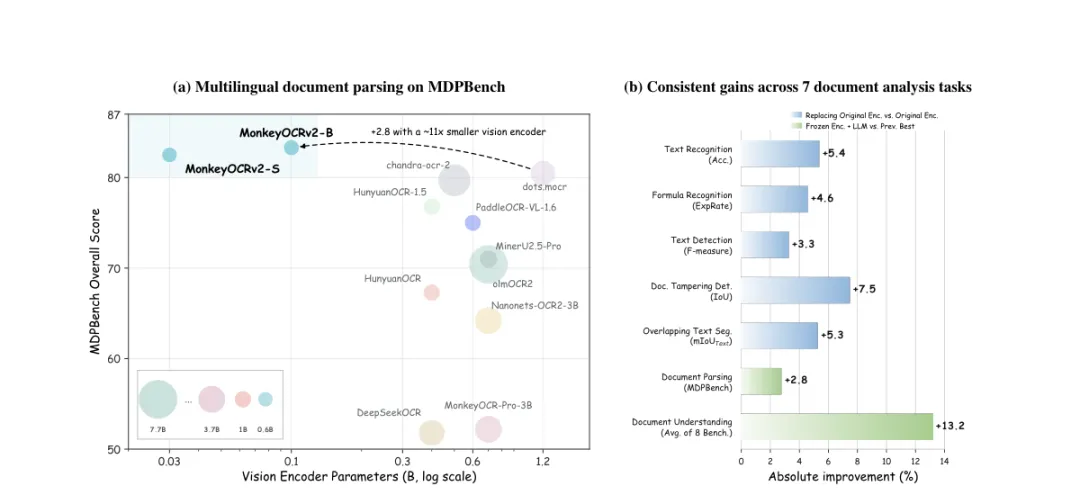
Figure 6: Left to MDPBench performance and visual encoder size, right to MonkeyOCRv2 for consistent improvement across seven types of document tasks.
How far has this chain of evidence been established?
Overall, MonkeyOCRv2 builds at least four layers of complementary evidence: frozen rear-end controlled replacement instruction visual encoders are independent variables; the model rebuild decomposition instruction contributes to the rebuilding goal; the disruptive text explains that this increase is related to language shortcuts decreased; output fidelity improved; and cross-task migration and system listing instruction features can enter the real downstream.
This is much more complete than just reporting a SOTA score, but it also makes "reconstructing visual memory" a research hypothesis with operational definitions, dissolution, behavioural testing, and migration results.
However, strictly speaking, the chain of evidence is not completely closed. Whether pixel reconstruction is the most effective memory method has not yet been determined; MSE may retain a large number of non-text-related low-level pixels, or it may have an average chemical edge. The addition of character edges to the paper continues to improve after being constrained by distance, precisely indicating that "what should be remembered" is more worth researching than "whether to reconstruct".
Stronger follow-up verification can include: comparing different rebuilding targets under fully matched training algorithms; mapping the visual Token number, the compression rate and the character authentication ratio; directly measuring characters, typefaces and surface information with a linear probe; independently reproducing in third-party code libraries; and checking migrations on low-resource text, handwriting, antiquities and live photography documents.
And most importantly, it's not just an open model.
Instead of putting 100 million levels of document data on public tables.
In the past, the field of document intelligence in the Big Model era was more about comparing final scores. Models are getting bigger and bigger, the lists are constantly updated, but training data, data comparisons and training processes are often invisible.
This has resulted in many so-called "model comparisons", which are not actually in comparison models. One system may have larger private data, more complex training processes and more invisible engineering resources, while another system can only rely on public data from scratch. Eventually, all the differences are compressed into zero points on the list, but it is difficult to judge whether the improvement comes from model design or from data advantages that are not available from outside.
Especially in the field of document analysis, communities have long lacked open data that can be directly used for large-scale visual pre-training. Many works have opened up the logical code and model weight, but have not opened up the documentary world in which the model has actually been studied. Researchers can use the model, but it is difficult to retrain it, and even more difficult at the same point to verify whether a particular structure, target function or training strategy is actually effective. Scores are open, but the evidence for forming scores remains closed.
MonkeyDoc v2 attempts to change this situation. It contains 113 million document images in 17 languages, including 8 million page-level images and 105 million fine-grained document elements, serving both page analysis, surface analysis and end-to-end identification, as well as local tasks such as text, tables and formulas. This is not an attached dataset released to supplement the paper, but Monkey OCRv2 is a public laboratory that it hopes to give to the community.
Figure 7: Distribution of data in MonkeyDoc v2.
It doesn't just mean "a huge amount of data". More importantly, when these 113 million document images are actually open, the teams finally have the opportunity to stand at a relatively consistent starting point and answer a series of fundamental questions: what does image to text generation and pixel reconstruction each contribute to? how should page-level data be compared to cutting data? how much coverage is required in low-resource languages? can smaller encoders outperform larger models through better pre-training goals?
Of course, public data cannot automatically guarantee that absolute fairness, computational, engineering experience and training budgets will remain different. But it at least establishes the most important premise of fair comparison: that others can not only see the results, but also check how they are produced.
This is also a cultural change MonkeyOCRv2 wants to promote. Document intelligence should not only remain a constantly updated ranking among the big models, nor should it become "who has more invisible data, who is more likely to lead". A truly valuable comparison should be made with fixed data, training protocols and downstream systems as much as possible, and then discuss what visual encoders, target functions and model structures actually bring.
When a work is only allowed to be used by others, it is still only a product; when others are able to retrain, question and transcend it, it truly becomes a public research problem.
From visual compression to visual memory
DeepSeek-OCR allows document AI to rethink a question: how much of a high-resolution document can be compressed into a visual token?
But a document is different from an ordinary image. It needs to be preserved not only efficiently, but also faithfully. A pencil, a small dot, a table boundary, or even a change in the reading order can change the final meaning. Once these details disappear in visual compression, later language models are reinforced and can only guess what was written on the page based on the context.
So there's a more basic question after the compression: what exactly do these visual tokens remember?
Monkey OCRv2 opted to answer with "rebuild". Rebuild is not about reproducing a good-looking page, but about using it as a visual memory test: if the encoded representation can still recover the character pencils, formula symbols, and print structure, it means that the evidence is not easily discarded during compression. When the text sequence is disrupted and the language context is unable to help, the model can still rely on visual memory to make judgments and is another way to test whether such memory actually exists.
Controlled encoder experiments, disruptive text testing, and cross-task migration all point to the same conclusion: more complete preservation of page evidence will not only improve recognition but also continue to transform into parsing and understanding capabilities.
Perhaps the next phase of document AI will not just be folding a page down to a smaller size, but ensuring that key traces remain on paper when it unfolds again.
DeepSeek-OCR opens up the issue of visual compression, while MonkeyOCRv2 attempts to answer the question after the compression: "Rebuild is visual memory" so that the folded pages can still be loosely unfolded.