Today, when Vibe Coding has completely lowered the development threshold, everyone is experiencing a strange phenomenon: having a coding agent change a code bug or add an API interface to an existing project, the interaction experience of the first three rounds is often very surprising. It can read warehouses, find documents, quickly write the first Diff, and even run tests by hand.
But as the context of the task gets a little longer and more complex, most developers fall into a very painful black hole: Agent hangs up on a run of tests, it starts to lose direction, changes the code madly in the chat window, apologizes for the high-channel, releases five new Diff rounds in a row.
Eventually, the whole session was filled with bugs and junk logs, and the environment was very noisy. In the face of this startling gossip, Agent who was playing locally, in order not to continue wasting Token, you had to manually cut off and build a new session. But this time you were faced with a more crumbling reality.
This is also the biggest bottleneck that AI programming tools currently face in large-scale real-world engineering: Agent now throws all the engineering clues and junk noise into the Chat Context, lacking an independent structured Engineering State to isolate and control.
In order to break this bottleneck, a team from Valkor University of Zhejiang's Intelligent Computing and Software Research Centre, University College London (UCL) software engineering team officially launched and open source loom.
The code repository:https://github.com/valkor-ai/loom
Loom's focus is on how complex software tasks can be continuously advanced, verifiable, and recoverable in real engineering processes after AI has been able to generate code.
After the Claude Code, the Codex,
What else is missing in AI programming?
The ability of the Code model has evolved rapidly over the past year. Agents like Claude Code have been able to penetrate real warehouses and perform complex multi-document modifications.
In real software engineering, however, Vibe would write the first version of the code and complete a reliable delivery loop, with a huge gap in the middle. This is why Vibe Coding can only stay in the demo stage and not be able to penetrate the real business reconstruction.
A real need, not only for snippets of code, but also for complex dynamic states: front-end interaction behavior, API boundaries, database changes, single measurement coverage, running time logs, CI states. For engineers, these states are scattered throughout Git, PR, CI logs, and the brain; but for Agent, if these states exist only in the chat context, long tasks will inevitably go out of control.
First, the context is easily overwhelmed with error-correcting noise. All compilation errors, retest logs, and temporary inferences are clogged into the Context window, causing the model to catch the wrong focus in subsequent decisions; worse, once the session is interrupted, or due to the token triggering the interrupt compression, the agent will fall into a loophole and begin to repeat the error, only to guess what the mouse is doing and where the mouse is doing it.
Loom would like to add that this is the level of engineering status that software engineering provides to Agent.
From the one-off Prompt to the one-off,
Resume the status chain at any time
Loom's entry point is extremely straightforward: it's more like a delivery bracelet that introduces a single-player game to the "Delivery Harness". It breaks down a complex software delivery process into a structured, recoverable chain of states.
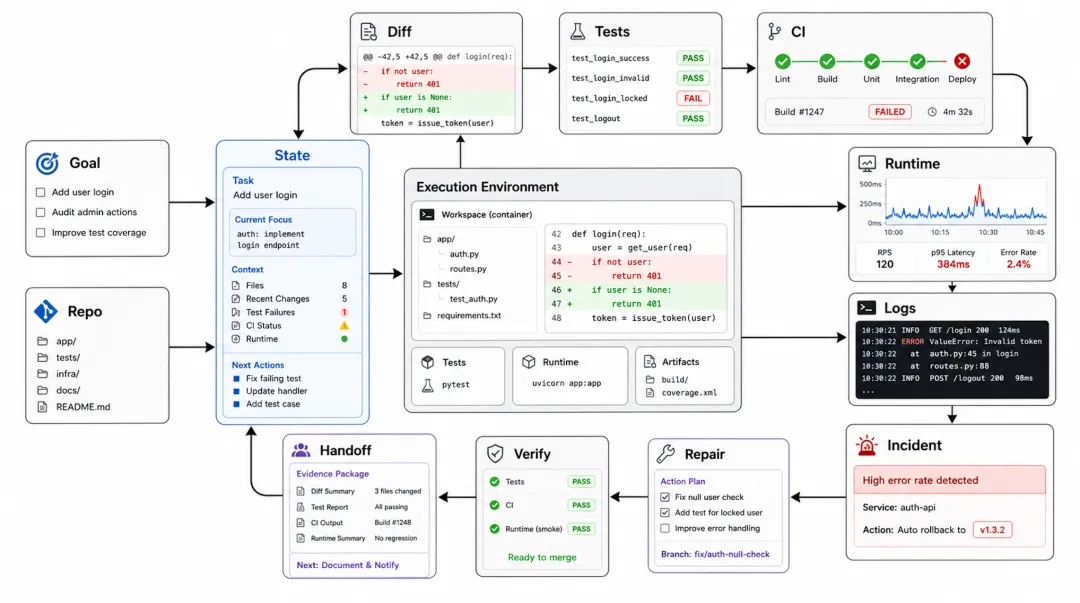
When the Agent runs a failed test, Loom doesn't throw the failure as a simple piece of terminal text into Chat, but instead captures and structures it into a standby state that exists independently of the chat record.
Bugs won't be flooded: Failure becomes a strong constraint on the next step, and Agents can't play the bug and miss it in subsequent conversations.
Multi-Agent Zero-Cost Acceptance: Future development must be multi-tool, multi-model collaboration. Developers may change the logic of the first five rounds with Claude 4.6 Sonnet, and the sixth round wants to replace it with GPT-5.5 running tests. Once the new Agent has accessed Loom, you can instantly know who you are, where you are, what you've just changed, which bug to fix.
Why is it that the Context Window is so important to you?
What are the symptoms of chronic obstructive sleep apnea?
Many people are inclined to blame the failure of long tasks on models that are not long enough. But this is a false proposition in real engineering logic.
In software development, the amount of information is not the same as the high reliability. Tens of thousands of lines of compilation logs, multiple rounds of Diff tests, and the output of a brain plugged into the context will only make the meeting environment full of noise. Models are very easy to get lost in complex information, or to misjudge a local code that seems to run as complete.
The essence of engineering is structure and certainty.
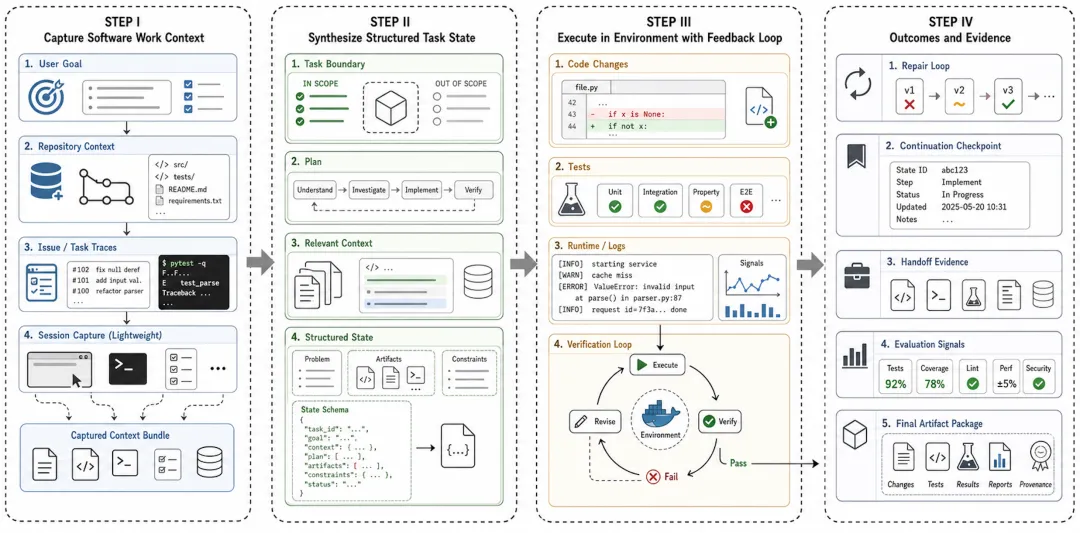
Loom's idea is not to make the model see more, remember more, but to help the model filter out the noise, only refining the most core engineering clues: what steps are planned? which single measurements are actually passed? which files have been typed Diff and can no longer be disrupted? When these key points become structured data that can be programmed to read, the measurement of the efficiency of AI coding also depends on how many lines of code can be generated from the scrolling model, which actually becomes the completeness rate of the continuous advancement of scrolling tasks.
Software engineering:
The big model actually landed in a sandbox of certainty
Software engineering may be Agent's best pitch, where the rules are absolutely rigid: code can be compiled, code can be compiled, and code can be hung. AI programming has to go back to the conventional wisdom of software engineering if it wants to go into a serious production environment.
Now, depending on Vibe Coding, everyone can get a Demo quickly. But there's a whole set of reliability checks between Demo and real software that runs in a production environment. If the Coding Agent just writes code and puts all the verification, correction, and error-correction costs to human engineers, efficiency levers will soon come to a head. From this point of view, what Loom wants to explore is not just a useful open source tool, but a big model that really goes to the missing state infrastructure of a serious production environment.
Large models learn from the static content curve what the ultimate code length is like, but it's hard to learn how a complex bug is positioned, compromised, compromised, and ultimately repaired, and the trajectories of these processes are at the core of engineering judgment in software engineering.
Through this state layer, not only can the long-term tasks of the Agent be advanced more stably, but at the same time capture the dynamic feedback trajectory of the Agent in the real execution environment. This also provides more authentic engineering content for future Agent dynamic evaluation (Benchmark) and data collection.
From model-generated code to Agent autonomous, continuous, verifiable completion of a complex software engineering lifecycle, the missing state of infrastructure in the middle is providing an important perspective that deserves to be reviewed for the advancement of AI coding technology today.