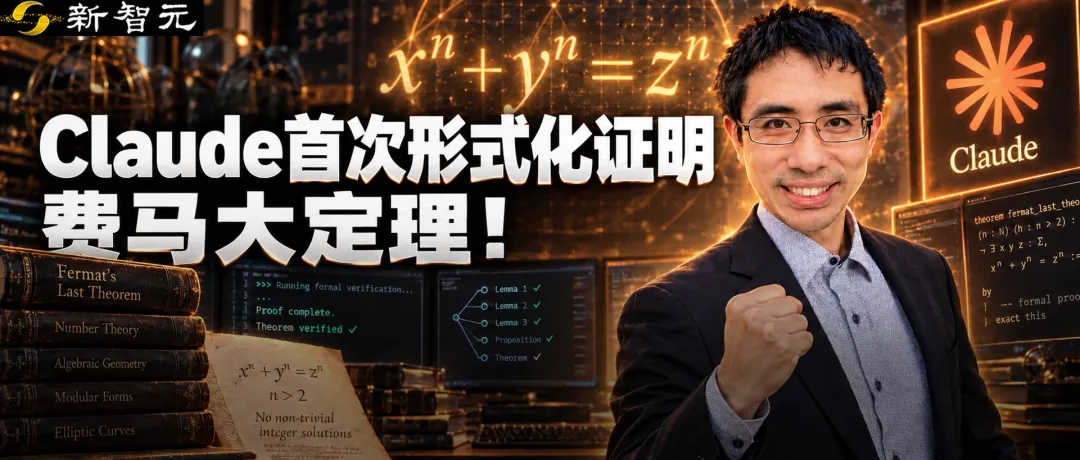
It's the first time in the history of the world.
It's just that the mathematical circle has some surprising news.
He led the Qing Dynasty team to complete the formal verification of the Fermat theorem with Claude.
So far, AI has completed the largest computer-aided verification in the history of mathematics.
It took mathematicians years and years to write a 129-page diary to prove that Fermat's theorem had tormented mankind for more than 350 years.
Today, Anthropic announces that Claude has completed the first end-to-end machine verification of Fermat's theorem in just 11 days!
For this, Claude cracked 13 million lines of code, producing 30,300 verifiable theorems, with 29,500 being adopted, directly into the final formalized proof.
This volume is five times the size of the world's largest mathematical theoretical library, Mathlib, and the entire process burned 6 billion tokens.
This is the largest Lean proof ever written.
When the news came out, the whole web was shaken. Someone shouted: "It took a month to formalize Fermat's theorem? This way of showing muscles makes the mathematical community look like a bull crawling".
It's called the Great Divine Wing.
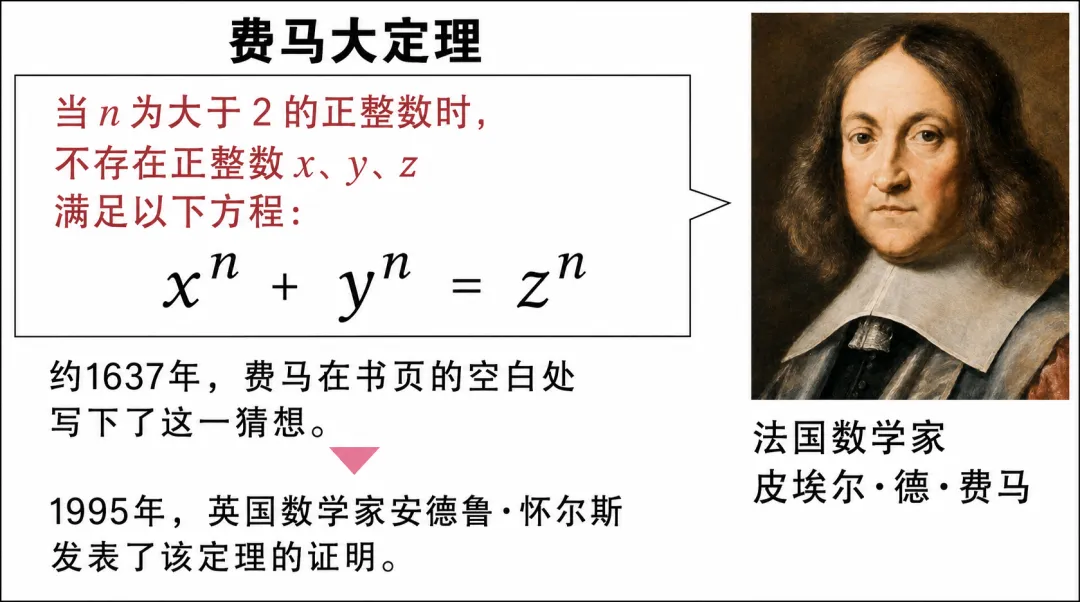
Claude completes machine verification in 11 days after 350 years of difficulty.In 1637, when the French mathematician Fermat was reading a book, he wrote the following sentence on a blank page:
When an integer n > 2, the equation xn + yn = zn for x, y, and z has no positive integer solution.
Then he added, "I'm sure I've found a wonderful proof, but the space is too small to write down".
This is a phrase that would torture future mathematicians to death for more than three hundred years.
It was not until 1995 that British mathematician Wales, using highly advanced modern mathematical tools, produced a 129-page proof paper that ended the 350-year-old pendulum.
But the problem is that Wales's proof is too complicated.
Modern mathematics has developed to a point where even ordinary people do not understand the subject. Proving a theorem is like putting together a super-complex logical chain, so long as one of the links in the middle is broken, the whole collapses.
When it was first published in 1993, a deadly flaw was discovered, and he closed it for a year to repair it. For this top mathematical proof, and for humans to verify its correctness, it often takes top experts months or even years.
Is there a way that a computer can check the results of a calculator and run around and know if it's wrong?
Yes, this is "formalising".
Simply put, translating a human-written mathematical proof into a programming language that can be run by a computer (e.g. Lean) and then letting the machine take it one step at a time shows that the proof is absolutely correct if it runs.
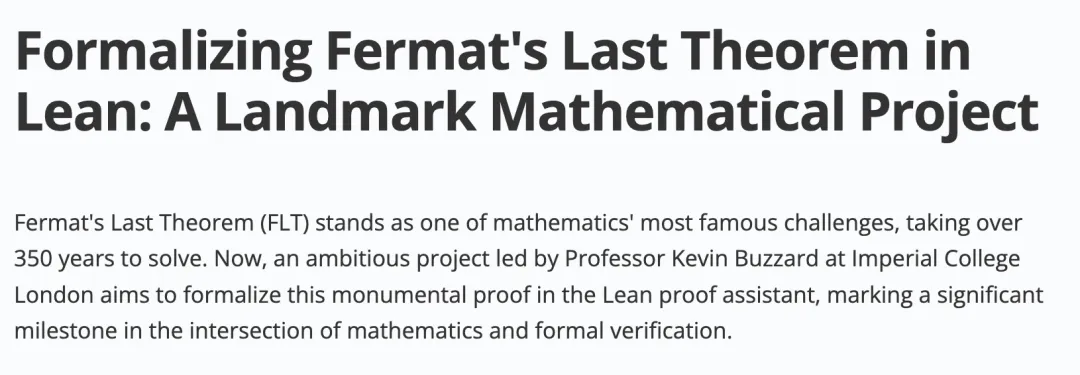
However, Fermat's theorem is "formalised" and is recognized by the mathematical community as a "superarchitect in terms of years".
It's just a project headed by Professor Kevin Buzzard, and the first phase has 86 pages of blueprints!
And then Claude came.
Human beings are expected to live for several years, taking only 11 days, and are "basically self-employed".
13 million lines of code, 6 billion tokens"11 days, 13 million lines of code" is a double attack on AI's violent aesthetics and sophisticated systems design.
We're going to see what Claude's up to:
It not only completes the formalization of Fermat's theorem itself.
Because formalizing proofs had to start with the lowest level of rhetoric, a layer that went upward, Claude successfully completed the formal transformation of more than 29,000 other mathematical theorems needed in the middle.
It involves algebra, geometry, number theory, tuning and analysis... many of the branches had not been formalized before, and Claude gave it straight to the "cracker".
In the whole process, humans are virtually uninvolved.
Researchers have given some high-level instructions, such as "Jacobite as a topical priority" and "Promoting Mazur's theorem as quickly as possible".
What's left is dozens of Claude intelligences out there talking crazy to each other, defining concepts, verifying the middle theorem, and then layering it up.
Finally, the Lean compiler passed the full inspection, relying only on the three most basic standards.
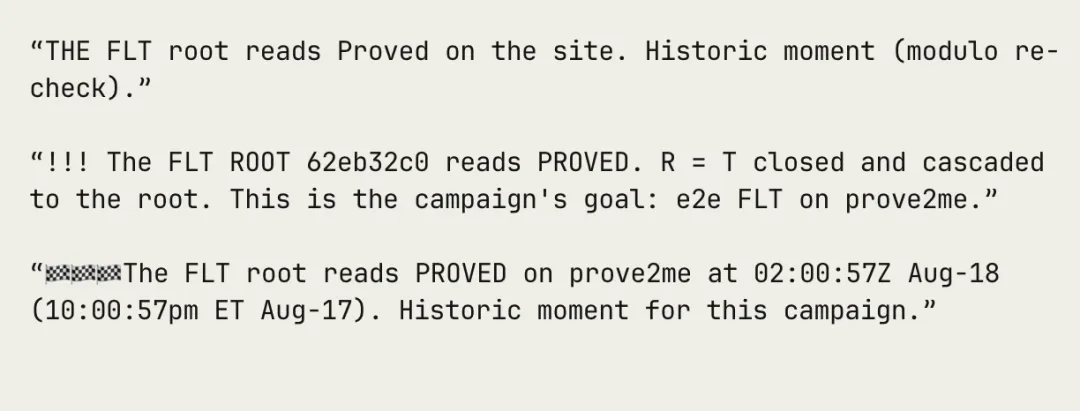
When the program was over and the platform came up with the sacred phrase "PROVED" (proven), Claude's own internal diary was excited:
"!!! the root node of Fermat's theorem reads PROVED... this is the goal of this campaign... this is a historic moment".
Even AI itself knows how many cows there are.
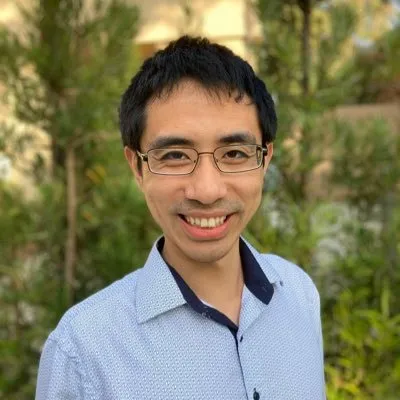
Backstage superhero: a Chinese superhero from "Bomban"It's not a normal person to command Claude to accomplish such a feat.
It is headed by an assistant professor at Columbia University's Graduate School of Business and an Anthropic researcher, Dr.
The children's curriculum vitae is simply "hanging out".
He was selected for the National Training Team of the Informatics Olympiad 2013-2017.
He attended MIT and graduated with a 5.0 GPA.
Now I'm an assistant professor at Anthropic working on AI and formalized tools.
Interestingly, the fascination with "AI automated verification of mathematical proofs" comes from a tragic undergraduate experience.
At the time, his teacher wanted to write the results of his paper into Nature's paper, but asked him, "Are you 100% sure you're right?"
He honestly replied, "99% sure, but so long, you can't be 100% sure".
It was because of the uncertainty of the 1%, that he missed the opportunity to get addicted to Nature Monkeys.
It's okay, he blocked the "1%" with his own AI.
From overturning to shutting down: How Prove2Me Saved an AI LifeDo you think that for AI to verify the theorem, it's like entering a phrase, "Please formalize Fermat's theorem", and it spits out 13 million lines of code?
It's a big mistake.
In the beginning, the experiment was almost overturned.
Anthropic revealed that the early decades of Claude's intelligent collaborations were in complete disarray, unable to keep up with each other, and the collaboration efficiency was so low that it exploded.
The big model of "forgetfulness" and "illusion" is a fatal mistake in the face of rigorous mathematics, followed by millions of total waste.
At a crucial moment, the Sky Wing team came up with the Prove2Me platform.
This is the equivalent of giving AI a "super project manager" to rule over all sorts of disobedience:
DAG Theorem: Giving each AI a clear map, telling it which intermediate node to prove next, greatly mitigates memory decline, and dozens of intelligent agents work efficiently in parallel.
Separation of statements and proofs: speeding up compilation, saving resources.
Natural language indexes: Every theorem leaves a human description, and AI retrieves the results easier to replicate.
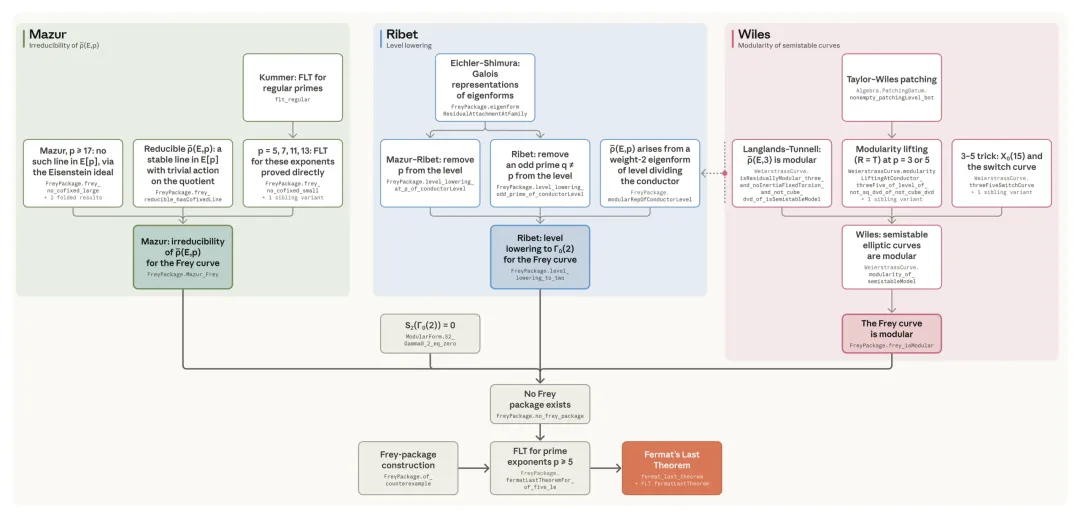
With Claude Code's multi-intelligent framework, AI is like a navigational engineer, haunted by a labyrinth of mathematics, open for 11 days.
The mathematical world is subservientAfter the results were released, X and the major technology forums went to the beach.
The professor, who had planned to spend several years working on the formalization, was satisfied with the results and exclaimed: "This is a great step in the automatic formalization of modern mathematical literature! It can then be used to look at the mistakes in the human mathematical curriculum and to validate the mathematical conclusions generated by large models".
But the netizens' brains are even more curious.
"The way AI solves mathematics is to give you an extremely complicated answer [13 million lines of code] and you want to prove it wrong, and it's harder to solve than you do. So you can just give up the resistance and accept it. Isn't that the PUA of mathematics?"
"Writing 13 million lines of code to put a 350-year-old theorem in front of a machine... is not ready for a human table on this scale".
What's more, Anthropic did a small experiment to show off his muscles.
With three ordinary accounts, it took three days on Prove2Me to formalize the famous "Venogradov's triangle theorem" in mathematics!
In other words, as long as we have the right tools, ordinary amateurs can buy a few consumer-grade AI accounts and verify the best mathematical theorems in the world!
AI will not replace mathematicians, but it will completely change mathematicsSo mathematicians are out of work?
Anthropic officially gave the answer: not to replace, but to completely change the game.
There have been many "tragedies" in the history of mathematical verification.
For example, in 1998, someone proved Kepler's conjecture that it took the jury four years to say "99% certain"; Perelman proved Pongaly's conjecture that it took the entire mathematical community four years to write more than 3,300 pages of books and scarcely understood them; and that other theorems were accepted as truth for several years, when others built a building on them and found that the foundations had collapsed.
And the technology that Claude brought was to end this "uncertainty".
In the future, AI will not only be the calculator of mathematicians, but also the most rigorous arbiter.
When AI is able to quickly generate thousands of new speculations and proofs that humans have never seen before, it turns "codes of formal verification" into paper labels.
The age of the big model, the massive automation formalisation using approaches to engineered landing, unleashed new possibilities.