“ What Musk was most worried about was what happened.
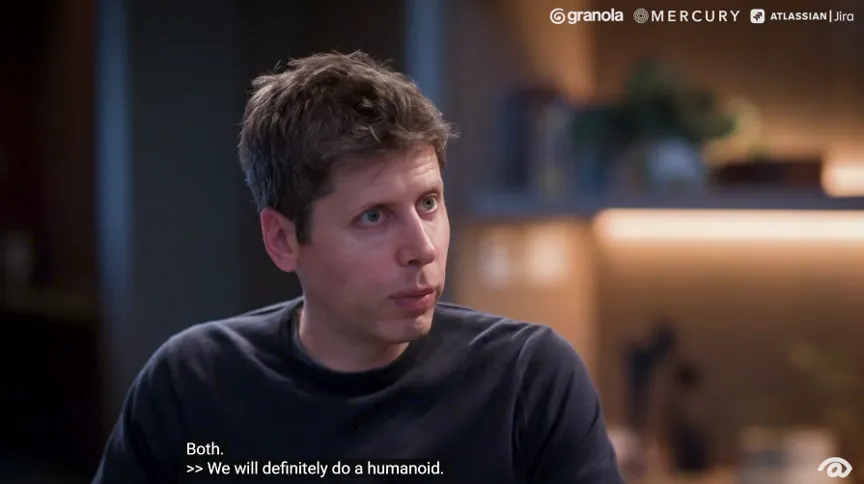
Just two days before the launch of the new-generation flagship GPT-6 Astra, OpenAI CEO Sam Ottman sat in front of a podcast and said a speech that silenced the entire Silicon Valley robotics lab for a few seconds.
Oh, we're going to be human robots.
It's not the chicken that considers the chicken, it's the chicken that explores the chicken, it's the chicken that doesn't exclude the chicken.
The same hands that dismantled the robot team six years ago are now announcing that they are going to rebuild it themselves.
01.
There are no spectators on the tables.
When the OpenAI footsteps in, Tesla is probably the most sleep-deprived.
Musk's Optimus humanoid robot has been the second curve in his paintings for Tesla. Tesla's stock price has already included a large anticipated premium on robot monopoly.
In the blink of an eye, OpenAI's explicit expression is directly embedded in the narrative of a wealthy AI-brain world's top competitor.
Silicon Valley investor Gene Munster said more frankly: "The market for humanoid robots is becoming a two-way street between Tesla and OpenAI, and OpenAI has huge capital gains. Tesla's storyboard is full of speculative color that makes it harder to justify its premium".
But in fact, on the day OpenAI officially announced the creation of the robot team three months ago, the two sides may have been secretly engaged. At about the same time, Tesla officially started work, preparing to convert part of the Texas super factory to Optimus's mass production base, planning an annual capacity of 10 million units.
Of course, the real battle is far more complicated than the so-called twin-pole quarrel. Because, after that day, Ingrid also worked with Yuri Tech to launch human-robot reference designs. The three giants unexpectedly meet on the robot track, Ingrid wants to be the robot's chip operating system, Tesla wants to be the robot's chip maker, and OpenAI will continue to be the chip brain vendor.
Three very different infrastructure paradigms are competing for the same course. This is where the most attention is paid. The United States is not merely adding a few robot companies, but trying to build a system of physical AI rules of its own.
02.
A six-year delay in returning
What many people don't know is that OpenAI is actually a company that was born from the blood of a crawling robot.
In 2017, OpenAI's robotic ambition was greater than that of any star startup today. That year, they created Dactyl Dynamics, a mechanical hand that was flexible enough to be able to rebuild the world by itself. Through reinforcement learning and automated-domain random makeup, they demonstrated that the ability to train in a simulated environment can be transferred to real robots.
It was one of the frontrunners of the global robotics circle at the time.
But the story took a turn for the worse in 2020 when OpenAI itself disbanded the robot team.
The reasons for this seem both cruel and reasonable today: data on the physical interaction of robots is extremely scarce, collection is expensive, iteration is slow; and the amount of text and image data on the Internet is inexpensive, endless. From the efficiency path to AGI, it is a smarter choice to focus resources on big language models.
As we all know, with the birth of ChatGPT, OpenAI has become the highest-valued AI unicorn in the world.
But OpenAI has never really left the robotics circuit. They changed their stance and chose to become one of the most generous mascots on the robotics circuit.
Overseas startups that you know of invested in 1X Technologies in Norway in 2023, in a $675 million B round of financing for Figure AI in February 2024, in a seed round and A round of financing for Physical Intelligence in March and November 2024.
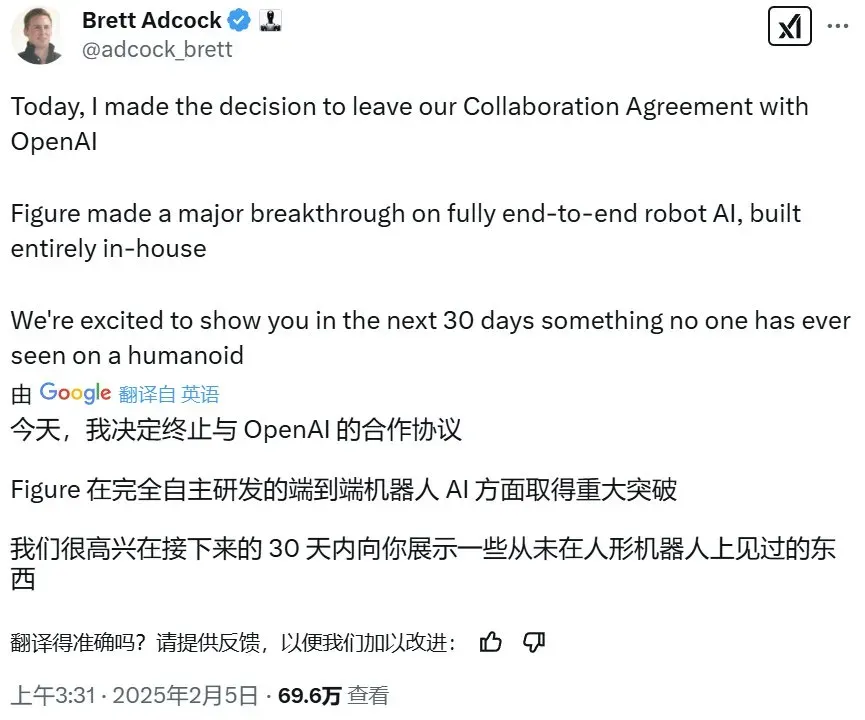
Of these, OpenAI and Figure AI have also entered into a strategic partnership, with Figure's first two generations, Figure 01 and Figure 02, both featuring OpenAI models and demonstrating amazing natural language interaction with object-oriented capabilities.
Then, in February 2025, the founder of Figure AI announced the end of the collaboration. Brett Adcock realized that Open AI's model, despite its excellent performance in language understanding and generation, lacked direct interaction with the physical world, and in pursuit of the ultimate answer to humanoid robots, he chose to abandon Open AI and developed the Helix model on his own.
This fact, which is undoubtedly both true and heartfelt for Ottman, was also the last straw in the mindset of the overwhelming OpenAI crowd.
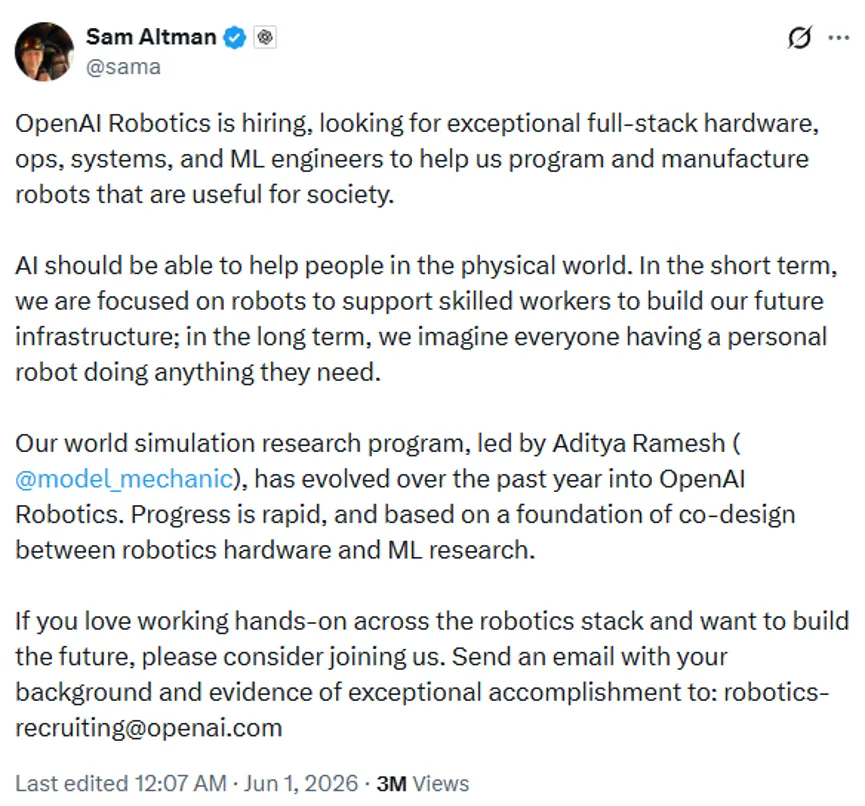
On June 1, 2026, Ottman himself posted on a social platform announcing the creation of the OpenAI Robotics team. Three months later, he sat down on a podcast and put the matter to death.
03.
Others created bodies, OpenAI created the world
So the question arises: What's different about OpenAI when the company that creates humanoid robots hits the market?
The answer lies in one person, Aditya Ramesh.
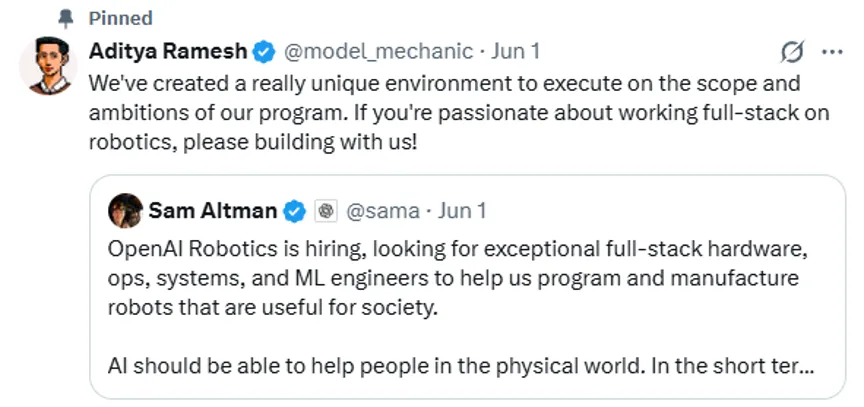
He is the inventor of the DALL-E series of models and the core developer of the Sora video generation model. He is now the Vice President of Research at OpenAI, where he leads a world simulation project called Worldsimming. Over the past year, the project has evolved into OpenAI Robotics.
Another artificial robot, which is a body, is trying to find a way to insert intelligence into it.
OpenAI's path is the other way around: first let AI understand what the physical world looks like in the virtual world, how things fall, how they touch, how they get caught.
The birth and evolution of Worldsim is a technological turning point for OpenAI.
OpenAI Robotics recruitment positions can also be seen from the end. In addition to the common positions, they have set up engineers who are responsible for narrowing the gap between simulation and virtual robotics. They allow robots to practice real things in the virtual world and migrate seamlessly to real machines. This could be a key barrier to OpenAI, as opposed to routes that rely on real machines to collect data.
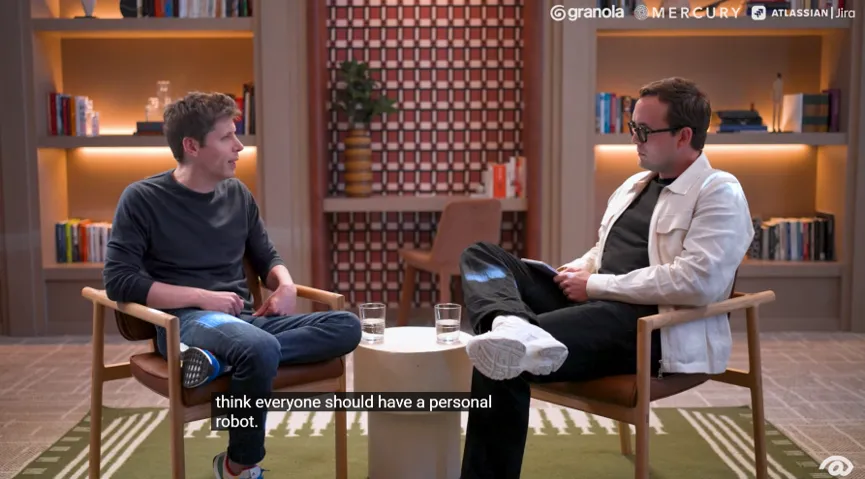
Short-term goals are also pragmatic. The long-term vision is based on Ottman's catchphrase: "In the future, everyone can have a personal robot".
04.
The body wasn't made in a day.
Of course, the hardware path of OpenAI will not go smoothly.
It has been reported that they have excavated hundreds of hardware engineers from Apple and Google. One of them, Apple, is said to have excavated more than 400 people. Therefore, Apple could not sit down and formally sued OpenAI for stealing trade secrets in July 2026.
At the same time, OpenAI's financial situation is not easy to talk about. The company expects to lose about $14 billion in the full year of 2026, with a gross profit of only about 33 percent.
But the Ottomans obviously made a choice.
He decided not to go back to the starting point, but with the accumulation of the past few years, to knock again on the door that he had seen firsthand.
The key to the deadlock is the valuation of OpenAI; betting is the entrance ticket to the era of physical AI.