Many people gathered in front of the stands of the 2026 IFA, MAMMOTION in Berlin.
This is not surprising. Over the past two years, the Chinese company has surged too fast in the field of lawnmower robots. Public reports show that: In 2025, Cook took the top spot in global sales of lawnmower robots without borders; last month, brand officials announced that the global household users exceeded 750,000+. Everyone in the industry was looking at what to do next.
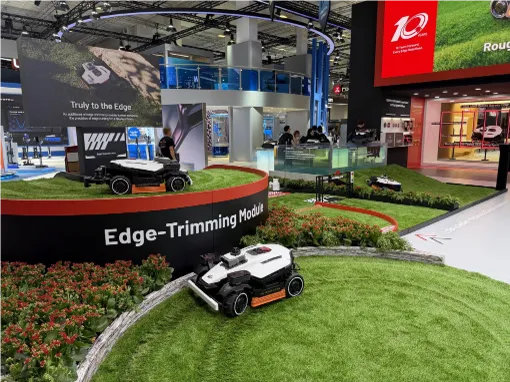
The new generation of the flagship four-wheel-drive family uses the lawnmower robot LUBA 4 AWD as it is up to date. The independent front wheel switches to dual-wheel drive, the machines no longer need to grind locally when the grass edge falls off, causing much less damage to the grass; the new mechanical arm attachments can also cut the corners of the wall, the fences and the dead corners that were easily left behind.
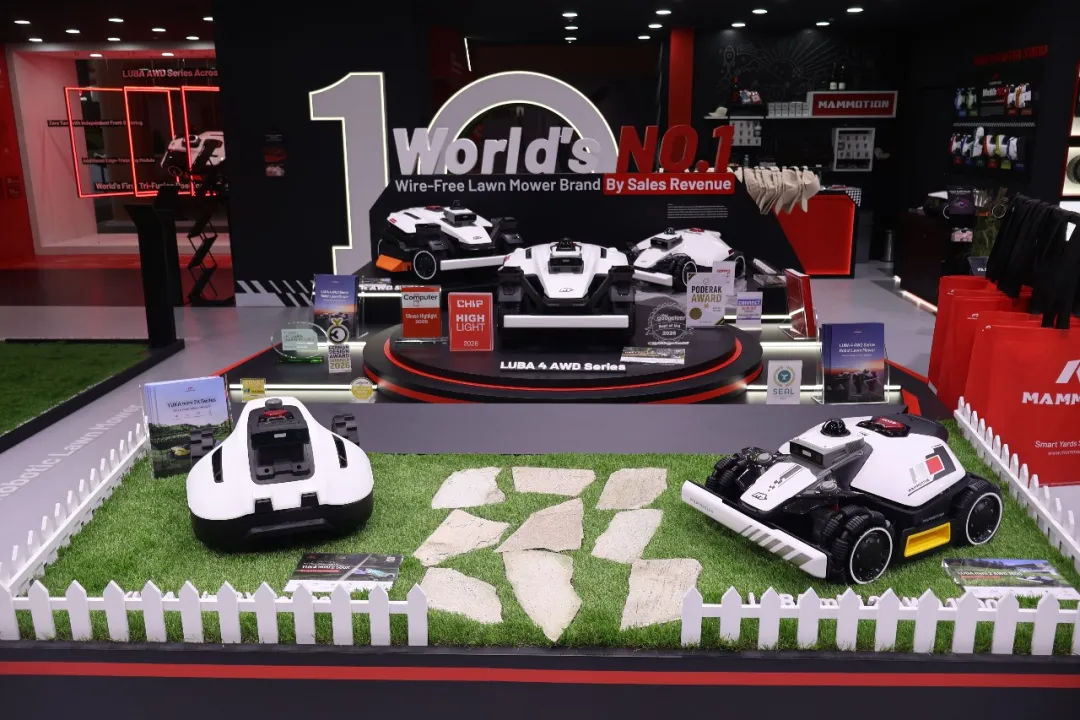
But what really brought the industry into the spotlight was the body-sized robot next door.
Maston, Cook's first commercial lawnmower.
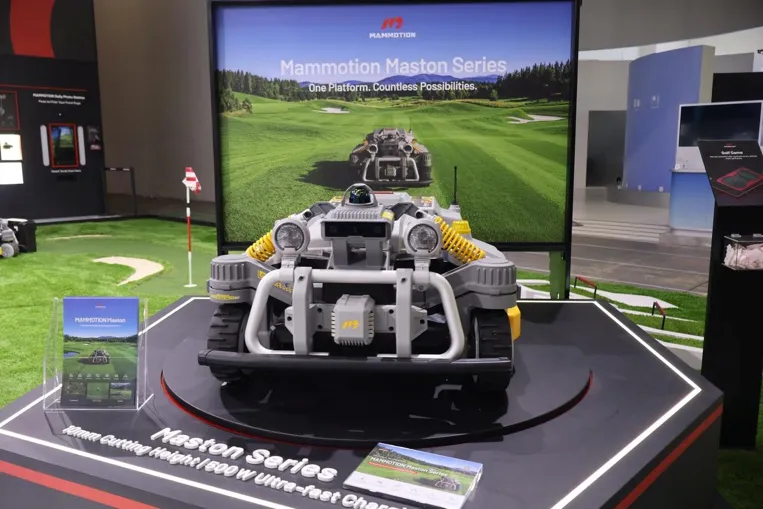
The champions of the household market to do business, which is itself a signal. In the past few years, many brands of lawnmower robots have shouted to make a commercial lawnmower, but they have really come up with a complete solution, almost none. Traditional garden machinery giants are looking for channels and brands, but they are slowly unable to open up in terms of intelligentization; most start-ups are still grabbing their share of the household market, and commercial is too heavy for them.
At this time, Kuon prefers to put the commercial program on the IFA stand. Some people feel that this is an inevitable step in the expansion of the brand, and others feel that the market has not yet stabilized and are in a hurry to get commercial.
But if you extend the timeline to 10 years, you'll find that this is a shortened version of how the lawnmower robot industry is entering the second half of the boom.
01.
The second half of grass-cutting robots: commercial isn't a choice, it's a must
Let's look at a set of numbers.
The global sales of smart lawnmower robots in 2025 are close to 1 million and are expected to surpass 1.5 million by 2026.[citation needed] It sounds like a lot, but in 250 million private gardens around the world, the penetration rate is still a single digit.[citation needed] Here, the yard area is less than 2,000 square meters of the domestic market, contributing to 78% of total shipments, but the growth has slowed to 12%.[citation needed]
In contrast, the commercial and semi-commercial markets - golf courses, municipal greenhouses, large estates - are rapidly unleashing market demand. Industry data shows that the global market for commercial robotic lawn mowers will be about $1.15 billion in 2025 and is expected to reach $1.87 billion by 2032.
The urgent need for a commercial scenario stems from structural contradictions at the supply end. Traditional commercial lawn care has long been highly dependent on man-made and pedestrian fueling equipment, facing rising labor costs globally, aging frontline workers, and difficulty in standardizing quality standards.
But the current industry reality is that there are many brands that are calling for commercial applications, and there are few solutions that can truly land and scale applications. Basically, many companies are trapped in a common cognitive misconception that the size of home lawnmower robots, the size of pottery, the power of pottery, the strength of pottery, is commercial.
In fact, household and commercial are two completely different business logics.
• Household scenes: The focus is on single-piece sewing equipment operating autonomously, solving the problem of the individual replacement sewing experience, the focus is on whether it is possible to cut automatically, automate the sewing machine, do not hit things, avoid obstacles, cut cleanly, attach the sides.
• Commercial scenario: The real competitive dimension is system-level operational efficiency with full lifecycle TCO (total cost ownership), which addresses the business needs for accuracy, stability, manageability, and cost reduction. Operational bills are calculated by end-customers who are concerned with continuity of operation, complex terrain stability, failure rate, multi-machine synchronization and long-term maintenance costs.
Team collaboration, charging scheduling, fault response, maintenance planning, cross-site management are what commercial customers really pay for.
Just making the home machine bigger, broadening the blade, increasing the battery, that logic doesn't work in a commercial setting. Just like you can't extend the chassis of a city SUV with two wheels, it's a truck.
This is why many traditional household brands, even old-fashioned garden tools companies in Europe and America, are slowly failing to really open up the commercial market.
02.
Three steps down, the commercial layout of Kuan Yew started long before IFA
The brand is not the first to enter the commercial market, but its pace of entry is quite different from the industry-common concept of cooking.
Time to go back to the CES exhibition in January 2026, the first time that Cuomo released a strategic signal to enter the commercial market. At the time, many in the industry thought that this was just another domestic brand's cross-border slogan, after all, too many brands had had similar expressions before.
But what happened next wasn't much different.
In June 2026, at the SPOGA+GAFA in Cologne, Germany, Cook made a dynamic demonstration with Maston. From the announcement of the crankshaft as a crankshaft to a crankshaft capable of running, he brought with him a machine capable of running in real time.
In September 2026, the IFA Berlin, Germany, officially unveiled the complete Maston commercial solution and announced the launch of the commercialization of the global market in 2026, including the Chinese market.
According to the Robotics Workshop, Maston is not a larger lawnmower, but a set of hardware-to-software systems: including dual-version hardware (Rotary and Flail) for different scenarios, a fleet collaboration management platform, the MAMMOTION Fleet App, a 500W high-power fast charging base station, and a fast replacement battery dismantling architecture.
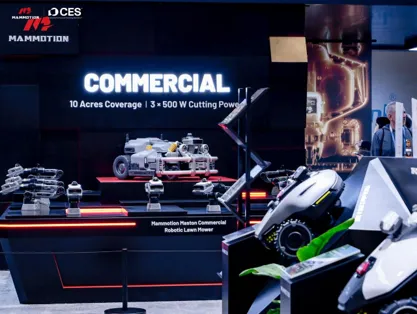
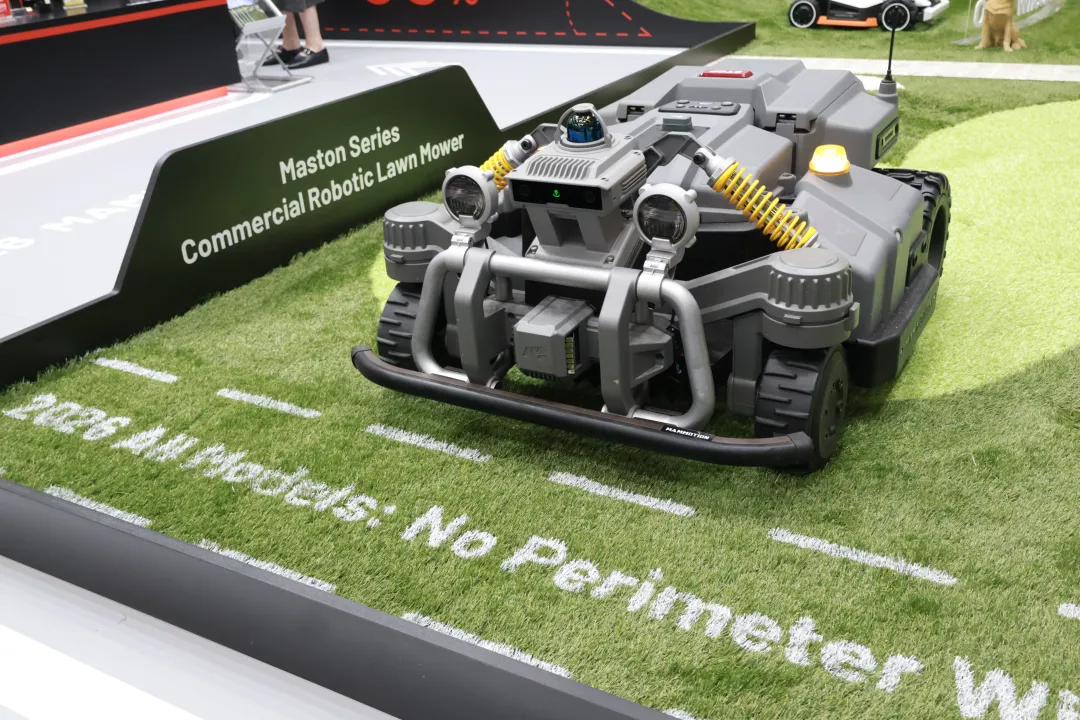
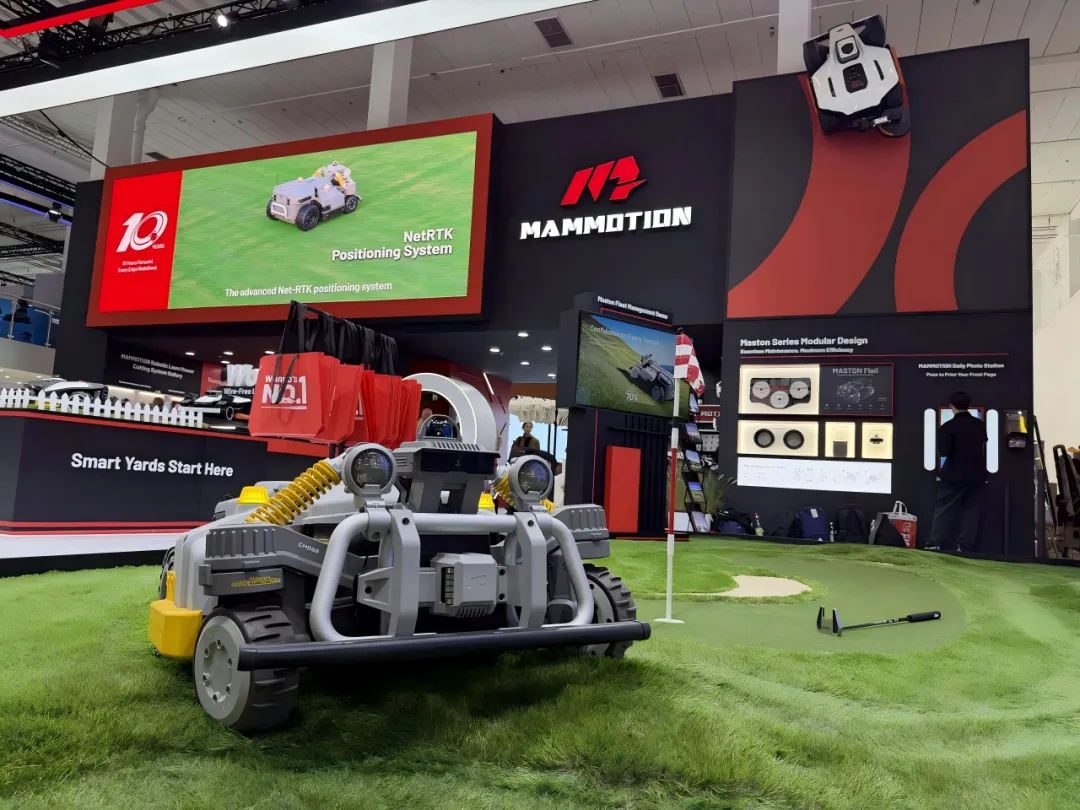
Sliding to the right.
The images are from CES, SPOGA, IFA.
From strategic intentions to dynamic testing, to the release of complete software and hardware programs.
In the context of the grass-cutting robotics industry shifting from the concept of heat pumps to landfills, specific program closures have become key indicators of assessing the commercialization capability of enterprises. This steady-state style is also consistent with the logic of business in the domestic market over the past decade.
03.
Deep demolition of Maston: the core of commercial use is not the aluminum dam, but the aluminum system engineering dam
To understand Maston, we must first understand the real difficulties of business.
A home lawnmower is essentially an individual lawnmower. It only needs to take care of itself, where I am, how tall the lawn is, where I have to go, no power back to charge. Out of the cage, the owner can intervene manually at any time.
But when it comes to the commercial scene, one machine becomes 10, 50 or even more, the problem will change: how to allocate tasks between multiple machines? how to reduce repetitive tasks? how to prevent communication? which machine has insufficient power to charge first? how to schedule multiple charging stations? how to handle a device that fails?
These problems cannot be solved simply by strengthening a machine.
Dismantling the Maston solution can be found to have the core logic of upgrading the single capability into a triad system that synchronizes hardware, disk, energy and cloud:
Scene Hardware: Don't sweat the crap out of the sky
The overwhelming majority of home lawn mowers have only one set of hardware schemes, because the difference between home lawn mowers is not so great as the difference between area size and slope mitigation.
However, the demand for commercial grasslands is highly diversified: golf courses and orchards seek millimetre-level integrity, while municipal greenery or desolate slopes require high intensity cutting power, almost two species.
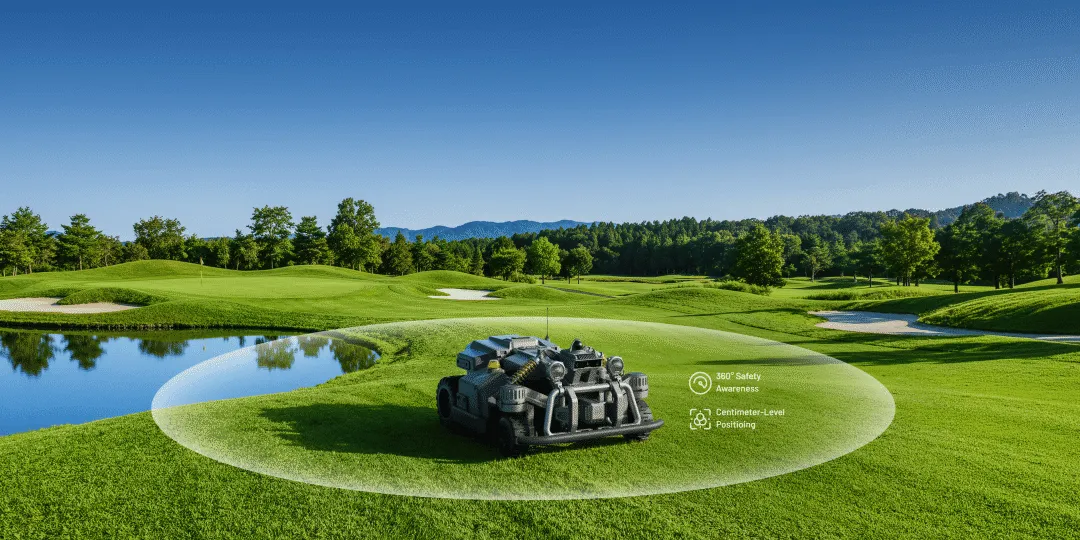
Maston's solution is that the two product lines are parallel.
Maston Rotary: With three 500W high-torque cutting motors, with a top speed of 6000 rpm, targeting high grass, thick grasslands, complex terrain.
Maston Flail: Cutting height down to 10mm and supporting millimeter-level precision adjustment, designed for golf courses, high-speed sports fields, and other high-end lawns that require extremely high levels of flatness.
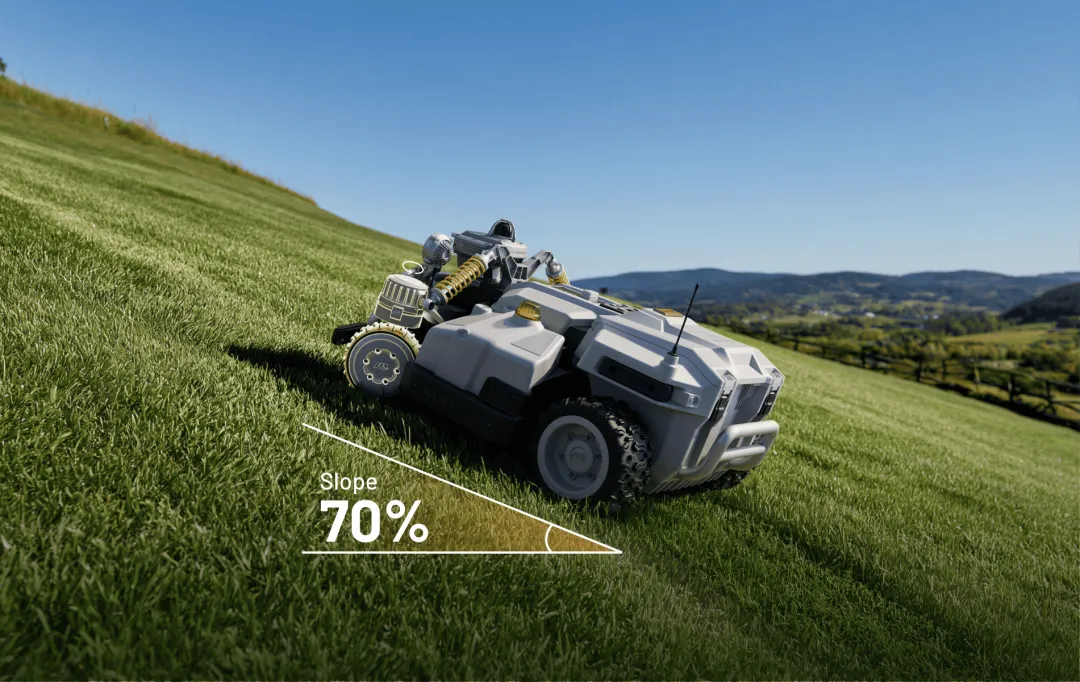
Commercial basement: from climbing slopes to turf-free grasslands
In the commercial scene, the equipment's damage to the turf directly affects the customer's commercial gains. Traditional equipment can easily cause the turf to tear when it falls off or slides down the slope frequently. Maston's undercarriage structure has been adjusted to address this pain: maintaining a four-wheeled position on a complex terrain by means of independent wheel suspension, reducing body bumps; combining independent front-wheel rotation with a two-way driving structure, reducing the turning radius, avoiding physical damage caused by the original grinding of the turf.
Full-Chain Energy System: From Reloaded Anxiety to Reloaded Stopping Anxiety
In the early years of the home lawnmower industry, a machine could run for 90 or 120 minutes and was once a key selling point for marketing.
But when it comes to the commercial scene, this idea needs to be completely reversed.
Because commercial customers are most concerned not with how long a single charge is running, but with how long the machine is actually running, 24 hours a day. In other words, the duration itself is not the purpose, it is the effective operating time.
Maston has built an entire energy system around the continuous operation of the pump: a 58V high-pressure commercial platform, which ensures stable power output under high load conditions, reducing power loss; a quick dismantling battery architecture, which takes only a few minutes to replace the battery in the field, without long waiting to charge; supports 500W high-power fast charging base station, supports intelligent energy management system, supports faulty peak charging and multi-charging station automatic scheduling.
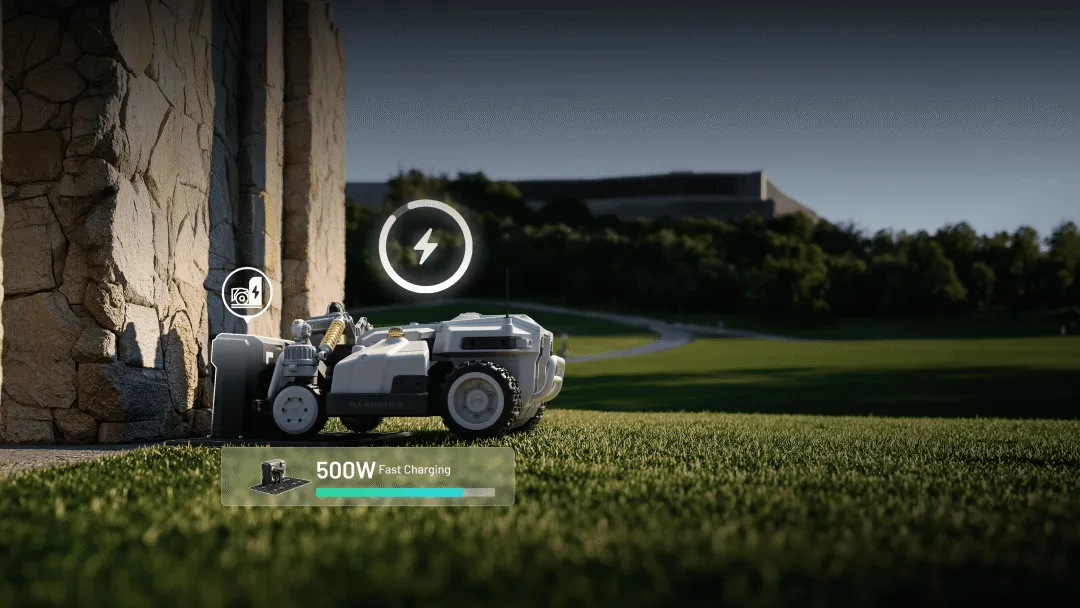
At the core of this logic is that machines spend as much time as possible on lawn mowing operations rather than waiting to be charged on site. Compared to a simple stack of large batteries, the combination of fast switching + fast charging + smart scheduling is more in line with the actual needs of commercial operations and can significantly improve the overall operational utilization of the equipment.
Global cloud fleet management: the real divide
After all, the three-dimensional pumps mentioned above, the dashboard, the energy pump, are essentially within the scope of the ability to pump a single machine pump. But the real divide between commercial and domestic pumps is that on top of the pumps' smart pumps, there is also a need for a layer of pump group smart pumps.
Maston is equipped with Cook's exclusive three-convergence positioning system (360° LiDAR+NetRTK+AI vision), achieving centimeter-level precision positioning, and a comprehensive upgrade of environmental sensing capabilities under complex terrain. Based on this, Cook has created a cloud-based fleet management platform (MAMMOTION FLEET APP) that allows operators to complete centralized control of multiple locations and devices on a single console.
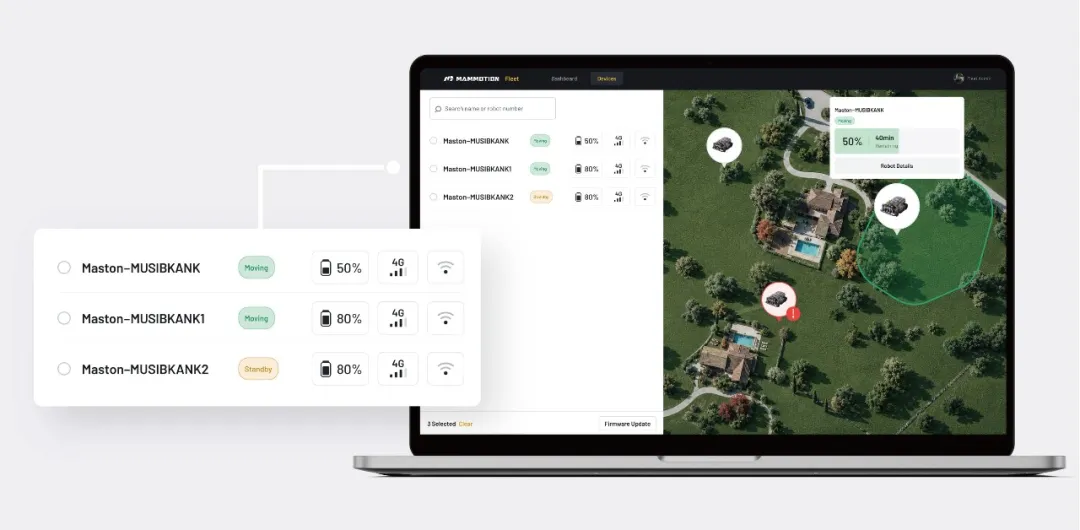
The system can do much more than real-time location and operational progress: it can automatically intelligently segment super-large operational areas, achieve multi-machine collaboration operations; support multi-charging base station deployment, smart scheduling equipment charging priorities; include remote fault diagnosis and equipment health monitoring, can predict component losses in advance, reduce man-to-man inspection frequency; and can generate detailed operational data analysis to help managers unify the quality of operations at different locations, and plan equipment maintenance plans.
Combined, these capabilities mean that commercial customers are not buying a lawn mower, but a system that can be remotely managed and replicated to scale. This is the real divide between the Maston and the larger home lawn mower.
In retrospect, the four dimensions of Maston have progressive relationships: hardware determines whether or not to cut well, disk determines whether or not to cut steadily, energy determines whether or not to cut continuously, and cloud determines whether or not to cut a group of machines efficiently together.
Instead of enlarging the home robot, the choice was to redefine a complete operating system from unit to unit, from lawnmower to management. This distinction determined whether it was a larger home robot or a true commercial solution.
04.
The answer lies in the decade-old home market.
Speaking of which, there is a question that naturally arises: commercial lawn mower robot racetrack isn't a no-man's-land, why did Kuan Yew come up with this complete solution first?
The answer is not in the IFA stands, but in the last decade.
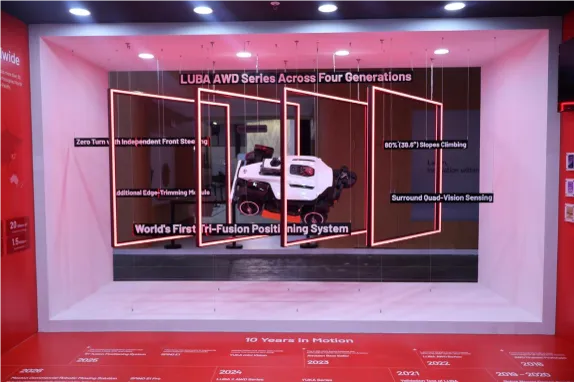
From a technological point of view, Maston's reliance on the combination of positioning and control of the dashboard was further refined in the four-generation iteration of its flagship LUBA series.
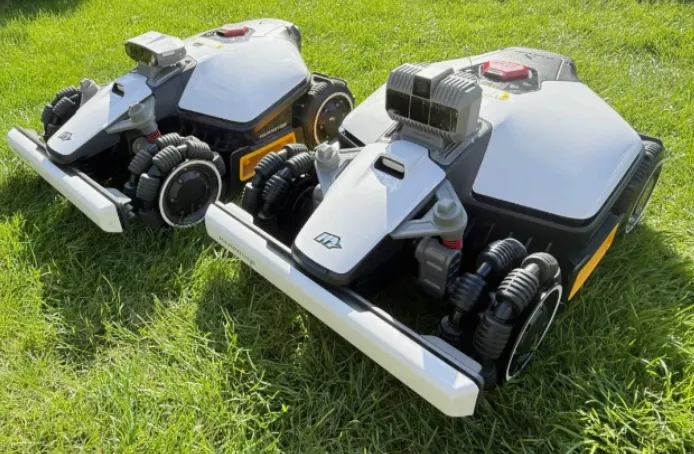
• LUBA 1 brings the combination of RTK+AWD to the realm of borderless lawn mowing robots for the first time, solving the problem of how robots can actually run smoothly;
• LUBA 2/3 introduces AI vision with LiDAR, upgrades single-sensory to three-fusion positioning systems (Tri-Fusion) and solves the problem of position drift in complex environments such as tree cover, dark light;
• IFA's LUBA 4: Technological transformation has entered the operational details: independent front wheels with dual directional driving, reducing damage to the grass; mechanical arm attachments to the side, solving the problem of residual grass residues at the edge of the fence.
Sliding to the right.
This method of verifying large-scale samples and improving the technical trajectory of commercial scenarios makes the stability and maturity of commercial systems based on tens of thousands of hours of real workplace data.
On the other hand, commercial customers need more than just mature products, relying on supply chain landing and localized service response capabilities. In the past, Cookware has pioneered major retail giants such as Walmart, Home Depot, Lowe's, becoming the first wireless electric lawnmower brand to land in North America's main channels; simultaneously, it has established localized service centers in Europe, North America, and Australia.
The business logic is clear: being able to serve 750,000 households, opening up mainstream retail channels around the world, and establishing a perfect supply chain and service system in multiple countries is the true foundation of enterprises crossing the commercial corridor.
From this point of view, Cook's entry into business was not a sudden discovery of a new cross-section, but a natural extension of his own ability to accumulate to a certain stage. The decade-long domestic market sharpened the sword, sharpening not only the products, but also the integrated capabilities of technology, supply chain, operations and services.
05.
What is the meaning of this verse?
From the start-up team of dozens in 2016, to the global leader in the category of grass-cutting robots without borders in 2025, and to the IFA exhibition in 2026, the decade of Qianlong's mixed martial arts showcases the complete trajectory of China's smart hardware enterprises from martial arts innovation to martial arts system solutions.
In a sense, Maston's launch as a lawnmower robot racetrack opens up a new imagination: the upper half of the lawnmower competition at home gardens is not over, while the upper half of the lawnmower for professional lawnmowers has already been rolled out. It is worth noting that Maston will be sold globally this year, including the Chinese market, but using an authorized agent model to land.
Of course, the B-end commercial market has never been a quick battle. From the program shown at the exhibition, to standardized scale applications in different landscapes and different climates, Cooking still faces the long-term test of operational responsiveness and commercial ROI. But this is precisely the most attractive place in the industry when the shortcut to the expanded household cabin is rejected, and future entry tickets will only belong to long-termists who are willing to dig deep into the technological underpinnings and build on the foundations of system operating capabilities.
In this arena of endurance and deep cultivation, Mammotion has undoubtedly been considered one of the most promising runners in the industry.