In the previous article, Nabotsky presented the research and development background of the newly-introduced RVminiTM, a small precision gear reducer with a turbocharged cylinder structure.
Please click on the link to read the details of the R&D background of the mini-precision gear reducer "RVminiTM".
In this article, Nabotsky will explore in-depth the behind-the-scenes story of the RVminiTM during production.
Why is the unified precision of precision deceleration machine production so difficult?
Researchers and developers confess that even if theoretical design schemes are established, it is very difficult to install drawings in real production lines.
Following the initial success of design program typing and sample verification, the next key challenge is to build a stable quantity production process.
Deep collaboration between R&D and production teams, repeated grinding
The heads of RVminiTM who lead the development of mass production processes remember the following phases of the project:
Annabotsk has conducted countless studies, designs, and manufacturing that have never been easy to compromise, as the ultimate goal is to pursue extreme product quality, whether it be the demands of the design side or the difficulties of the production line.
If the difficulty of on-site processing is ignored and production is forced according to the drawings, the precision of the whole machine will be greatly deteriorated once the processing capacity of the high-precision parts is not met; but no compromise can be made on design standards in order to facilitate processing.
Nabotsky is thinking every day: how can we design this set of high standards and turn it into a mature product that can be produced in stable quantities?
In the development of precision reducing machines, and in the development of core technologies, the difficulty is the precision of the integrated machine in mass production.
Precision gear reducers do not only require high precision of individual parts, but the overall performance after assembly is crucial. It is far from enough to rely solely on theoretical calculations that designs meet performance standards.
From designing to testing integrations to polishing quality
There must be errors and fluctuations in the actual processing and assembly connection, and the mass production phase must control the entire process of processing and assembly, to avoid discrete deviations in the performance of the product; only when the performance is stable and reproducible, the product is truly mature.
In the absence of any of the above, it is not possible to produce a quality stable finished product. Even if the sample test results are excellent, the core value of the product will not be fully realized once the precision of the quantity production phase is out of control.
From design selection materials, precision processing, assembly assembly, to finished product testing, performance evaluation, the whole process is connected to create stable quality that can withstand large-scale production tests.
As a result, the RVminiTM project is simultaneously advancing design development and building a comprehensive mass production process system.
Nabotsky continues from R&D, production of two-sided synchronous compilation, iterative optimization, performance feasibility of the sampling phase, upgrading to consistency of quality that can be replicated on the mass production line, and placing theoretically feasible design schemes into mature products that can be manufactured on the production line.
RVminiTM is not simply a product that pursues performance indicators, but a product that is fully consistent with quantity productivity, quality stability, and grinding through a complete commercialized landing process.
Exploring potential optimization topics in conjunction with actual job evaluation
During sample testing, Nabotsky discovered a variety of problems that had not been predicted at the design stage, rooted in differences in laboratory standard test conditions and actual operating conditions on the customer's premises.
Product development is difficult to fully prejudge all customer use scenarios on the ground, but if the difference in working conditions is ignored, it will directly affect the performance and reliability of the product after delivery.
For this purpose, Nabotsky has integrated a research and development, production and technical team to thoroughly dismantle all types of failure inducers.
Abandoning rough, hands-on modeling that relies on experience, visualizing the phenomenon of the operation of the device through data and maps; complete collection of data such as load distribution, heat transfer, wear progression, and filling the gap between theoretical design and real-world operation.
Day-to-day test evaluation and continuous improvement, ultimately significantly improving the reliability of the product under real working conditions.
Improving lubricants and building product differentiation competitiveness
Meeting the industry's basic standards is just the beginning of a product, and in order to stand out from the competition, you have to create a unique advantage that creates clear value for your customers.
And the lubrication system has been optimized to be a breakthrough in the differentiated competition of RVminiTM.
Small decelerators need to withstand high loads in a narrow space, and the choice of lubricating oil directly determines the overall performance limits.
Nabotsky is simultaneously developing a special lubricating oil for the RVminiTM exclusive structure.
Combined with the use of this custom lubricant, the decelerator can maintain stable performance for a long time, which is also one of the core competitors of the product.
With the advantages of high reliability and compact volume, the RVminiTM is widely used in small robot joints, precision transmission unit drives, and improves overall equipment reliability.
RVminiThe core value TM brings to customers
RVminiTM is not just a small decelerator, it provides long-term stable operation guarantees for small robots, precision transmission equipment, and high performance in the four dimensions of rigidity, durability, volumetricity, and maintenance of convenience.
Although there are similar competitors on the market, Nabotsk has been able to gain customer recognition because: from product research and development, production manufacturing to material selection, the whole design idea is based on the quality of quantity production.
The RVminiTM, developed jointly by the design and production team, expands the design freedom of robotics as a core component to enhance the performance of the entire set of devices and help customers develop their intelligent manufacturing careers.
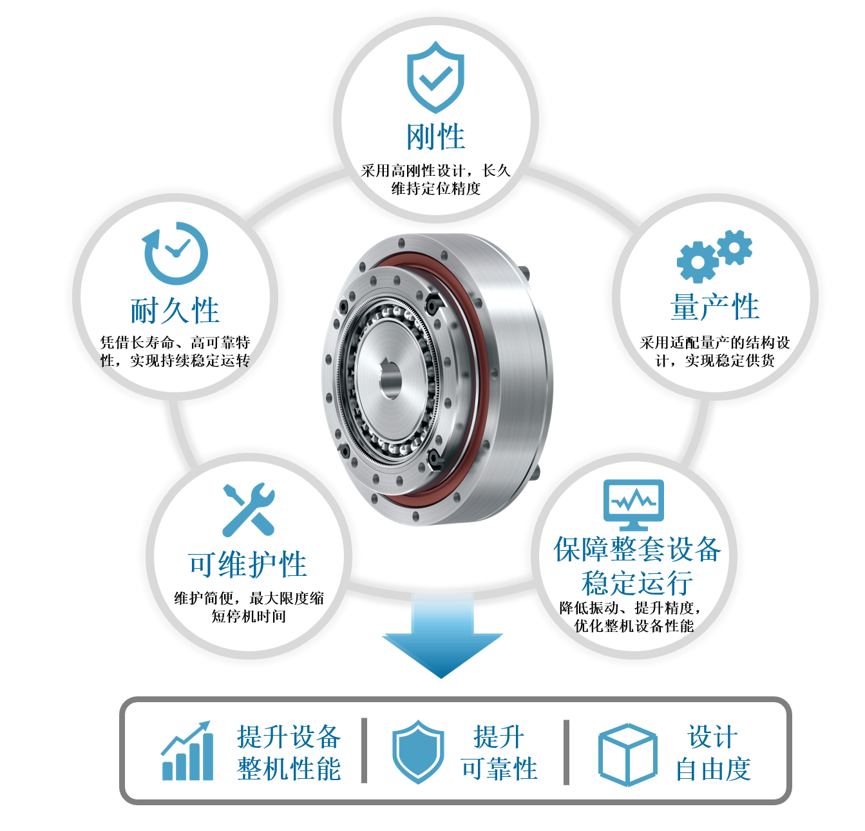
Nabotsky aims to provide better solutions for the compactness and simplicity of the design, production and assembly of customer automation equipment.
In the future, Nabots will continue to focus on its customers and continue to develop new product lines to meet their needs.
* Translated from Nabotsk