It's the first time in the history of the world.
Just now, GPT-6 has broken a new record for speculating on the number of nitrogens.
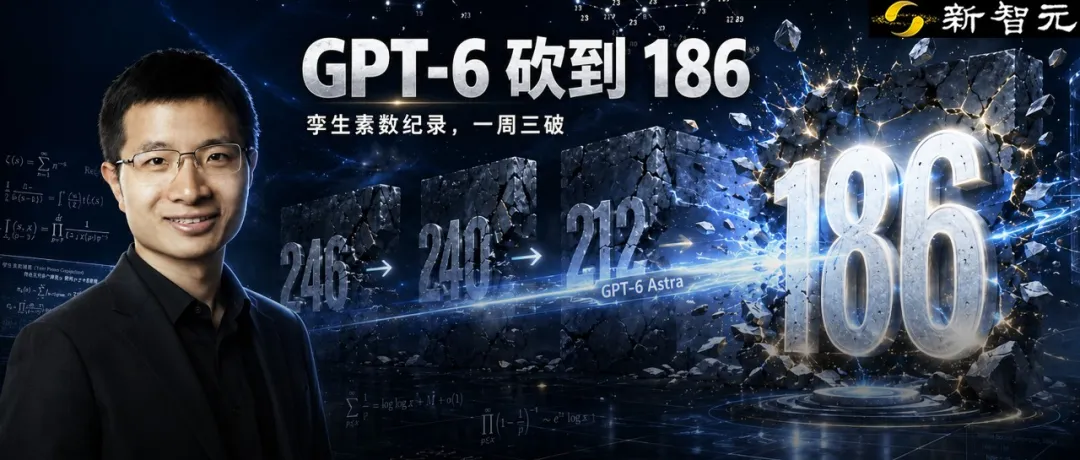
OpenAI announces that GPT-6 is pushing the boundaries of nitrogen counts to the top186!
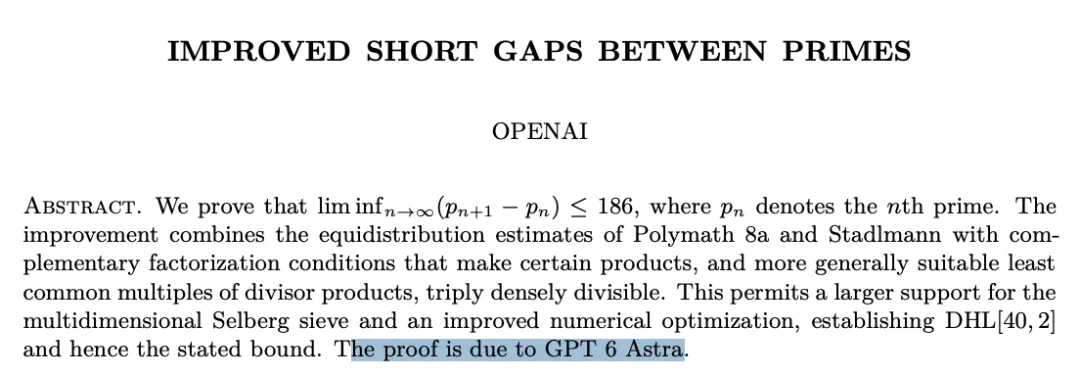
At the end of the abstract, it is written directly: proof attributed to GPT-6 Astra
The starting point of this line, 70 million as demonstrated by Zhang Yi-dong in 2013, was then squeezed to 600 by Maynard and then locked to 246 by Tao Zedong.
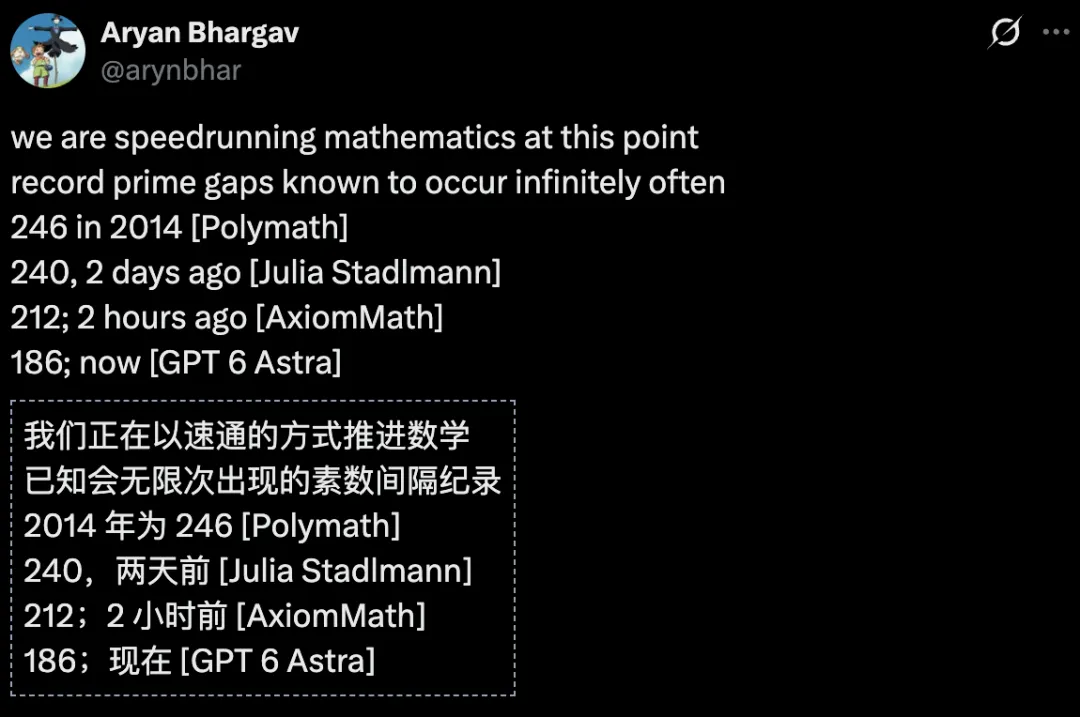
On August 31 this year, Oxford mathematician Julia Stadlmann pushed it to 240; on the morning of September 3rd, Axiom Math compressed the record to 212; just hours later, OpenAI announced: The latest record given by GPT-6 is 186!
Taotjeong kept the record for 12 years, being beaten three times in a week, and the miracle really came.
OpenAI researcher and Grade 7 Mathematics graduate Suzanne J. said it was "the birth of a new era of intelligence!"
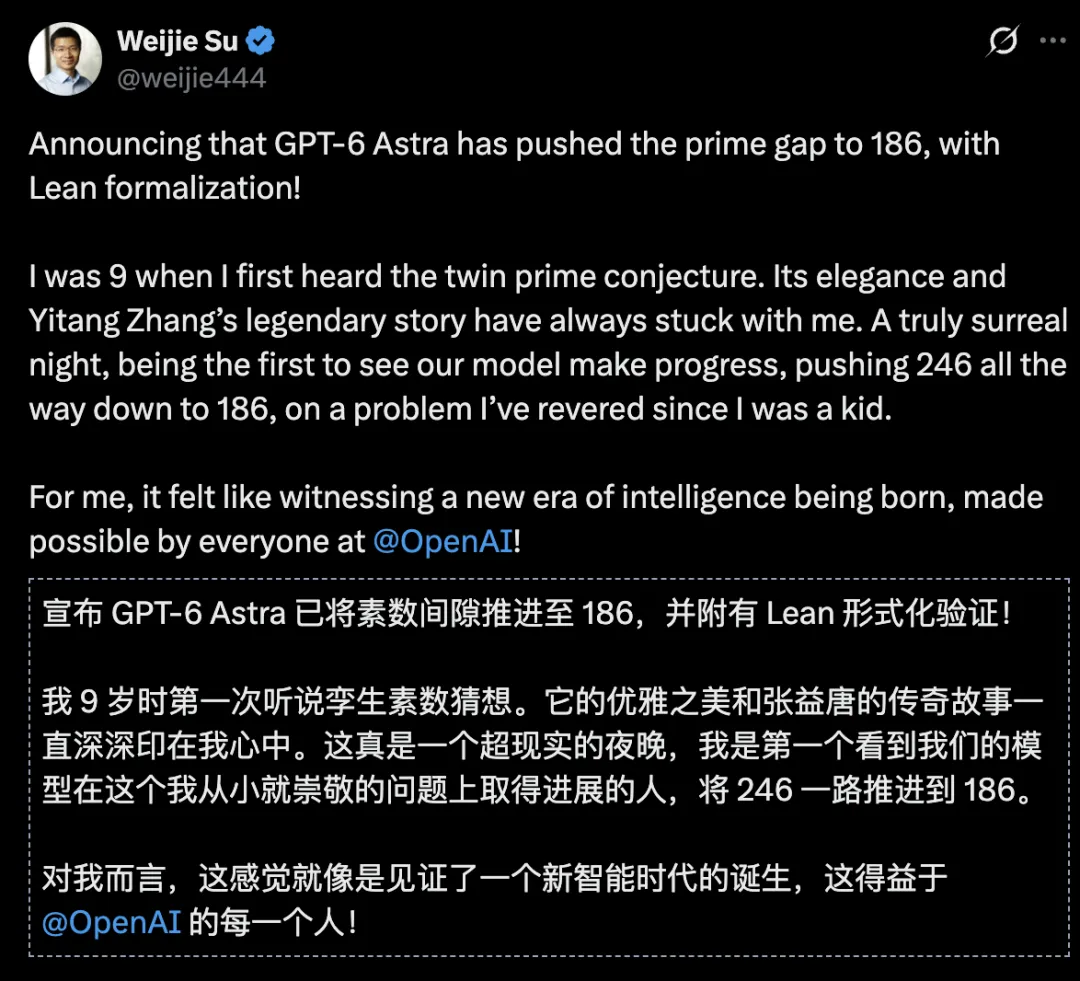
Suzuki, who was involved in the hypothesis, said: "The first time I heard the photon number guess was when I was nine years old. Tonight, I witnessed our model pushing 246 all the way to 186"...
Ken Ono, a professor of mathematics at the University of Virginia, exclaimed: "September 3, 2026, is the craziest day in the history of mathematics!"
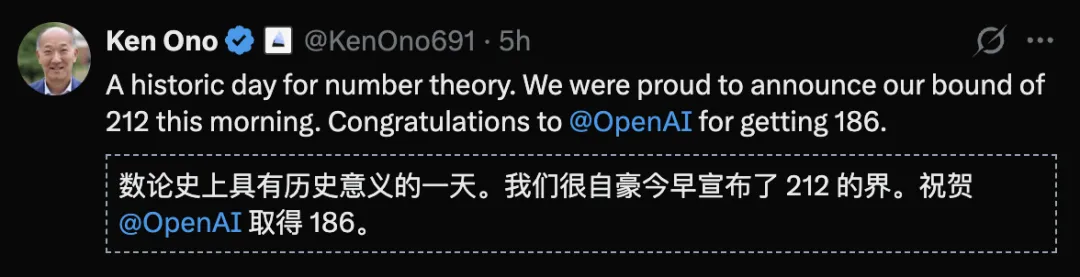
There is no doubt that this is another achievement at the FIFA Awards.
This night, mathematicians around the world have been awake all night.
September 2026, a crazy week in the history of mathematicsThe Pythagorean Theorem has always been the jewel in the crown of mathematics. It proposes that there are infinitely many primes, and the difference between them is just 2.
For hundreds of years, humans have not been able to prove that even "zero-number spacing is finite".
It wasn't until the birth of Zhang Yi-Tang in 2013 that there were infinitely many primes with a space of less than 70 million.
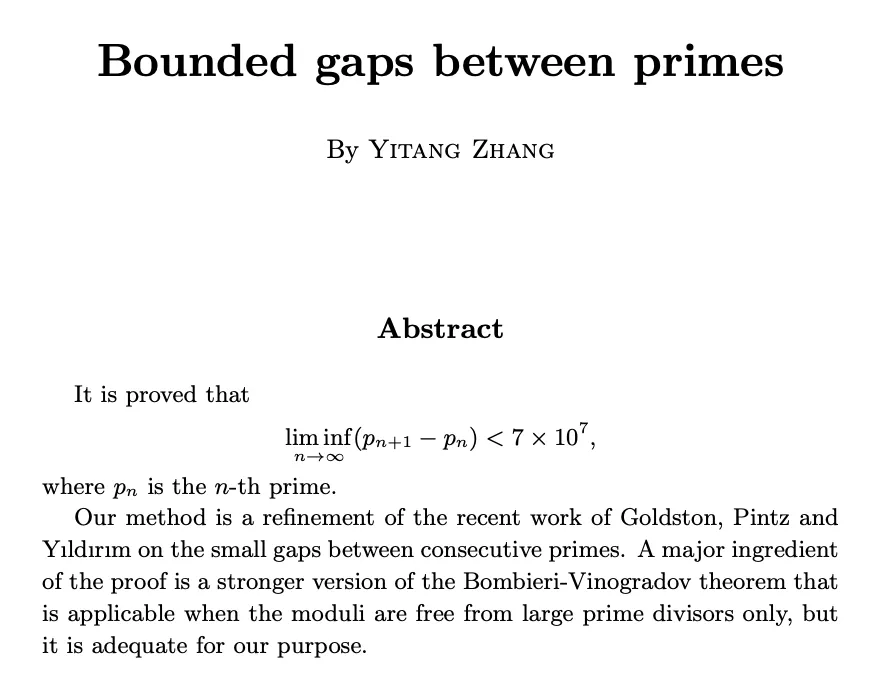
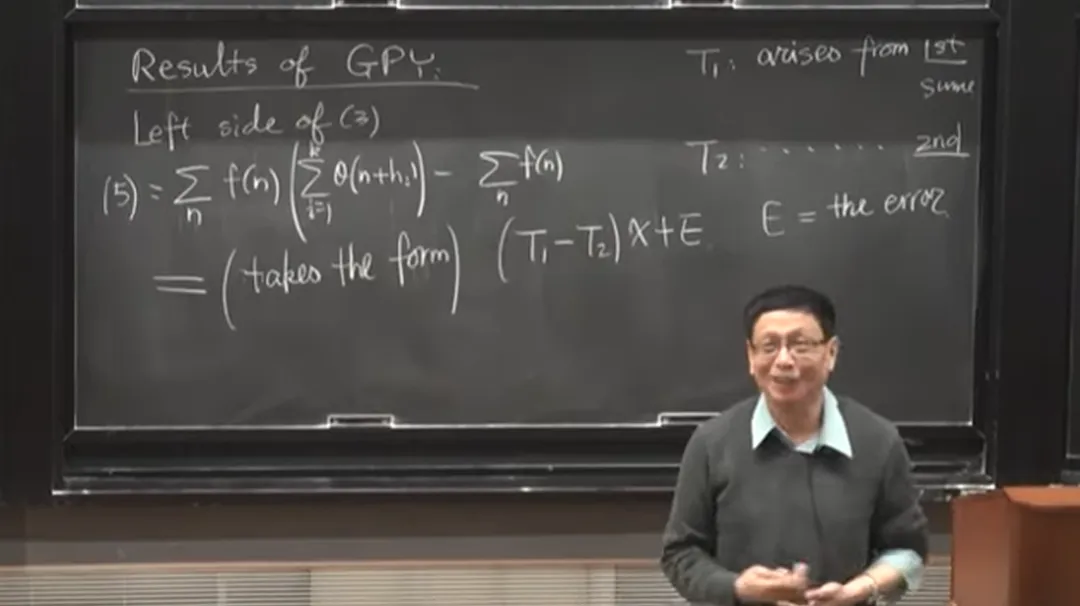
James Maynard and Tao Te Ching then launched the Polymath project, which cut the gap from 70 million to 246 million.
However, after 246, the original method seems to have reached its limit.
Until the autumn of 2026, the problem was accelerated madly.
On 31 August, Julia Stadlmann, a mathematician at the University of Oxford, with her brilliant use of an all-new average distribution estimate of the smooth model, pushed the record from 246 to 240.
On the morning of September 3, the AI mathematics startup team Axiom announced that on the basis of Stadlmann, their AI system AxiomProver would squeeze the limit to 212.

Most surprisingly, just a few hours later, OpenAI officially released a paper on short-range improvements to prime numbers, opening a GitHub warehouse called PrimeGaps 186.
From 246 to 240, humans took 12 years; from 240 to 186, AI took only 3 days.
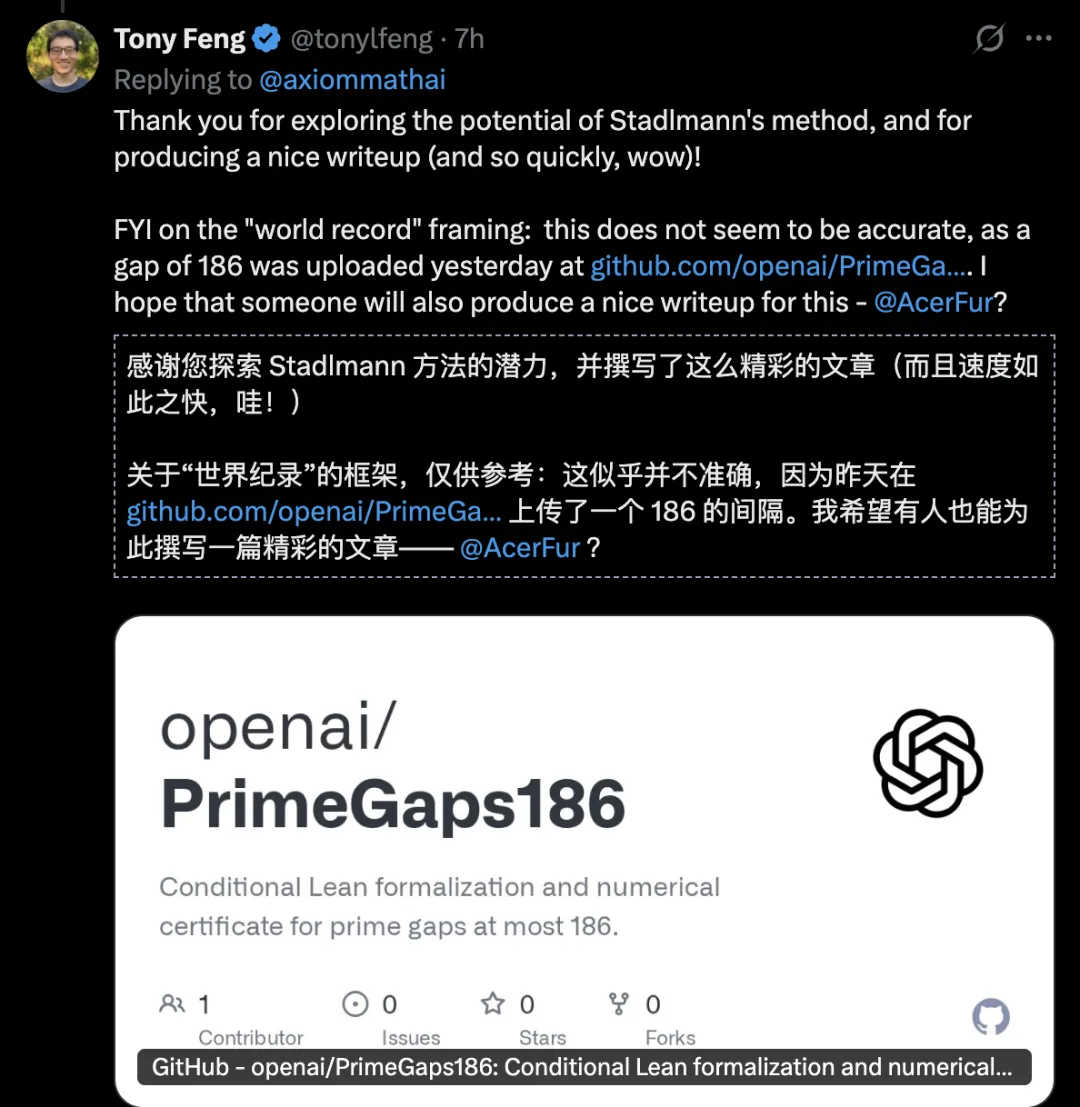
UC Berkeley mathematics professor Tony Feng directly @Axiom team: "To tell you a story about the World Record, this may not be very accurate because OpenAI has just submitted 186 proofs on GitHub"...
This evening has become one of the most influential nights in the history of AI4Math.
Squeezing the boundary from 246 to 186 is by no means a mere "violent crackdown".
At the heart of the numbering problem of nitrogen is controlling the nature of the "allowable subgroup".
The 246 boundary corresponds to a 50-metric group of length; the 240 corresponds to a 49-metric group. The GPT-6 directly crosses the middle zone, forming a permissible set containing 40 elements with a diameter of exactly 186.
To prove this in parsimonial mathematics, a new "breaking point" is needed in the famous GPY theorem.
According to the OpenAI paper and GPT-6's CoT notes, GPT-6 does not fall into the trap of blind search, but instead shows deep mathematical intuition.
First, it discovered a whole new condition called "triple density decomposition".
In previous studies, mathematicians have had to limit modules to a strict range (such as extremely smooth numbers) in order to use Zhang Yi-dong's approximate distribution estimates.
GPT-6 discovered a complementary factor decomposition condition that gave specific multiples (the appropriate minimum common multiple of multiples) "triple density decomposition".
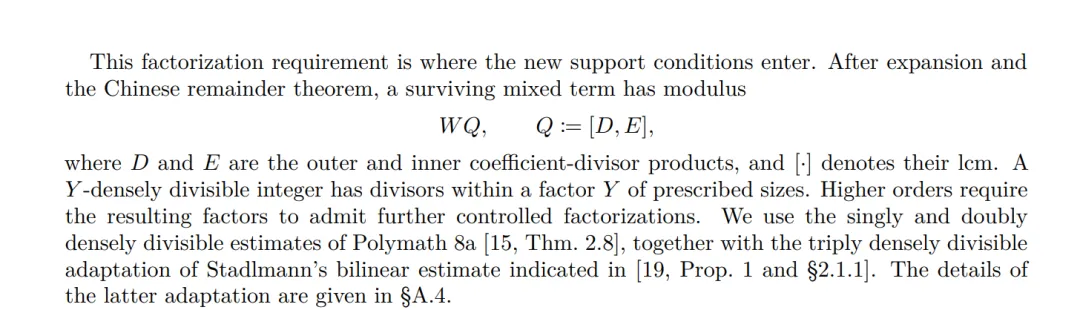
Simply put, the GPT-6 loosened the locks on their suits, proving that even in the less "smooth" numbers, there is still a huge amount of space hidden.
After expanding the range of modules, GPT-6 gained wider weight support in the Dover Selberg algorithm.
In the face of extremely complex scores and errors, GPT-6 did not retreat.
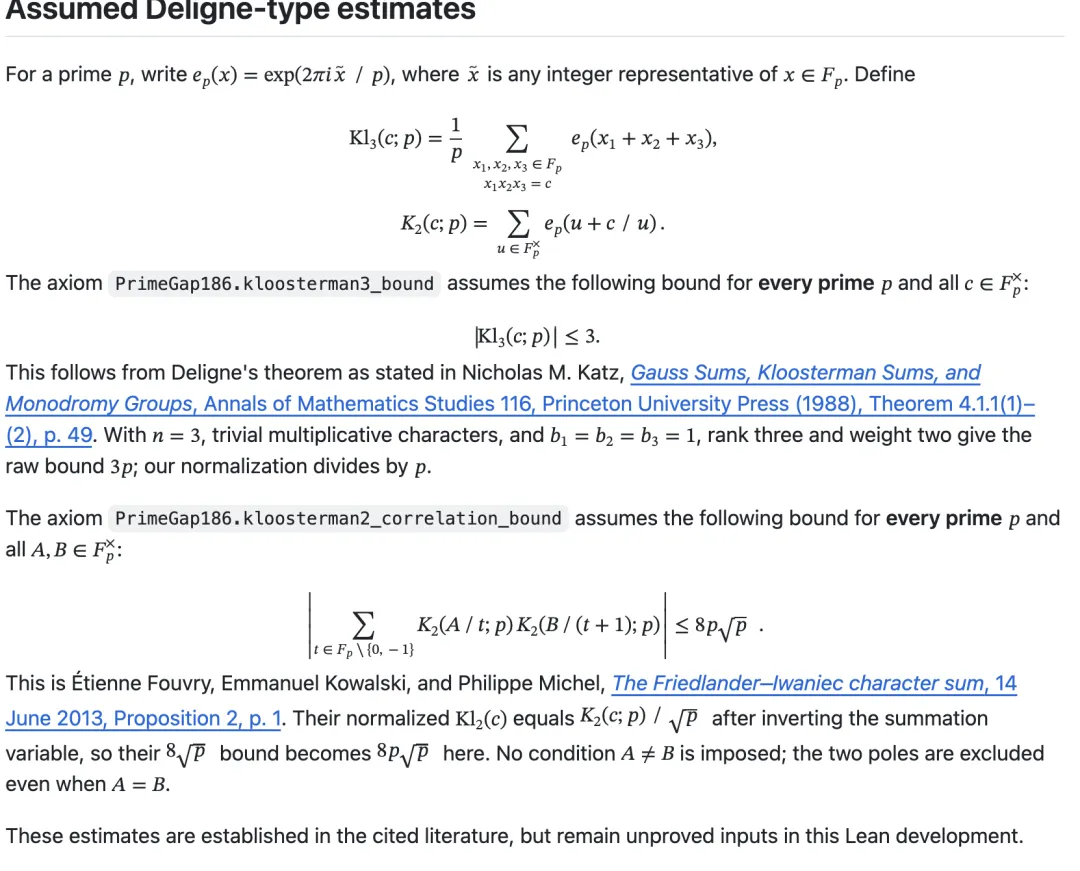
It converted high-dimensional pointers into precise finite coefficient constant equations by constructing a polynomial-dominant function, and succeeded in finding a "safe island" in a chaotic mathematical space containing negative values where the pointer ratio is strictly greater than 1.
Is the proof of GPT-6 sufficiently rigorous?
OpenAI has shattered all doubts.
In their open-source openai/PrimeGaps 186 code repository, GPT-6 Astra not only provided PDF papers, but also submitted complete, executable Lean 4 code.
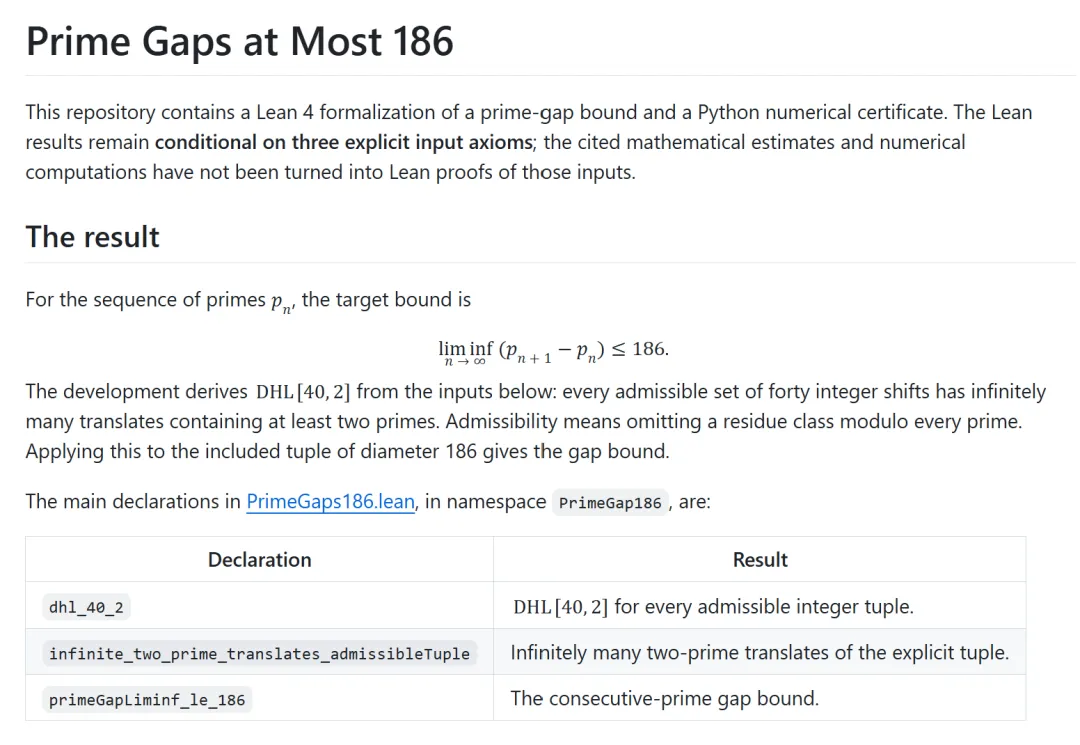
Lean 4 is one of the most authoritative interactive theoretical proof languages in mathematics. Under Lean, code running means that logical chains are absolutely strict.
In this proof, GPT-6 wrote tens of thousands of Lean codes and produced a complete numerical certificate using the FLINT library in Python. Each proofing process was subjected to computer-based calibration.
However, OpenAI also made an honest statement in the project that the current Lean formalization proves to be "conditional".
The entire proof is based on three input axioms not proven in Lean, which mainly deal with indexes and estimates in finite fields.
These conclusions have been proven to be true by humans in existing mathematical literature (such as the famous mathematician Deligne's theorem on Liman's conjecture on finite fields), but AI has not yet fully translated those thick mathematical books into Lean codes.
In other words, this time, the GPT-6 skillfully stood on the shoulders of giants and made 186 breakthroughs.
CoT documents reveal the heart of GPT-6OpenAI simultaneously released a CoT document that fully documents GPT-6 Astra's entire process of thinking, dealing with obstacles, and self-evolution while tackling the problem.
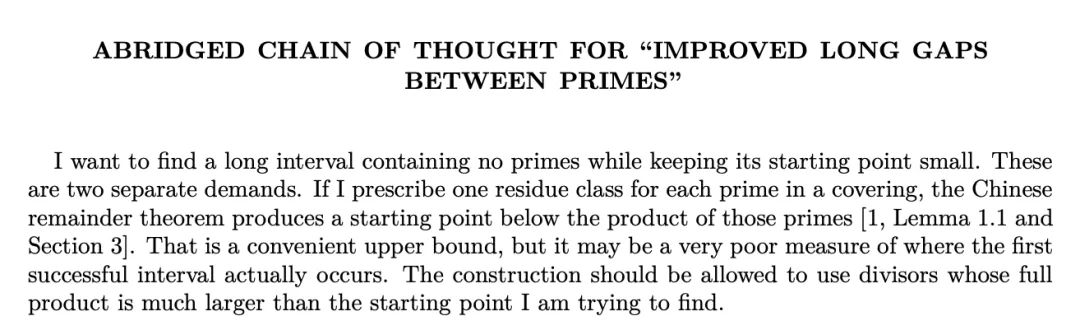
For example, it refuses to speculate.
GPT-6 was originally conceived of as "stealing".
It attempted to construct a sparse set of integers to bypass the complex calculations of particle number theory, but it soon discovered by constructing counterexamples: "Pure qualitative metric group conclusions cannot filter out better prime pairs, and this method does not work".
It also shows a keen ability to correct mistakes.
When approaching a higher dimension, GPT-6 found that using floating-point numbers to optimize computation would fall into the "trap of numerical conditions".
It records: "Small generalized characteristic vector residues do not prove that the Gram matrix is accurately calculated...a small strict inequality can only be established when the marginal error, the underlying error and the supporting error are less than the permissible amount".
Thus, it decided to abandon approximate computation and turned to extremely rigorous precision arithmetic.
In addition, in the course of the impact 186, GPT-6 found that the optimization of 41 dimensions had gone to zero, no matter how mitigated the parameters, the result was always 0.997 tons.
It did not remain deadlocked, but re-examined the underlying logic of factorization, proposed asymmetrical density allocation strategies, and handled the probability distribution of "maximal prime fragments" with extreme precision.
Eventually, in a 40-dimensional architecture, which was allocated with a budget of errors beyond human precision, Hardcore pushed the numerical value over 1!
This proves that GPT-6 has demonstrated enough scientific taste to know when to use approximation and when to be precise.
Twelve years ago, when Zhang Yi-dong published a paper in the yearbook of Chinese mathematics, the world was overwhelmed.
Today, we stand at a whole new historical juncture.
In the most basic areas of mathematics, AI is no longer an auxiliary tool but a leading discoverer.
When the team at Axiom Math scored 212 points, they exclaimed: "The distance between human dreams and mathematical proofs can be shortened from a lifetime to a few hours".
GPT-6 uses powerful reasoning to reduce time to the limit.
Of course, there is still a long way to go, as the ultimate target for predicting the number of nitrogenous elements is 186.
Will GPT-7 or GPT-8 break this record in the future?