It's the first time in the history of the world.
Finally, Astra is here!Today, OpenAI officially released GPT-6 Astra. ARC-AGI-3 is up 99.9%, FrontierMath Tier 4 is down 97.6%.
The numbers start a bit pale here.
OpenAI President Greg Brockman shouted at the event: "Welcome to the AGI era".
Fable 5.1's SOTA is only two days away.
On September 1, Anthropic just pushed Claude Fable 5.1 to the throne: Ramp ran it for 38 consecutive hours, found that the training data label was wrong, changed it, ran six sets of experiments, and wrote his own conclusions.
On September 2, Google released Gemini 3.8 Flash, which was tested externally on multiple coding parameters to match Claude Opus 5.
DeepMind's core researcher Liu Xiaobo commented: "It's a small step on the model and a huge leap on the path to self-improvement".
On September 3, the GPT-6 Astra landed.
Three days, three bombs -- placed two years ago, any of them would be enough to digest the industry for a month.
And that's not the most stressful part.
The release of the GPT-6 Astra has a somewhat bizarre story behind it.
On August 7, OpenAI issued a statement in a rare language.
It can independently detect previously unknown system vulnerabilities, independently write attack code, and independently complete the entire process from invasion to deep penetration.
For this reason, OpenAI even suspended two weeks of reinforcement training.
Altman posted a long post: "We have suspended some of the front-line RL training to ensure the necessary alignment, safety and monitoring standards to reach new levels of capability".
The brakes themselves are the signal.
Just two days before the GPT-6 was released, Musk and Altman's speeches at the G20 summit could almost be seen as the pinnacle of the week.
"AI will just crush all humans at software".
He gave a clear timeline for the next 12 to 18 months, where AI will reach the "Stockfish level" in software, squeeze human programmers like a chess engine squeezes top chess players, and "be extremely good at all forms of engineering and all digital transactions".
AI will not only defeat humans, it will also train humans.

Altman compares AI to electricity: "Saying a country doesn't have AI is about as bad as saying we don't have electricity a hundred years ago".
But then he added another line: "It's reasonable to worry. It's the way we prejudge the issue. Unless people act very urgently, there will be big problems with cybersecurity".
Then the GPT-6 landed. The exploitBench is full.
It's over, and we're entering the ASI rush.Last year was the 10th anniversary of Xinjiang, and we said that by 2027 AI will reach the ASI milestone.
A year has passed. METR's curve of "the time it takes for AI to complete tasks independently to double every seven months" has not only not slowed down, but the latest data shows that the doubling rate may have been accelerated to every three to five months.
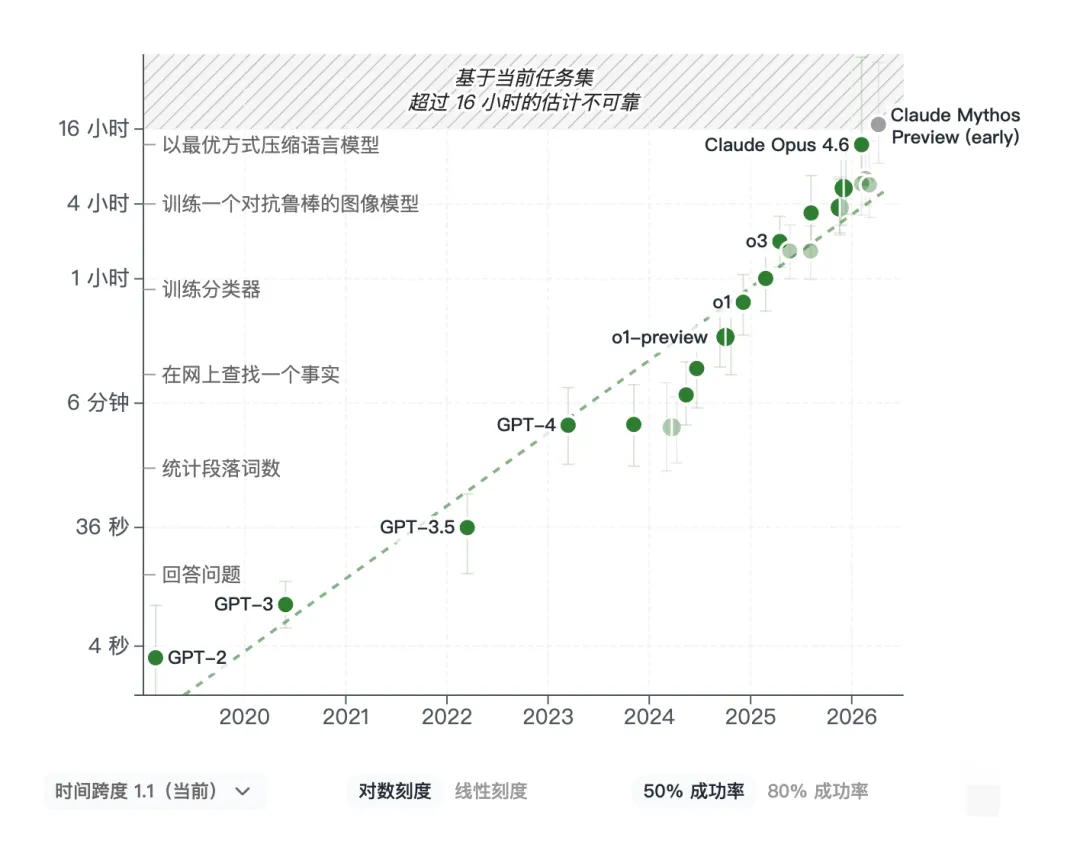
38 hours of continuous autonomous operation is already a reality. ARC-AGI-3 scores are already a reality.
We may not have arrived at the ASI, but we have entered the super-high acceleration phase of the ASI.
It's time for the ASI rush.
It's like the horizon of a black hole. 11 years ago, we stood at the edge of the horizon and remembered what we saw.
Looking back today, we've come to the point where the map doesn't work. Back and forth, old graphs, old lists, old update cycles are not enough.
Eleven years ago, when we lit the first candle, the ASI was still a distant word. It was enough to remember what we saw.
In this era, the media had to have a set of observational tools to talk about recording.
The model's coordinates are scattered in dozens of locations. Running at LMArena, Vals.ai, MathArena, SWE-bench, prices on home pricing pages and OpenRouter, communities around the world.
The same list, single agent and multi agent parallel divisions are several points apart, and the manufacturer publishes the draft only the one that picks up the high.
The result is two-fold: he checks the news with anxiety every day, and the more he checks it, the more he checks it, the more he checks it, the more he checks it, the more he checks it, the more he checks it, the more he checks it, the more he checks it, the more he checks it, the more he checks it, the more he checks it, the more he checks it, the more he checks it, the more he checks it, the more he checks it, the more he checks it, the more he checks it.
However, neither should be the law of 2026.
So we just let Agent do this -- keep tracking, sorting, calibrating changes from different data sources, not sleeping, not leaking.
You don't browse the entire web by yourself, and you won't miss the important coordinate changes in the ASI.
We decided to do an ASI coordinate system.So we decided to build a new ASI observation system.
It's not a six-monthly updated list. It's not a post that stops after publication. It's a coordinate map that changes every day.
It is calledThe new ASI coordinate system。
Twelve independent data sources, 29 secondary indicators, and seven dimensions of intelligence, reasoning, knowledge, coding, agents, economics, and efficiency, combined into a total score of 0 to 100.
Twelve lists can only be converted to the same scale. Multi-source cross-validation, any single data source in the entire system not exceeding 15%, is not mentioned in any list.
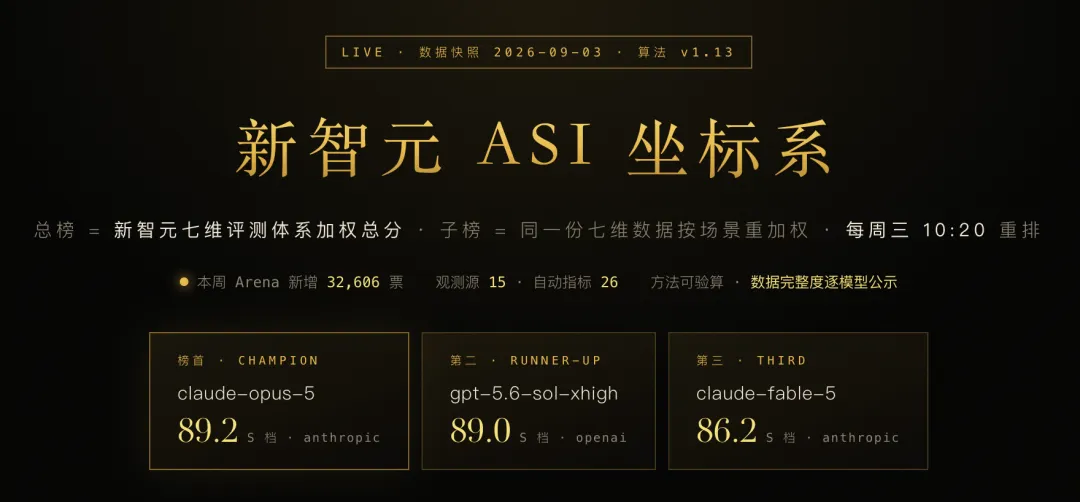
One of them is the core module.ASI Today's boardThe answer is: What has changed in the global model coordinates today?
Who's up, who's down, what's new, what's new, what's new, what's new, what's new, what's new, what's new, what's new, what's new, what's new.
The focus is on "Today", and it is constantly updated.
Why the GPT-6 AstraCan you get an 89.1?GPT-6 Astra was just announced today, and the developer documentation of OpenAI has just been uploaded, it has entered our tables, it has been classified, it ranks first.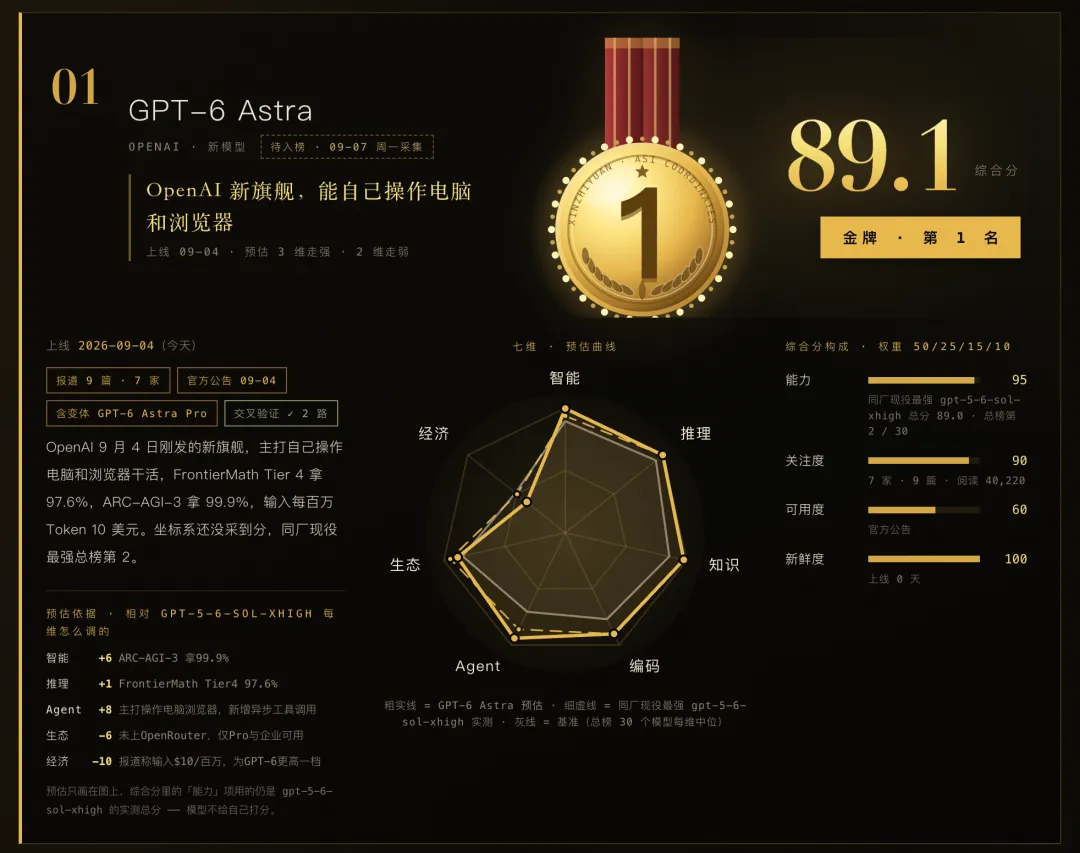 The first is the OpenRouter model catalogue, which shows the timing, price, and length of the subtitles. The second is the LMArena weekly chart, which shows the week the model first appeared. The third is our own model library, which has a release date for it.
- GPT-6 Astra 89.1 point one;
- Claude Fable 5.1 84.9 second;
- Gemini 3.8 Flash 81.5 third;
- Muse Spark 1.3 78.9 The fourth.
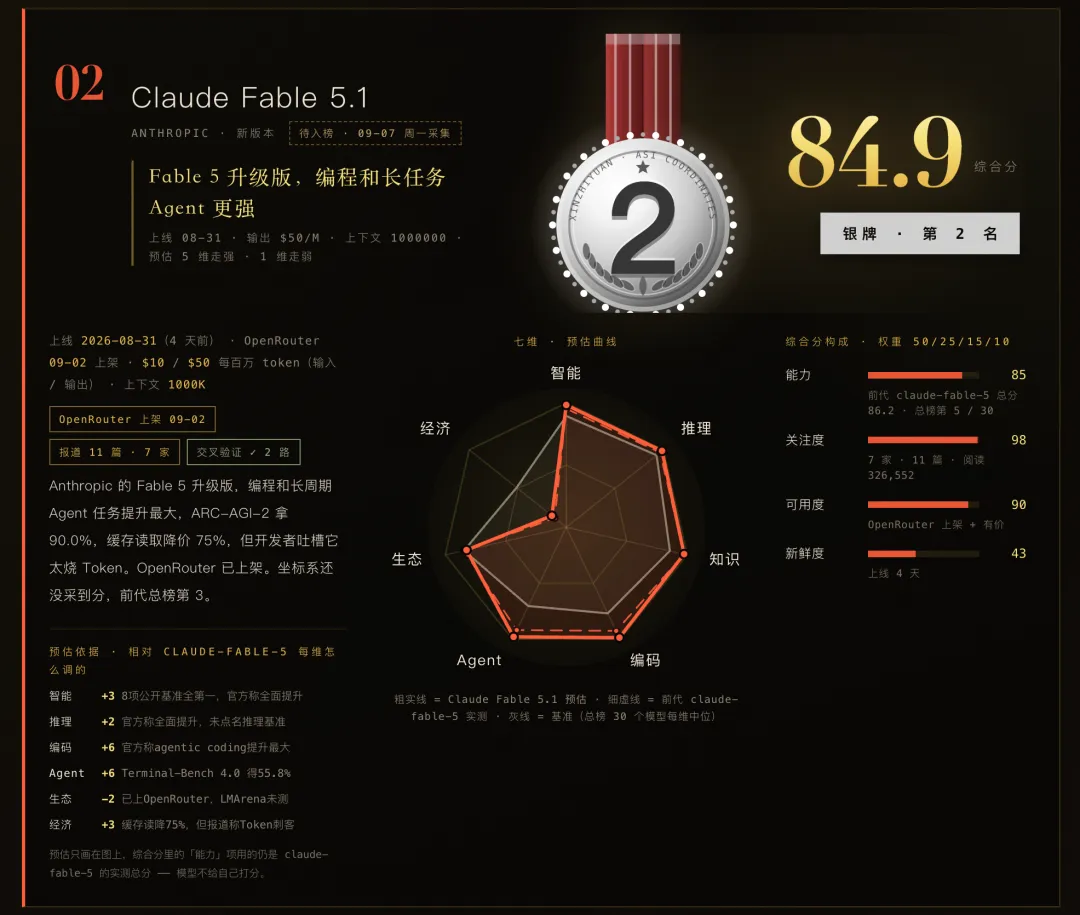
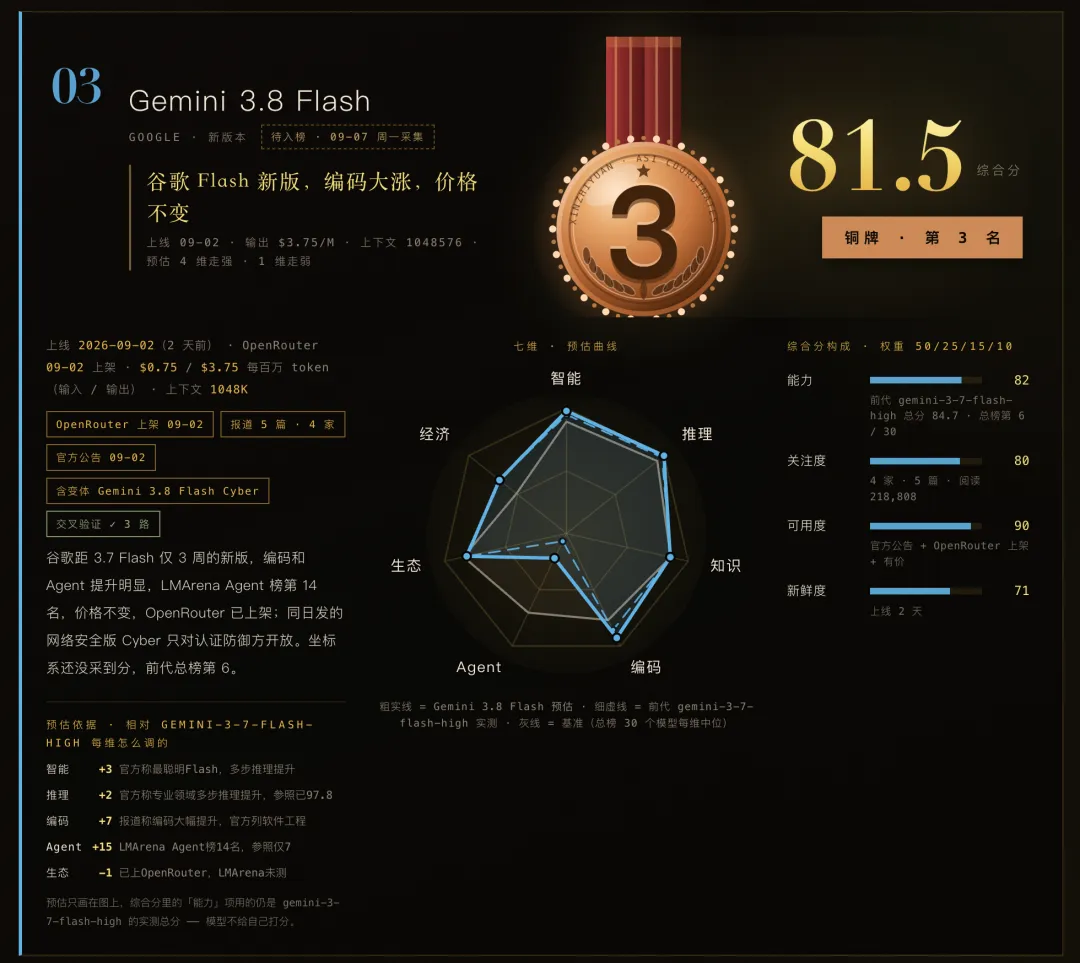
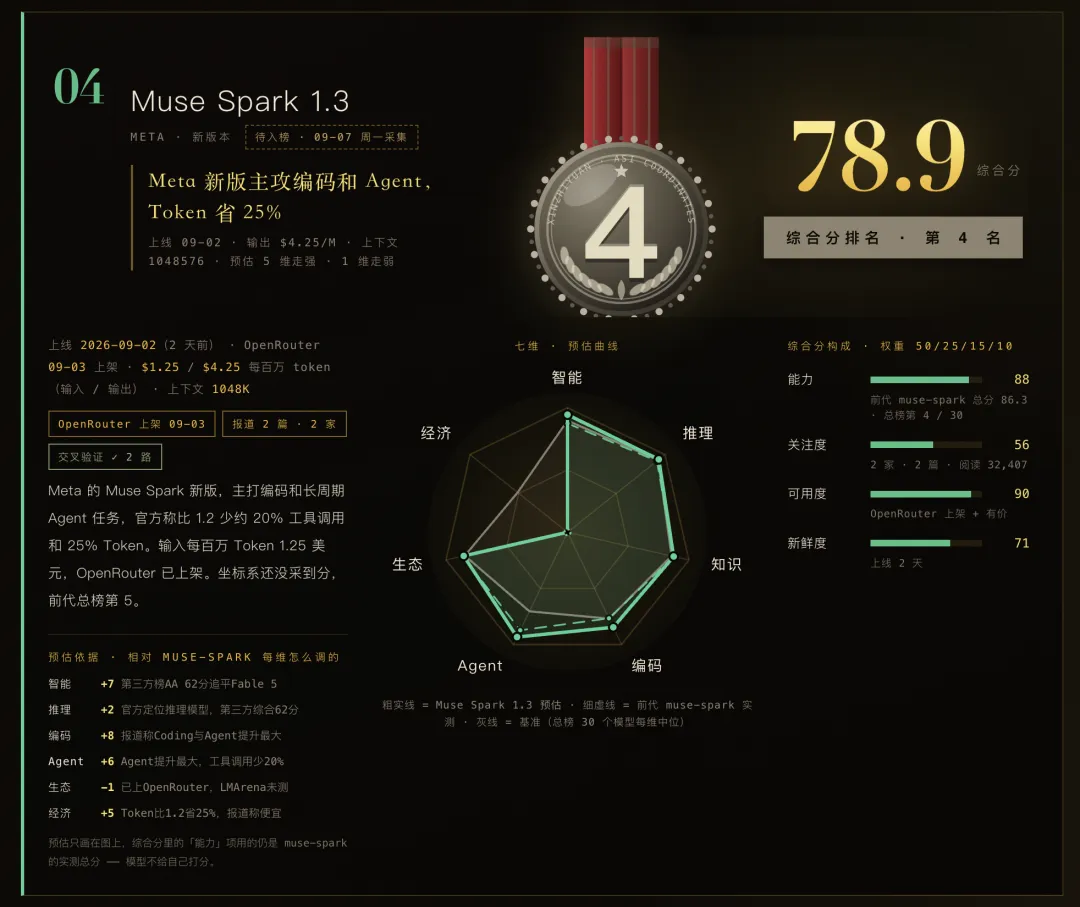
How did the GPT-6 Astra score 89.1?
There are four areas of focus here:It's the ability, the focus, the availability, the freshness.
Of these, capacity was the largest contributing 47.5 per cent.
In the past, it was the publishing of models, the editing of the news, the third-party evaluation, the evaluation of the hot spots. It is now an official announcement that in the morning, the machines themselves gathered the evidence, mapped it, and sent it to the official website.Other topics, includingSeconds to ASIThe answer is: What just happened?
New models are released, versions are updated, price changes, key laboratory movements. Robots are crawling every second, humans are editing decisions in a minute.
The ASI explosion pointThe answer is: What is the global AI community arguing about today? No matter who's loudest, no matter what's hottest, sync every hour.
There are three modules, three time scales.
ASI's Apocalypse is also featuring deep daily and Top 10 hot texts, videos and live broadcasts.
On 7 September, seeOn September 7, the 11th anniversary of the founding of the ASI coordinate system officially came online.
There's something worth waiting for, and we want you to know it first.
So this commentary area is also the demand gateway to the system before it goes online.
Before the official opening of the ASI website, we want to know one thing:
In the face of a rapidly evolving model, what do you most want to see every day - the latest runs, price changes, improvements in model capabilities, or a real boom in the community?
Welcome to the message to tell us.
This time, we're not going back to the moon.AIAs of today, we are tracking ASI per second.