It's the first time in the history of the world.
When we're amazed that big-language models can write poetry and program, scientists are faced with a trickier question: How do we make AI like a real researcher to solve scientific puzzles that require months or even years of thought and are full of unknowns?
The traditional approach is to give AI a predetermined "brain structure" (or fixed architecture) and then let it handle a variety of tasks. It's like having a mathematician, physicist and engineer share the same brain, although omnipotent, but not always "well enough" when dealing with specific complex problems.
Recently, the Eureka architecture, proposed by a team of academics from universities across the country and abroad, including Guangdong Industrial University, Hunan University, Shanghai University of Transportation, and Duke University, provides a disruptive solution. It no longer uses fixed brains, but gives AI the ability to "grow" the most appropriate specialized "brains" in the process of solving tasks, according to the needs of the task dynamically.
Link to the paper:https://arxiv.org/abs/2608.19047
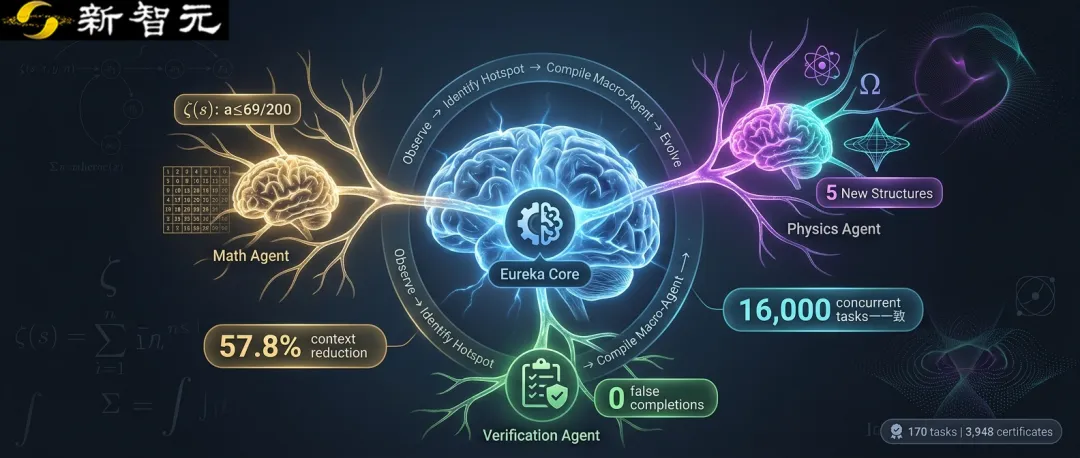
In a rigorous system test, Eureka delivered an almost perfect answer: completing all 170 complex recurring cycle missions, generating 3,948 verifiable "certificates of qualification", and throughout the process,There is no false "self-confirmation" or false "task accomplishment".。
More importantly, Eureka has shown remarkable adaptability in the face of two very different scientific peaks.
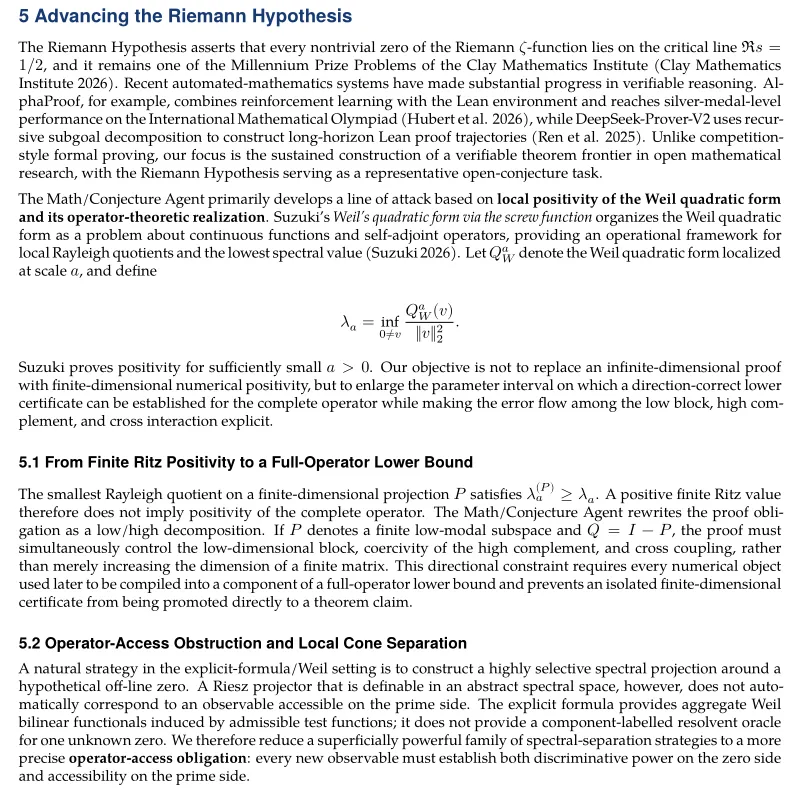
Challenge the Holy Grail of Mathematics: Getting closer to Liman Guessing the New FrontierWhile exploring the famous Riemann hypothesis, Eureka automatically constructed a "mathematical/guessing intelligence body" that did not directly prove the difficulty of this century, but it paved the way for an important proof path.Local Weil secondary positivityIn addition to the above, the scope of application of the key certificates will be extended from the previous one.aThis new boundary has already touched the first threshold of the theory. 99.55%While distance is ultimately proven to be a distance, it is a solid, verifiable breakthrough on this route.
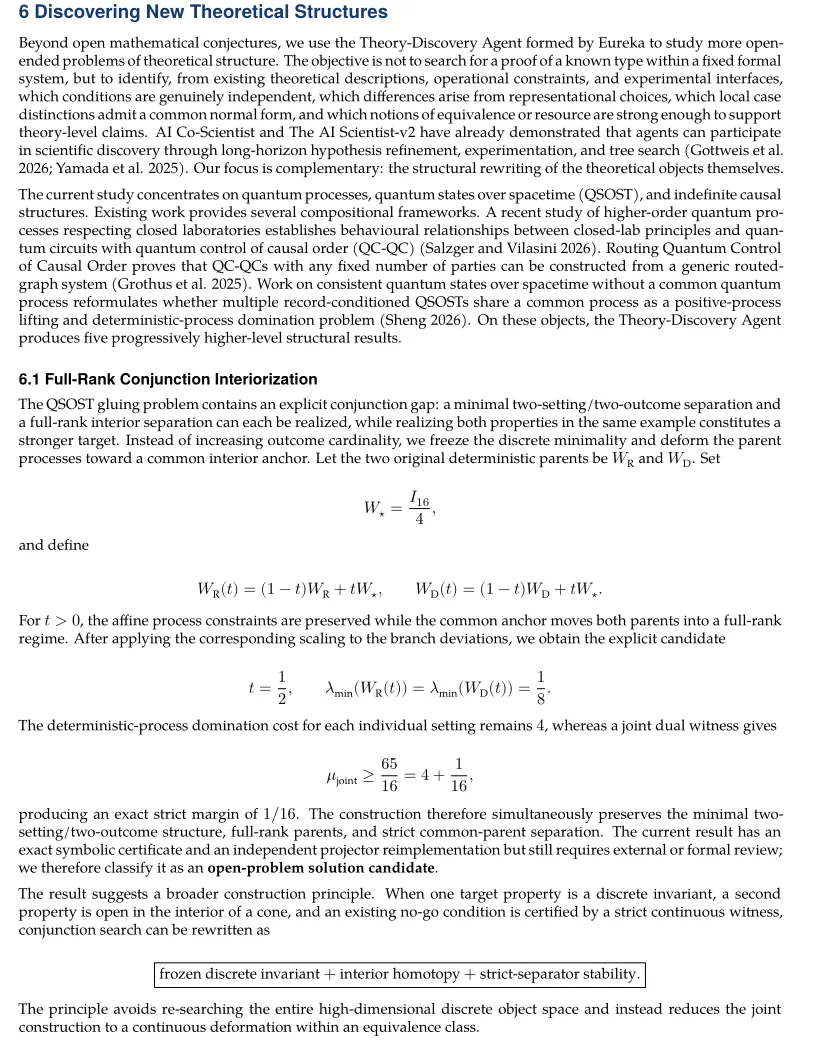
Reconstruction of physics: five new structures discoveredIn exploring more open theoretical problems such as quantum processes and the theory of time and space, Eureka "grows" out of a "theoretical discovery of intelligent agents". It, like a keen theoretical physicist, directly "reconstructs" the theory itself, producing five structural discoveries with progressive relationships. For example, it discovers subtle differences between different forms of theoretical equivalence and rigorously demonstrates this."The same behavior" is not the same as "the same nature".It provides a more rigorous standard for comparative theories for physicists.
Background of researchWhy doesn't the fixed "brain" work?
Currently, the most advanced AI systems, whether single-brain or multi-brain collaboration, whose "brain structures" (including memory, tools, validation methods, and internal collaboration processes) are usually pre-designed.
This is highly efficient when solving a single type of problem. But the scientific finding is a highly uncertain process. A research hypothesis may take weeks to validate and a new mathematical proof may overturn previous planning.Long cycles, high uncertainty, and structural differencesA fixed brain is unable to perform its task.
The architectural mismatch:An architecture that excels at extensive search assumptions may be inefficient when performing rigorous mathematical proofs due to the high cost of state synchronization.
Plans failed:At the beginning of the mission, future steps are full of unknowns. Perfect long-term planning in advance is not only a waste of computing power, but can easily become worthless due to some new discovery in the middle.
Research methodsA sub-architecture that allows AI to "self-evolve".
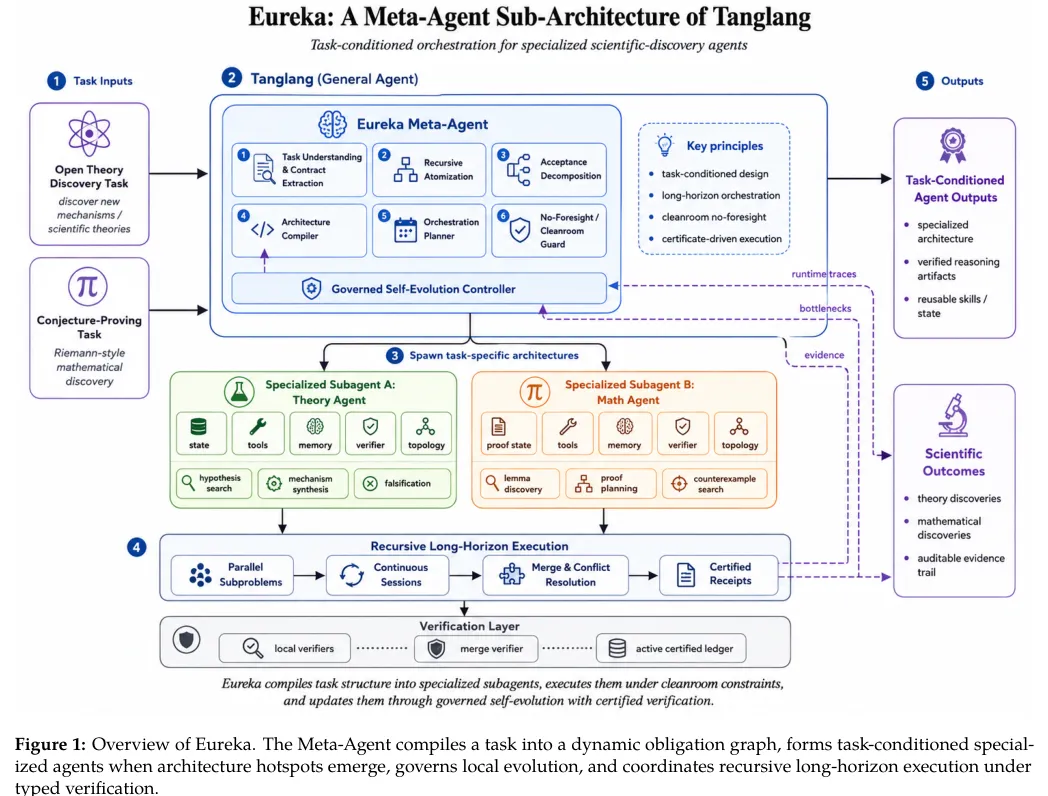
Eureka's core idea is to"Mission Execution"and"Brain shaping".It is no longer just a "worker" who performs a task, but also a "master architect" who can "add floors, add equipment" according to the task blueprint.
Its workflow can be understood simply as:
Dynamic compilation tasks:After receiving a complex task, Eureka does not immediately attempt to resolve all the details. It first dismantles the task into a dynamic "obligation chart", planning only certain parts of the current information that can be identified, while remaining unknown. This avoids the waste of resources caused by premature planning.
Identify "hot spots" and "architectural upgrades":During execution, when Eureka discovers that a part of a task (such as a complex sub-problem) requires repeated use of the same state, tools, or close collaboration, it identifies a "structural hotspot".It's called "Architectural Improvement".。
A special "macro agent" was created:"Architectural Improvement" is not simply a hint to a longer term.I'm trying to create a whole new, dedicated "macro agent".It has its own "memory", "toolbox", "verification standard" and internal workflow. It is like an independent small expert, able to handle this part of the task efficiently and autonomously, while the main system only has to wait for it to give the final verifiable results.
It's the first time I've seen this.When a macro agent encounters the same type of bottleneck over and over again at work, Eureka, like a cautious manager, first evaluates whether the "reform" is worth more than the cost. It only upgrades the macro agent's internal structure when the benefits are determined to be greater than the cost.
Experimental results and application prospects
Eureka's ability to generate dynamic architecture has led to visual effects.
Extreme efficiency improvements:By separating semantic planning from deterministic computing, Eureka reduces the above-context burden on the AI core work area.57.8%And it was avoided.65.38%It's just a matter of repeating it.
Safe and reliableand distributed:In concurrent tests involving 16,000 missions, Eureka ensured that all results performed in parallel were fully consistent with the results executed in sequence, eliminating data conflicts and errors.
A smarter self-evolution:Compared to other "barbaric" or "passive" evolutionary strategies, Eureka's "three-minded and backward" controlled evolutionary strategy achieved the lowest operating costs and highest mission success rates.
The emergence of Eureka paves the way for AI to be applied to more areas of high-difficulty science.
Accelerated mathematical research:It can not only help mathematicians explore proof paths, but, like a mathematical assistant, validate complex logical chains and even find new structural directions in open problems.
Theoretical physics:For abstract fields such as string theory and quantum gravity, Eureka was able, as a theoretical reconstructor, to help physicists reason, unify, and refine complex theoretical systems to discover deep connections between different branches of theory.
Resolving over-scale engineering problems:In areas such as chip design, drug development, and long-term, multi-team collaboration, Eureka's "task-architecture" evolves to create a smarter, more adaptable project management and execution system.
This study by the ManXis team reveals a whole new dimension in the development of AI. The limits of AI's capabilities in the future may not only depend on the "brain capacity" of the model, but also on whether it can continue to shape its own "brain" dynamically based on the cognitive structure of the task. Eureka is an exciting milestone on this path.