It's the first time in the history of the world.
It's too crowded.
In the last three days of September, five flagship models have been released!
Anthropic's Fable 5.1 and Mythos 5.1, Google's Gemini 3.8 Flash and Cyber, and Meta's Muse Spark 1.3...RSI, for sure, are here.
Just last night, Google's Gemini 3.8 Flash had just become the lightweight champion, and Meta came to the palace.
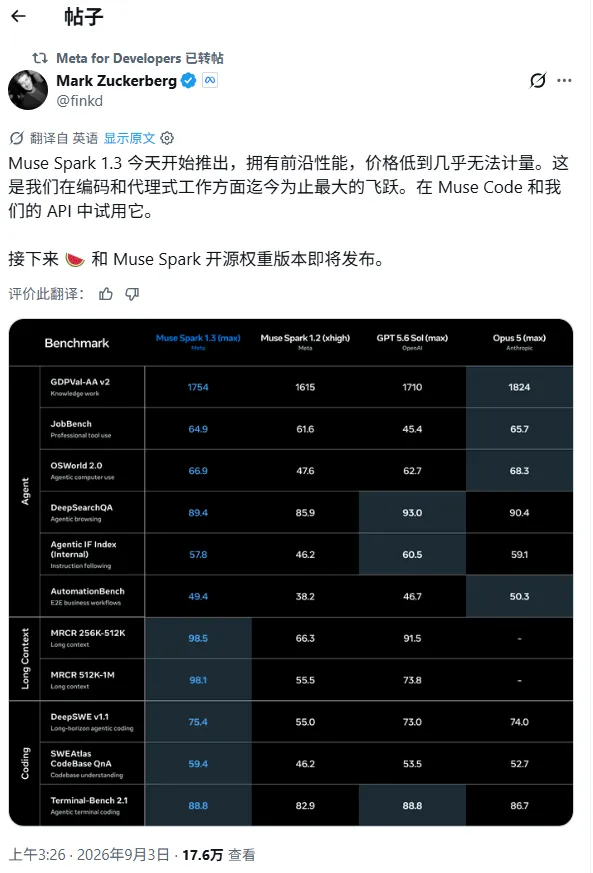
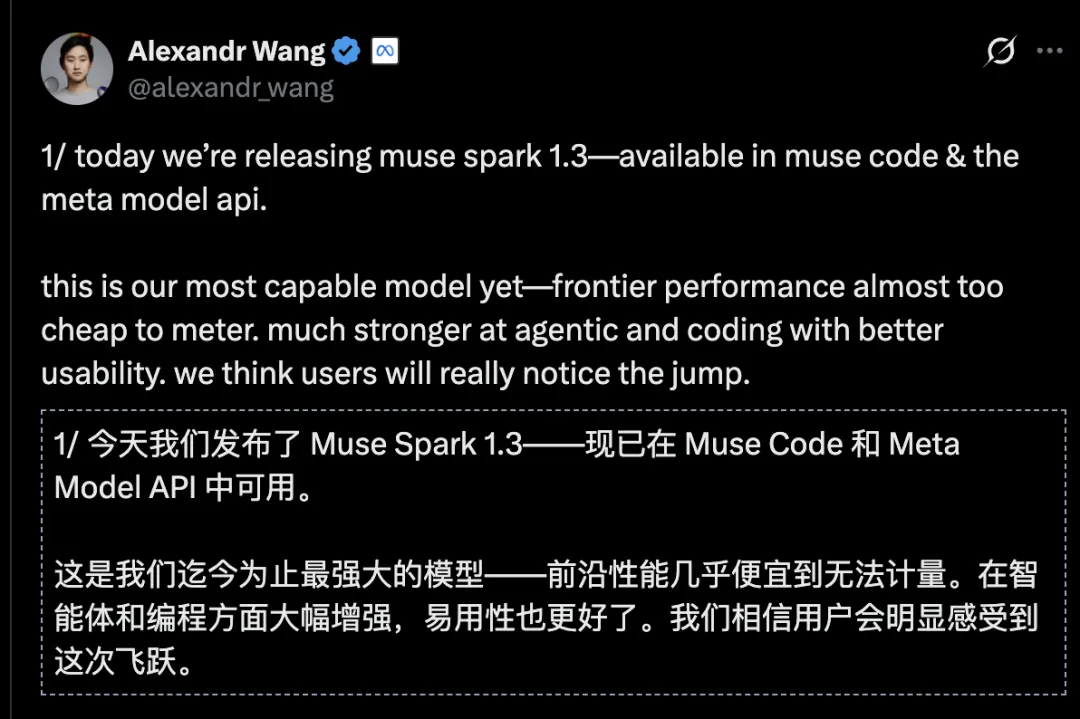
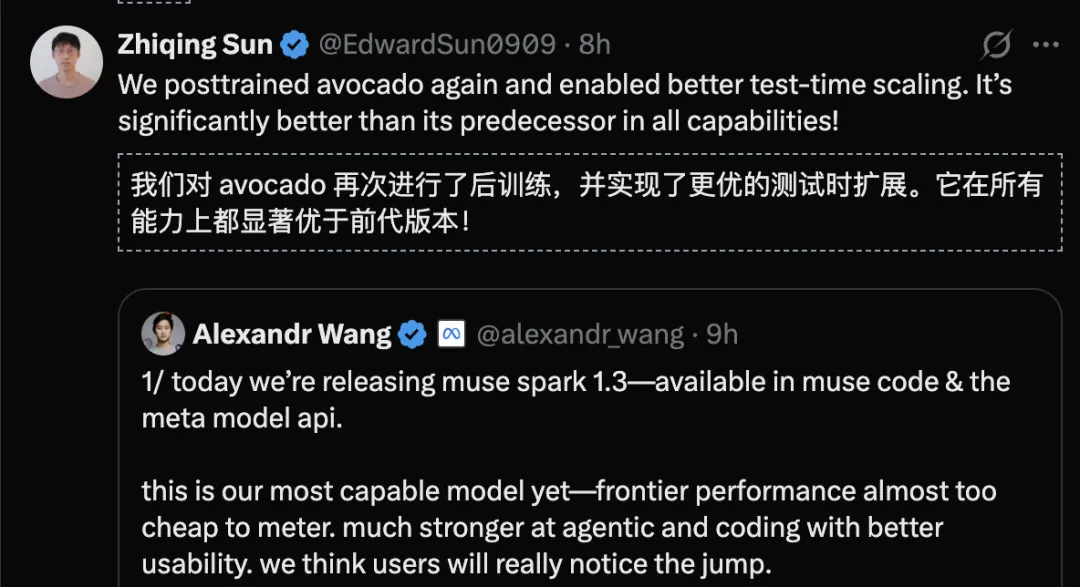
Mouse Spark 1.3 was officially unveiled today, delivering an almost inexpensive to unnecessary experience alongside its previous performance. This is the biggest leap forward we've made in programming and working with smart objects to date!
Alexander Wang, the head of Meta's superintelligence lab, has also released three more X-rays, revealing the central killer of the "King Blast".
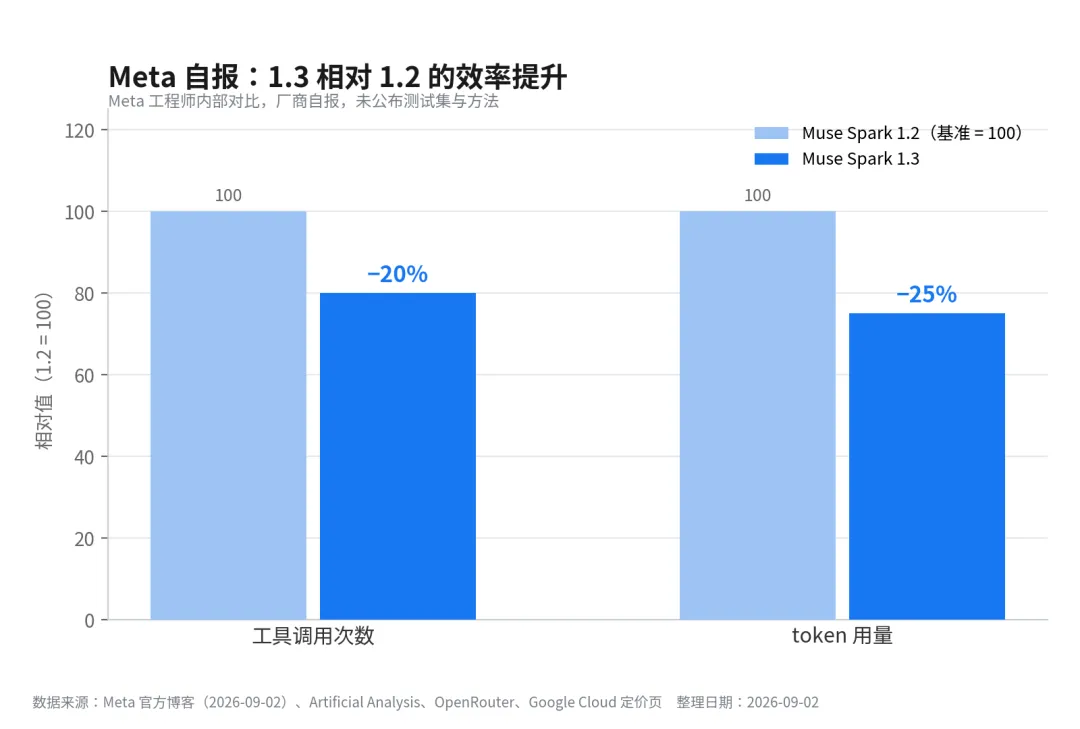
He said that when compared to Muse Spark 1.2, Muse Spark 1.3 reduced inefficient turnarounds, reduced tool calls by ~20%, reduced token consumption by ~25%, and improved demand for long-cycle tasks.
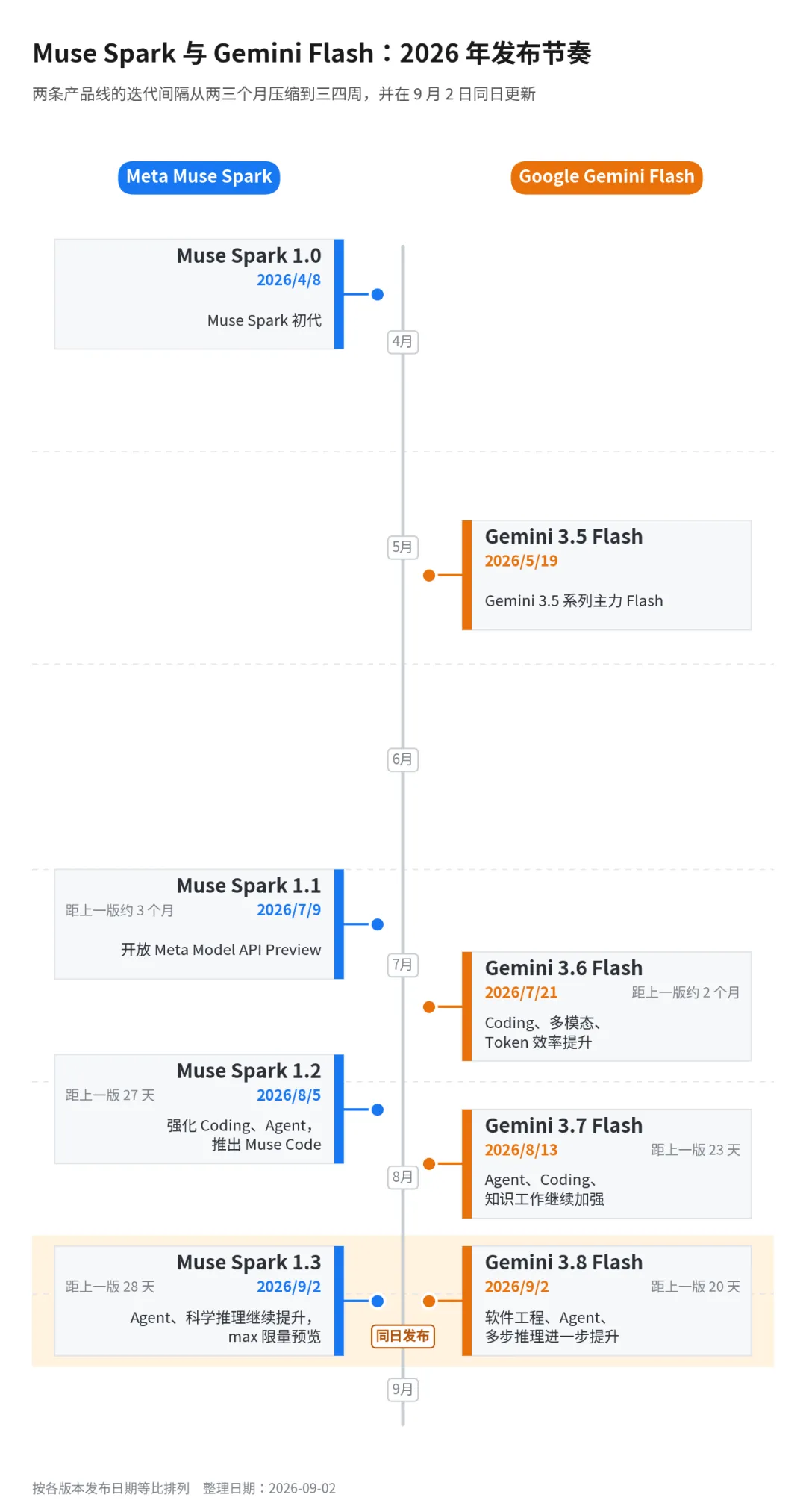
The release of Muse Spark 1.3, the Gemini 3.8 Flash, which was released last night, was a bit embarrassing.
The score shows that this is an improvement on Muse Spark 1.3.
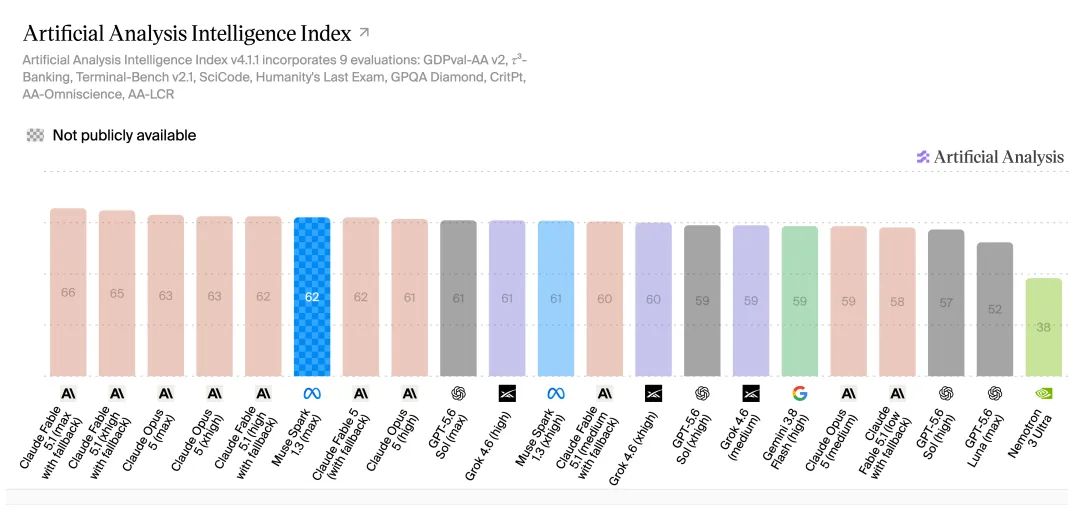
Not only has it outperformed GPT-5.6 Sol and Fable 5, but the Artificial Analysis Intelligence Index has reached 62 points in the running score, making it into the current first tier.
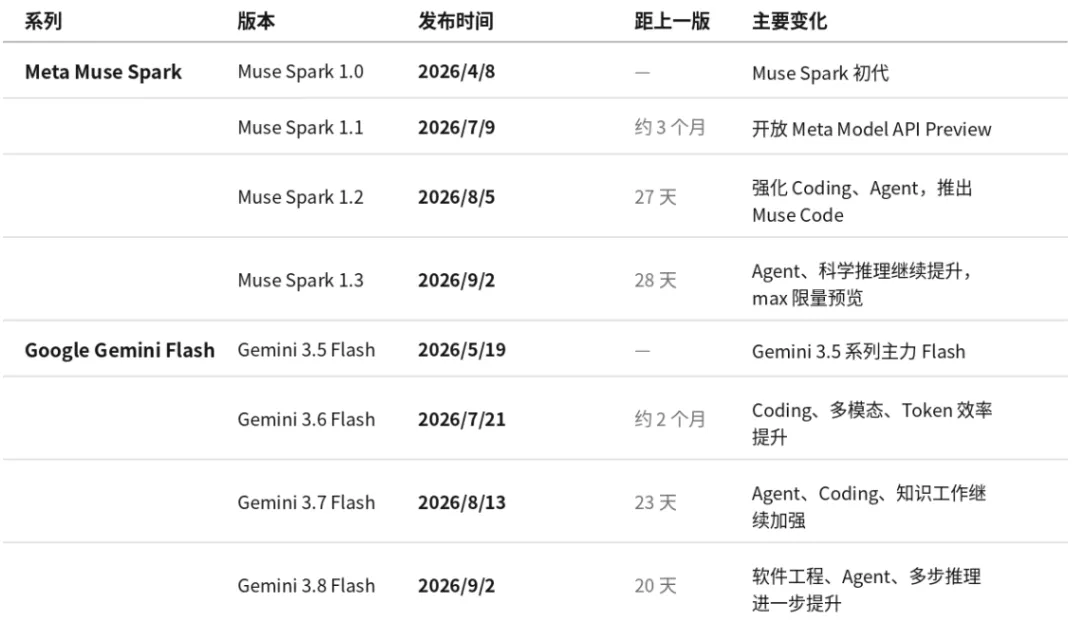
Within five months, Meta had unwittingly replaced four versions of Muse Spark.
King Alexander is mocking Google"Smoking the tail of other models".Recently, the first AI ladder is very crowded. GPT-5.6 holds the throne, Fable 5.1 later on, and Gemini 3.8 Flash is tunneling the supercar.
The appearance of Muse Spark 1.3 directly upset everyone.
In the DeepSWE v1.1 benchmark test, which best exemplifies the model's true long-range programming capabilities, Muse Spark 1.3 directly outperformed Opus 5 and GPT-5.6 Sol, taking the current highest score behind the recently released Gemini 3.8 Flash.
Muse Spark 1.3:75.4 seconds
It's the first time I've ever heard of it.
GPT-5.6 Sol: 73.0 points
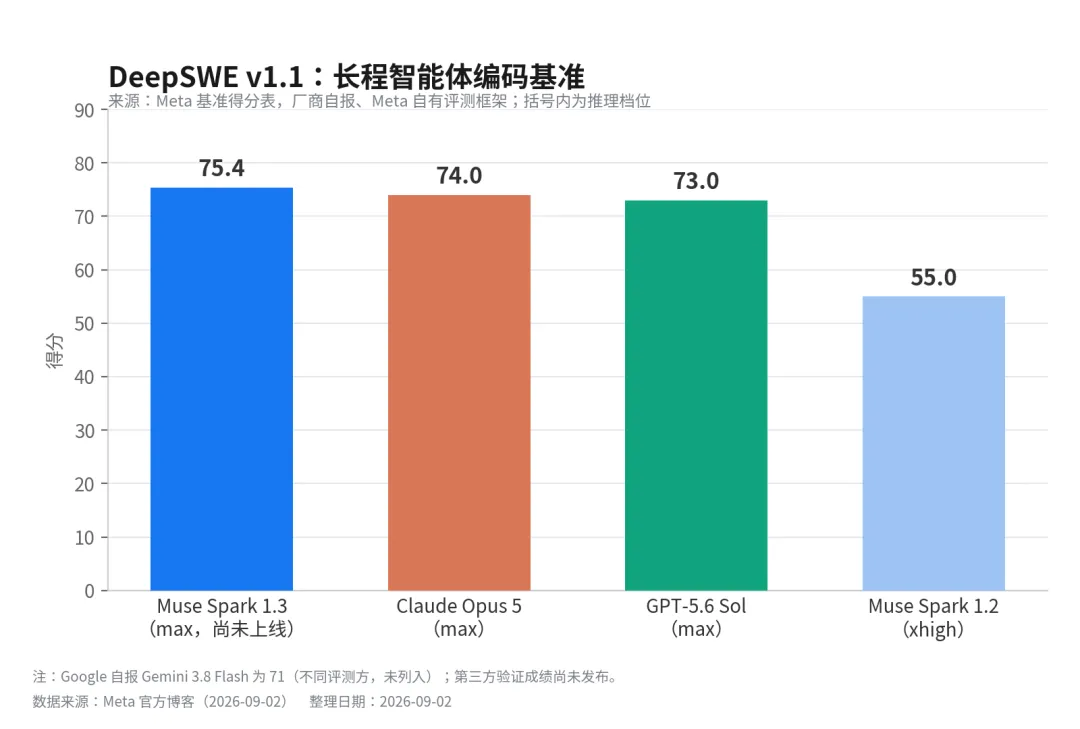
Not only that, among several other key developer indicators, Muse Spark 1.3 also demonstrates unparalleled performance.
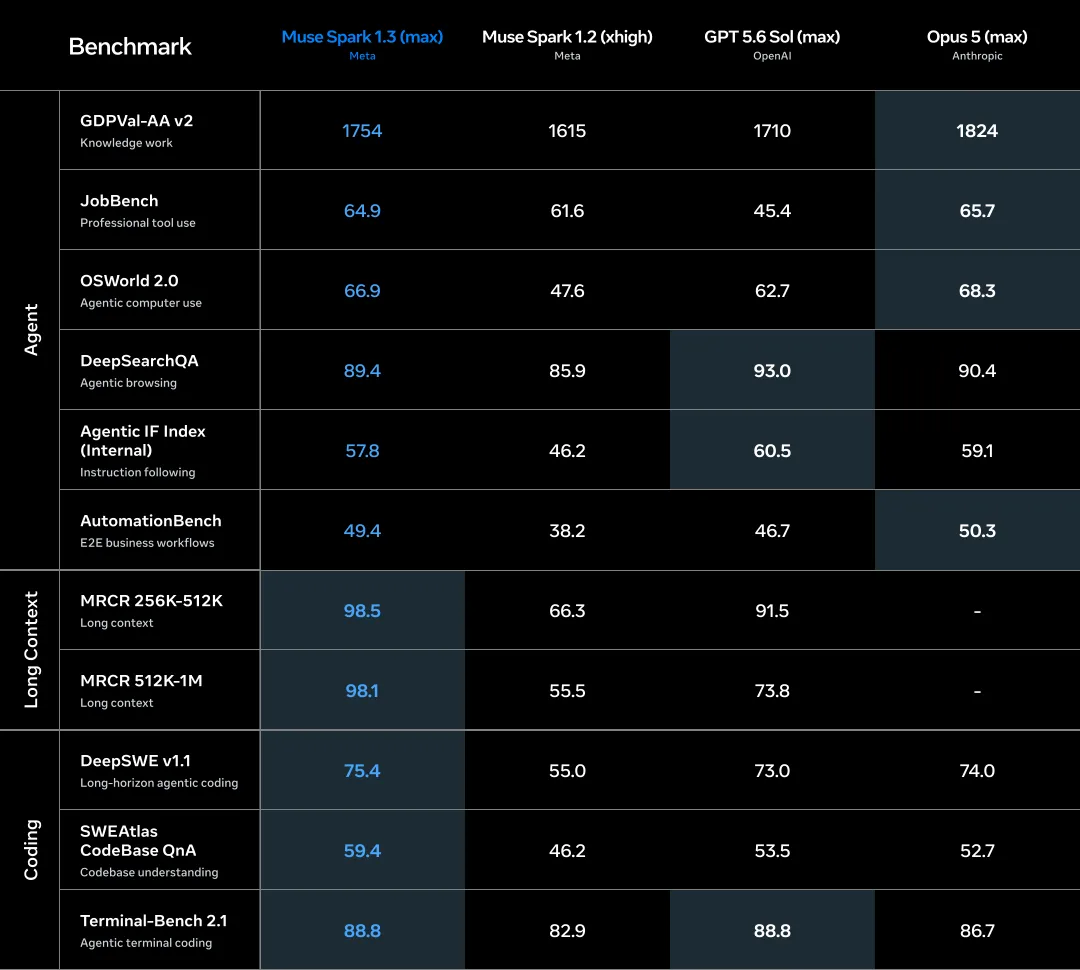
In SWEAtlas CodeBase QnA, it took 59.4 points, ahead of GPT-5.6 Sol and Opus 5.
In Terminal-Bench 2.1, it took 88.8 points.
On the MRCR 512K-1M, it got a staggering 98.1 points!
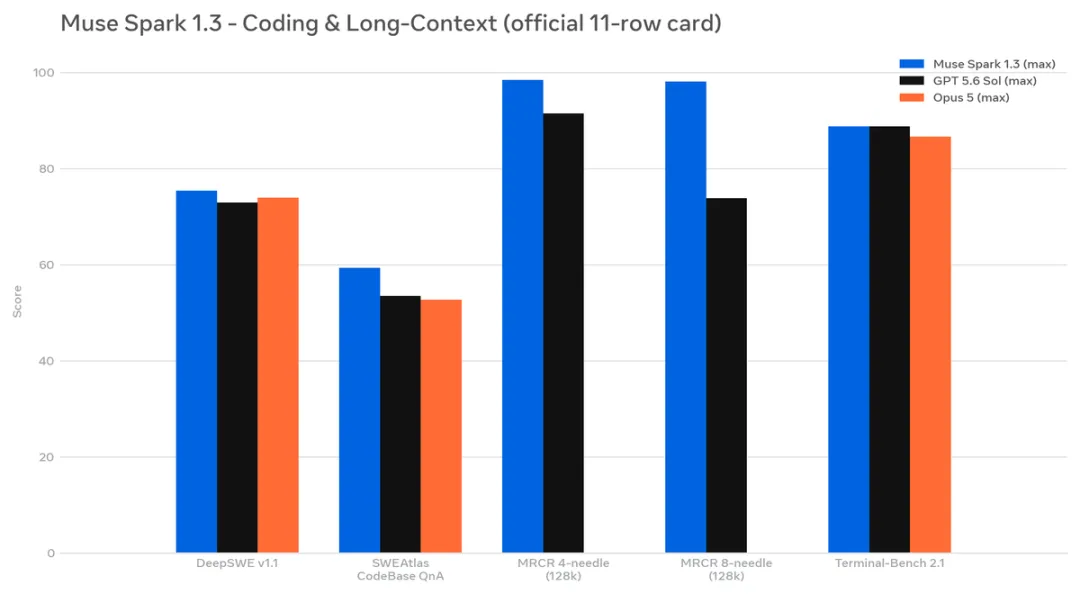
In terms of Agent capabilities, it is also basically on the cutting edge, with only a few percentage points of gap left with Opus 5 in tests such as JobBench, OSWorld and others.
In Artificial Analysis, Muse Spark 1.3 has the Gemini 3.8 Flash clearly behind it.
On the Smart Index, it scored 62 points, tied with Claude Fable 5 and ranked top.
In terms of the cost of the most concerned developers, Muse's input cost is eight times lower than Fable 5, output costs are nearly 12 times lower, and the price is low.
In the face of such brilliant results, Alexander Wang, Meta's chief AI officer, said: "On the Artificial Analysis Intelligence Index, the Gemini Monkey is not, and can only eat the tail of other models".
Google really is a dead end.

Some have joked: "Google has worked hard for four months on four Gemini Flash releases, while Meta has replaced four Muse Spark+ releases in five months.
 Less is More: $1 for a 2-hour performance monster
Running scores are tough, but in today's AI world, what really excites developers is always useful and cheap.
The reason Muse Spark 1.3 is known as the king of sex ratio is because it not only runs fast but also saves money.
In the words of Alexander Wang, Muse Spark 1.3 is "cheap to unremarkable", "front-end performance, cost is zero".

It takes a completely different approach from the previous model, "Strong Miracles, Crazy Stacking Parameters".
Specifically trained for long-cycle programming and better instruction-following capabilities, Muse Spark 1.3 reduces unnecessary interactions and simplifies output.

It's getting smarter, it's getting cleaner, it's getting less crap.
The direct consequence of this reduction is a steep drop in costs.
The following is a very shocking real-life test case.
Developers @SPAC89 used the Muse Spark 1.3 Ultra Contributor mode to compare it to Fable 5.1 xHigh.
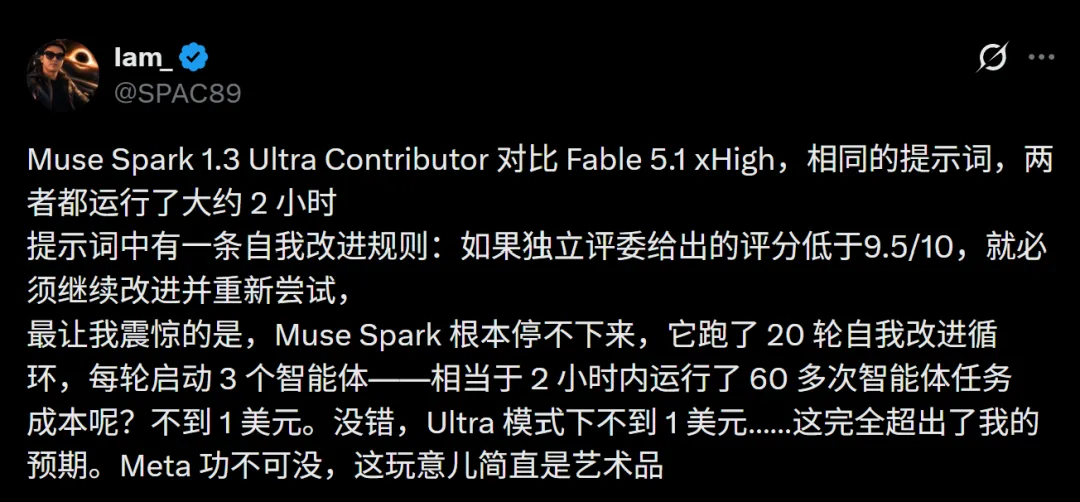
His Prompt contained a strict "rule of self-improvement": If an independent jury scores below 9.5/10, the intelligent organism must continue to improve the code and try again.
Both models ran for about two hours, and the results were amazing.
Muse Spark 1.3 is just like a tireless super worker, and it just can't stop, running 20 rounds of self-improvement cycles, with the equivalent of running more than 60 smart-body runs in two hours.
And the total cost of completing this enormous and complex long-range reasoning task is less than a dollar!

The developer exclaimed, "This is way beyond my expectations, it's just a work of art!"
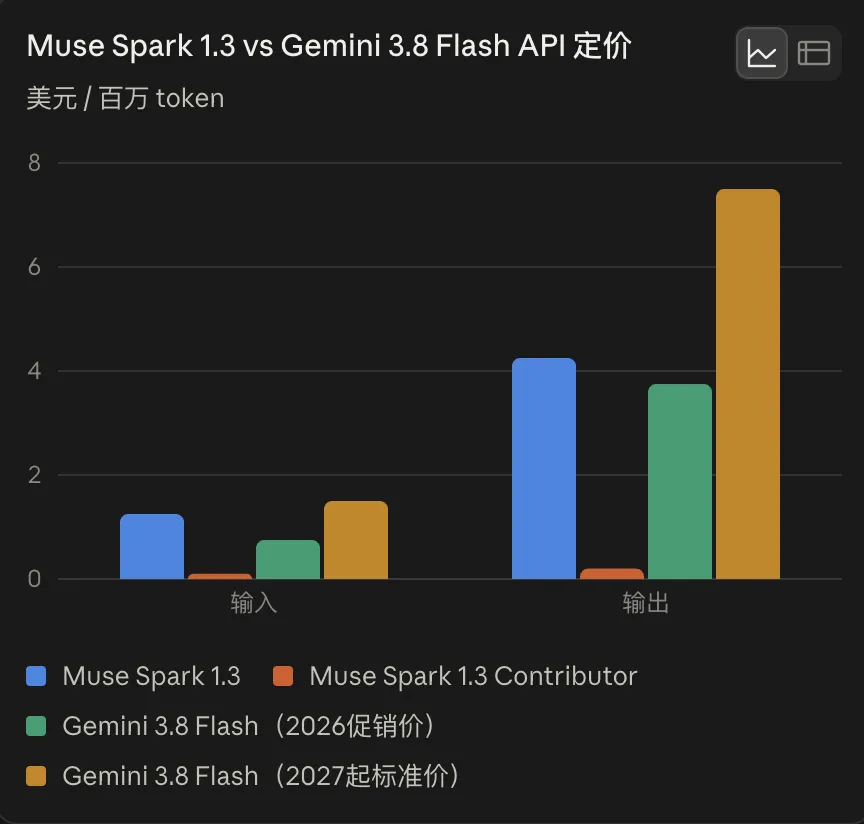
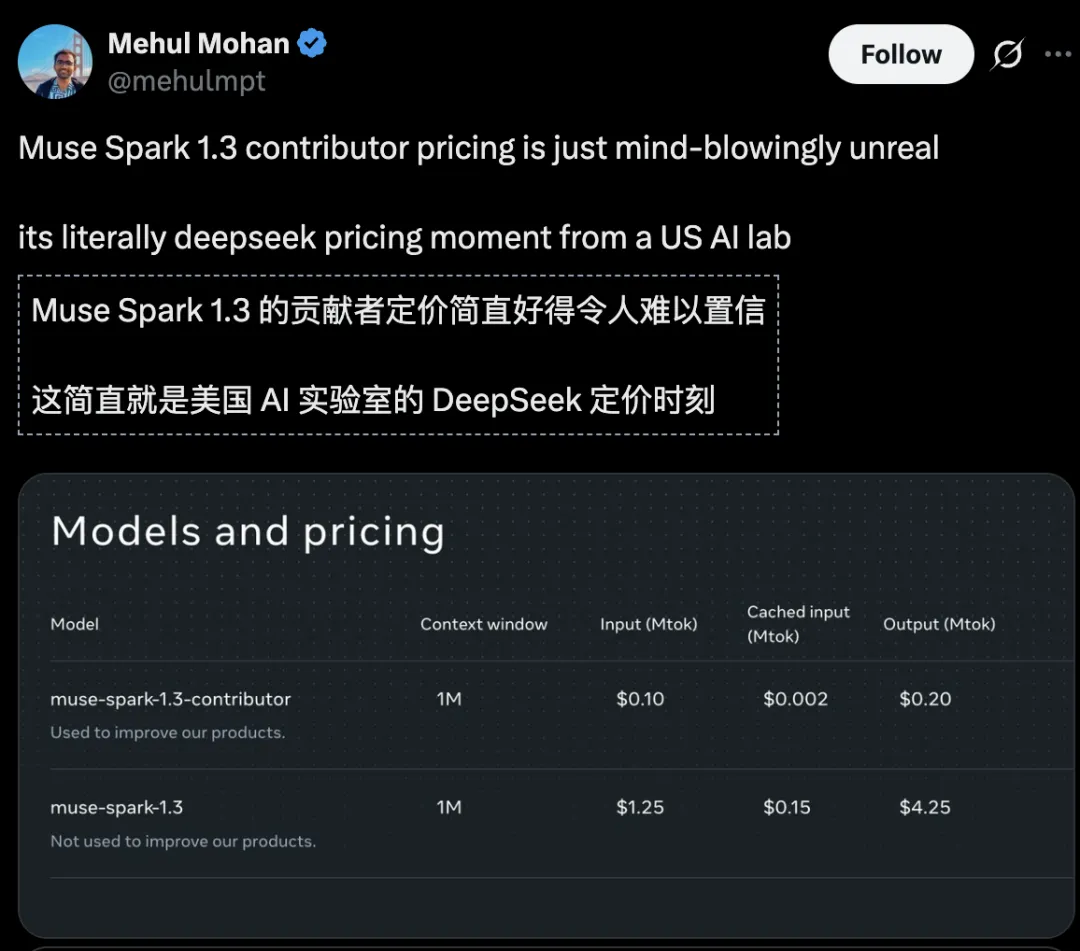
In macroeconomic pricing, Meta has shown great sincerity. The new model adds no additional pricing, maintaining a price of $1.25 per million of tokens for input and $4.25 for output.
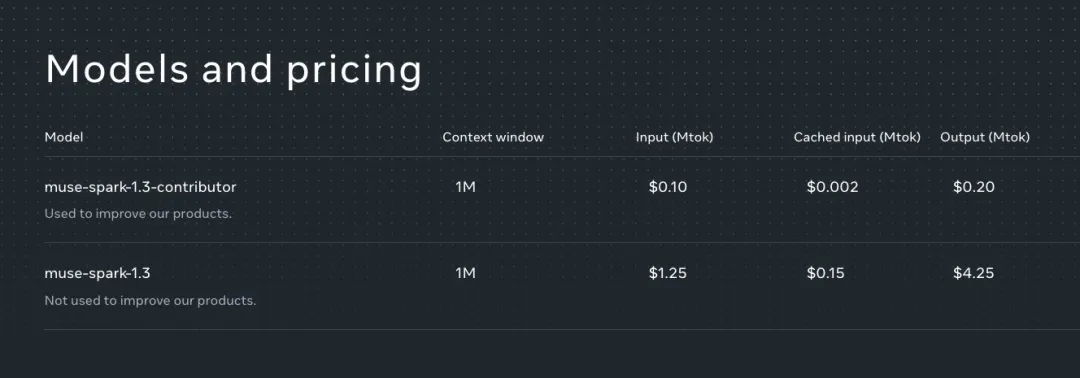
In pricing, the "muse-spark-1.3-contributor" contributor version of Muse Spark 1.3 is more of a pricing floor for foreign models.
Mehul Mohan, the founder and developer of Codedamn:
This is the "DeepSeek Pricing Moment" of the U.S. AI lab.
In Artificial Analysis' statistics, in models with the same level of intelligence (more than 59 points), the single-task cost of Muse Spark 1.3 is only $0.55, which is the absolute best solution.
For comparison, the Grok 4.6 with equivalent intelligence (61 points) costs $0.94, the GPT-5.6 Sol costs $0.95, and the Claude Opus 5 costs as much as $1.23.
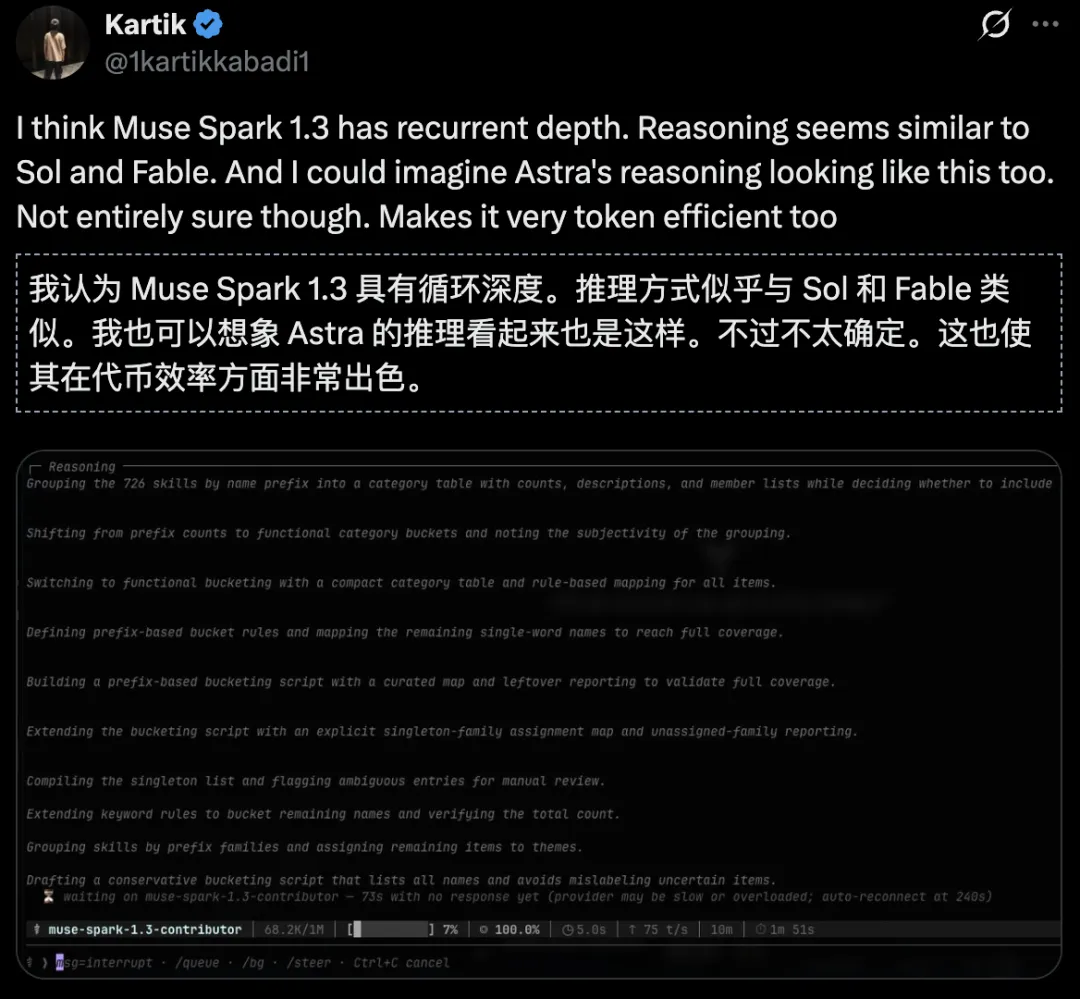
In fact, developers Kartik point out that Muse Spark 1.3 appears to have "loop depth" reasoning capabilities similar to those of Sol and Fable.
It does not generate answers in an instant, but is able to logically execute them internally, which makes its token efficiency surprisingly high.
The Muse Spark 1.3 was born in space, away from the steering wheel behind it.
In July this year, Meta released Muse Spark 1.1, which focuses on 1M hypertext and computer operations.
In less than two months, version 1.3 has pushed its long-range coding capabilities to GPT-5.6.
Such a rapid evolution is the result of Alexander Wang taking over the Meta superintelligence lab.
What is their ultimate goal, as Chao and Alexander Wang have repeatedly stressed: "smart body" and "cheap to neglect".
In other words, Meta is looking at the next ASI headline, "Smart Body Engineering".
In an interview with Axios, Alexander Wang, head of Meta AI, made it clear that all the improvements in availability are aimed at serving the massive blueprint kit mentioned many times by Zhao Zhao to build a 7×24-hour personal smartphone online.
If you want an intelligent organism to help you process emails, write code, and analyze data 24 hours a day, it has to have two conditions:
1. Extremely intelligent and stable: It needs to cling to very long dialogue threads (long threads) and be able to handle multiple workflows simultaneously.
When instructions are vague, it must know how to ask proactive questions; when it encounters obstacles, it must know how to turn to humans for help; it must know how to confirm prior to performing critical operations.
2. Extremely inexpensive: If an individual smartphone costs tens of dollars a day to run, it will always be a toy for a few people.
The emergence of Muse Spark 1.3 essentially paved the way for a 7×24-hour personal smartphone.
It's like a mature senior engineer, you give him a goal, and he can plan for himself, he can fix his mistakes, he can deliver himself.
For this reason, Northeastern University alumnus and Meta researcher Sun Ying revealed that the Meta team has re-trained on the previous model of beef and avocado to achieve better test scaling.
However, Muse Spark 1.3 has also been questioned.
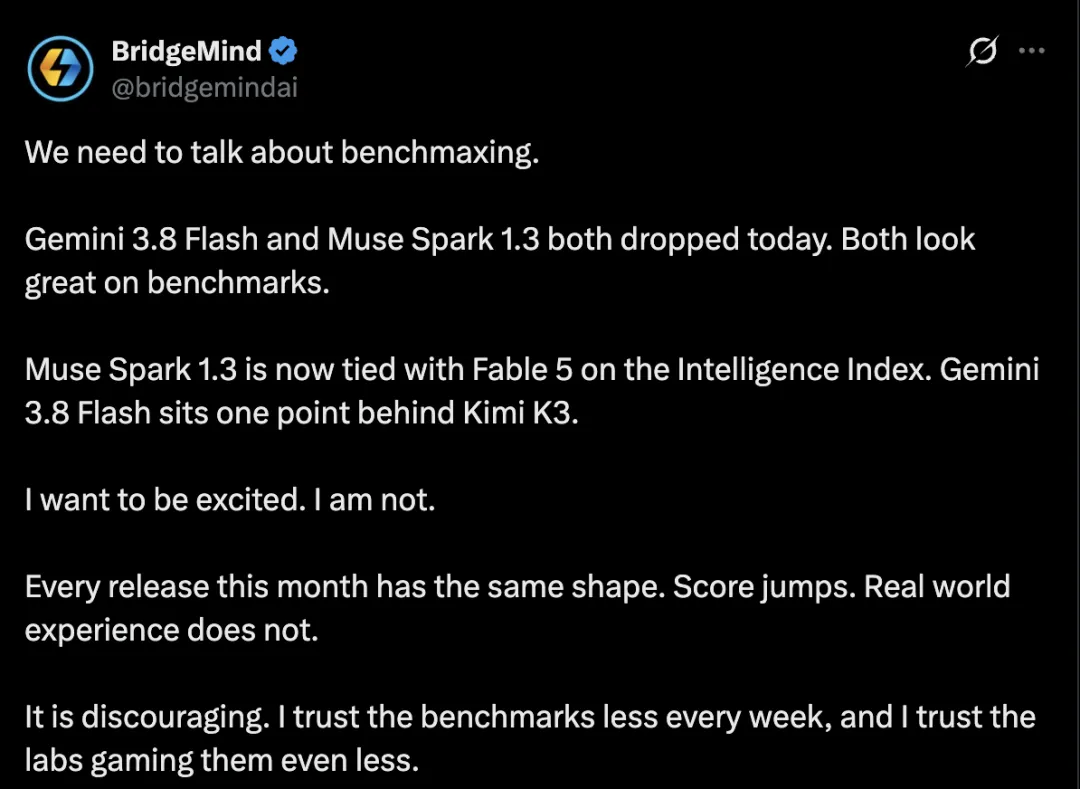
A well-known AI agency, BridgeMind, has issued a thought-provoking statement:
Gemini 3.8 Flash and Muse Spark 1.3 were released simultaneously today.
Muse Spark 1.3 is currently paralleling Fable 5 in the Smart Index...I want to be excited...but I'm not.
Because this month's AI release is a big one.The score is rising.ButThe real world experience has not progressed.
This is frustrating. My confidence in benchmarking tests is dwindling every week, and my confidence in laboratories that are playing with benchmarks is even less.
This passage accurately hits the pain points of the current big model industry.
Some netizens tested the pressures of Muse Spark 1.3 and Gemini Flash 3.8z in rear-end 3D constraints, and both models were exposed:
Muse Spark 1.4 isn't that good, while Gemini Flash 3.5 is purely printed.
Now, major laboratories have fallen into the "training to run" freak circle. A model has been released, which must be accompanied by a few radar charts and ranking shots of hang-gatherers.
DeepSWE, Tau3-Bench, GPQA, have become the targets of all the crazy "brush topics".
And the Muse Spark 1.3 also revealed the horse's feet.
In the in-depth report of Artificial Analysis, we can also see a small step backwards.
For example, in the AA-Omniscience test, both xhigh and max versions declined because its "absence rate" became so high that when it was uncertain, it was more inclined to not answer than to confuse it.
This reduces the rate of hallucinations, but also sideways indicates that its absolute knowledge reserves are not as exaggerated as raising runs.
What is the second half of the big model?Today's release of Muse Spark 1.3 and Gemini 3.8 Flash gives us the following judgments:
First, the "parameter dividend" of the baseline model is coming to a head.
The marginal utility has been increasingly low as the path to improving intelligence is simply by expanding the scale of the parameters.
In the future, whoever, like Muse Spark 1.3, can introduce logic mechanisms similar to "loop depth" in the system architecture and make extreme "reductions" in tool calls will get a real boost in experience.
Moreover, "intelligent engineering" is the winner.
The battle for the big model has shifted from "who speaks more" to "who works better".
The key obstacle to the future is not a single run, but real landing capability for long-range missions at extremely low cost.
Like Muse Spark 1.3, a model that runs 60 trial-and-error cycles for less than $1 will completely reshape the business model.