Specifically, there are at least four imaging problems in steelworks: (1) high-reflection and multiple-reflection point clouds of workpieces are missing and noisy, directly affecting screening recognition and avoidance; (2) the natural light of the skylight interferes strongly with the field arc light, causing a sharp decline in the rate of camera recognition due to insufficient light resistance to the environment; (3) the field of view and the field of view are small, making it difficult to cover large workpieces across a wide range of dimensions; and (4) complex workpieces require a mix of front and line scanned cameras, multiple software hardware and high-definition overlapping, drawing the complexity of the overall system.
To address these pain points, the technology proposed a solution to the three-dimensional solution of the one-to-one interface as early as 2024, and introduced the RVC M series of 3D cameras specifically aimed at welding scenarios. The technology integrates three imaging patterns of front-facing structural light, oscillating line scanning and fixed line scanning into a single camera, which can be flexibly switched to different welding links and on-site working conditions.
The face-to-face mode is able to quickly obtain a complete three-dimensional silicon density cloud, suitable for large-scale workpiece rough positioning, charge positioning, and other high-beat-demand scenarios.
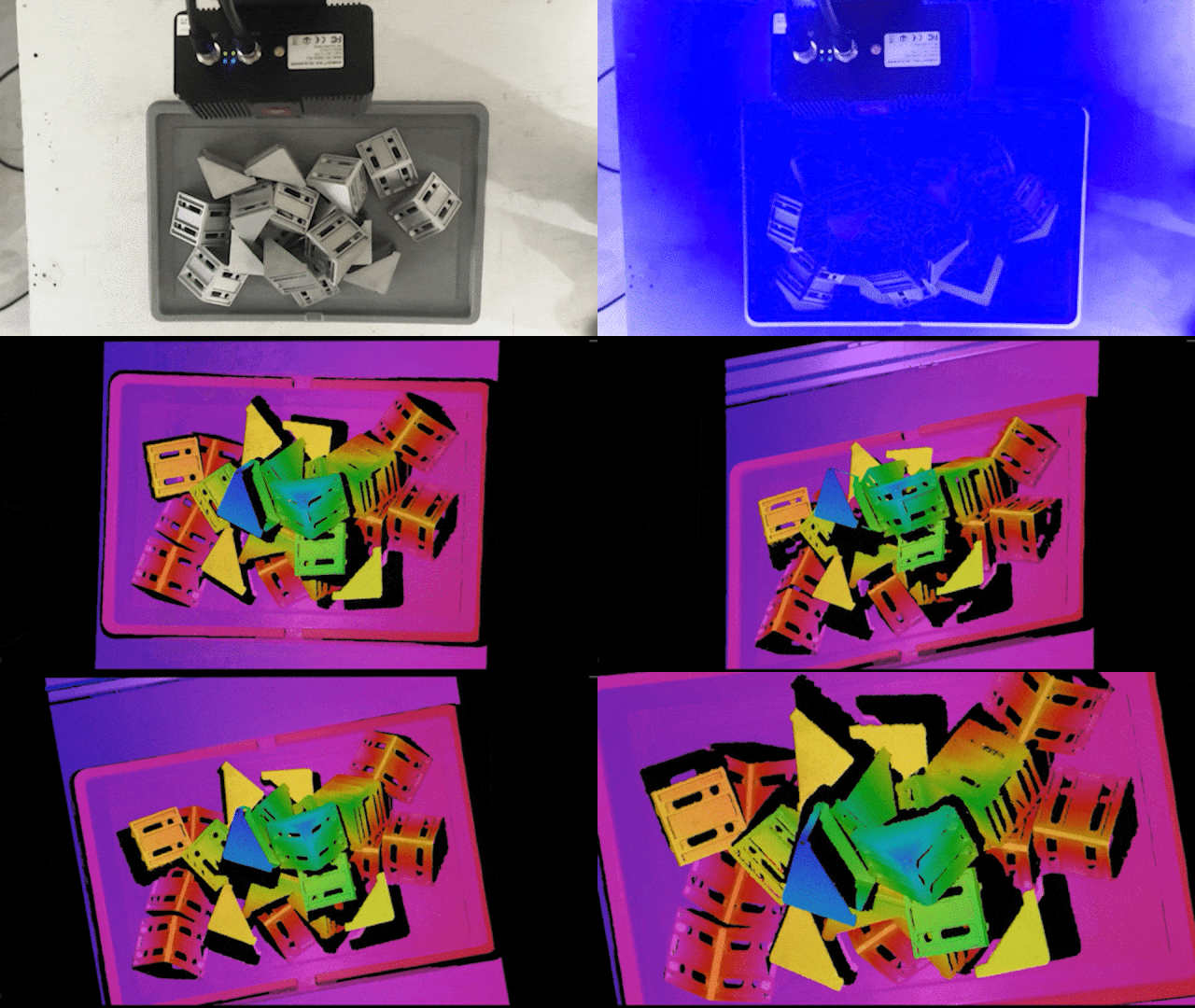
The oscillating line scanning mode has stronger resistance to ambient light, resistance to high resistance and resistance to multiple reflections, which can cope with image problems such as grinding surfaces, high resistance to metals, complex structures and outdoor bright light.

The fixed-line scan mode is capable of producing high-speed single-line point clouds for location tracking and can be combined with mechanical arm or guide-track movements to complete large-scale image collation.

Through three-mode collaboration, a single camera can cover the needs for multiple stages of vision from workpiece positioning, complex surface imaging, to location tracking and tracking, reducing the development and maintenance complexity of multiple camera configurations.
The direct value of this design is that the rough positioning, precision positioning, tracking and tracking of multiple sensors required to be completed in the same blink of an eye, reducing the overall point of failure of the intelligent welding system, while simultaneously reducing the cost of integrator options and on-site modeling.
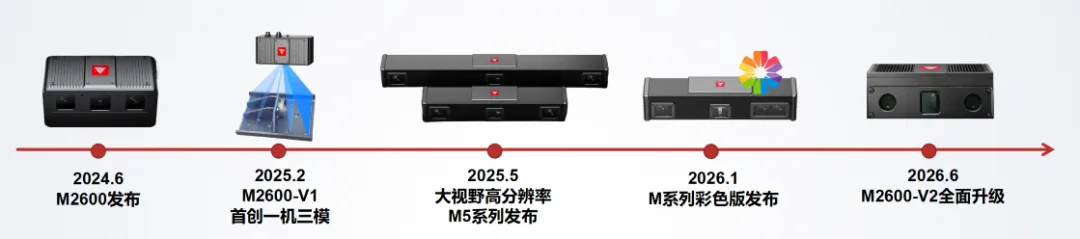
Around this technology, the RVC M series completed the spectrum in two years: the M2600 was released in June 2024, the first three models on the M2600-V1 launched in February 2025, the M5 series launched in May 2025 for high-resolution demands in high-visibility; the M series was released in color in January 2026, and the M2600-V2 was released in June 2026, with new hard-trigger capabilities as well as weight reduction.
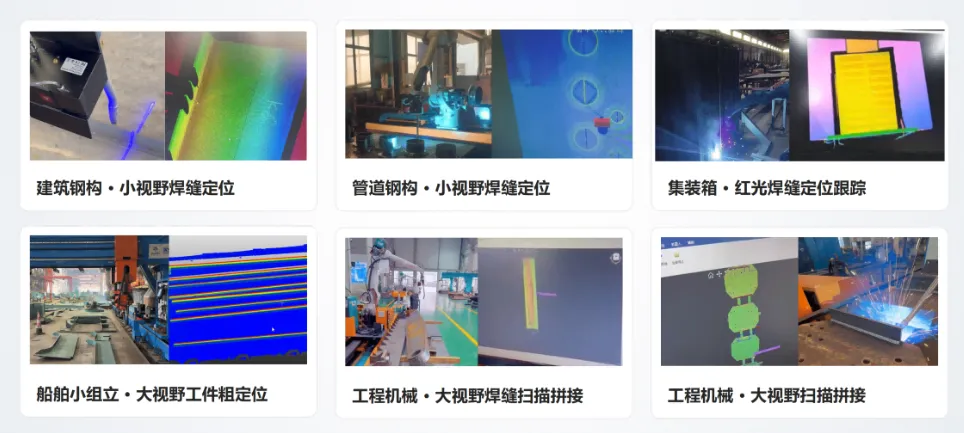
With its existing product spectrum, such as the M-series, which supports in bulk the three main types of welding workstations of single fixed, single guided, single/multi-machine doors, covering the welding of small and medium-sized workstations, long workstations and large structural parts respectively. Thanks to its stable three-dimensional imaging capabilities and flexible process adaptation, the M-series has entered the field of intelligent welding and has gained wide industry recognition.
The new challenges of collaborative linking:
It's a beautiful place to live, and a beautiful place to live.
Although these three types of workstations have solved the vast majority of the problems of standardized production lines, there are still limits to capacity. For example, large volumes in factories, workpieces that need to be deeply grounded internally, outdoor work by shipbuilders on docks and decks, and construction sites that do not have fixed working conditions on the site itself.
Faced with these scenarios, these three types of workstations either cannot enter or cannot be built. The value of a collaborative welding robot is precisely reflected in the way that it can be deployed in a mobile, flexible way, to complete welding tasks in collaboration with the welding industry in complex environments. Once the camera is moved from its fixed position to the collaborative arm, the nature of the task changes as well: the previous test was that the hammer can't see the hammer, now to answer the hammer can't be mounted, the hammer can't hold the hammer.
A major hardware constraint faced by collaborative welding is weight. In order to facilitate transport and human-machine collaboration, collaborative welding robots have both been weighted, with load capacity often concentrated at 3 to 5 kg, while the total weight of shotguns, cables and structural components has reached 1.5 to 2 kg; if 1.5 kg of 3D cameras are superimposed, the end load can easily reach 3-4 kg, directly approaching or even exceeding the load limit of the collaborative arm.
The thrust torque is more tricky than the collaborating arm load limit, the collaborating arm torque gun is usually fixed in front, the camera is also installed in front, and the focusing of the focus will cause the end torque to surge, and the positioning accuracy of the end is not guaranteed.
Based on this pain point, the answer given by this technology is the ME series and the first product to be released in the series, the RVC ME2400. This 3D camera body designed for collaborative welding measures 114×70×53mm, the positive size of a card.
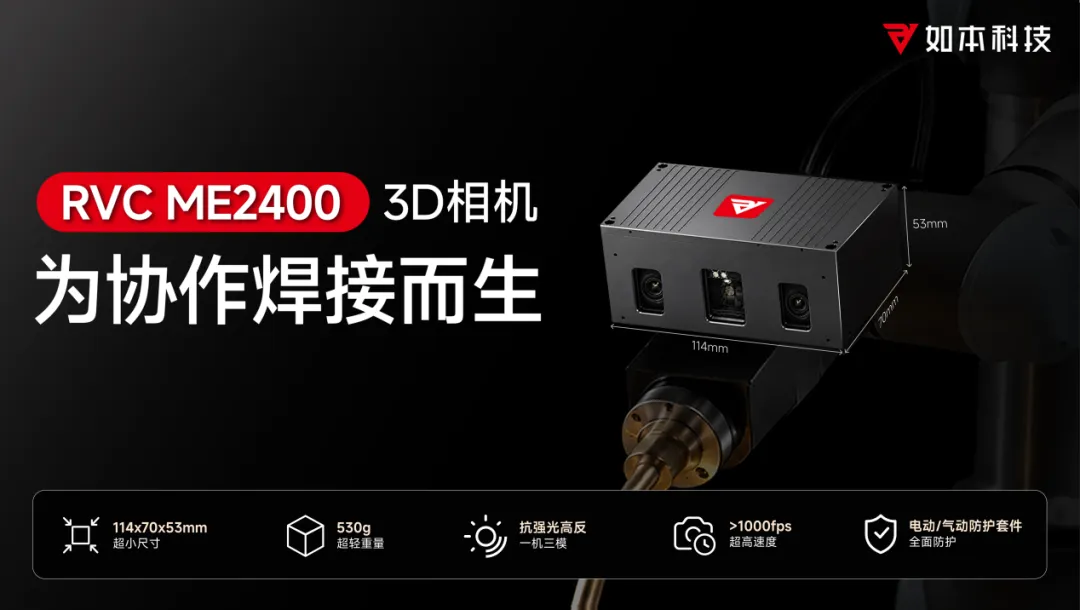
In terms of weight, the ME2400 has a body weight of 485 g, with a total weight of only 580 g, even after adding protective suits and quick replacement lenses, which is about 1 kg less than the common 3D camera on the market.
In terms of image performance, the ME2400 is a complete successor to a three-mode technology base, with an anti-ambient light intensity of more than 600,000 LUX, which can stabilize the image in outdoor sunlight and arc light, and can generate dense scene clouds in just 0.8 seconds. In terms of protection, the ME2400 body is rated IP67, with a selectable air or electrical protective heat dissipation kit, supporting 3-second quick replacement protective lenses, which quickly restore the clarity of the image after contamination with soot oil.
In addition to its weight, volume and protective properties, collaborative welding also has an easily overlooked landing barrier: hand-eye marking. Cooperative welding robots require frequent relocation and re-deployment, with lower intrinsic rigidity than conventional industrial robots. If each deployment goes through a complex, time-consuming marking process, equipment efficiency will decrease significantly and will directly affect the willingness of first-line welding workers to use it.
For this purpose, the technology provides a fast hand-eye marking solution that can be used to automatically decipher the 3D position of the hand-eye in less than 1 minute by aligning the focal length with the TCP terminal to record the coordinates, and then pulling three photographic points. In addition, the technology also provides a variety of hand-eye marking solutions for the camera in different installation locations, and provides free API calls for secondary development.
Let's get our eyes on more places
For example, with the M series, the technology has solved the problem of screening workpieces and screening screens, while the ME series solves the problem of how screening cameras follow screens to the site screens. The first keywords are image quality, the second keywords are self-weighting, volume, timing, which are almost not bottleneck indicators at fixed locations, but in flexible operating scenarios, as a prerequisite for whether the project can land and the screener is willing to use.
GGII data shows that in 2025, China's leading industrial 3D camera shipments reached 231,000 units, an increase of 55.76% compared to the previous year, which is the fastest-growing segment in industrial 3D cameras. A large part of the growth space, distributed in medium thick, large-sized machinery, outdoor operations, narrow spaces, is well-balanced with the main battlefield of collaborative welding.
As a result, collaborative welding poses higher demands on 3D cameras: lighter, smaller, more durable, faster calibration, and more complete imaging. Whoever takes the lead in matching these capabilities will have a better chance of capturing the growth that belongs to vision on this fast-growing subtractive path.
The rifle was delivered, and the next defeat came both on the mechanical arm of the rifle and in the blink of an eye on the 3D cameras attached to the scene.