Robots are becoming more and more "universal".
From grabbing everyday objects to completing multi-step operations according to language instructions, the VLA model is getting the robot out of the way of development of the past "a task, a set of programs". But when the robot actually moves to the manufacturing site, the problem changes as well: will it do, is no longer the only standard; can it be completed steadily at the millimetre or submillimetre level of contact, and recover itself after a mistake, to determine whether it can actually enter the production line.
Precision assembly is precisely where the threshold is most concentrated. The parts may have "looked smooth", but in the last few millimeters there is a deflection and stagnation; once an exception is not restored, the entire task chain may be disrupted.
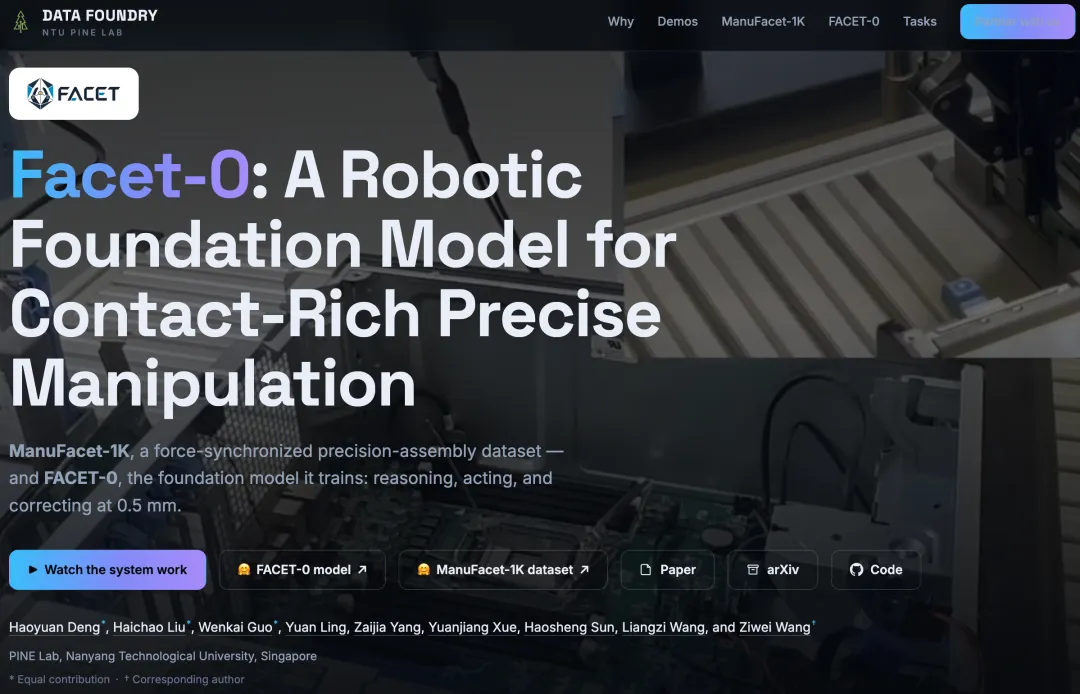
Address of the project:https://pine-lab-ntu.github.io/facet-0/
Link to the paper:https://arxiv.org/abs/2609.01596
In response to this, the team at NTU's Pine Lab developed the Facet-0 robotic base model, which aims to make robots not only understand "what to do" but also be able to "do right or wrong" in real contact and continue to improve based on failed experiences.
Facet-0 completes installation tasks such as RAM, CPU, Disk, GPU and so on.
In five real robot computer assembly missions, Facet-0 achieved an average mission success rate of 82%; by contrast,π0.5 was 10%,GR00T N1.7 was 4%. The model's placement accuracy reached 0.5 mm, with instructions delaying about 50 ms.
This is not a free-space-grabbing demonstration, but a set of 23 sub-targets, multiple alignment, insertion, compression, and locking steps, with a large number of key steps occurring within the installation gap of 0.10 to 0.30 mm.
More importantly, 82% are not solely dependent on expanding pre-training. The complete training process of Facet-0 will raise the success rate from 16% in pre-training to 38% in post-RL training and then to 82% through light weight adaptation. In post-deployment training comparisons, the human intervention rate decreased from 47% to 24%, and the failure recovery rate increased from 44% to 81%.
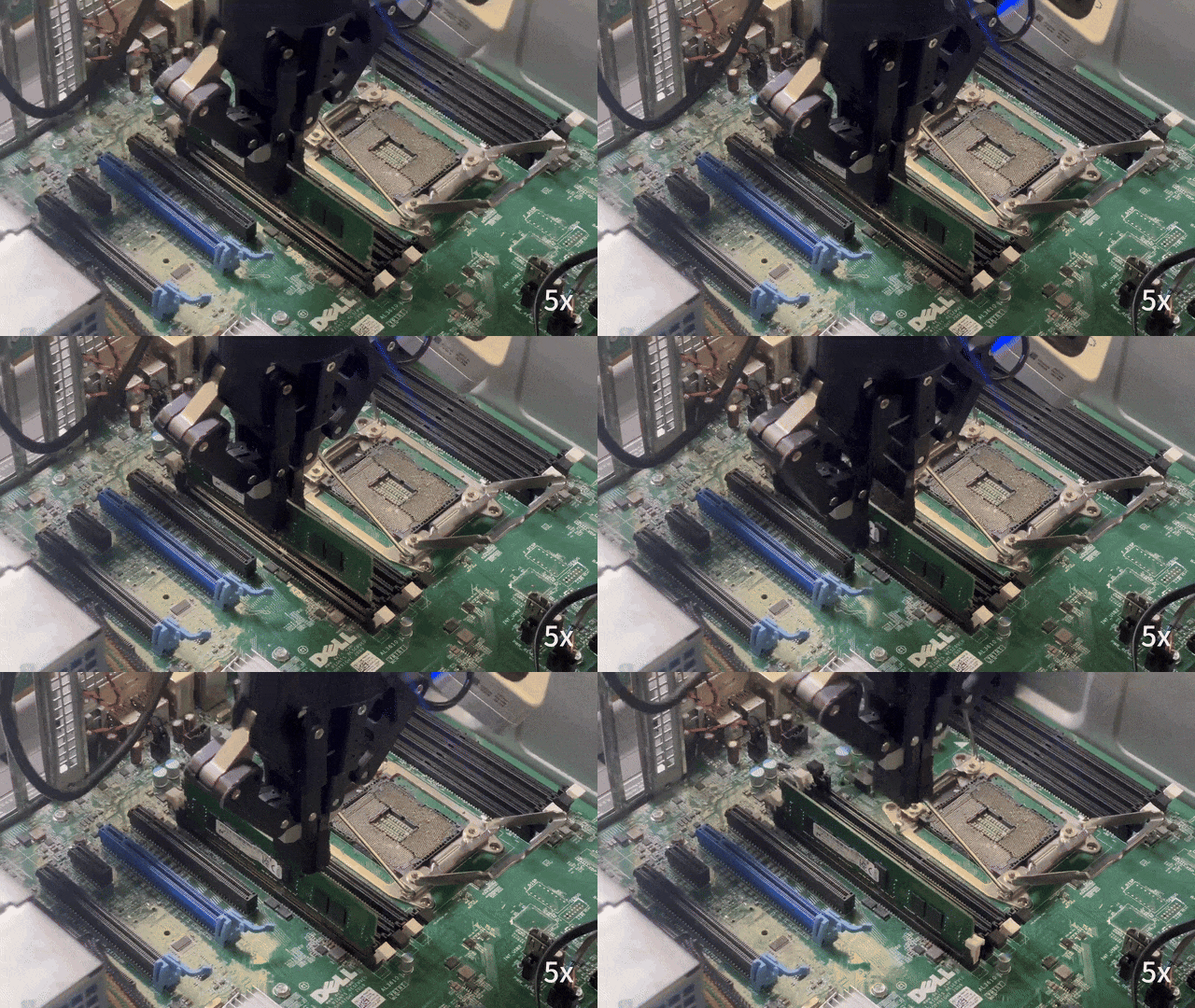
The card is backed up, re-aligned and inserted.
For memory modules that have never been seen before, Facet-0 uses only 10 samples, about 3 hours of training, and updates parameters of 6.6%, reaching a 45% success rate; the strongest baseline is 5%.
Why does precision manufacturing need new robot models?
General VLA models are already capable of understanding instructions, identifying objects, and performing many of the day-to-day operations. However, the most difficult part of building on the ground often occurs after visual "tasks have been completed".
When the parts reach the last few millimeters, the robot faces no longer just "where are the parts", but: is the slot really aimed? is the contact force growing normally, or is it sloping?
Vision is good at providing semantic and geometric information, but it may not be able to see the slight deviations that are obscured by machinery; the force/force torque sensor can directly reflect the contact state. The position of a part is almost unchanged, but the force continues to increase, which in itself is a failure signal that is difficult for vision to provide.
Therefore, precision assembly needs to be addressed not just by "making robots feel the power", but by making vision, language, bodily states, and emotions truly part of the same decision-making chain: understanding tasks, judging contacts, timely corrections, and continuing to complete tasks after failure.
ManuFacet-1K:
Data base for high-precision contact operations
In order for the model to learn this ability, the data itself needs to contain "how contact occurs".
The ManuFacet-1K contains approximately 1,000 hours of power synchronous demonstration and closed-loop data, covering UR7e, xArm, Franka, three mechanical arms, two types of server boxes, and GPU, RAM, CPU, and Disk installation tasks.
The data set is characterized not by a re-declaration of a general collection infrastructure, but by a unified design around precise operations: each set records multiple viewpoints, language instructions, terminal posture, claw states and six-dimensional force/force ratios simultaneously, and is marked according to skill stages such as approximation, alignment, insertion, compression, positioning, tightening, and removal.
More importantly, the data did not just preserve the "correct answers". Failures in real deployments, man-made takeovers and subsequent recovery processes were also left behind.
This means that model learning is no longer just "what a successful trajectory is like", but can also be seen: how an action generates contact, what is the difference between a normal contact and a stagnant one, and how to get back to a state of accomplishment after a mistake occurs.
Facet-0: aligning the semantic movements of the VLA with gravitational control
With the power data, the next question arises: Do robots "feel the power" and know what to do?
The answer is not necessarily so. If gravity is only an additional input into the VLA, and the training goal still requires the model to simulate position movements, these gravity dimensions may still be ignored in the face of mass-visual characteristics; even if the model knows that a collision has occurred, the original position control interface does not necessarily allow it to stop, retract and re-align in a timely manner.
Facet-0 thus establishes a coordinated path from VLA semantic decision-making to access control:
1. The model simultaneously receives polygonal images, language instructions, the state of the robot's body and the history of the six-dimensional force/force moment; perception is used as an independent signal to enter the model so that contact states can be clearly represented within the model.
Mr. Motion Experts converted the task-related rough grain motion into a stress-force sensing segment; after entering the contact phase, the refined expert combined real-time sensing to further transform it into more fine-grain motion to connect "what to do" and "how to adjust when to contact".
3. High frequency compliance controllers execute final instructions and impose safety constraints such as workspaces, single-step movements, so that the model's judgments are truly implemented in physical interactions.
Facet-0 is therefore trying to solve not "does a robot have power sensors", but a deeper question: can robots turn contact into a truly comprehensible, evaluating, and actionable information?
Post-training reinforcement learning for exposure to quality and self-recovery
But even if robots are already able to sense and control contact, there is a more difficult question: once the installation is finally successful, does that mean that all the actions in between are worth learning?
The answer is similarly negative. Both strategies may end up inserting RAM, with one finishing in position after a slight adjustment, while the other lasting hard top, producing a much higher-than-normal level of contact. If reinforcement learning only sees a "success" at the end of the task, the two tracks receive little difference.
Facet-0's RL post-training starts right here.
The first step is to break down "Is it finally successful" into "how to do it every step of the way".
The system allocates credits according to alignment, insertion, compression, and location-based sub-tasks. Even if a trajectory fails in the middle, as long as the robot subsequently successfully withdraws, re-aligns, and completes the current phase, this recovery behavior can still be evaluated positively, without being discarded because the entire trajectory has gone wrong.
But it is not enough to see if the stage has been completed, so the second step begins to judge "how it was completed".
Facet-0's value model combines action and force/force torque variation to evaluate exposure quality. Excessive exposure reduces credit, so even when both actions are inserted, moderation and alignment gain a higher value than forced impact. Robot learning is thus no longer just a "successful action" but a "more repeatable successful action".
The next step is to address a problem that is easily overlooked: the really decisive pieces of contact that are successfully assembled often make up only a small part of the entire trajectory.
If all the moments are put together, a large number of free-space movements overwhelm those brief but critical contact movements. Facet-0 therefore conducts credit screening in the contact phase and free-space phase, respectively, to retrace the learning focus back to the moments of alignment, insertion, lag and recovery of these truly decisive results.
Finally, these value judgments must re-influence the strategy itself.
Selected high-value contact experiences are used to reinforce motion experts so that models not only know which trajectories are successful, but also gradually form judgments about "what moves and contact states should occur next". At the same time, the trajectories of success, failure, and retrieval in real deployments continue to flow back to the training link, forming a closed loop from running → discovering abnormalities → artificially correcting/autonomously restoring → evaluating value → updating strategies.
This is also the difference between Facet-0's RL post-training and the simple "keep on training with data deployment": it tries to solve not how to make the average trajectory a little better, but how to make a few who will actually make a production disruption fail, be seen by the model, evaluated correctly, and ultimately become the next self-recovering experience.
This mechanism reduces the rate of human intervention from 47% to 24%, and the rate of failure recovery from 44% to 81%. Lightweight adaptation modules are then responsible for transferring the learned contact capabilities to new parts and working conditions without having to re-train the entire VLA.
From a Successful Movement to Continuous Evolution
For a robot manufacturer, it's really hard to scale, never to make a beautiful demo.
The production site is more concerned about whether it can still be completed when it encounters a minor deviation for the 100th time; whether it can return on its own when a training session is uncovered; how much re-deployment costs will have to be paid after replacement of parts, workpieces and even robotic platforms.
Facet-0 does not provide the ultimate answer to all precision manufacturing problems, but a worthy technological path: building a contact base with synchronized high-precision data, linking semantic and physical interactions with multi-modal models, and reinforcing learning in real deployments to transform failure from "abnormal" to a continuously usable training signal.
This also reflects a shift in the ability of a basic robot model to move from general operations to industrial settings, from "seeing and executing" to "contacting, judging, correcting and accumulating experiences".
In the future, PINE Lab will continue to expand its coverage of long-tail parts and conditioning, explore more unified semantic and cognitive modeling, and continue to learn about safety for long-term deployments.
Because in precision manufacturing, it may not be how many times a robot actually enters the production line that it succeeds ideally, but when the inevitable failure comes, it will be able to continue the task on its own.