The Vision-Language-Action Model (VLA) is becoming an important base model for robot operation. After a small amount of modeling, the VLA has been able to accomplish a variety of tasks such as grabbing, placing, stacking, etc. However, the success rate of the model will decrease significantly once the task involves close contact, narrow spaces, or out-of-distribution locations.
This is why real machine reinforcement learning is so important: pre-training and simulation learning gives a robot a good starting point, while reinforcement learning allows it to continue testing errors in real environments, adapting to specific objects, perspectives and contact dynamics.
Therefore, the central question facing machine-reinforcing learning is not whether it can learn, but how to use as little real interaction as possible to make strategies succeed as quickly as possible.
A natural answer is to involve humans. When models explore the wrong direction, humans can immediately take over and complete the correction. However, a new contradiction arises with the VLA that uses flow matching: humans give off robotic movements, while lightweight reinforcement learning optimization is the initial noise. Humans know how the mechanical arm should move, but cannot directly tell which noise the model should choose.
Researchers from Microsoft's Institute of Asian Studies, the University of Technology Sydney and the University of Tsinghua have proposed UniSteer. It converts human correction into noise monitoring through motion-to-noise conversion, enabling supervised learning and reinforcement learning to jointly update the same lightweight noise actor, while pre-trained VLA motion decoders remain constantly frozen.
To demonstrate the potential of this method in high-precision missions, the researchers challenged the mechanical arm to a difficult manual task: spinning soybeans.
The mechanical arm needs to extract small particles of polyethylene from the vacuum and place them accurately on a spike plate with a column-like protrusion. The force is too great, and the spike can fly; the posture is slightly distorted, and the spike cannot fit seamlessly into the protrusion; a slight collision when released may cause the already placed particles to fall.
It's not. Based on the model, UniSteer trained additional noise actors, placing 16 beans each, and eventually spelling out Microsoft's Logo. The human data budget for the entire online learning phase of the task was only two complete demonstration tracks.
Below is a video of UniSteer's slightly modified VLA completing the bean paste task.
The authors have pre-published the paper on arXiv, and open-source training code.
UniSteer: Unified Noise Steering for Efficient Human-Guided VLA Adaptation
Link to the paper:https://arxiv.org/abs/2605.10821
The code link:https://github.com/microsoft/UniSteer
The noise space is light enough, but exploration is still too expensive.
Currently, many VLAs use flow matching to generate continuous movements. Given visual observation, robot state and language instructions, the model first samples a goose noise and then moves it through a series of steps to turn it into a robot motion.
If online reinforcement learning is done directly to the entire VLA, not only is it costly to calculate, but it also requires that the gradient passes through the multi-step movement generation process, training can easily become unstable. Noise space reinforcement learning provides a lighter route: freeze pre-training VLA, training only a small noise actor, by which it selects the initial noise according to the current state, and then hand over to the frozen VLA to decode the movement.
Its execution process can be written as:

Among them, He is a trained noise actor.
 It is a freeze-dried VLA action decoder.
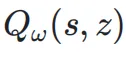 。
This design has two direct advantages: first, only updating the small actor, which significantly reduces training costs; and second, all moves are still decoded by pre-trained VLA, so it is not easy to deviate from the model's original moves.
However, light weight is not the same as efficiency. Initially, the success rate of the initial strategy was low; rewards only appear when the task is completed, and the noise actor still needs to rely on self-testing and error to find a few successful tracks. If the mechanical arm always approaches the object in the wrong gesture, it is difficult to get any positive rewards, let alone learn from rewards.
Human correction should have solved this problem: seeing the mechanical arm approaching the claw from the wrong direction, humans can pick up and move the claw to a lower, easier-to-grab position. However, this correction trajectory records the movement, and the noise actor needs to learn the noise. 。
This converges the problem into a key technical question: can we find a noise that makes the frozen VLA happen to generate movements that are close to human correction?
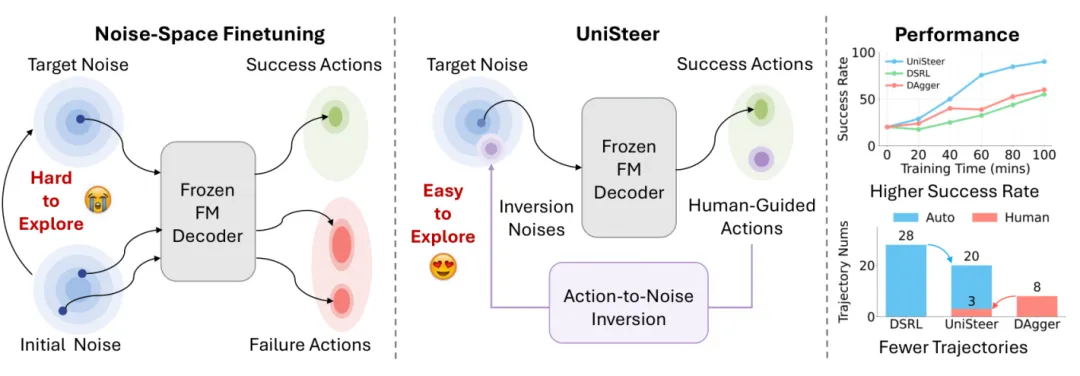
The action cannot directly monitor the noise actor, UniSteer chooses to reverse the entire generation process
UniSteer's core idea is not complicated: since frozen VLA defines mapping from noise to action, the initial noise generated by human action is reversed along this path.
Fixed status Flow matching decoder from initial noise
 Get out, along the speed field.
 It's evolving and getting action at the end.
 :

In continuous time, if the speed field satisfies the continuity given by the paper with the Lipschitz conditions, this mapping from noise to motion is dual-ray: each motion has a unique initial noise corresponding to it. The real difficulty is that the actual model uses discrete Euler steps to complete decoding, while single-step reverse mapping still relies on unknown inputs.
A forward update is defined as:

In order to recover input from the output, you need to ask:

The right-hand side still contains unknowns and therefore cannot be directly substituted for the solution. However, it naturally constitutes a non-moving equation. UniSteer iterates from the beginning:

When the Lipschitz constant about the speed field is and is satisfied, this map is a compression map, which converges to the only immobility point. Thus, UniSteer can start with human action and gradually reverse each Euler noise step, eventually restoring the corresponding initial noise.
The same noise interface, how can human correction and reinforcement learn at the same time?
After obtaining the target noise, human guidance can finally directly enter the training of the noise actor.
When the model is executed autonomously, the system records the state, noise actor sampling noise, reward and next state, and puts them in the reinforcement learning buffer zone. When humans take over, UniSteer corrects the action and reverses it to target noise; this data enters the demonstration buffer zone on the one hand and directly monitors the actor with a homogeneous error:

On the other hand, the actor also enters the reinforcement learning buffer zone, helping the critic to learn these more valuable states: noise and noise combinations.
Therefore, human correction and reinforcement learning no longer modify different parts of the model separately, but update the same actor through the same noise interface. Supervisory learning first draws the actor to the hopeful areas indicated by humans, reinforcement learning re-utilizes mission rewards, and continues to explore and consolidate near these areas.
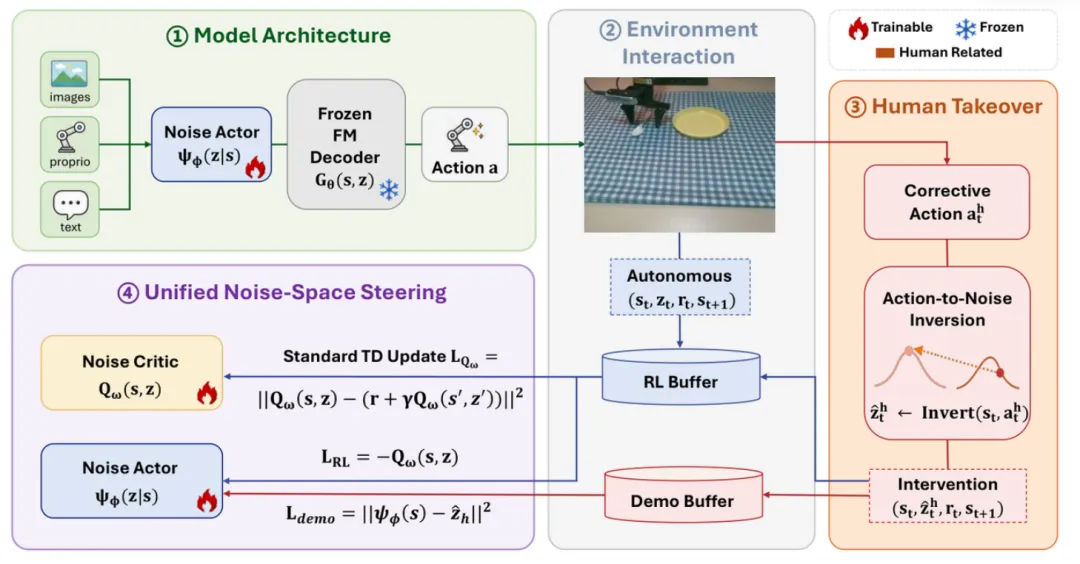
On average, 66 minutes went from 20% to 90%, improving from more efficient exploration.
Using the AgileX Piper's mechanical arm, the researchers tested four real-world tasks of picking up hooks, stacking blocks, inserting squares and folding towels, covering crawling, placement, precise contact and manipulation of deformable objects.
The system receives 30 Hz side-view and wrist-to-side RGB images, 6D terminal posture and claw state. The four formal benchmark experiments are based on a pre-trained architecture, with each mission preheating with 30 samples before entering the online virtual microwave.
After an average of 66 minutes of online mitigation, UniSteer raised the average success rate of the four missions from 20% to 90%. In contrast, only noise space reinforcement lessons, non-human-guided DSRLs, reached 55%; and DAgger, a human-combined demonstration in motion space, reached 60%.
In order to test whether the model is merely a repetitive demonstration, the researchers also specially set the initial location of the out-of-distribution OOD. The initial strategy is that the success rate for the three OOD tests is zero. After the UniSteer mitigation, the OOD success rate for all three tasks is 100 percent. By comparison, the DSRL reaches 0 and 25 percent respectively in the three OOD tests, and the DAgger 0% is 75 percent, 100 percent and 25 percent respectively.
Compared to classic AI error-correcting algorithms such as DAgger, UniSteer requires less human input. In contrast, in experiments, DAgger collects eight pure artificial tracks per round fixed; while UniSteer achieves good results with fewer artificial tracks per round. UniSteer uses fewer pure model tracks than the DSRL baseline, indicating that its improvement does not come from getting more, but from more efficient exploration.
This results not only in higher ultimate success rates, but also in faster improvements. DSRL relies entirely on autonomous exploration, and the weaker the initial strategy, the more difficult it is to collect successful trajectories; while DAgger can use man-made movements faster, it may cover previously learned behaviour in continuous action space surveillance. UniSteer first corrects to find more hopeful noise-correcting areas and then retains and expands these capabilities through reward-driven optimization.
The value of a fixed point reversal is more than just being able to reverse it.
Noise-to-motion is not the only way to achieve this. The researchers also compared two alternatives: one that uses noise itself as an optimization variable to reconstruct human activity through gradient search; and another that does not explicitly restore target noise by sending the actor's output to the freeze decoder and then transmitting the error from the action to the actor in reverse.
The experiments showed a better balance between fixed-point reversal speed, rebuilding accuracy and ultimate success rate. On eight test trajectories using the mouse mission, the fixed-point reversal took 73.26 seconds and achieved 8/8 success; based on the optimized reversal time of 208.04 seconds, only 3/8 success was achieved.
While direct motion supervision can achieve a higher success rate, it requires that the ladder pass through the entire multi-step decoding chain. In the clutch and insertion squares tasks, its training takes 193.22 seconds and 90.43 seconds, respectively, which is significantly higher than the fixed-point inversion program.
Fixed-point reversal is therefore really important not only to "find a noise", but to find noise monitoring targets consistent with freezing VLA at a lower cost. It both avoids repeatedly optimizing individual noise and avoids every actor update going through the entire action generation process.
What is the meaning of this verse?
VLA has provided a powerful precedent for robotics, but the transition from "almost doing" to "stably doing well" remains inseparable from real-world adaptation. The difficulty lies in the fact that real-world interaction is expensive, pure reinforcement learning is slow to explore, and human correction and noise space optimization use two different representations.
UniSteer's answer is to reverse human action as initial noise, bringing supervised learning and reinforcement learning together on the same lightweight noise actor. Human correction is responsible for identifying more promising exploration areas, reinforcement learning is responsible for continuing to optimize based on real-world mission rewards, and frozen VLAs always provide action pioneers.
From raising the success rate of four missions from 20% to 90% in an average of 66 minutes, to completing the Microsoft Logo puzzle with just two complete demonstrations of mechanical arm by arm, UniSteer shows a real-world path: not to completely update huge VLAs, not to blindly test robots from scant rewards, but to allow human corrections at critical moments to be directly learned in the noise space.
As VLA moves into more precise, longer-range and more complex real-world tasks, how to transform limited human involvement into efficient, stable strategy improvements will become an increasingly important post-robot training issue. UniSteer provides a concise and unified interface to this problem.
Introduction by the author
The paper was completed jointly by the University of Technology, University of Technology, Sydney, and Microsoft Asia Research Institute. Lujunje of the VAIL Laboratory at the University of Technology, Sydney, was the first co-author with Liu in the Department of Automation at the University of China; Zhang Chuyu and Wang of the Microsoft Asia Research Institute were the co-authors of communication; and Liu was the project manager at the Microsoft Asia Research Institute.