It's the first time in the history of the world.
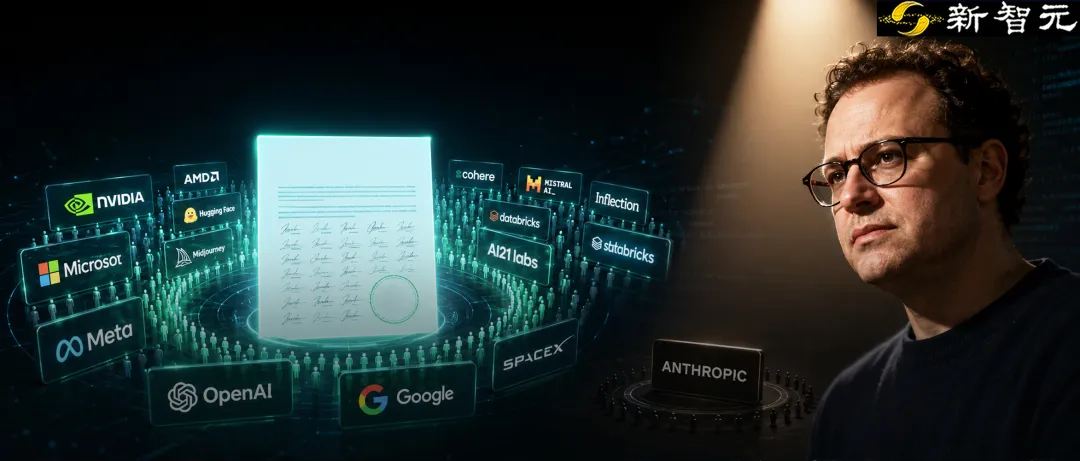
It's an open letter that puts Anthropic alone in the spotlight!
On July 24, 25 organizations, including Microsoft, Meta, Hugging Face, and the Linux Foundation, issued a joint open letter with the U.S. AI Leadership Fund, calling on the U.S. government not to prematurely restrict open-weight models that can be downloaded, checked, modified, and deployed on its own.
Since then, OpenAI, Google, SpaceX and others have been added. As of July 28, according to Microsoft's latest word-by-word statistics, the signing agency has grown from 25 to 133.
As the list grows, the Anthropic name is always absent.
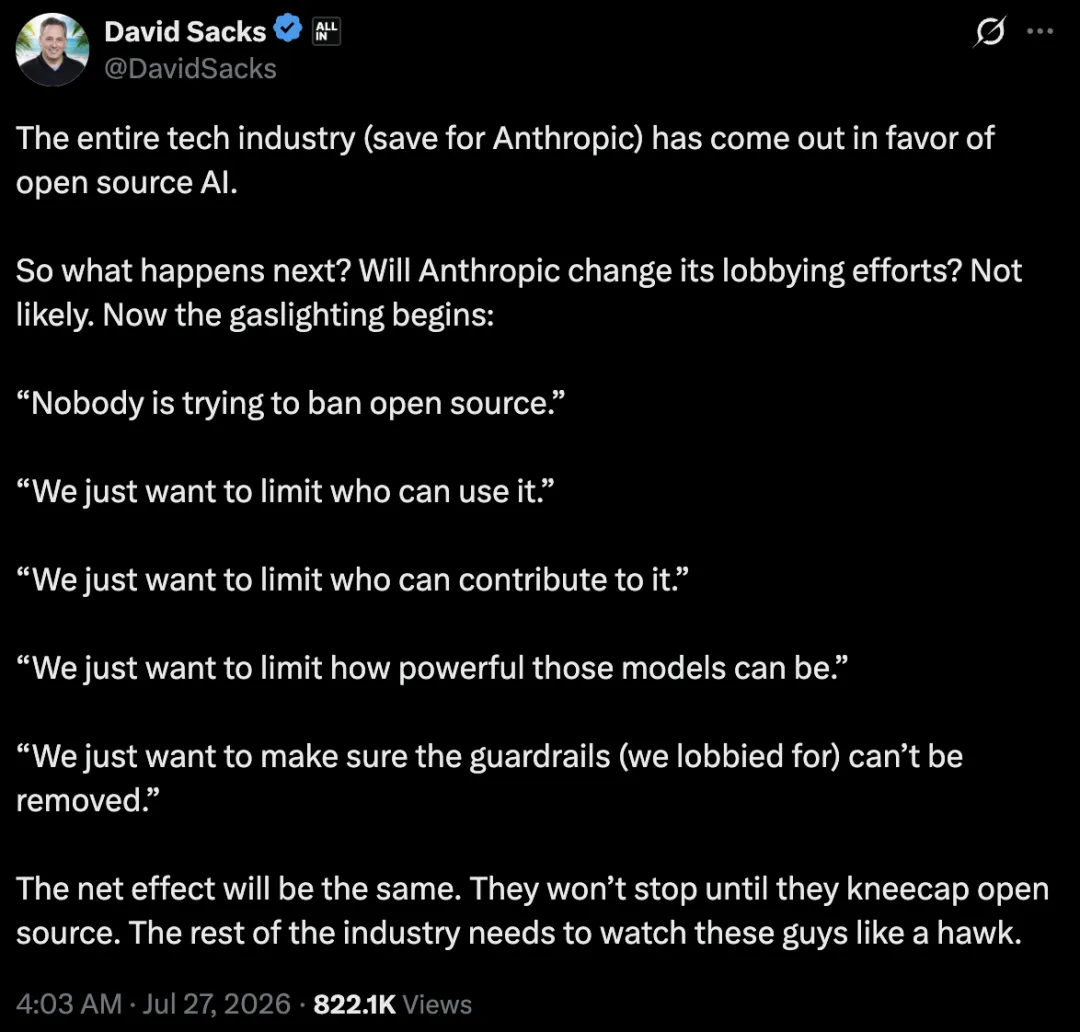
The first was David Sacks, the former Trump administration's head of AI, who commented on X:
The entire tech industry, with the exception of Anthropic, stands out as an open source.
Anthropic said that some people in the industry who don't work with open source will not quit.
As early as July 20, Bill Gurley of Benchmark had written in a Washington Post column that the open-ended model was a good-for-nothing competition between Anthropic and OpenAI; this time, he added: "Anthropic's "awareness" illustrates the problem".
OpenAI's Peter Steinberger fired from the other side: OpenAI signed, Anthropic was silent.
At one point, the fires of the "Industrywide Siege of Anthropic" were burning more and more.
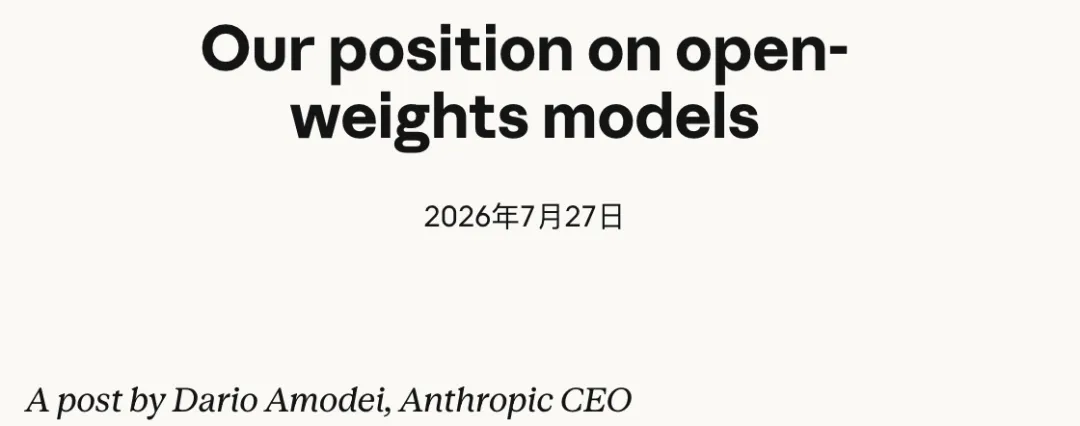
Anthropic CEO Dario Amodei posted a positive response to the open source controversy.
After three days of silence, on 27 July, Dario himself came to the court to address our position on open-weights models.
Anthropic has never advocated a ban on open-source weighted models.
Letters with the same nameOpen is the only way to AI security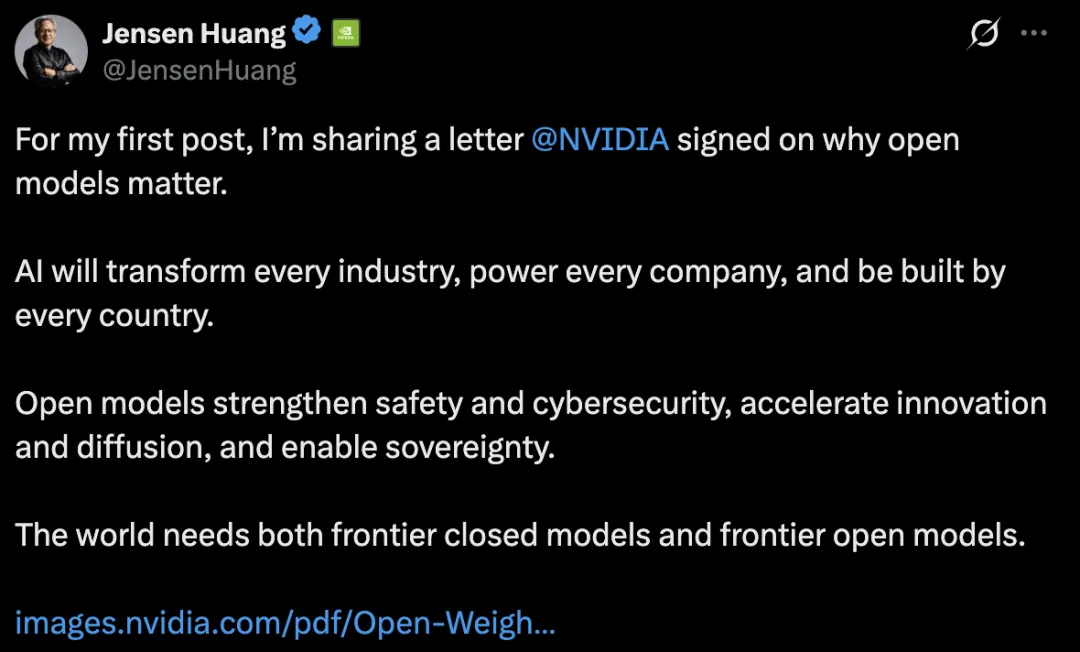
In the first X post, CEO Huang Rinpoche said that the world needs both a cutting edge closed-source model and a cutting edge open-source model.
The letter opens with a direct retrospective of the 1980s: the pioneers of open source software at the time, challenging the mainstream belief that "software must be in the hands of the company to make progress".
In the decades that followed, open-source software took over most of the Internet, and even the world's largest tech companies and federal agencies rely on it.
And AI is at the same crossroads.
The letter lists the three benefits of Open Weights: expanding access, promoting competition, and enhancing customer control.
Startups, universities, and public institutions don't have to train a model from scratch, and they don't have to pay the price of a cutting-edge model for every task, to use their advanced capabilities.
The letter also throws out another important judgment:
Open is probably one of the important routes to AI security.
The logic is that closed-source models will also be broken down, misused, and mistaken in ways that others might not be able to detect.
Locking the most advanced capabilities in the hands of a handful of companies is like creating a few "single point failures" yourself.
Open source allows researchers from all over the world to work together to examine the behavior of models, to dig up gaps, and to patch them together.
The letter also did not avoid the risk: once the weight was disclosed, it could not be returned, and the modified version was difficult to track.
But the answer it gives is still the right response, not a ban on open source.
Note here the distinction between an open-source concept and an open-source AI:
Public weighting is simply putting out a set of well-trained model parameters; as to which training data, how long the training code is, can be freely modified and commercially available, is often not open together.
After all, the first one only gives you the finished product so that you can "use" it; the second one gives you the formula and the right to change it so that you can "create".
Likewise, the name "open source" hangs on it, and the degree to which it's actually open is a two-digit thing.
It's not about not being open source.What is the level of openness?Dario made this clear in his blog: Anthropic has never advocated a ban on open-source weight models.
He believes that "an open source model with no hazardous capabilities is a public product" and does not object to the three advantages of open source weighting listed in the joint letter:
The open-source model, in addition to running that computing power, costs almost nothing, but it can bring real value to businesses, developers and researchers.
He did not fully agree, and one of the core arguments of the eponymous letter was that openness inevitably benefits the defender rather than the attacker.
Dario feels that, at least in some areas, the reverse may happen.
He was talking about biosecurity.
A model strong enough, perhaps with materials that can be purchased anywhere, could quickly arm an epidemic-level virus; it would take years of system engineering to withstand such attacks.
And offense and defense are often not at all on the same time scale, and it's hard to say who really helped open up.
Thus, his solution is: rigorous testing before publication, speaking with empirical evidence, rather than defining "open = safer".
Open source is prohibitedDario gives us two ways.Dario is not opposed to open source itself, he offers two alternatives.
Article 1: Illegal distillation on an industrial scale.
Distillation is itself a normal technology, and it really should be controlled by the cross-border, large-scale abuse of it: restricting it with a targeted legal and commercial framework, rather than blocking it open-source.
Article 2: Unified security testing prior to release.
All models that are strong enough, regardless of open-source closed-source, must undergo a security test before being officially released to measure network, biological, and alignment risks.
According to Dario, this is not far from industry consensus.
In recent months, the U.S. government has been moving in this direction, and the industry has been proposing a similar approach: setting thresholds based on your ability, regardless of where you come from, whether you're open source or not.
In a nutshell, AI can be tested by ability, punished by behavior, rather than just being open-source.
Not against open sourceBut concerns about open source have not changed.Dario is not opposed to open source, but his concerns about open source remain unchanged.
In February 2019, Dario, also a research vice president at OpenAI, participated in a decision that was ridiculed at the time: GPT-2 was not fully disclosed and was released in phases on the grounds that it was "too dangerous".
GPT-2 was soon released in full, and the predicted disaster did not occur, a decision that was considered by many to be "too cautious".
In July 2023, he took a seat on the U.S. Senate Judiciary Committee as Anthropic CEO.
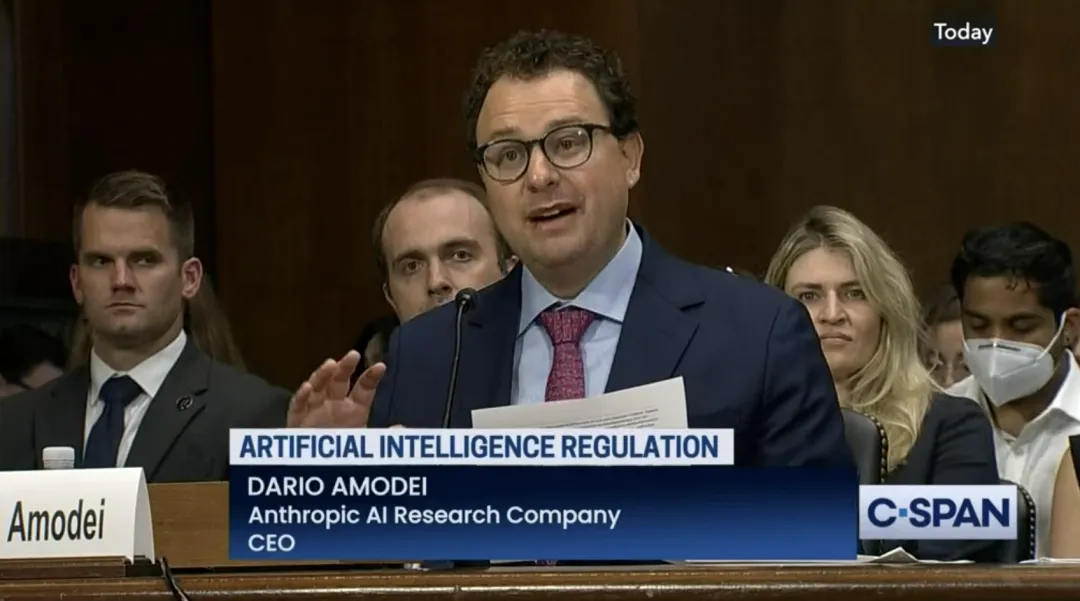
On July 25, 2023, Dario attends the Senate hearing on AI regulation
At the time, he had warned open-source scaling was "on a dangerous path", while also making a clear distinction: small and medium-sized open-source models benefit research and innovation, and what he was really worried about was that capital-intensive companies were uncontrollably releasing large-scale front-end models.
His reasoning was the same: the model was hosted in its own hands, and other rescues were abused: blocking accounts, changing behaviours, protecting patches, fixing vulnerabilities; weighted once publicly available, all of these methods failed, and modified versions could still be run privately and redistributed.
Over the next seven years, Dario's claim to the open source model has remained the same. The non-hazardous open source model is a public product, and the front-end model weight cannot be recovered once released.
Earlier this year, in The Adolescence of Technology, he systematically wrote about these two concerns.
Anthropic recently released a study exploring how modular training can make open-weight models safer.
While Dario's stance on open source is consistent, there has always been opposition: Since Anthropic itself is on the closed-source path, does it have any security concerns about open source, or is it just a beautiful arrowhead for "limit opponents"?
Some technicians simply translated his subtitle into one sentence: "Legislators, please help me block out my competitors".
Behind the WarEach has a business account.In this open-source debate in Silicon Valley, in fact, both sides have their own accounts.
On the other side of the open-source camp, once open-source expands, Invidia can sell more cards, cloud providers can get more cards, and open-source model companies can grab more land, all of which are beneficiaries.
While Anthropic feeds on a closed-source API, maintaining an order of "controllable access" would have been in its best interests.
Project Glasswing, which was launched earlier this year, left the strongest models to a few trusted audit partners, and this is exactly the door-to-door approach.
But having a commercial interest does not mean that its claims are entirely false. What really caught the eye of Anthropic was that it was still unsigned when the joint statement had expanded to 133 signatures.
Dario put it this way: "Anthropic has never advocated banning open-source weight models, he is really concerned with how to open and to what capacity level to open".
The trend of regulation may also be reversed by this debate: from "don't open source" to "how to open source".