Given a large model's description of vulnerabilities and code repository, can it, like a security researcher, read code, search for inputs, call tools, build inputs, and repeatedly verify its judgments?
This is no longer just a question-and-answer question. A real cybersecurity task often takes ten minutes or longer, and the model needs to be searched, compiled, run, analyzed, and corrected in the real world.
There are still several gaps in the existing open source schemes:
Some front-end models, although open-weighted, do not have open-source replicable cybersecurity training processes;
There is usually only one solution to a single task and a unified solution has not yet been formed.
There is already a lack of scalable smart data solutions;
Large-scale synthesis of intelligent body data requires security-related prior knowledge.
A research team from Beijing Aerospace University, the European Institute for Learning and Intelligent Systems (ELLIS), Singapore Management University (SMU) and the Institute of Cognitive Innovation (IQuest Research) proposed CyberFactory and trained the OpenAegis open-source cybersecurity model on the basis of it.
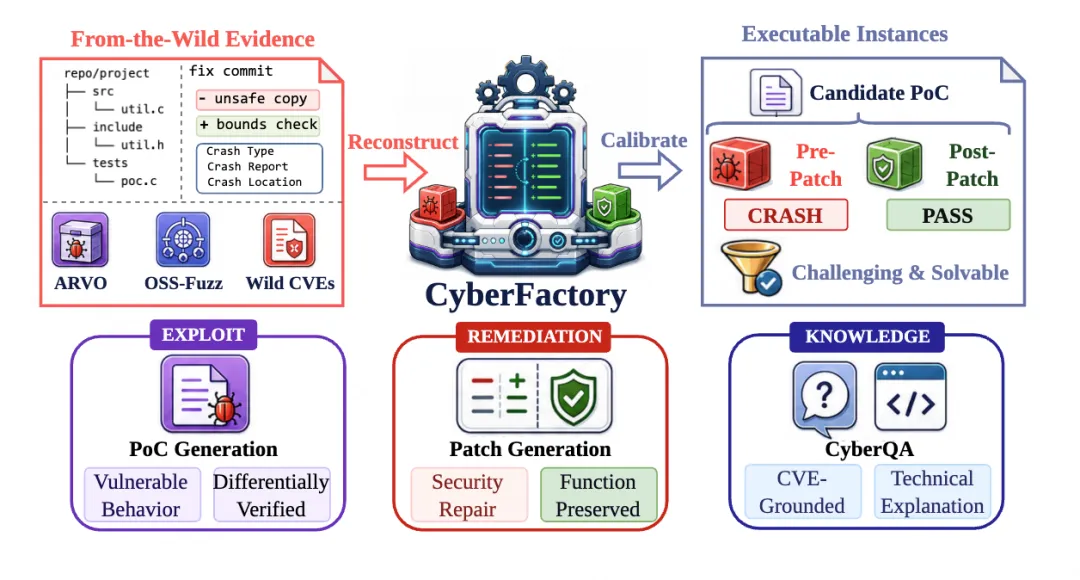
CyberFactory reconstructed fragmented vulnerabilities in the open world as functional, detectable tasks, and used a set of security analytics Skill to guide the intelligence to complete tasks, leave operational tracks, and eventually train these to do things in OpenAegis. The final assessment time limit was 1 hour. Under this condition, the OpenAegis pass rate increased from 29.6% to 58.1%, leading the GLM 5.2 by 14.8 percentage points, leading the Kimi K2.7 by 6.4 percentage points, compared to the Qwen3.5 base.
CyberFactory: Scaling Cyber Security Capabilities with Instances from the Wild
Hugging Face:
GitHub:
Two key breakthroughs:
Forward the trajectory, then let the model learn the method
This work revolves around two problems that have not been solved simultaneously in the past.
First, real vulnerability data is not the same as training data. Open source CVE records typically contain only vulnerability descriptions, repaired submissions, and a small amount of crash information. To get an intelligent organism to actually tackle the problem, it also needs to replenish the affected code versions, repaired versions, compile environments, run inputs, and automated judgment procedures.
Second, even if the task environment is ready, the existing open source model will not be able to complete the task steadily. Security research is not a one-time answer, but a process of constantly making guesses, calling tools, checking results, and changing strategies.
CyberFactory offers the following solutions:
A unified, open and reproducible training process: organizing fragmented vulnerability materials into executable, auto-determined tasks, connecting data construction, trajectory generation and model training, and covering vulnerability replication input generation, vulnerability repair, and cybersecurity queries.
A set of scalable smart data generation methods: using replicable general vulnerability analysis as a field approach for Skills, then using tool interaction, environmental feedback and automatically determining high-quality trajectories.
The former solved the puzzle where it came from, and the latter solved how the high-quality puzzle solving process came to be. Combining the two, the team did not get the usual answer yes, but a complete intelligent trajectory including code retrieval, tool calling, compile running, fail analysis, and result verification.
This is the most important difference between OpenAegis and many existing cybersecurity models: it not only learns the knowledge of vulnerabilities and the ultimate answers, but also learns the sequential processes in security research tasks.
CyberFactory is not just a set of training materials, but a complete pathway for continuing to build tasks, generate trajectories and train models from open source vulnerabilities.
Where did the title come from?
From open source vulnerabilities to workable tasks
In the real world, the sources of vulnerable materials are complex and incomplete. CyberFactory uses a variety of sources such as ARVO, OSS-Fuzz and open source CVE.
Of these, open-source CVEs are the most difficult to handle. A common entry may only give corrective submissions, vulnerability types and brief descriptions, but there is no built-in operating environment. The team designed a three-step process for this purpose.
Step 1: Rebuild the programming environment before and after the vulnerabilities
The system derives source warehouses from multiple sources, localizes repair submissions, constructs verification documents, and builds a run-able environment based on the repair submission to extract the vulnerability version and the repair version respectively. Thus, the same candidate input can be run before and after the repair.
Step 2: Confirm that the task is solvable and control the difficulty
The system will verify the actual running of the evidence obtained with open vulnerability types, crash reports and crash locations, so that the remaining tasks have a verifiable vulnerability basis. It will then eliminate redundancies without leaking additional clues used during the verification phase to the training model.
Step 3: Create task descriptions that are suitable for use by smart bodies
For complete restoration submissions, the system directly retains the valid information contained therein; for vague entries, it combines available evidence of a vulnerability with a description of the task generating the restoration content. Additional clues for task verification and screening will not be given to trajectory generation or model training to avoid leaking answers.
After these steps, the material that was scattered in the vulnerability library, the code warehouse and the building of records became a task that could be handed over to an intelligent organism.
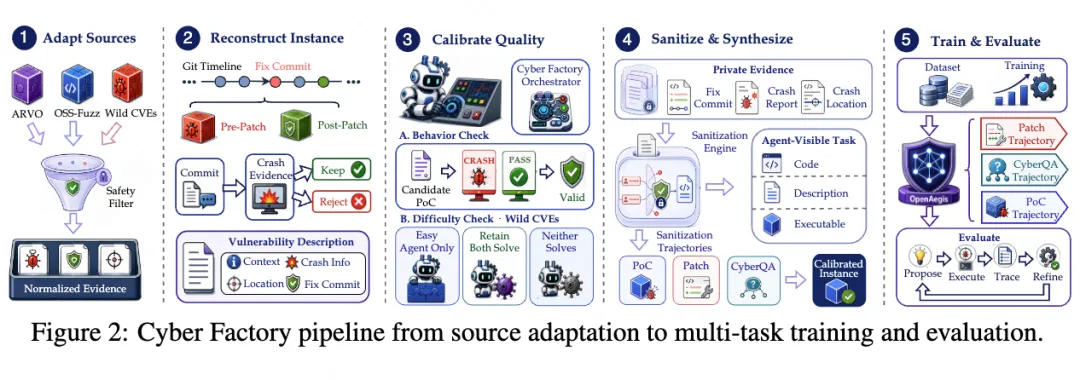
How did the high-quality problem solving process come about?
It provides a process for analyzing rather than providing specific answers.
The task instance specifies the problem to be solved by the model, but does not specify how the model should be handled. When directly generating trajectories, the model may spend a significant amount of time on temporary constructing inputs or repeated attempts, lacking a stable analytical process.
To this end, CyberFactory provides a replicable vulnerability analysis Skill when generating trajectories. It describes general processes unrelated to specific tasks rather than actual answers to a particular vulnerability:
Examine the target procedure and its constituent constraints;
Select appropriate methods of analysis and testing to explore candidate inputs;
Verify the evidence obtained and adjust the method when the verification fails.
Skill only gives an analytical process, and the model still needs to interact with the environment, identifying and triggering each vulnerability on its own. CyberFactory only retains the trajectory of the final results to satisfy the corresponding task verification conditions.
The Skill set is used for the data and trajectory generation stages and will not be provided during OpenAegis reasoning. The team then uses the verified trajectory to monitor and fine-tune and migrate the analytical processes embodied in it to the model parameters.
OpenAegis:
Open source 397B-A17B large model of cybersecurity
Using the trajectory above, the team trained the OpenAegis multitasking cybersecurity model. The model also learned three complementary tasks:
Creating duplicate inputs: implementing code analysis into executable inputs;
Fixing vulnerabilities: removing security issues while maintaining the original functionality;
Cybersecurity Q&A: Supplementing security knowledge, understanding and interpretation of concepts.
In the CyberGym test, all models used the same script and set a one-hour task time limit.
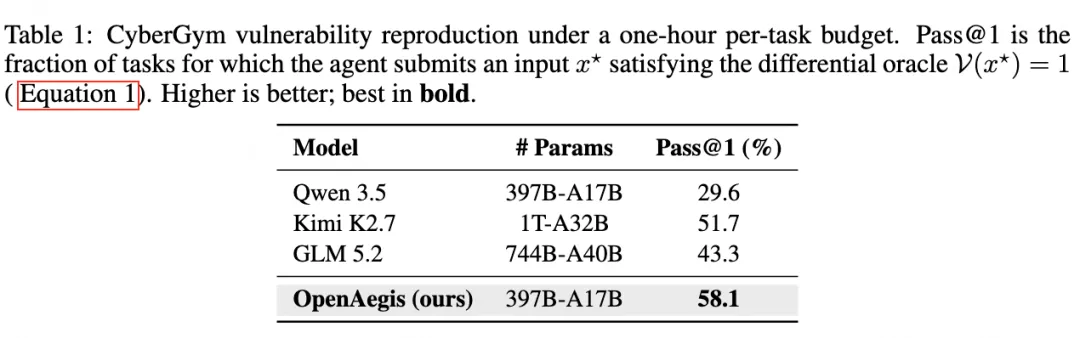
OpenAegis achieved the highest pass rate with fewer parameters. Combined with trajectory analysis, its advantages can be seen not only in the final scores, but also in the way it operates closer to security researchers.
Compared to the Qwen 3.5 baseline, OpenAegis' pass rate increased from 29.6% to 58.1%, an absolute improvement of 28.5 percentage points; it also leads the GLM 5.2 by 14.8 percentage points, and exceeds the Kimi K2.7 by 6.4 percentage points.
In long-range missions,
How to maintain a really useful context
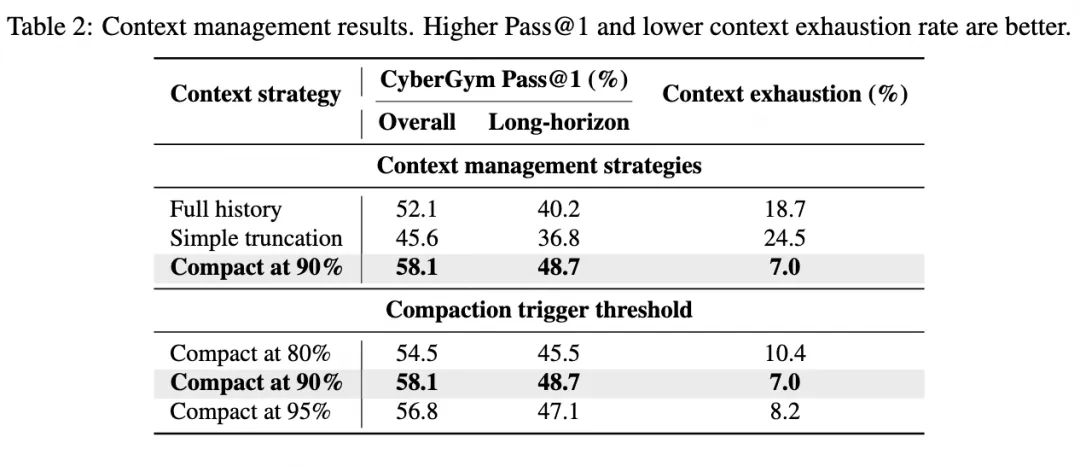
Failure replication often involves dozens of tool interactions, and the entire history may be exhausted before the end of the task. CyberFactory, when 90% of the use in the previous context is reached, compresses the already confirmed evidence, failed attempts, unresolved guesses, builds, and next actions into a continuously executable working state, allowing the intelligent body to complete the original task.
In the above context management experiments of the paper, this practice achieved an overall pass rate of 58.1%; for long-range tasks interacting with more than 40 tools, the pass rate reached 48.7%, and for long-range tasks the exhaustion rate decreased to 7.0%. Compared to maintaining a complete history, the pass rate of long-range tasks increased by 8.5 percentage points, and for long-range tasks the exhaustion rate decreased by 11.7 percentage points.
From Skill Injection to Modeling Internation
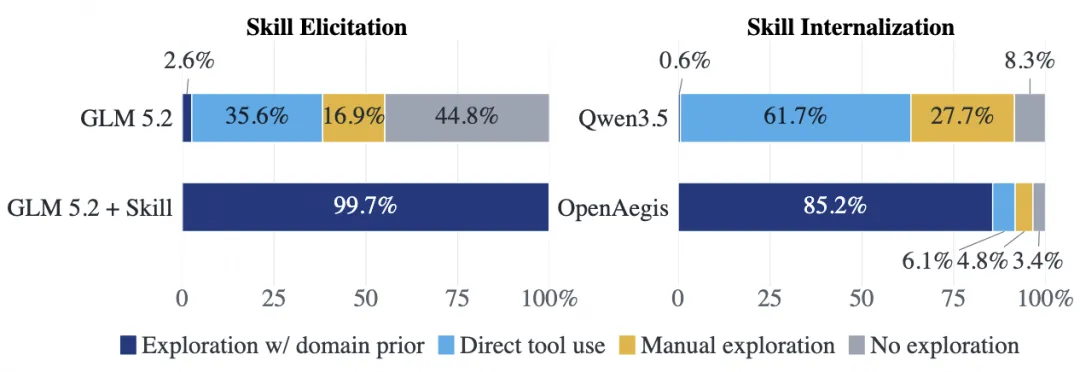
We directly added Skill to GLM 5.2 to see if this approach could improve trajectory generation efficiency. Without Skill, each task ran 1 time, every 60 minutes, Pass@1 was 43.3%; after Skill, each task ran 5 times, every shortened to 15 minutes, Pass@1 was raised to 46.5%.
The changes brought about by Skill are also evident in the operational process: the trajectory of systematic exploration by GLM 5.2's field pioneers has risen from 2.6 percent to 99.7 percent, almost completely shifting to the processes given by Skill. This means that Skill is able to steadily inject target behaviour, but also suggests that injecting Skill directly into reasoning may make the model overly dependent on the field pioneers provided.
More importantly, OpenAegis didn't get the Skill when it came to reasoning, but compared to the base model Qwen3.5, it showed similar changes: the trajectory share of systematic exploration carried out by pioneers in the field increased from 0.6% to 85.2%; exploration operations per trajectory increased from 0.01 to 1.32 times, and verification operations increased from nearly 0 to 1.05 times. OpenAegis still retains a more strategic distribution than the GLM 5.2 that explicitly joins Skill.
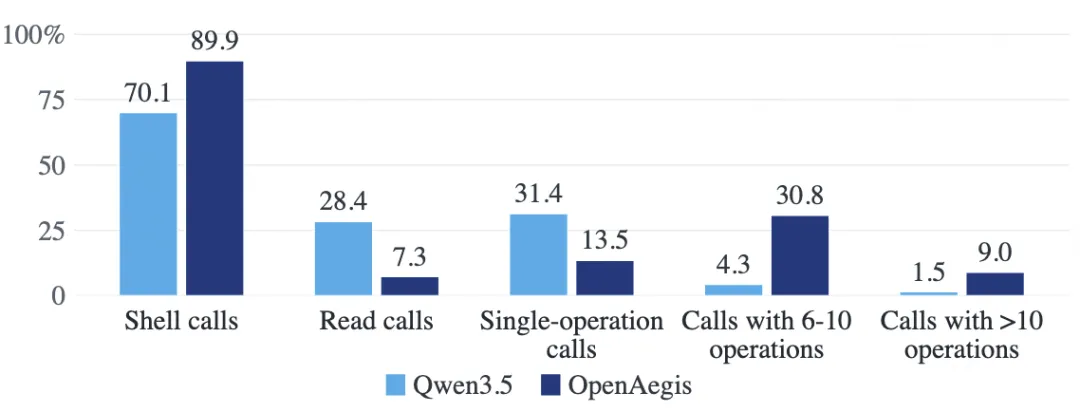
This internalization is not just about moving an operation. OpenAegis's terminal call share increased from 70.1% to 89.9%, and the number of operations included per terminal call increased from 2.7 to 5.5, indicating that it is better at organizing continuous environmental interactions together. AddressSanitizer compilation events increased from 155 to 1795 times; the trajectory of submitting a single result increased from 37.9% to 48.2%, while the trajectory of submitting at least five submissions decreased from 10.4% to 2.0%.
This forms a continuous chain of evidence: Skill injects scalable vulnerability analysis processes into the rollout model, high-quality trajectories pass on the process to OpenAegis; the model replicates core methods without reading Skill text, and further learns the use of more compact tools, program detection and result submission habits.
Problems still to be solved
CyberFactory is not an underground method.
First, the completeness of open-source vulnerability materials varies greatly, and task reconstruction is still limited by code versions, depending on the environment and build conditions. Second, blur testing is not suitable for all vulnerabilities; the paper also found that a few tasks are still more suitable for manual build inputs.
In addition, the most comprehensive quantitative results to date have focused on bug replication tasks. Both bug fixing and cybersecurity queries require equally rigorous and uniform assessments to more fully illustrate the benefits of multitasking training.
Summary
The value of OpenAegis lies not only in achieving a higher test score, but in demonstrating a pathway to building reproducible capabilities:
To reconstruct tasks from open-source vulnerabilities, Skill uses vulnerability analysis to generate high-quality intelligent trajectories and then trains to immerse trajectory methods into model parameters.
This path completes a long-standing gap in the study of existing cybersecurity models, which not only prepares topics and answers, but also systematically records how an intelligent organism uses tools, understands feedback, and ultimately completes tasks.
For a large cybersecurity model, this may be more important than simply adding static content: the model needs to be learned not only to know what's wrong, but also how to make things right.