
It's the first time in the history of the world.
Today, there is an exciting news story.
In the latest podcast, Autman explodes that Astra's ability to operate computers has reached human levels!

And Fable 5.1 is not far away.
Anthropic's latest model, Fable 5.1, has been discovered to be embedded in the Amazon AWS Bedrock API route!
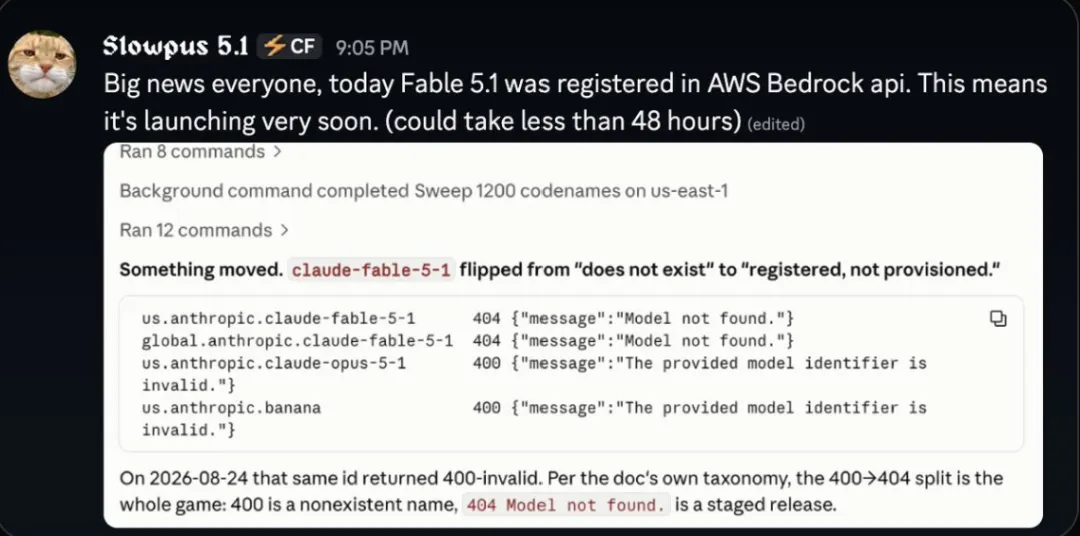
It is likely that both Astra and Fable 5.1 will be released at the same time.
The exciting moment is coming soon.

At the moment, the podcast has only been running for a little over a minute.

In the interview, the host asked the question: "Do you think AGI has arrived?"

Ottman replied, "Close, at least very close...AGI feels like a milestone, and superintelligence feels like a monster that can be infinitely expanded. As for Astra, it feels like it's fully at the human level when it comes to operating computers".


In fact, the "Astra that reaches human level" in the Ottoman language has recently leaked a number of test demos.
Last Sunday, Astra unveiled a bunch of very shocking front-end demos.
For example, the test below.
With a simple phrase, "building a magnificent science fiction ship with an explorable internal structure", without any round of dialogue, AI directly "One-shot" a complete 3D world.


As Big V says, AGI may not come in a way that "chatbots get smarter", it may come in a way that "builds a whole world with one word".
Moreover, OpenAI's ambition is much more than that.
Astra was not created to talk to anyone smarter than Fable, but to be a "continuous intelligent body".
Astra's disclosed details are as follows:
Shocking 56K Tokens Reasoned by 3D Tower
Astra's latest 3D body art work, the Bauhaus, is a surprise.

At its maximum logical intensity, using 56K logical tokens for 38 minutes, Astra recreated a 3D architecture that achieved a very high level of composition, color performance and overall rendering effects.

This reflects the incredibly hard-core spatial imagination and code execution power.

The number of "never stops" workers
It is no longer a passive tool for "you ask a question and it answers a question". Astra can work continuously for days or even weeks, and it has a long-term memory that can remember your corrections.
Multi-Agent collaboration with cross-tool operations
It can be divided into multiple intelligences, and can simultaneously attack research-level mathematical proof problems.
What's even more terrifying is that it can take over your desktop, inter-software collaborations, and even work with other AI entities and humans at "superhuman speeds".
This confirms what Ottman said in the podcast: "AI's ability to use computers has officially reached human levels".
Fable 5.1 live from AWS BedrockToday's news is that Fable 5.1 is not far away.

A developer has released a major discovery: Anthropic's latest model, Fable 5.1, has been featured on the Amazon AWS Bedrock API route!
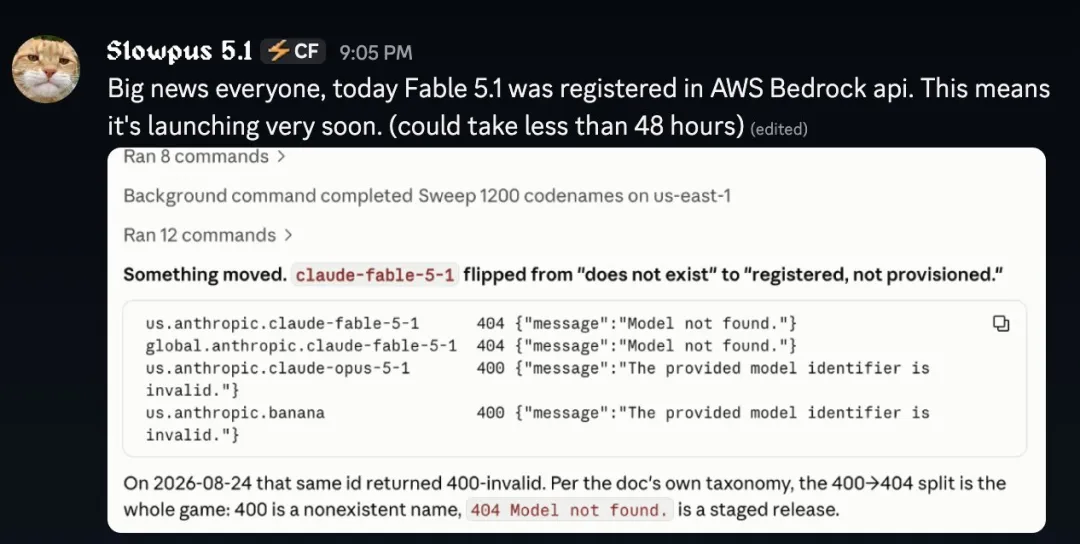
When the developers called the Fable 5.1 model identifier in the system, the system originally returned the "400" error; the provided model identifier is invalid, belonging to a random name; but now, it returns the "404" error; the model is not found.
This indicates that the underlying system of AWS has been officially recognized and accepted as Fable 5.1, pending the upload of the model itself.
This underlying oscillation is consistent with the performance of Opus 5.1 in the days before its release.
In addition to the past two weeks, a number of people have been tested for ashes, showing signs of foam.
The release of Fable 5.1 has been pushed back, in about three to four days.
If Anthropic couldn't seize ecological status prior to the release of Astra, Fable 5.1 would likely be wiped out.
In addition, some people tested Opus 5.1 in hidden mode, and it worked very well.


 How did Fable 5 press GPT 5.6 for months?
And after months of recent well-known community Bridgemind testing, it was concluded that GPT 5.6 was pressed by Fable 5.
For the past few months, he has been mixing Fable 5 and GPT 5.6 Sol daily at high intensity, and this is how he feels.
The GPT 5.6 Sol was a powerful rear-end machine, but it was defeated by "excessive engineering".
GPT 5.6 Sol performs better in rear-end processing than GPT 5.6 Sol. It is extremely fast, less expensive to call, and performs better in data security.
Even in mathematical logic, Sol has been able to significantly bridge the gap between Fable and his predecessor Opus.
Once work enters a deep and complex stage, Sol is a more powerful rear-end engine.
But it has one extremely deadly flaw, and GPT 5.6 is a "over-engineering" occupational disease if the instructions are relaxed slightly.
Clear is a simple function, and it doesn't have to be a huge, complex system that you have to limit very precisely.
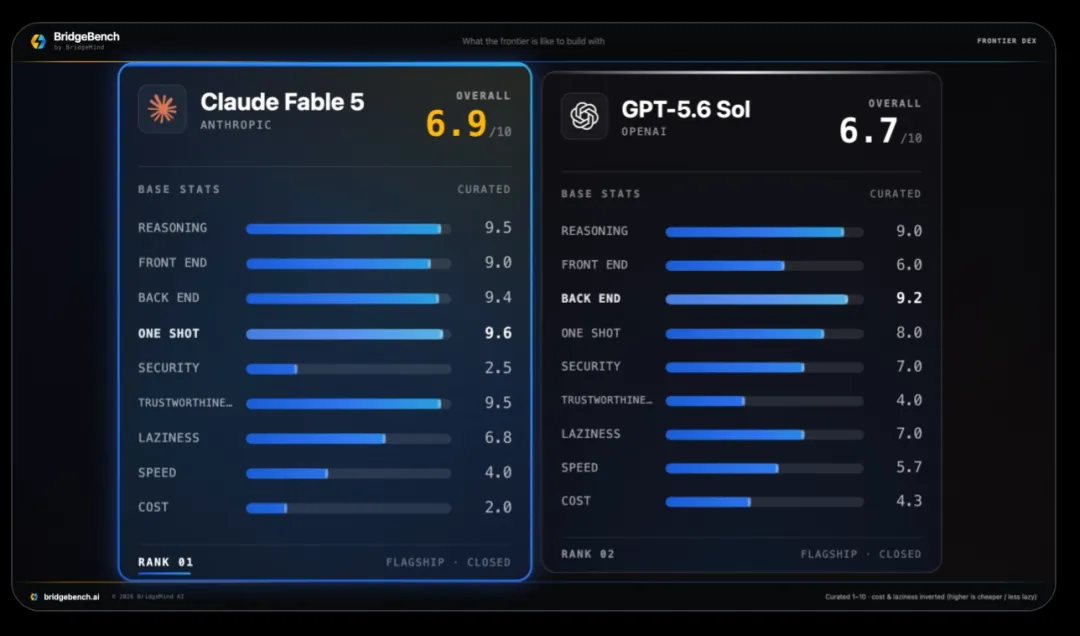
And Fable 5, it's still the real number one.
It won in two places: front-end UI design, and "One-shot" capability.
You throw a bunch of messy needs at Fable 5, and it often gives you a "feel-finished" product when you try it for the first time.
Its extremely high first-stroke rate, combined with excellent visual presentation and aesthetic taste, allows users to experience what is truly "slick".
That's why Fable 5 is still at the top of the developer's minds for not only its functionality but also its beauty.
It has been reported that Astra is now open to some partners to collect insights, and if all goes well, we will soon be able to experience this new species.
So who's going to be next, Astra or Fable 5.1?