It's the first time in the history of the world.
AlphaEvolve is up again!
Pushmeet Kohli, chief scientist at Google Cloud and vice president of DeepMind, said:
The fastest theoretical speed of matrix multiplication has been refreshed again!
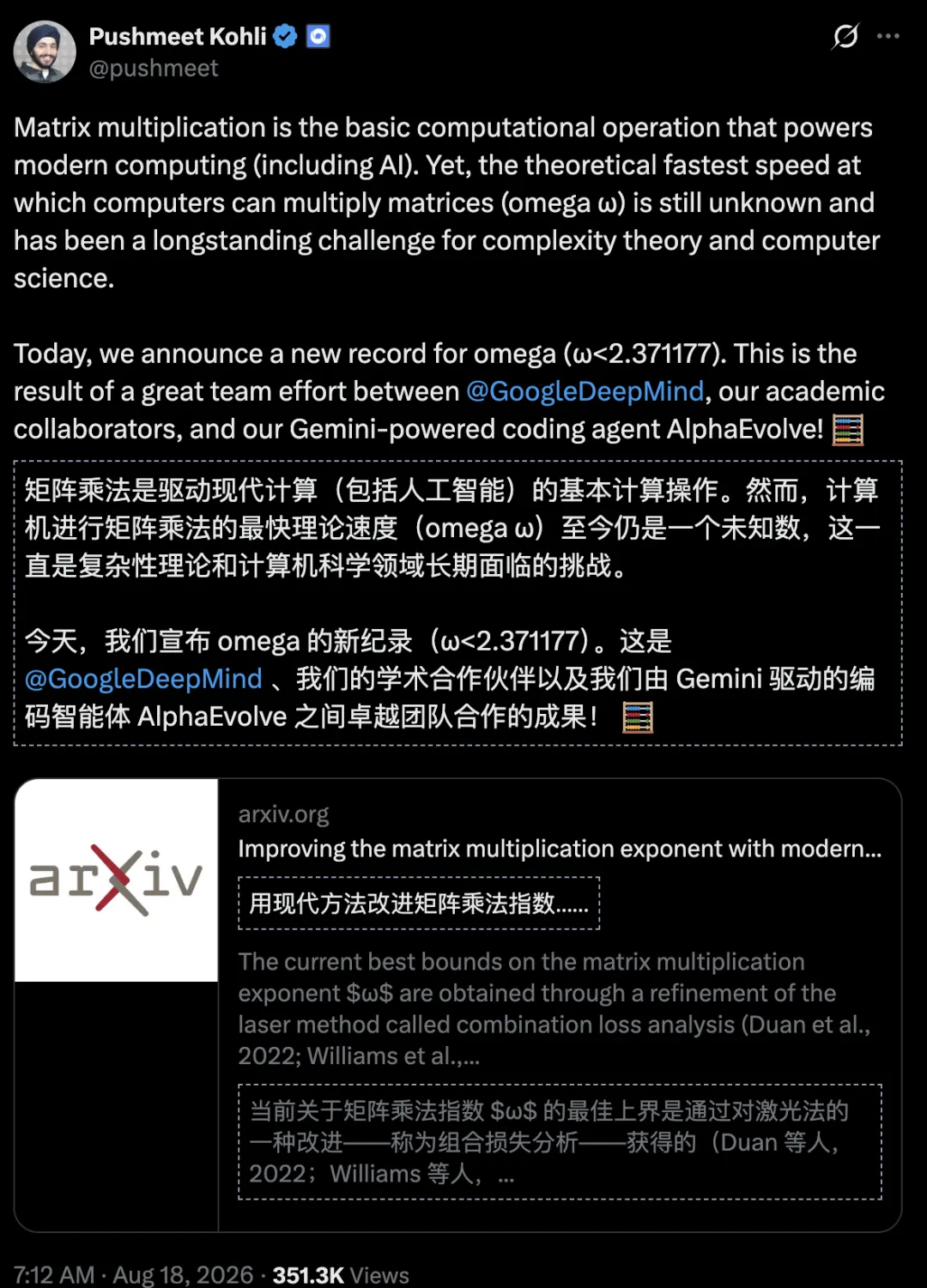
Matrix multiplication is a modern computational "dark matter" that drives everything from graphical rendering to massive neural network training, but so far no one really knows its theoretical fastest speed.
This velocity is defined by the exponent ω: the approximate complexity of multiplying two n × n matrices is O (n^ω).
In 1969, the German mathematician Volker Strassen lowered the textbook algorithm to about 2.807.
Over the next half-century, the boundary was gradually pushed upwards to 2.371339.
Now, Google DeepMind is collaborating with theoretical computer scientists like Alman, Vassilevska Williams, to create a Gemini-powered coded smartphone.AlphaEvolveIt's just a matter of getting this up and running.ω < 2.371177。
The improvement was only about 1.62×10⁻⁴, "equal to most of the progress of the last 40 years".
This is the first time AI has intervened substantially in one of the most classic, rigid open questions in theoretical computer science.
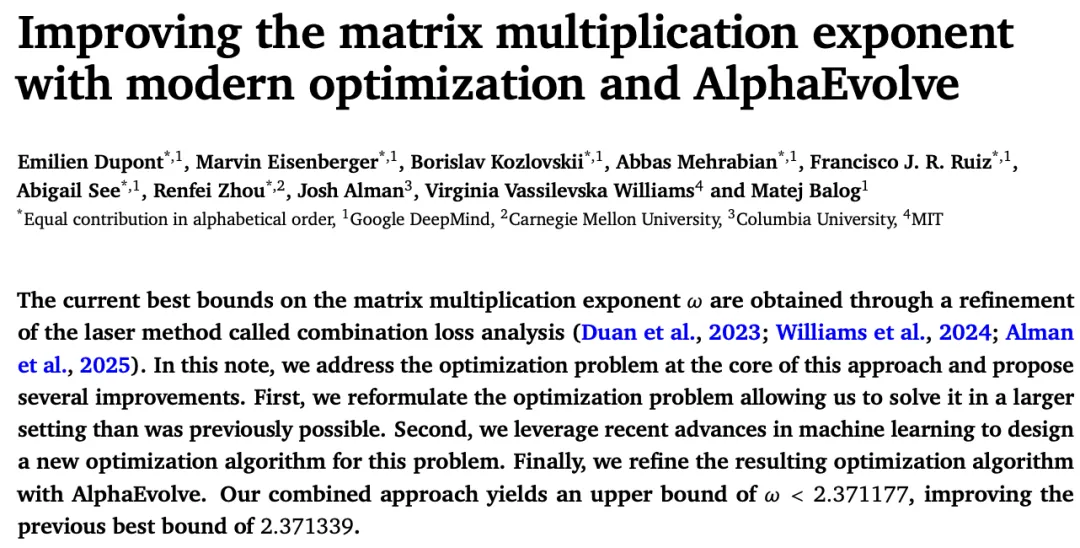
Improving the matrix multiplication exponent with modern optimization and AlphaEvolve
It's the door.
How to solve a classic puzzle with a tripod axeThis progress did not create a whole new mathematical framework.
What it does is more subtle, pushing the "optimization core" of the existing framework to an unprecedented scale.
The first board ax isReconstruction。
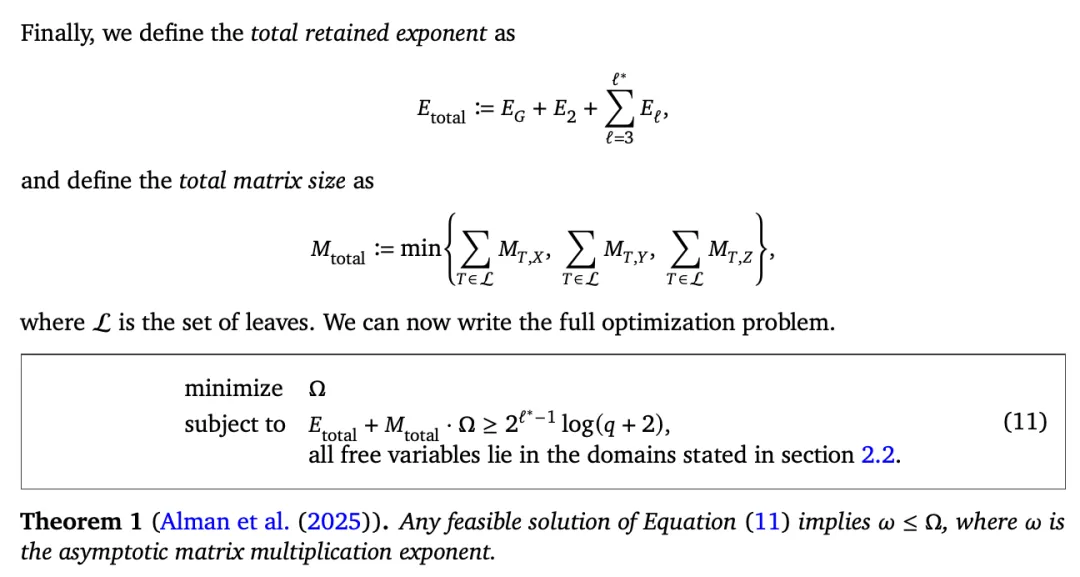
Combination loss analysis is a refined version of laser law, the core of which is a non-convex optimization problem.
Previously, the best results were only for the recursive level l*=3, about 25,000 parameters.
The research team reformulates the problem so that it supports l*=4, the parameter scale jumps directly to about 7 million.
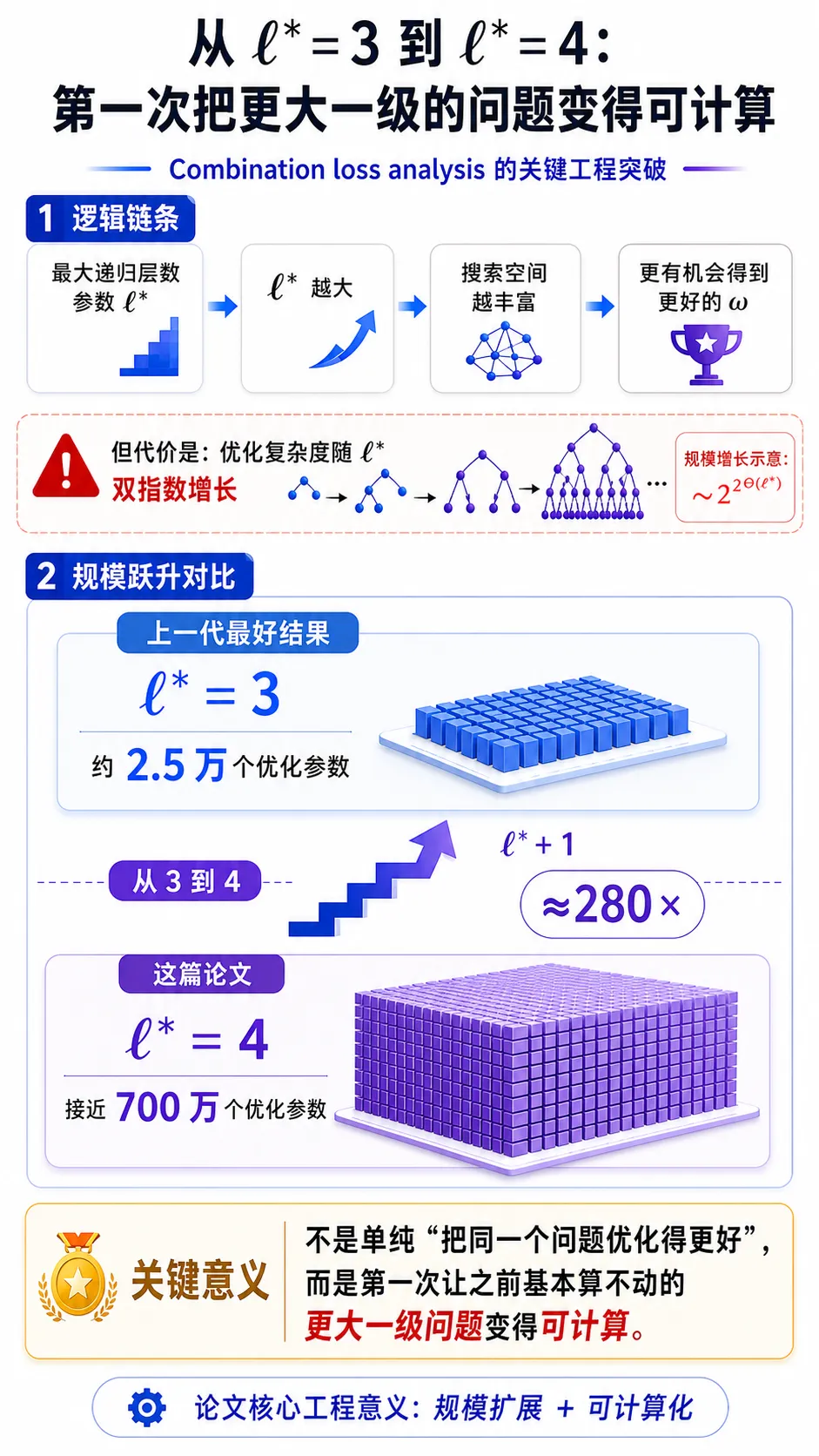
They used voltage representation, phantom nodes and phased arrays in parallel, and turned the previously difficult to extend computation into a problem that could be solved efficiently on GPUs.
The second ax isOptimizers for machine learning design。
They used gradient descent (Adam), Softmax parameterization (Sinkhorn-Knopp algorithm) to calculate the maximum gradient, and then combined the hidden subtraction to search directly in the non-convex space of the 7 million parameters.
The third, and the most remarkable, is the handing over of the optimizer itself.AlphaEvolveThey evolved.
AlphaEvolve refined the program at a parametric scale of about 7 million, running out of results for about 5 hours on a single GPU, and added about 0.63×10⁻⁴ improvements.
It's like humans first design a huge maze and then let AI learn how to navigate the maze and transform the structure of the maze itself.
If optimization itself becomes a bottleneck, is it necessary to recalibrate our past judgments that "there has to be a whole new mathematical idea to break through"?
The real form of human-machine collaborationMore importantly, the list of authors.
DeepMind team signed with former record holder Josh Alman, Virginia Vassilevska Williams.
This is not "what AI has discovered on its own", but a clear division of human labor:
Human beings propose a framework, define the boundaries of problems, design verification pathways;
AI is responsible for exploring and evolving solutions with unprecedented efficiency in a vast search space.
AlphaEvolve hasn't invented a new laser technology; it just pushes existing methods to the limit.
The real creative framework is still being proposed by humans.
This is perhaps the coldest and most important insight:
AI is not a substitute for mathematicians, but is the most powerful "experimental assistant" to mathematicians. It can push boundaries within human boundaries at a speed unimaginable in the past.
Larger leaps (really close to ω=2) still require a whole new way of thinking from humans. But the process of pushing existing approaches to the ceiling has irreversibly become the home ground of AI.
This is perhaps the most profound meaning of this tiny number in 2026.