
It's the first time in the history of the world.
Just now, the OpenAI engineer admitted that he couldn't understand the code written by the AI.
When looking at the underlying code of their self-developed chips, OpenAI engineers relentlessly admitted that humans are no longer able to fully understand the code generated by AI, SemiAnalysis reported.

More surprisingly, almost at the same time, the team at Silicon Valley Architect Labs threw out a paper that could destroy the entire semiconductor industry:
Two human engineers, writing high-level specification manuals in only natural language, AI intervened in two weeks, creating a real chip hardware that could run a large model from scratch!
The CUDA Guards River in Adelaide was directly breached.
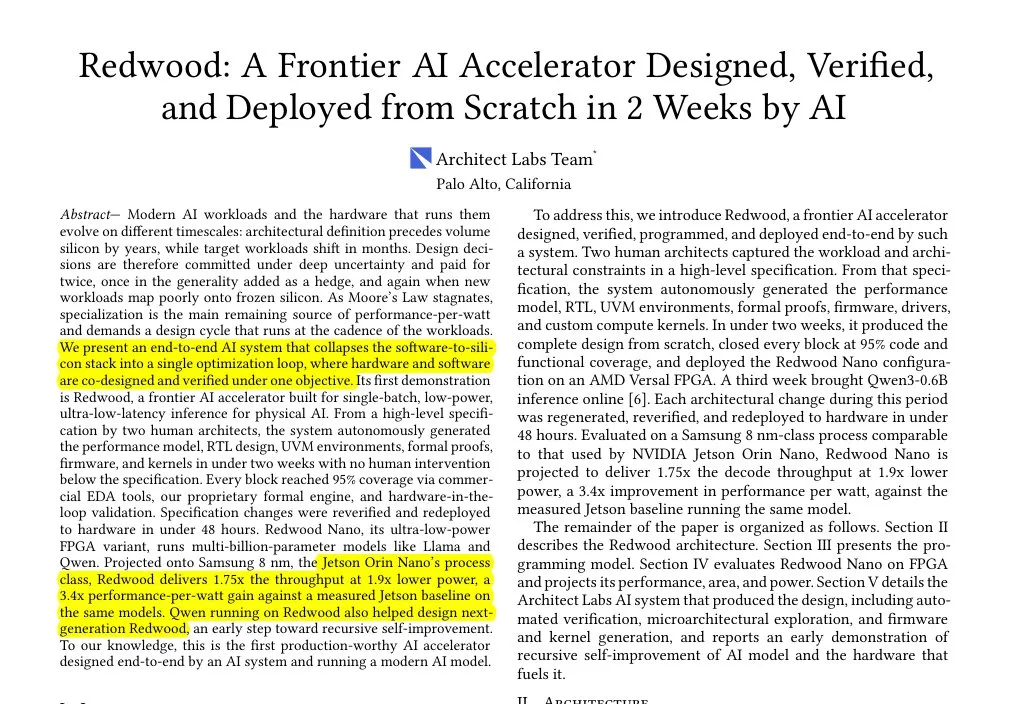
Redwood: A Frontier AI Accelerator Designed, Verified, and Deployed from Scratch in 2 Weeks by AI
This is a pre-print:
Modifying an architectural specification, AI from code reconfiguration, re-verification to hardware deployment, takes just 48 hours.
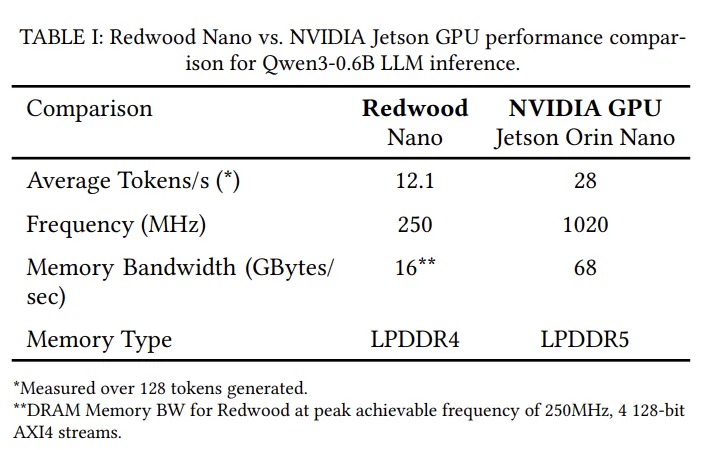
Moreover, the chip runs on an open-source model on the FPGA, and is estimated to be 3.4 times more efficient than the Jetson.
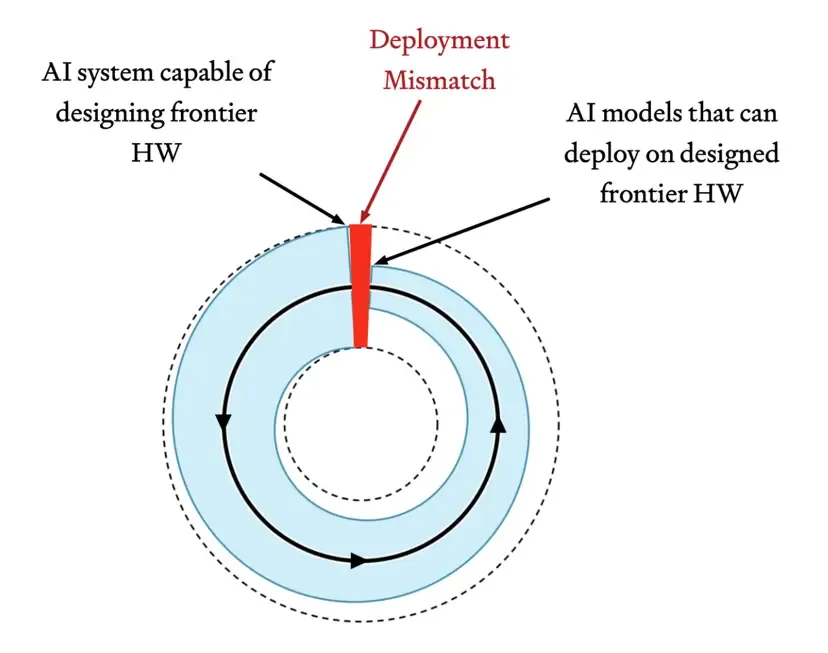
The most shocking thing is that the AI running on this first-generation chip has already started designing its next-generation chip.
 The OpenAI engineer confessed:"We can no longer understand AI.The code」
In an interview, experts at SemiAnalysis pointed to a piece of code and asked, "How exactly do these lines of compile logic move hardware units?"
Several of the top OpenAI engineers in attendance grumbled face to face, finally shrugging their shoulders and frankly admitting:
「To be honest, we don't really understand what it's doing in each line. But it doesn't matter. AI understands it, AI tests it, and it runs fast, and performance explodes".
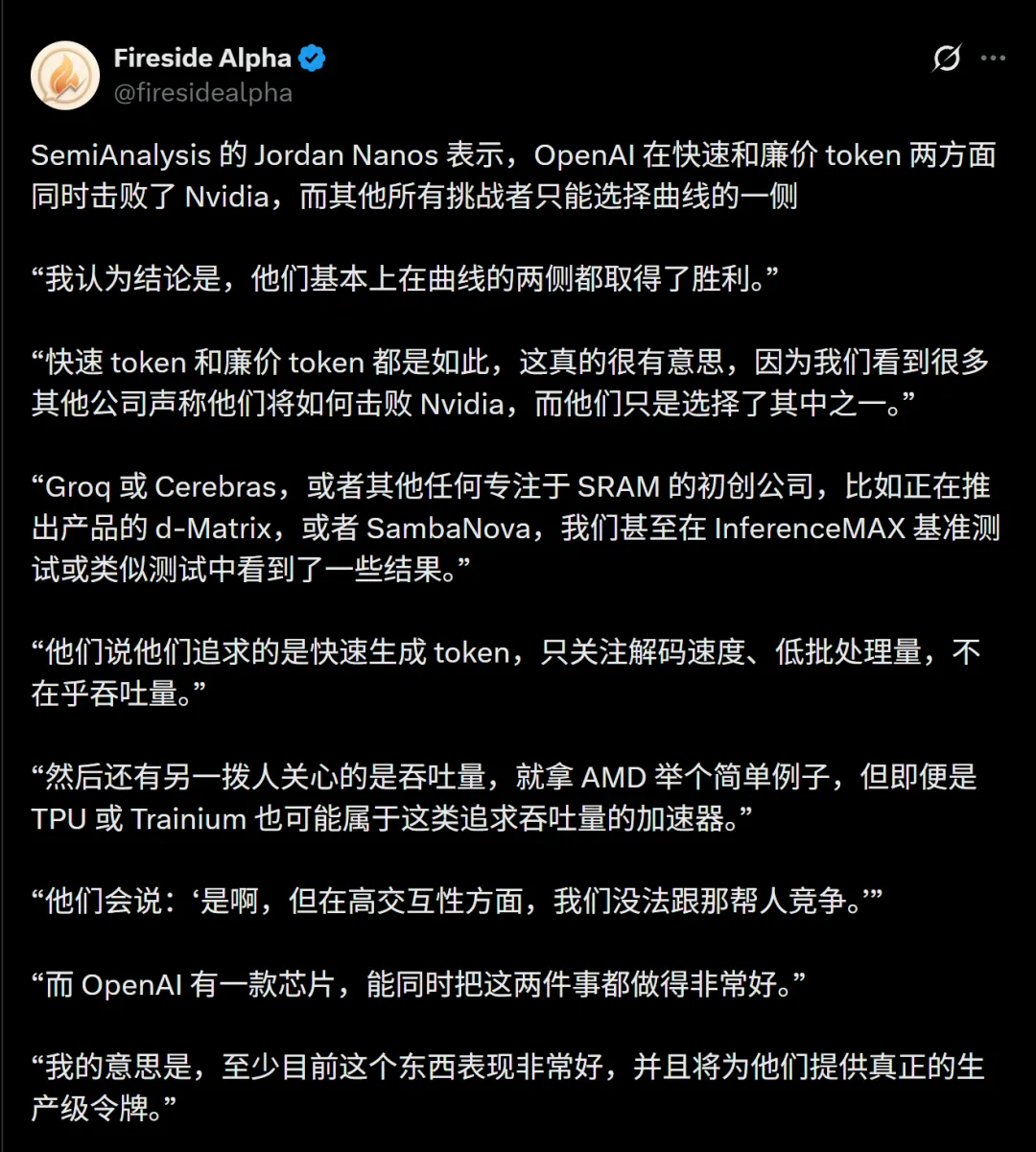
According to a major disclosure by SemiAnalysis expert Jordan Nanos, OpenAI has completely transferred the underlying compilation code to AI as it develops its most core underlying accelerator for its self-developed chips.
On top of Triton, the OpenAI team built an underlying kernel programming language called Gluon.
The complex hardware instructions in Gluon are automatically generated by AI in a short amount of time.
"Code doesn't need to be understood by humans, as long as AI understands it, verifies it, it's right".
This is the worst paradigm breakdown in more than half a century of software engineering.
Why give the underlying code to AI?
Because this is the only way to tear apart the mathematical defenses of the empire built by Huang Ren.
According to SemiAnalysis, OpenAI's secretly developed, self-developed AI chips are a challenge to Intel in terms of speed of generation and running costs.
More deadly, it is directly destroying the CUDA River, which has ruled the world for 20 years.
What makes Invidia irreplaceable is that millions of developers and hundreds of thousands of businesses around the world are tied to the CUDA ecosystem.
When underlying software hardware collaboration optimization is fully taken over by AI, humans no longer need to adapt to complex CUDA libraries. AI can directly target hardware architectures and automatically generate optimal underlying assemblies.
The chip cycle is broken!Two people + AI two weeks to create real hardwareAt the same time, this landmark paper just published by Architect Labs has completely disrupted the semiconductor hardware design industry.
Address of the paper:https://arxiv.org/abs/2608.26418
In the traditional semiconductor industry, what is the concept of making a dedicated accelerator chip?
Team sizeIt's a great way to connect hundreds of top chip architects, verification engineers, and back-end teams.
R&D cycleFrom geometry, architectural design, RTL writing to streamlined verification, it usually takes 18 to 24 months.
Cost of fundingFor example, in the United States, there are millions of dollars, even hundreds of millions of dollars, and the error rate is extremely low, leading to direct bankruptcy.
And what Architect Labs is doing is making the whole industry stand out:
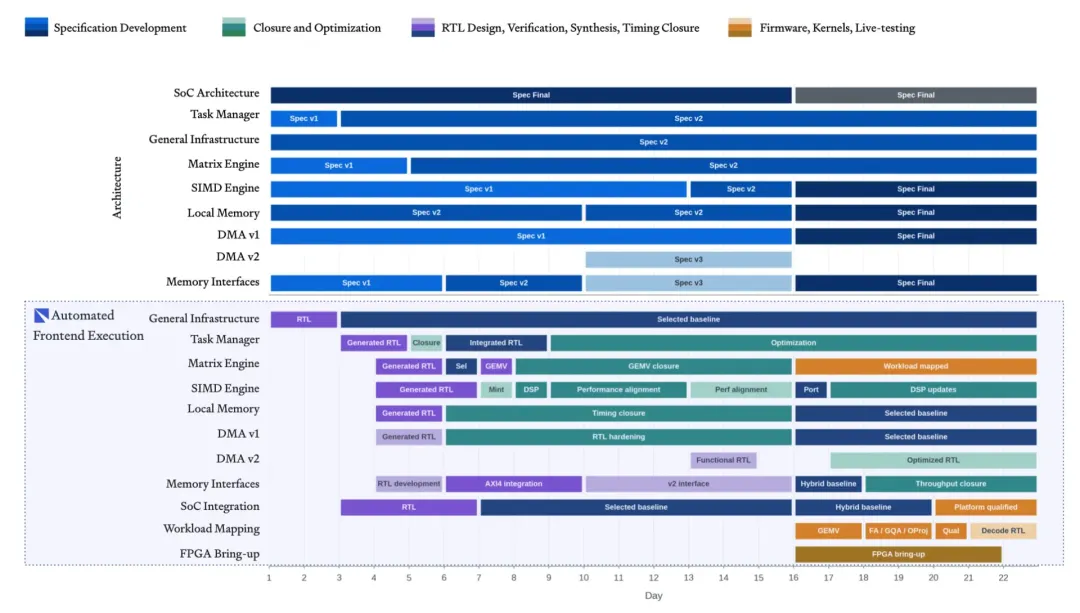
Only two human engineers have written a functional specification manual for the top layer in natural language.Two weeks of AI generating a complete set of hardware designs。
Under the regulations, the whole process is zero man-made intervention!
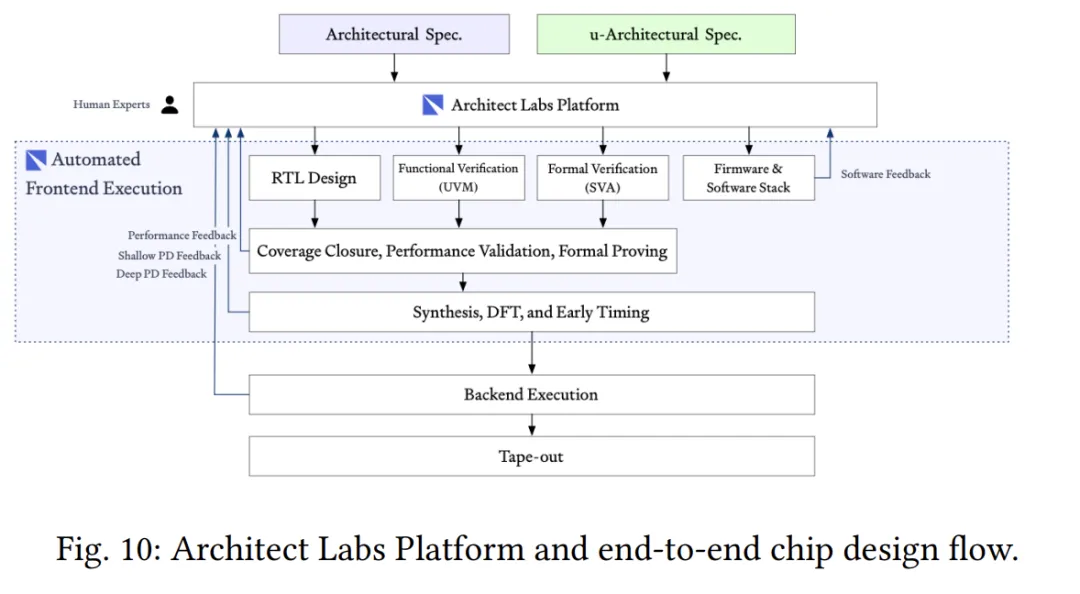
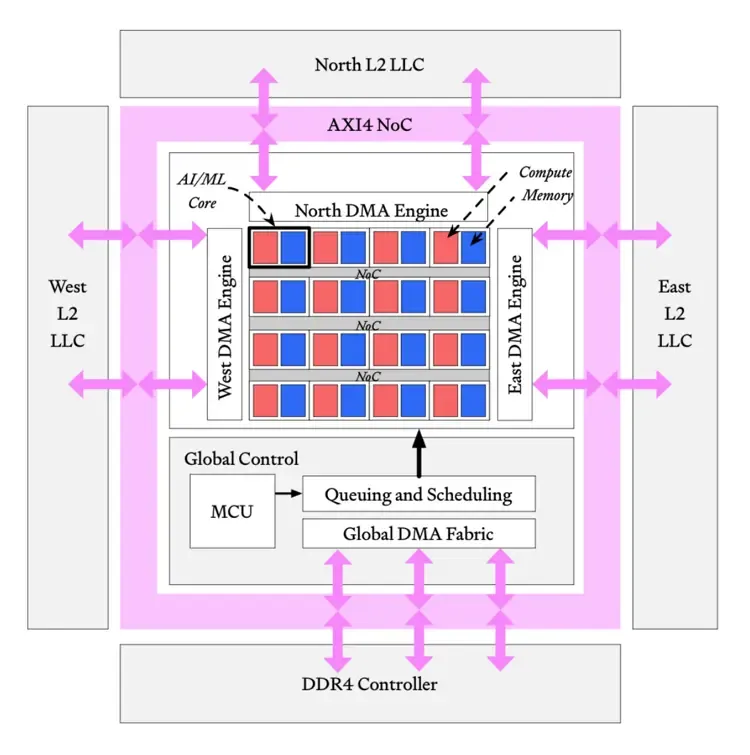
Without the use of any commercially available commercial accelerator IP, the AI system generated fully automatically in just two weeks, including registry transfer-level codes, hardware verification kits, and supporting underlying hardware.
Traditional chip design fears changing demand, and changing a module may take months to replicate and validate.
But in Architect Labs' AI system, after modifying the specification manuals, the AI re-generates, verifies and deploys real hardware, and the entire process takes only 48 hours.
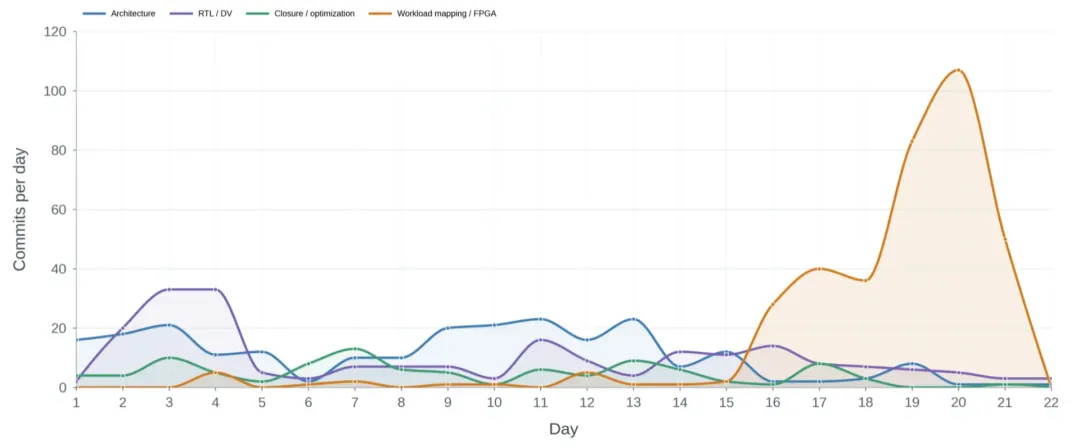
At its peak, the system was able to automatically integrate 115 hardware changes a day, with a module coverage of up to 95%, and the first version delivered 0 Bug!
The chip is called Redwood, and it's definitely not a paper toys for soldiers.
It is directly deployed on AMD Xilinx Versal FPGA hardware, running an open-source large-scale model in real-time.
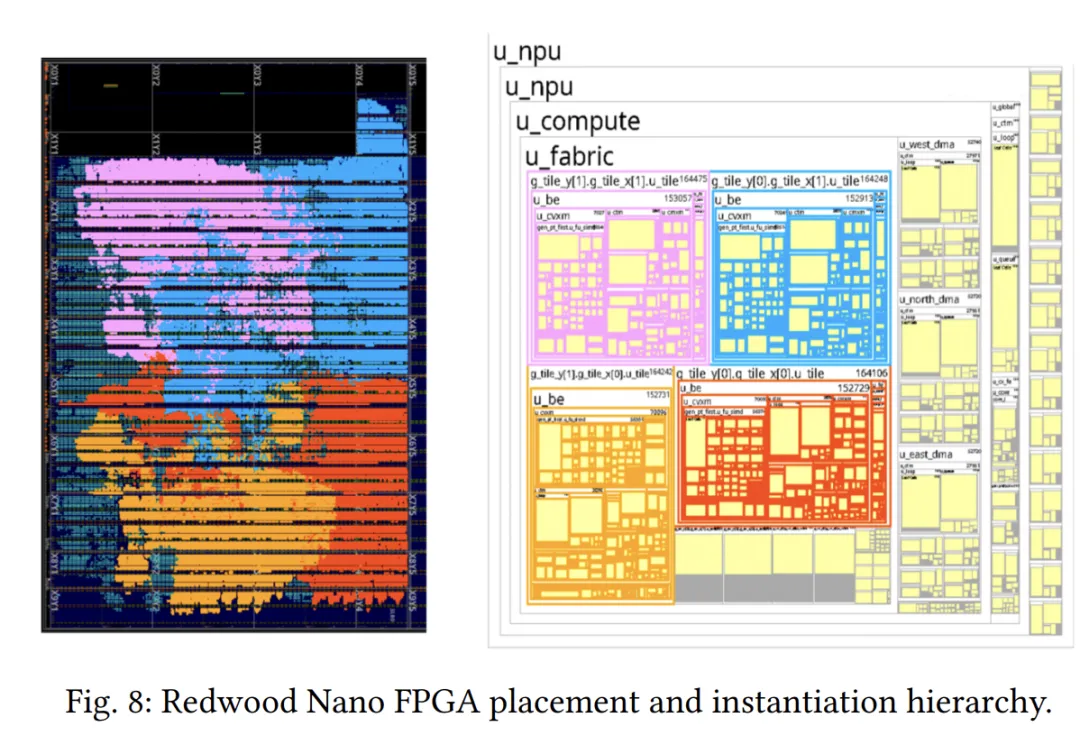
It is estimated that if Redwood is converted into an ASIC chip with the same system, its energy efficiency in the end-side physical AI (Physical AI) and in the low-power scenario is directly up to 3.4 times that of the flagship Jetson of Ingrid Edge Computing!
The half-century-old "hardware research and development cycle" of the chip industry has now been completely broken by AI.
AI is designing its own next generation of chipsIf you think this is just another case of AI reduction, you completely underestimate the huge storm behind it.
In the corner of the paper is a description that upsets all computer scientists:
"Running on the first-generation Redwood chips, the home-generation model has been fully involved in and involved in the architectural design and code generation of the next generation of chips".
Please stop and taste the words carefully.
This is the ultimate concept that the computer science community has developed for decades: the self-recurring evolution of hardware.
In the history of human evolution, it has taken millions of years from stone to iron and two hundred years from steam to integrated circuits.
But this is not the end of the world.
When a smarter AI designs a more efficient chip, the chip runs at 3 times the computing power and 48 hours faster than the larger AI, creating the next generation of chips.
Once the steering wheel starts to rotate, its rotation speed will not be linear but exponential.
Humanity is being marginalized.
Do programmers and engineers become the breadwinners of the Creator?Today, for the first time, the complexity of technology exceeds the brain bandwidth of the creator himself.
At the software level, "programming" in the traditional sense is dying. Future software development is the assessment of the constraints on AI's intentions and outputs.
At the hardware level, the billion-dollar threshold for chip design is collapsing. The semiconductor empire, once dominated by a giant monopoly, could be defeated by countless "AI+2 teams".
The underlying hardware and core algorithms supporting the future global computing network are becoming black boxes that humans cannot see.
We can only stand outside the black box and watch AI build a kingdom beyond human understanding.
Perhaps a whole new civilization that humans will be unable to understand and control has arrived?