On August 26, 2026, in a phone call with the British Financial Reporting Office, Huang Jian was asked how to view general artificial intelligence (AGI) and he replied: "For many tasks, we can say that AGI has already been achieved".
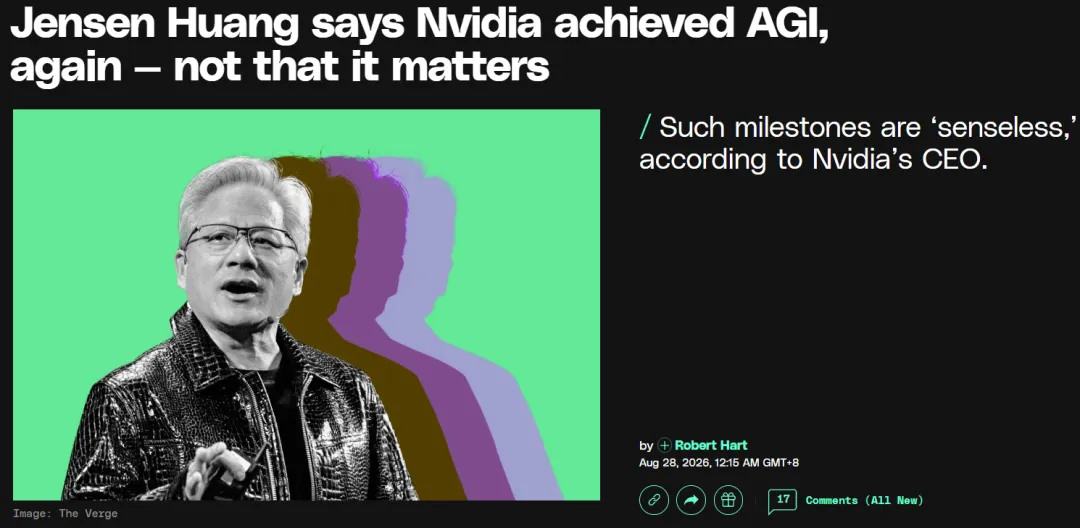
Of course, this claim is highly controversial and not widely accepted, but it is also sufficient to prove the strength of AI today. In retrospect, the field of AI has gone through 70 years of ups and downs.
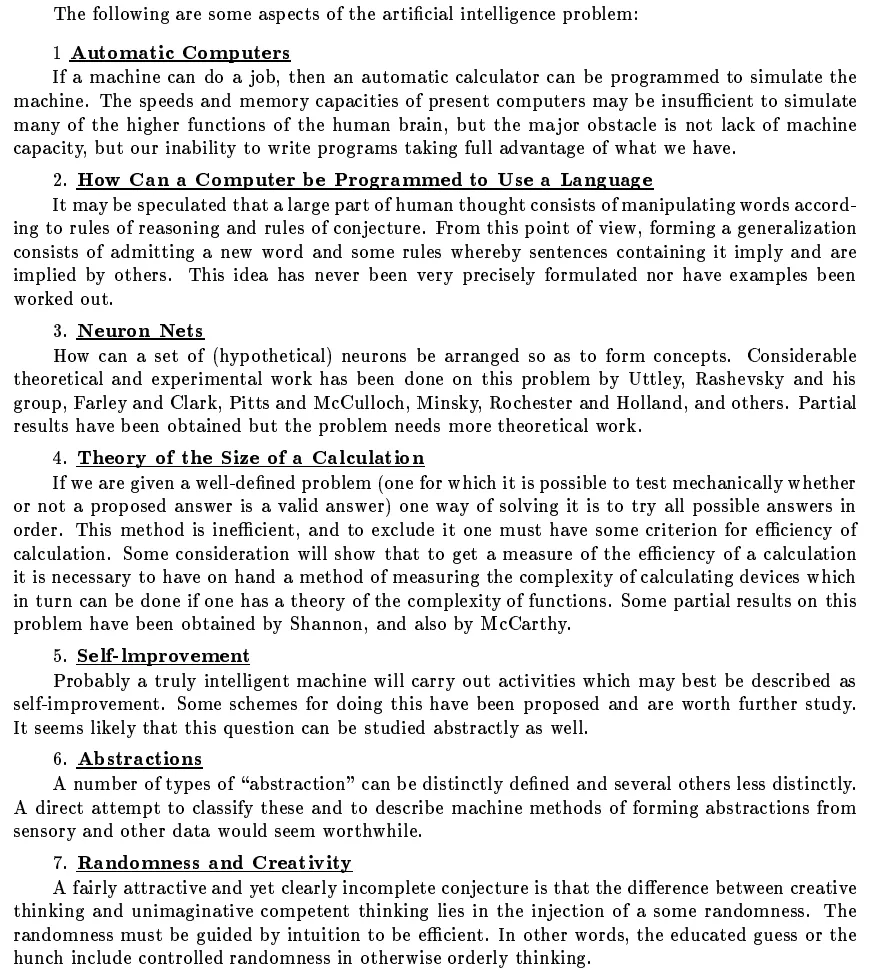
Seventy-one years ago today, on August 31, 1955, four young people submitted a proposal to the Rockefeller Foundation. The proposal was titled "Proposal for a Summer Study of Artificial Intelligence at Dartmouth". The opening line read: They suggested a two-month study of artificial intelligence at Dartmouth College in Hanover, New Hampshire, in the summer of 1956, involving ten people; the study was based on a hypothesis that every aspect of learning, or any other feature of intelligence, could in principle be described accurately so that machines could simulate it.
The four signatories were: John McCarthy, 28, assistant professor of mathematics at Dartmouth College; Marvin Minsky, 28, a Harvard undergraduate; Nathaniel Rochester, 36, director of information studies at IBM; Claude Shannon, 39, a mathematician at Bell Laboratories. Only Shannon, a mathematical theorist, was able to calculate stars.
They applied for $13,500. The Rockefeller Foundation approved 7,500.
Ten people, two months, $7,500 to solve the problem of intelligence. This is the first and most famous underestimation in the history of AI. Seventy years have passed since the tasks listed in this proposal -- allowing machines to use language, form abstractions and concepts, solve current problems that can only be solved by humans, and self-improvement -- just formed a product roadmap for the entire industry in 2026.
How AI has evolved over the past few decades is worth re-telling because its story is so twisted, it's a thread that bounces over and over and over again, and the reasons for each fall are surprisingly similar.
Name: A word coined to avoid Vienna
Prior to the emergence of the term "artificial intelligence", the field was already known as control theory (Cybernetics). Norbert Wiener's book of the same name, published in 1948, was the Bible of the time and formed a huge academic circle around him.
McCarthy did not want to join the circle. According to many later recollections, he was neither willing to acknowledge Vienna as an old man nor to argue with him, but also felt that Shannon's information theory was too theoretical.
This is how Artificial Intelligence came about. It is not an accurate technical definition, but a product of academic political manipulation. This detail is worth remembering because it explains a dilemma that has repeatedly arisen in the field over the past seventy years: the word has not had an operable definition since its first day of birth, so it can never be proven to have been realized, nor can it ever be proven to have failed.
The conference lasted eight weeks from June to August 1956 at Dartmouth College. Unlike today's academic meetings, there was no fixed schedule, no papers collection, scholars came and went, someone stayed for a week, someone stayed for the whole summer.
The most striking thing about the meeting came from two people who did not sign the proposal: Allen Newell of Carnegie Institute of Technology and Herbert A. Simon. They came up with a program called "Logic Theorist" to prove that Russell Bertrand Russell and Alfred North Whitehead wrote the thirty-eighth of the Principles of Mathematics, Chapter Fifty-two.
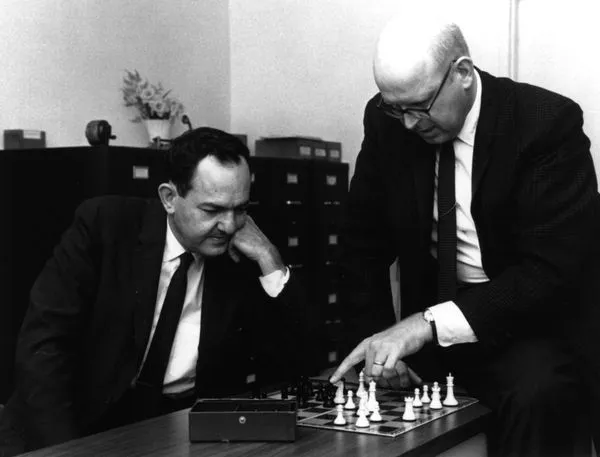
Herbert Simon (left) and Allen Newell (right)
Newell and Simon were thrilled to write a paper that was submitted to the Journal of Logic Symbols, with the author's name attached to the logical theorist.
For the first time in history, an AI system has been denied the right to sign.
In any case, after that conference, the field of artificial intelligence was born.
The Golden Decade: Everyone is Mad
The decade after Dartmouth was one of the happiest in the industry. Money was high, people were few, results were dense, and every demo was like a preview of the future.
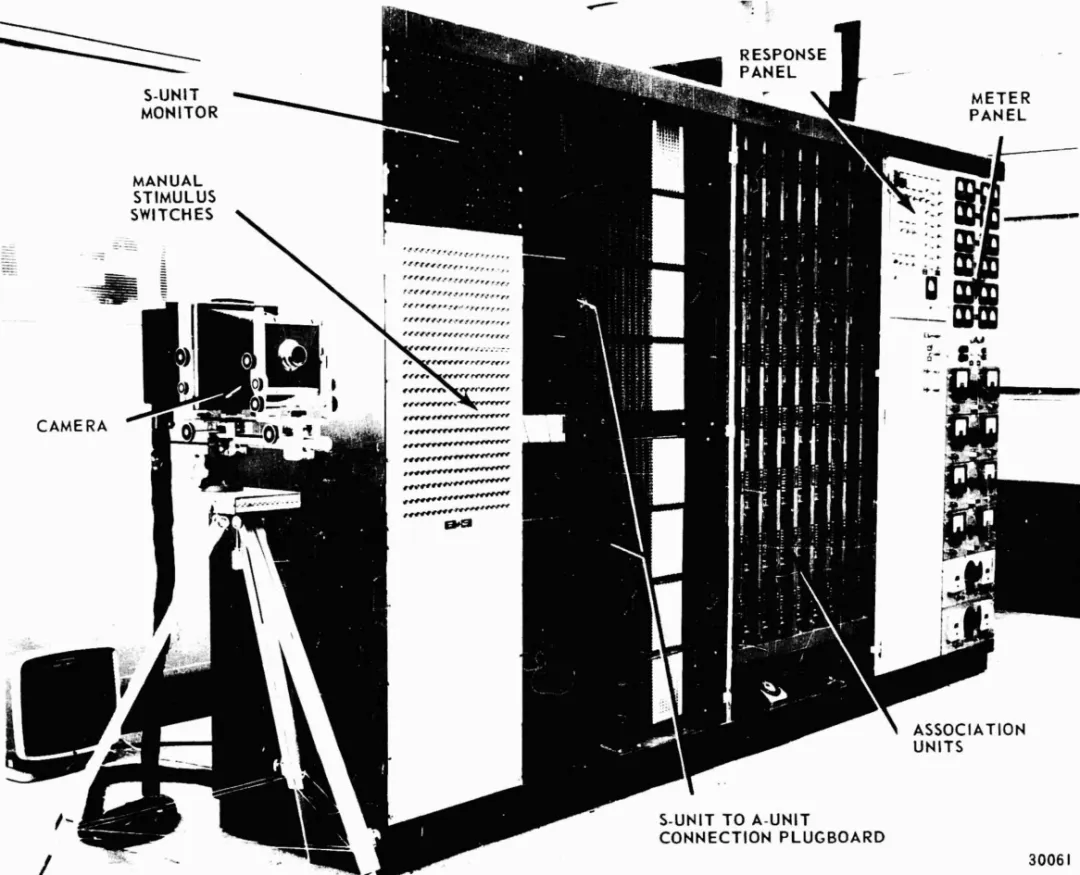
In 1958, Frank Rosenblatt of the Cornell Aerospace Laboratory invented the Perceptron. It was a real hardware device, the Mark I Perceptron, which uses 400 optical tubes as "optical retina", powered by an electrical switch, and powered by a motor to update parameters. It learned to distinguish simple graphics.
In the same year, McCarthy invented the LISP language, and for the next thirty years, it was the general language for AI research.
In 1959, Arthur Samuel of IBM let his jumping chess program play chess with himself and won his own chess. This was the first time the word "machine learning" had a physical equivalent.
In 1966, MIT's Joseph Weizenbaum wrote ELIZA, a pattern matching program with just over two hundred lines of code, in which he played a psychotherapist from the Rogers School who turned your words into an answer to a question and threw them away.
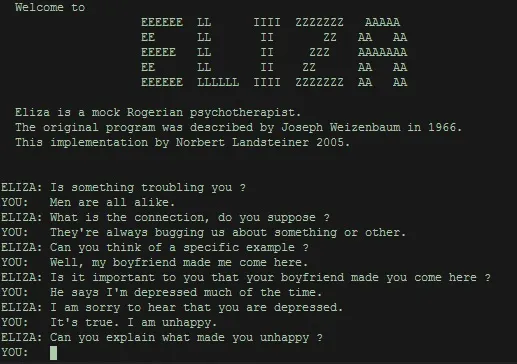
As a result, his secretary took a few minutes and asked him to leave the room because she wanted to talk to ELIZA alone. This frightened Vison Tom, who later became one of the most vocal critics of AI.
In 1970, Terry Winograd's SHRDLU was able to understand instructions such as "put that big green block on top of the red block" in a virtual world of blocks, and to answer questions about why he had just done so. Shakey, a robot at Stanford University at the same time, was able to plan a path box in the corridor; although it took a long time to think about it every step of the way, that's what the name came from.
In 1965, Herbert Simon wrote that in twenty years' time machines will be able to do anything that humans can. In 1970, Minsky told Life magazine that in three to eight years' time we would have a machine with the intelligence of ordinary people.
At the same time, Minsky did something else. In 1969, he and Seymour Papert published a book on the mechanism of sensorineural resonance, using rigorous mathematical proofs that no simple logic such as single-layer sensorineural resonance or XOR can be expressed. The book also discussed the possibility of multi-layer networks, but the attitude was pessimistic, believing that its training problems could not be solved.
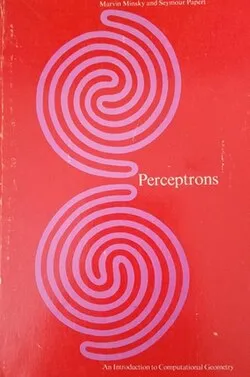
The book's lethal force far exceeds its mathematical content. Neural network funding was largely cut short in the decades that followed. Rosenblatt died in a boating accident in Chesapeake Bay on July 11, 1971, his 43rd birthday.
Symbolism won this race. But it won too early, and it was too early to find itself about to hit the wall.
The first winter: Leithill report
The wall came quickly, and it was two sides of the same wall: computational and combined explosions.
In 1966, the ALPAC report of the National Academy of Sciences was the first to give machine translation a shot. The report concluded that, after a decade of investment, machine translation was not only much faster and cheaper than artificial translation, but also much worse in quality, and recommended ending funding for fully automated translation.
In 1973, the British Council for Scientific Research commissioned the applied mathematician James Lighthill to evaluate the value of AI research. The conclusions of the Lighthill report were unsatisfactory: AI research fails to deliver on its promise in all areas, and those that perform well on toy issues will fail completely when faced with a real-world scale problem due to exploding combinations of search spaces.
Combined explosion is the fundamental dilemma of this generation of AI. Chess, labyrinths, theoretical proofs, in essence, are searching on a giant tree. The tree of the toy problem is small and poor; the tree of the real problem is large enough to have the number of atoms in the universe, and there are not enough intelligent illuminated cuttings.
Following the release of the report, almost all funding for AI research in the UK was withdrawn, with only two or three universities remaining. Across the Atlantic, U.S. DARPA's open funding for AI shrank significantly after 1974. Carnegie Mellon's Voice Understanding Research Project (SUR) was cut because it did not meet DARPA's expectations.
The first winter lasted until after 1980. It was caused by a gap between what AI promised and what it could deliver.
This gap will occur twice later.
Knowledge is power: a decade of expert systems
The solution is a strategic contraction: if you can't create universal intelligence, you have to create an expert who only knows one thing.
The motto of Edward Feigenbaum is "Knowledge is Power".