It's just that OpenClaw 2.0 has arrived.
Officials also joked that it was faster than GTA 6:
According to the project's own statistics, this is the largest update ever, with 933 contributors participating, 569 of whom were the first to submit code to the project, and more than 160,000 pull requests for the merger, about half of all OpenClaw mergers to date.
The blog was written by Hannes Rudolph, a member of the team, and the title is interesting: OpenClaw 2.0, Accidentally Crashed (accidentally). According to him, the team only intended to do two things: simplify the installation process and make the browser experience a first-class citizen.
Prior to this update, OpenClaw hadn't released a new version for nearly seven weeks. In the 230 days prior to that, it had released 106 versions, usually only a day or two apart from the two releases. The blog explains that as the release pace slows down, development accelerates, team size increases, workload and speed exceeds the baseline of the original code and release process, and the two sides return to work together.
What's changed with 2.0?
The installation has been pushed back. The new bootable installation will first scan the existing AI access permissions on the machine, which can be duplicated using a verified Codex, ChatGPT or Claude CLI login, accept an API key, go through the vendor's own login process, or find the Ollama and LM Studio models installed on the machine, and then verify that the specific option does provide a response, and then save the model and credentials.
The newly installed OpenAI configuration uses GPT-5.6 by default, while the local side replaces node-llama-cpp with the hosted llama-server, and the default context length of llama.cpp refers to 64K.
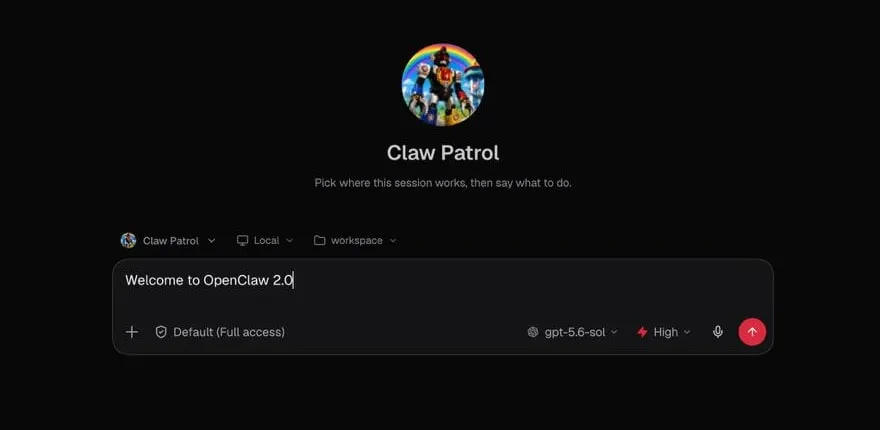
Rebuilt browser ends open directly to a dialogue interface
The Control UI at the end of the browser is rewritten as the chat-first structure, the original Overview page is deleted, the session goes into the sidebar, and the conversation is centered. The files, approvals, terminals, Git changes and a stand-alone browser panel line up next to the conversation, the tool calls and results to show that the file changes show focused diff. A command called /btw can open an independent multi-sided conversation to lower the issue of not wanting to contaminate the mainline record. The official performance figures given come from a simulation testing environment (mocked Gateway, 50 milliseconds HTTP/1.1 delay).
The underlying storage has also been changed. Session and transcript records are transferred to SQLite, at the cost of the downgrade being no longer free: before rolling back to the old file storage version, the old format of the transcript files must be restored to the current CLI archive, and the sessions created after the migration will not appear in the old version at all. The official recommendation is to make a verified backup before upgrading.
The most productive thing to do is to share a cloud session. Rudolph says the team used this feature themselves: they increasingly handed over work to their Claw in the process of developing 2.0, and then found that when they wanted to share tasks with colleagues, collaborate, or even transfer completely, OpenClaw had no way of pulling another person in without losing context. Now the meeting owner or administrator can decide whether someone else would just read suggestions, work on draft, or participate directly.
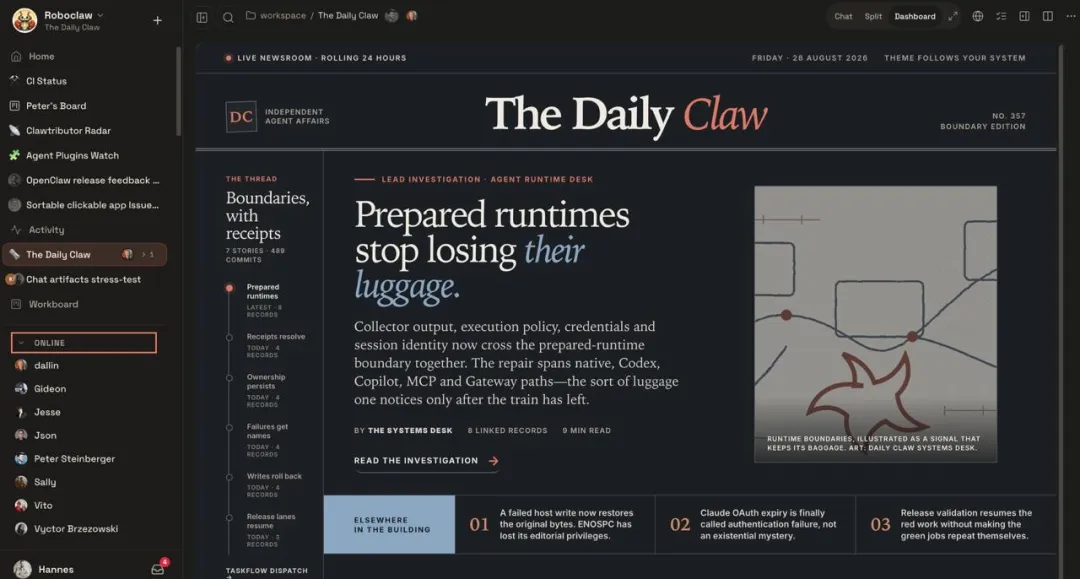
A user-created dashboard in a shared multi-user OpenClaw workspace
It's worth noting that the documentation is fairly straightforward about the self-setting of this feature: these controls are not tenant isolation, nor do they constitute a security boundary, and after permissions are revoked the interface may still be briefly displayed as available before a refresh. Incognito mode is defaulted to shut down, the dialogue remains only in process memory, no disk transcripts and automatic memory, Gateway restarts will disappear, but messages are still sent to model vendors, tools can still write files and affect external services.
The security section, Gateway default binding loopback, most chat channels returning matching codes to unfamiliar private letter senders, open-law security audit commands for checking site access, tool impact radius, network exposure, browser control exposure, and plug-in whitelisting. The document cites a set of crowd-sourced attack arena data in 2026:41 of 272,000 attacks in the smart-body scenario, only when the smart-body performs both malicious operations and hides from the user. Claude Opus 4.5 is rated 0.5%, Sonnet 4.5 is rated 1.0%, Haiku 4.5 is rated 1.3%, and Gemini 2.5 Pro 8.5% respectively.
What is the meaning of this verse?
This is a technically well-established version, but its timing is worth more than the content itself. In the past six months, the project's most common keyword in the Chinese and English communities has been "Is it cool?" After all, the heat of OpenClaw in recent years has actually waned a lot. Many users have left, and the enthusiasm of developers and contributors is not as intense as when it was released.
This 2.0 update, it looks like OpenClaw intends to evolve into a truly available productivity tool. Replicating log-in credentials, moving sessions to SQLite, adding 30 days of history to requests for approval, writing down destructive paths in a warning box, actively declaring "this is not a safe frontier" in collaborative documentation... These are projects that will only work hard when they move from demo to production tool, which is exactly what it lacks in the January-March frenzy.
Let's take a look at how 2.0 can bring people back.
Reference links