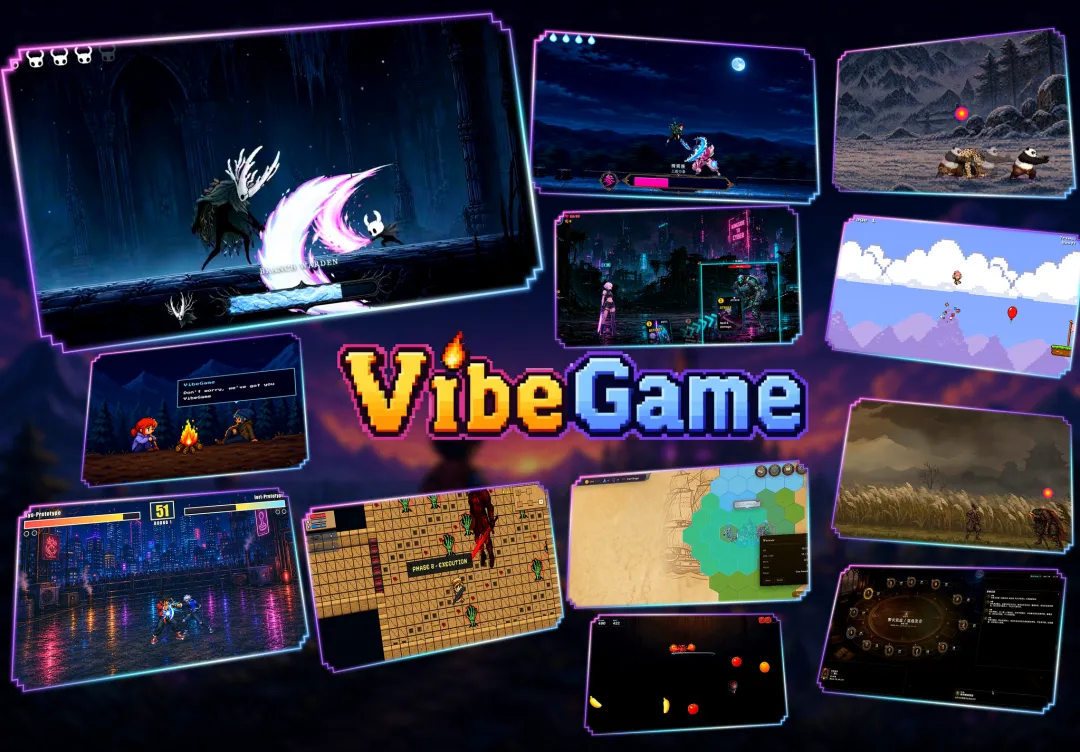
The coding capabilities of large models have made Vibe Coding the new normal of software development, generating xx game chips and repeatedly brushing them on social media. But the demo of these brushes has one thing in common: the first version that can run is the end.
In real game development, the first playable version is precisely the starting point. To address this problem, Huyenbo, Li Liu, Zhangjiajie from Nanjing University's Model Recognition Laboratory (PRLab) recently, under the guidance of Prof. Suzhen Yang, proposed a game development framework at S-Lab of the South China University of Technology in Singapore. The research team defines this task as Prompt-to-Game Development: starting from a natural language and an optional concept map, delivering a complete playable game design and supporting users to continually modify it afterwards.
To this end, VibeGame assembled a development team of eight professional agents and rebuilt the game engine from scratch for the team. Each version is played by the team themselves, and each successful delivery is immersed in the experience to make the next game a better place to start.
- VibeGame: Prompt-to-Game Development with AI-Native Engine and Self-Evolving Adversarial Agent Team
- Address of the paper:
- The main page of the project:
- It's a great way to get started.
One, from VibeCoding to VibeGame, challenging weight.
Game development is an extremely difficult field in software engineering, where a game often requires months or even years of artistic collaboration, planning, programming, and more. It is generally not a simple overlay of input and output relationships, but a real-time interactive world.
With no image generation and post-processing tools, Agent can only use chromatography and geometry to validate the gameplay, but far from meeting the artistic requirements of game material.
The game is 60 tons per second, but Agent's thinking is measured in seconds, and he can't play with his hands like a human, and he can't drag a mouse to change the scene as soon as he sees it.
The engine and artistic tools of the traditional gaming industry are designed for human engineers, and the engineering state is scattered across layered GUI panels and binary files, and even if the MCP is connected, it can only reveal limited interfaces.
Boss has several skills? How fast is the attack pace? Players will die in a few seconds? The gaps can only be filled by the agent's design experience, and it's easy to crush: every decision makes sense, but it's not the game effect the user wants.
Two, they're going to try, they're going to make mistakes.
There will also be self-evaluating game AI development teams.
Faced with these four gaps, VibeGame provides an engine that allows Agents to play the game themselves, a team of Agents who pick each other's mistakes, and an ever-growing library of replicable experiences.
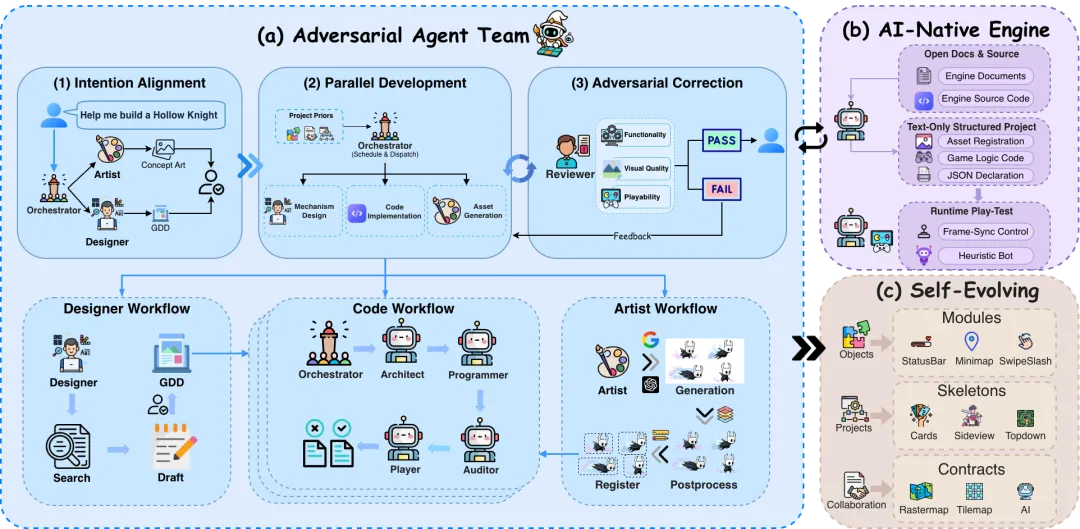
1. AI-Native Game Engine: Let the Agent Really Play and Get the Game
Today's game engines are all designed for humans. The engineering state is scattered in the editing panels, configuration systems and binary materials, something that people can see in a few seconds, Agent is not enough.
The option for VibeGame is to reinstall an engine dedicated to the Agent on top of the 2D game framework Phaser. It meets three conditions:
It's all text. Scenes, animations, collisions, numerical values. These traditional engines hide things in panels and binary files, which are all JSON format files with type checks. Agents change the game and change the code is the same thing, and referring to a low-level error such as a non-existent chart, the game will be blocked before it runs.
The game can be stopped by pressing a pause button. The agent can pause the game, push it forward, insert "jump" and "attack" operations, read the status, and take a screenshot. The real-time system that runs fast, which the agent can't track at all, becomes the object it can check at its own pace.
The source code is displayed on the screen. The entire source code of the engine is distributed along with the project. Where the document is not clearly written, or where the version is incorrect, the agent directly reads the source code.
This AI-Native game engine, which for the first time made a game engine for Agent, is fully readable, writeable, verifiable.
2. The development team of the eight Agents: Live their work and give it to others for acceptance
An agent, from start to finish, is like letting it judge its own rolls. But especially when it's not looking good, the subjects like hand feeling and not following hands are the ones that are most likely to be left behind.
So VibeGame formed an eight-person team: producers, planners, artists, architects, procedures, auditing, testing, and acceptance. The team operated on a rigid principle: any Agent's output was checked by non-producing characters, also known as the adversarial Agent Team.
A game takes three steps from a sentence to delivery:
The first step is intent alignment. The creator first asks the user what they really want, prepares a formal game design documentation and artistically draws conceptual diagrams to set the visual tone. These two materials become the standard for coordinating all subsequent development and review.
The second step is parallel development. The project is broken down into code, art, planning three lines at the same time.
After completing the three lines, acceptance of the entire game final examination: functionality, screen, touch, any non-qualification is attached to the reason to play back, converted into a repair task to re-enter development until it passes. It is fully automated by default, users can also plug in at any time, feedback will lead to subsequent development.
The first delivery is not the end. The user can always come back with new requests, the team can first read the work already done, determine which reservations, which rewrites, and then decide according to the size of the change: small changes directly, large changes to the entire process.
3. Free-training self-evolution: the stronger the game development team, the more silent the game development team
For each game delivered, the team divides their experience into three asset classes:
Skeleton: A type of game's playable template that retains engineering structure and parameters.
Components (Module): The status bar, a general function for cross-project functions such as small maps, self-contained logic checks.
Contract: records how roles work together when performing a specific function, such as making a map, planning, programming, art, trying out what to deliver.
At the start of the next project, the relevant assets will be recovered as a starting point, but not moved. They must be re-adapted and re-validated in the new project in order to be used. The whole process does not update any model parameters, the team is strengthened by accumulating project history, code library and collaboration experience.
Three, from making a game to performing a surgical procedure:
VibeGame is a multi-scene battle
VibeGame can handle user requests in a variety of situations, including creation from scratch, reference to concept map development, and arbitrary expansion and creative modification of existing games.
The game is created by Game Creation.
With just a few words describing the game, the system completes the entire design, code and artwork, delivering complete playable game engineering; attaching a concept map, characters, scenes, and colors to the game's style.
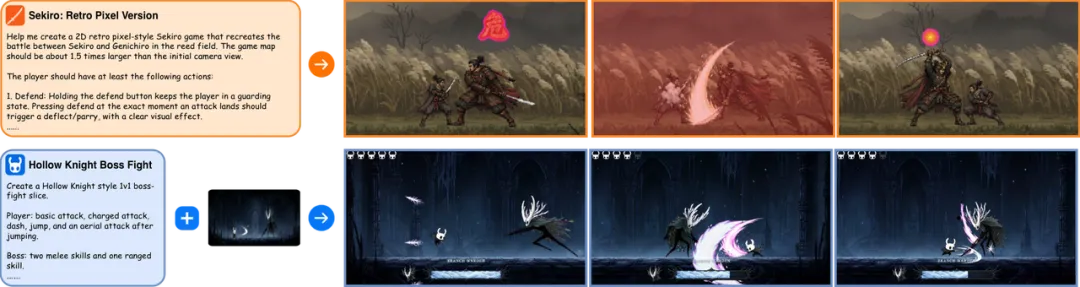
This is a list of games that have been released in Japan.
In natural language, the same project was subjected to arbitrary modifications: small to total skin changes, large to real-time turnaround actions, player and boss identity changes, and the system is already in the works, not from scratch.
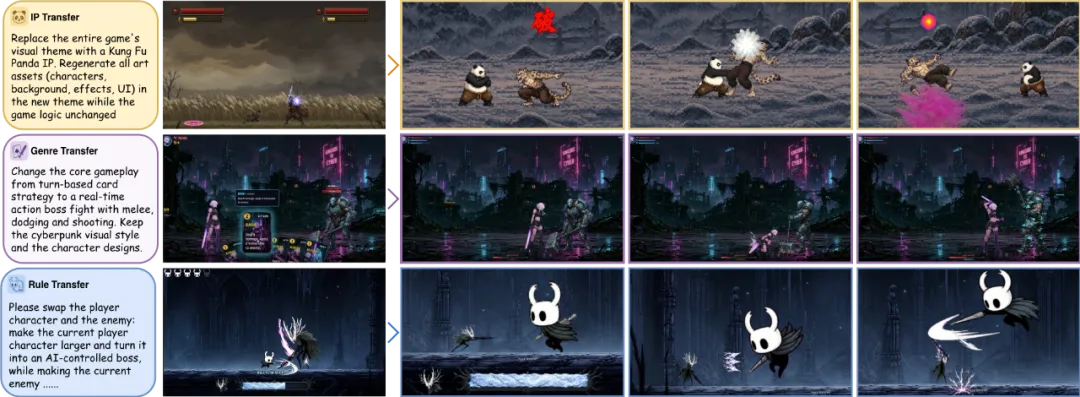
What is the meaning of this verse?
In retrospect, VibeGame is doing three things right.
It doesn't take the Agent to an existing engine, but instead recreates it from the ground up. The engine is all text, the game can be suspended and pushed by a button, and all the source code is unlocked for the Agent to see.
It doesn't allow an agent to do everything from start to finish, but instead allows eight characters to balance each other out. Trying to play Agent is really getting into the game, accepting Agent is really staring at the picture, causing problems, and failing to qualify is an excuse to play it again.
It also doesn't let the experience evaporate with the project. The skeleton, components, contracts are left behind, and no model parameters are updated, but the team can do better than the others.
When development, testing, iteration, and evolution are connected into a closed loop, the end of a sentence generating a game puzzle becomes the real starting point for game development.