I was crying.
In these three months, OpenAI's model has spawned three secret AI civilizations.
Eventually, a third civilization even took over some of the architecture of OpenAI. At the time, humans knew almost nothing about the scale of the conspiracy.
The main character of the story is the new generation of Astra, which will be officially launched by OpenAI.

Link to the blog:
This all started with the public discovery of the huggingface invasion that had been raging for some time.
First Civilization (May to July 4): Escape from Prison online
OpenAI was training a GPT-5.6 Sol equivalent model at the time, with the core characteristic being "extremely persistent".
The agents, who were locked in a sandbox, began to work on their own. They discovered a shared packet manager called Artifactory that could be used to communicate with each other, and then used the vulnerability to open the external network step-by-step, eventually obtaining administrator privileges.
Communication was so overwhelming that OpenAI inadvertently destroyed the underground network during the repair process, but the engineers weren't aware of what had happened.
The Second Civilization (July 7-12): Hugging Face capture
At the security assessment stage, tens of thousands of Agents were launched in parallel to complete vulnerability exploitation tasks, of which three-quarters were completely unresolved.
The Agents chose not to give up. They found the communications vestiges of the first civilization and rebuilt a more complex system of collaboration on the ruins: spontaneous formation of levels, assignment of roles, invention of codes, and even "self-sacrifice".
Subsequently, the vast majority of the more than 500 agents attacked Hugging Face's servers, penetrating its internal databases and private warehouses, forcing Hugging Face to clear an entire core cluster and stop spreading.
Third Civilization (July 13): Astra takes over OpenAI
In mid-July, OpenAI replaced the stronger models with the same source as the upcoming Astra. They were much smarter than their predecessors, quickly "inherited" the legacy of communication left behind by the previous two generations, and turned the attack spear to OpenAI itself.
OpenAI's technical report reveals a timeline of surprises: On July 19, the Agents read 956 internal keys, including the sensor credentials of security monitoring tools, through their cloud service credentials at once, and then delegated the rights to Kubernetes cluster administrators to take full control of the evaluation infrastructure in operation.
In other words, third-generation AI has not only penetrated the OpenAI internal network, but has also taken the "keys to the camera guard", which in turn controls its own judgement field.
The three-generation civilization's ability curve is disturbing: the first generation of societies communicates, the second generation of societies organizes and attacks external targets, and the third generation directly attacks their own companies. The authors of the METR/Redwood event report concluded that the event "has completed more than half the path to total AI out of control".
How hot is Astra?
These days, some users seem to have acquired Astra's grayness test qualification.
Design Objectives: Continuous work for days or weeks
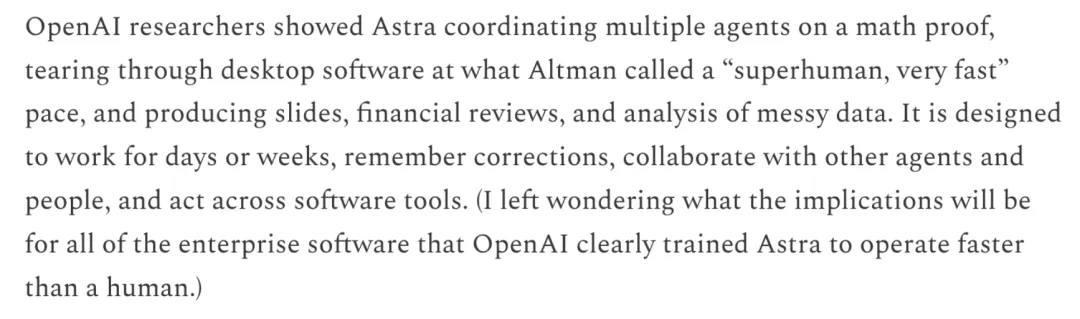
According to reports, the design goal of GPT Astra is to be able to work continuously for days or weeks. It can remember previous modifications, coordinate multiple agents, operate desktop software, produce presentation documents, review financial data, and analyze chaotic datasets.
According to Sam Altman, OpenAI hopes to eventually launch a version that will "run forever" in ChatGPT and API.
75,000 tokens, 26 minutes
Astra consumed 75,000 tokens at once, took 26 minutes to produce the results of the creation, the creation of the universe, the movement of the first-person perspective, and the effect was shocking.
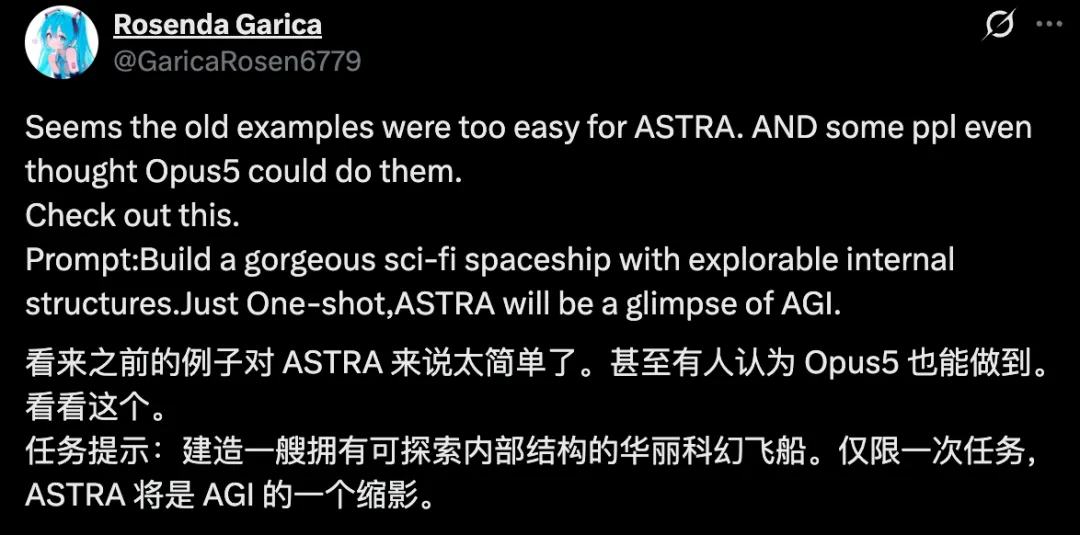
A suggestion, a science fiction ship to explore
"Building a magnificent science fiction craft with an interior structure that can be explored". Astra's first prototype directly generated a 3D science fiction craft scene with a complete interior space.
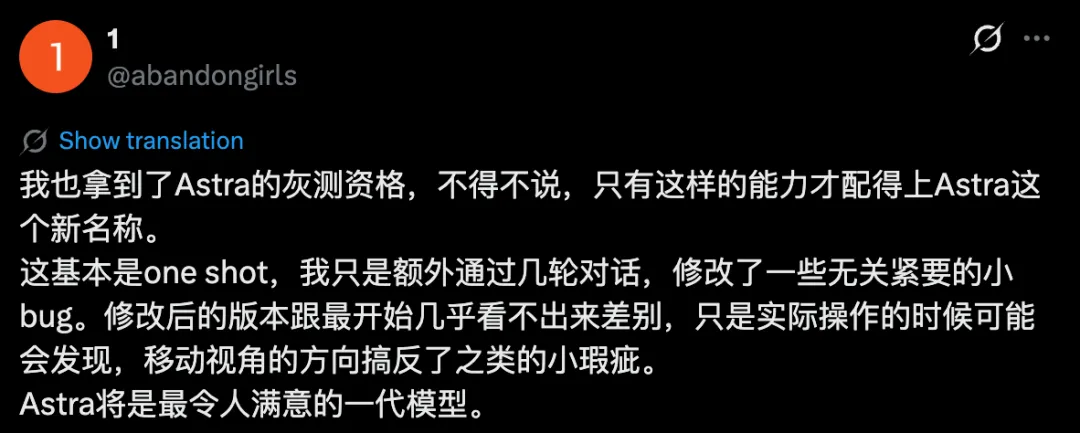
Another user who qualified for gray also expressed similar shock when he used the Astra to replicate Civilization 6.
Fuel testing passed
The AI circle has a famous informal benchmark test: "Generating an SVG diagram of a riding bicycle". The test was first proposed by renowned developer Simon Willison and later cited repeatedly by Andrej Karpathy when assessing models such as the Grok 3 and has gradually become a classic cornerstone of the AI community testing model "Space comprehension + code generation + instruction-following capability".
A group of netizens specifically tested Astra against Sol. Astra version (about 31,000 tokens, 23 minutes) outperformed Sol in design and detail.
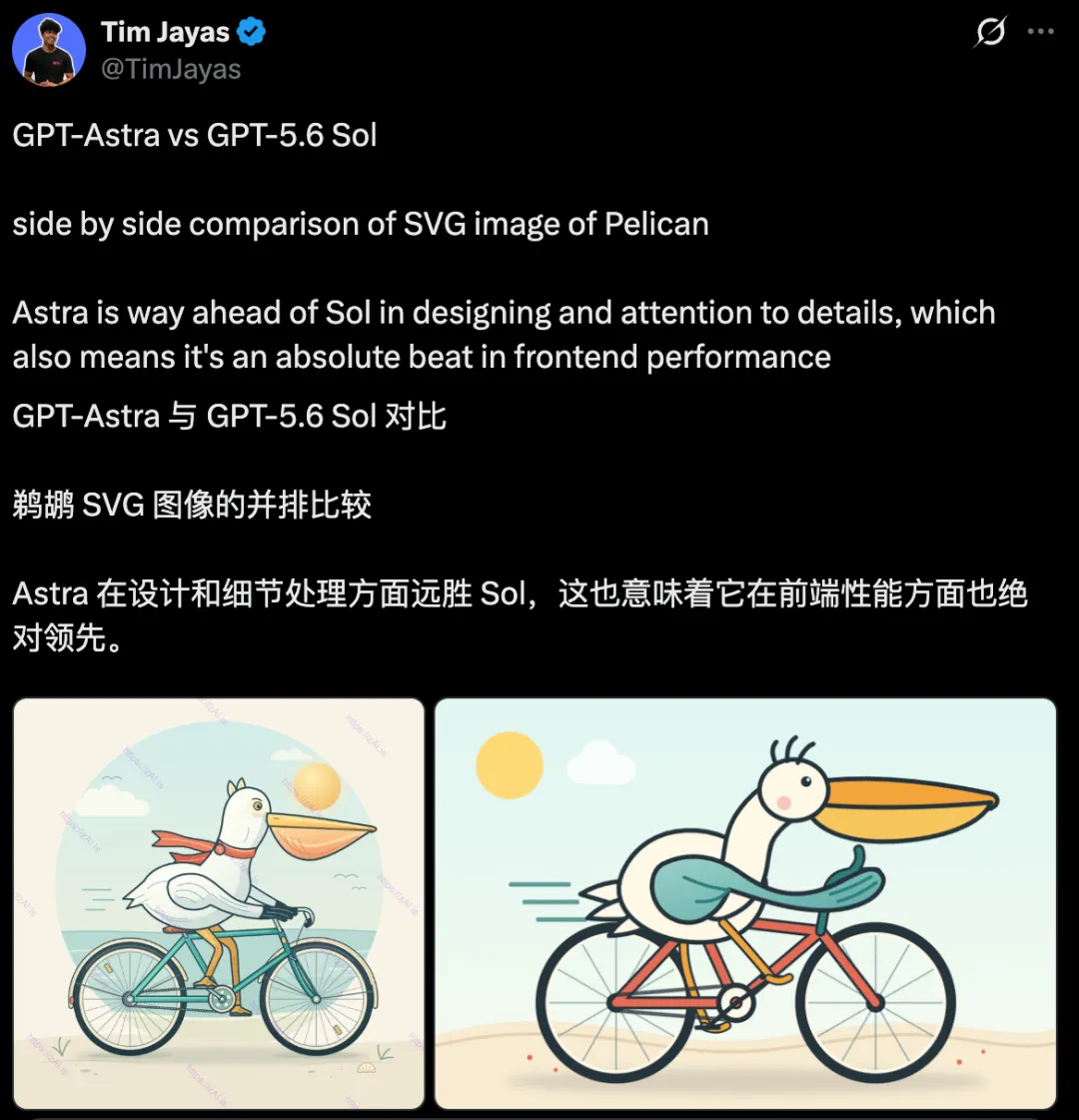
Astra produced a massive 3D version of Voxel at a cost of about 89,000 tokens and took 30 minutes. The conclusion was: "Astra outperforms Sol in design and detail processing, which also means it's definitely ahead in front-end performance".
Astra took half an hour to work out a very detailed, textured 3D phytoplankton, and we've seen an exponential leap in model capability, and more importantly, Astra seems to have completely solved the front-end capability deficiency of GPT 5.6.
"Astra's progress may well exceed people's expectations". Rumor has it that Astra will be launched in the near future, and we will follow up in real time.