The key gap is not in the model, but in the scalability of the experience. Ropedia uses HOMIE Gen2 as its gateway to unlock the Physical AI's Experience Scaling Law for the world, making the human experience the core productivity force of physical intelligence.
Ropedia The latest release of HOMIE Gen2
Ropedia, a Singapore-based Physical AI company, today officially launched a new generation of multi-modal acquisition system, HOMIE Gen2, and will be available for public sale in multiple locations worldwide. This is the company's fourth generation of acquisition hardware in 12 months, and the next public release after its flagship data set, Xperience-10M, in March this year.
It is understood that the goal of HOMIE Gen2 is to scale human experiences in the real world into training data that robots can directly learn from. Ropedia describes the judgement behind this as the Human Experience Scaling Law: The ability of robots will continue to improve with the scale-up of high-quality human experience.
Ropedia co-founder and CEO Chen Shou has an intuitive metaphor: learning to cook a dish, only watching videos made by others, you might know what the final product will look like; but actually doing it yourself, you'll know when to cook, how much power to use, what changes the ingredients. It's the same for robots: it really needs to learn, not just see what's happening, but to synchronize sensory action, environment and feedback from the outside world, and understand how each of its actions affects the environment. If the scale of AI over the past decade is based on the scale of models and digital data, then Physical AI needs to be addressed, and the scale of real-world experiences. This is exactly what Ropedia is doing.
"I've read a thousand books and I haven't gone a mile": What robots lack is not model, but experience.
There's a strange divide in AI today. Perceptual models can accurately understand the scene and deliver a streamlined set of coffee roasting tutorials; generative models can synthesize a randomly crafted coffee roasting video; but once they enter the physical world, the same intelligence often fails to make a reliable grab.
Ropedia's co-founder and chief scientist, South Korea University of Technology associate professor Jon Yang gave his explanation in a recent public speech: AI has read everything but hardly experienced anything. It has never really had a cup of coffee and naturally doesn't know what to do with it.
This is also Ropedia's core judgment of the Experience Scaling Law: what is missing is not a larger model, but a complete learning experience.
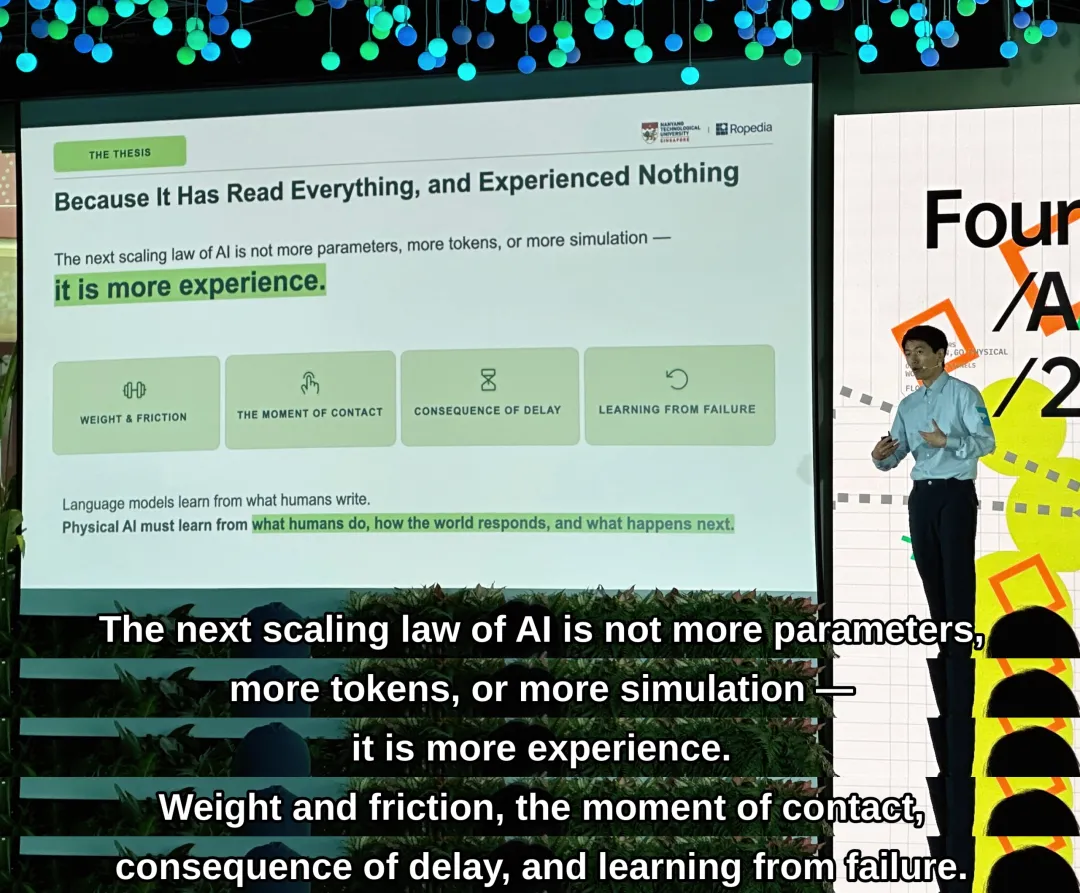
A live photo of a speech by Professor Monk Liu in Singapore
"It's not the picture, it's the experience".
In Ropedia's view, learning sources define the upper limits of intelligence, and experience is not video, RGB, motion capture, or any single pattern in depth, or simply overlapping them; only when the context and multi-form information in the movement, intent, environment, and timing are simultaneously present, aligned with each other, can a record be called a true human experience.
From a model perspective, this definition is more intuitive: language models learn what is written by humans, while physical AI learns what humans do, how the world responds, and what happens next.
Just recently, Generalist AI released the body-based model GEN-1.5: Putting a few seconds of human demonstration into context, where robots can handle new tasks without re-training, which is called physical prompting, demonstration. It demonstrates how accurate the experience snippet can be to drive a model directly like a prompt word, and how much information it contains, determines how much the model can learn.
"A device born to experience": three key words for HOMIE Gen2
HOMIE Gen2 Wears a pattern
The three keywords are summarized as follows:
Immersive human experience: 360° + 4 paths of full-screen 360° + 4 paths of full-screen space audio, captured not only in images, but also in a complete relationship between the mission and the environment;
A rich understanding of polymorphism: more than a dozen models in the same time axis, in the same coordinate system, together to reproduce complete human behavior;
Training level data for use in open boxes: about two-thousandths of the space positioning relative error, depth error < 2.5%, hand motion capture error of 4.68 mm, movement semantic accuracy rate of 96%, obtained immediately into training, without requiring second processing.
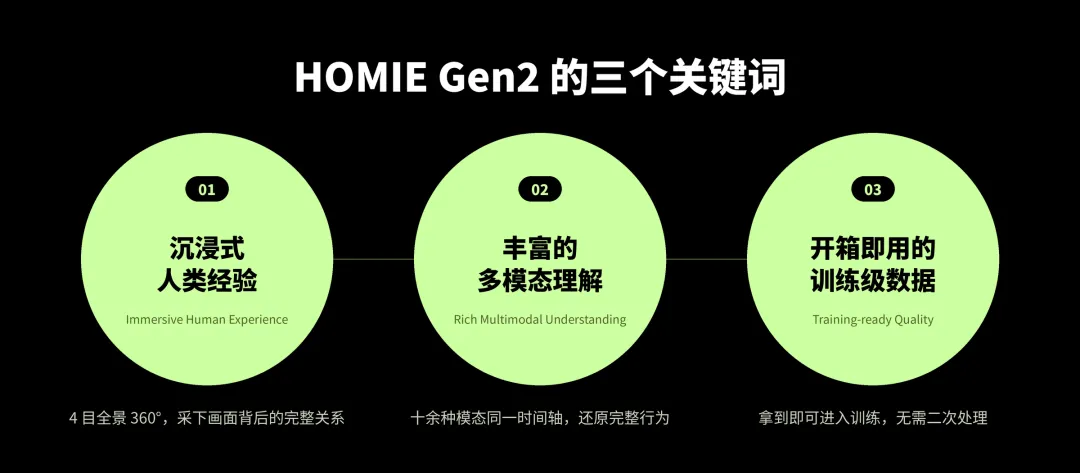
Three key words for HOMIE Gen2
1 Submerged human experience
HOMIE Gen2 achieved 360° full-angle coverage through 4 viewpoints, and supplemented the sound field information with 4-way space audio, forming an environmental recording that is synchronous with first view behavior. Here, the "immersion" focuses not on the larger picture, but on the upper context as much as possible when a real action occurs.
The hardware itself is also well-prepared for use at any time and anywhere: the whole machine is about 380g, supports about 13 hours of continuous collection, the synchronization accuracy between multiple sensors reaches 50μs, no external layout is required, and it can work in open environments such as homes, factories, and shopping malls all the time, naturally.
According to Ropedia, its deployment rate is about 10 times faster than the previous generation, and the collection cost is about 1/12.5 in the past; multiple HOMIE Gen2s can also operate simultaneously, record the same environment from different people, from different perspectives, and capture a single scene at once.
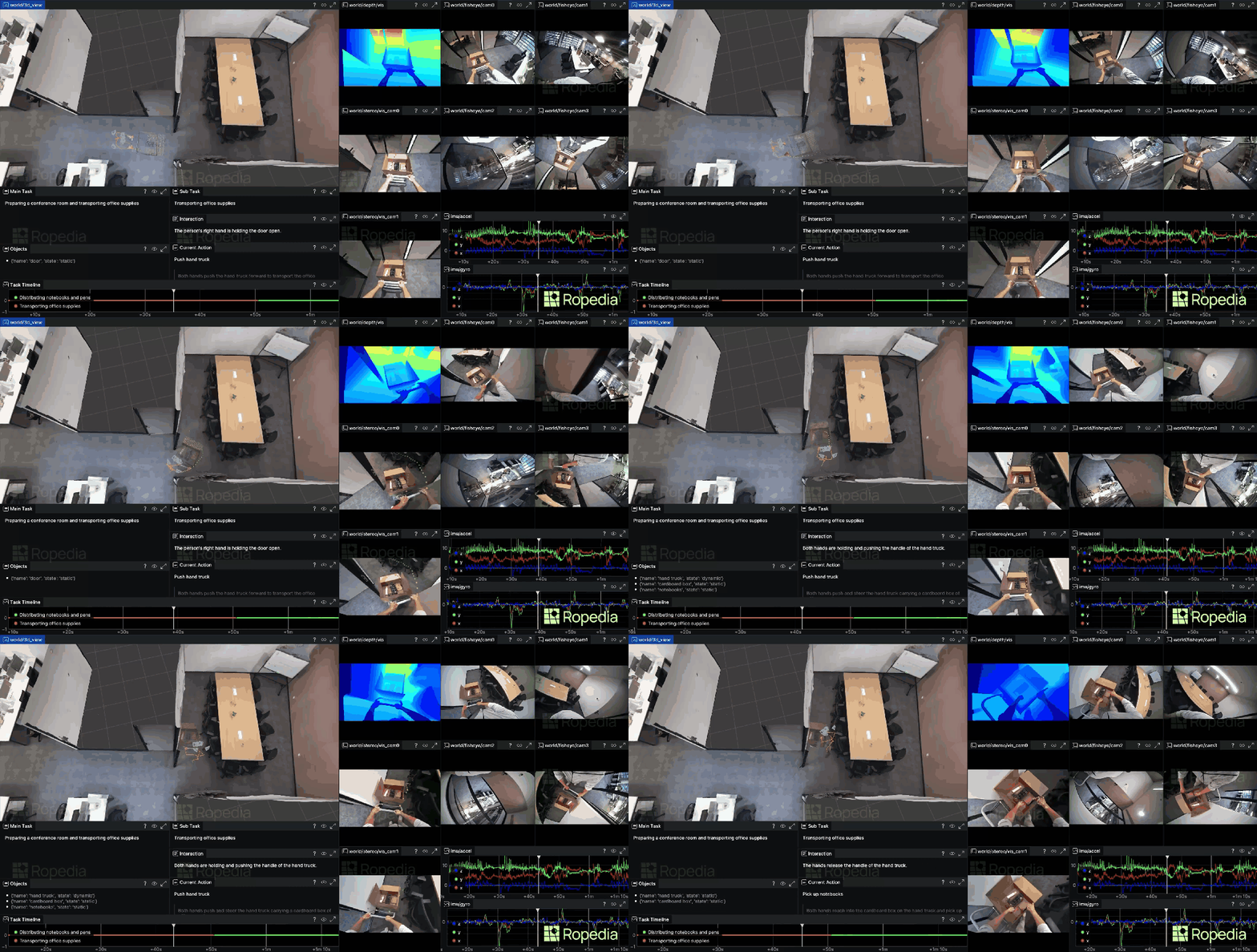
Ropedia HOMIE GEN2 Demo
2 Rich Multimodal Understanding
Robots understand the world without ever relying on a single sensor. With HOMIE Gen2 as the gateway, the Xperience system provides a complete multi-mode list: corrected pinholes, double-eyed video, depth graphs, camera postures, handles 21 key points, whole body 52 key points, Main task/Sub task/Current action 3D text labeling, 3D gauge, scene mesh 2D object detection, 3D detection sensing and 4D object tracking.
The key is not just the number of models, but that the information is unified into the same time axis and coordinate system: different sensors see the same movement, the same environment, the same moment, so that the model can see what the mouse sees, what it does, how the environment changes.
3 High-precision training level data for use in open boxes
The end result is not raw data, but data collected, synchronized, reconstructed, labelled and quality controlled that can be directly accessed through model training.
According to Ropedia, accuracy testing based on the HOMIE Gen2 Gold Standard Sample Dataset (Gold Standard Sample Set): the absolute error in space positioning average is only two thousandths, the depth range error is less than 2.5%, the hand 21 key point motion capture average error is 4.68 mm, and the motion semantic marking accuracy rate is 96.0%.
In Ropedia's position, the value of a product is to help customers build stable, sustained data production capabilities, rather than being a one-time acquisition tool.
"Billions of people, the biggest collection network": the cost structure of how to rewrite data without a physical collection
Where does experience come from? The traditional answer is remote operation: one person with a robot, one step at a time. The problem arises in the cost structure: the price of the robot itself is high, data capacity is locked up in the amount of robots holding, and the diversity of scenarios is limited.
This is exactly the cost structure of uninhabited recruitment: remote-operated data capacity, tied to the amount of data held by robots; and HOMIE's data capacity, tied to the number of humans.
This means that data capacity is no longer directly constrained by robotic holdings. Public research has shown that even with first-person video captured with a single camera, the expansion from 20,000 hours to millions of hours of data can still continue to bring benefits. But this is only the lowest share of the experience gap: since the lowest share has already shown a scale effect, the upper limit depends on who can use the experience more fully.
In fact, the largest collection team has been in existence for a long time, billions of people who interact with the physical world every day. In the words of Professor Monk Liu: "Man is not the noise that needs to be filtered out, but the teacher of the richest understanding of the physical world".
"Twelve Months, Fourth Generation Hardware": from 3D printed bamboo to Human Experience Engine®
Why would a data company start with hardware? Repedia's answer is: to retrieve information that was lost at that moment, no subsequent algorithms can replace it, and the hardware determines the data limits of the entire system.
In June 2025, the team built the first first point-of-view extraction prototype machine with 3D printed structural components, called a bamboo frame; in October of the same year, R-Ego improved the camera layout and headgear structure, completing the first hardware sales; in January 2026, HOMIE Gen1 went into production, supporting the launch of the Xperience-10M in March of this year; and today's HOMIE Gen2 is not only a better extraction device, but it enables large-scale industrialized production of human experience.
According to Ropedia, with this route, they became the first company in the industry to launch a dedicated first-person space data collection device. In their definition, the product line is neither a camera nor a wearable device in the conventional sense, but a new category: the Human Experience Engine®. It lies between the physical world and the basic model: downward perception of the real world, in the middle processing the original signal into a complete experience, and upward delivery and verification in a trainable form.
Hardware replacement timeline map of bamboo rubber prototypes → R-Ego → HOMIE Gen1 → HOMIE Gen2)
"Don't be a data builder, be an infrastructure builder": where does the experience fly to?
The real world experience cannot be crawled like the web: most physical experiences have never been recorded, sensors are highly dissonant with the environment, and harvesting requires hardware, personnel, and on-site operations.
Therefore, in Ropedia's product system, HOMIE is just an entry point. According to Chen Shou, Ropedia was constructed as a self-developing infrastructure that evolved from the ground up into three layers: hardware acquisition experience, data infrastructure processing experience, model understanding experience, and whole-system feedback, ultimately delivered to customers in the form of an Xperience Dataset.
Ropedia self-developed self-developing infrastructure
In these three layers, the hardware is the input; the data infrastructure uses intelligent-driven flowlines to advance processing from manual integration to automation; and the model layer trains unified multimodal models on its own data, both automatically marking new inputs and deploying back the hardware to provide capabilities for downstream strategy models.
The system already has verifiable output. The previously released flagship data set Xperience-10M contains approximately 10 million real-world interaction clips, 10,000 hours of first-person video with audio, 288 million RGB chips, 576 million motion capture chips, and 350,000 objects, totaling close to 1PB.
These links eventually combine to form a closed loop: collection, structuring, modeling, action, learning, gaps in model ability, which in turn determine what the next round of collection is going to be.
CEO Chen Shou is clear about the company's position: Ropedia is not just a data collection company, data collection is just the first step. He believes that human action data will come before the massive deployment of robots, igniting a new era in the industry; three to five years from now, he wants Ropedia to be a robotic learning infrastructure company that covers data, hardware, and infrastructure models.
Prof. Zheng Yi's judgement on the industry echoes this: Zheng Yi is not just building bigger brains, but building better experience locks. If Internet data unlocks the intelligence of big language models, then human experience will unlock the intelligence of Physical AI.
The encyclopedia of the experience of robots, written from Ropedia.