
It's the first time in the history of the world.
The largest mathematical proof in human history has now been formalised by computer verification.
Classification of Finite Simple Groups (CFSG, Classification of Finite Simple Groups)It's just been fully formalized by AI!
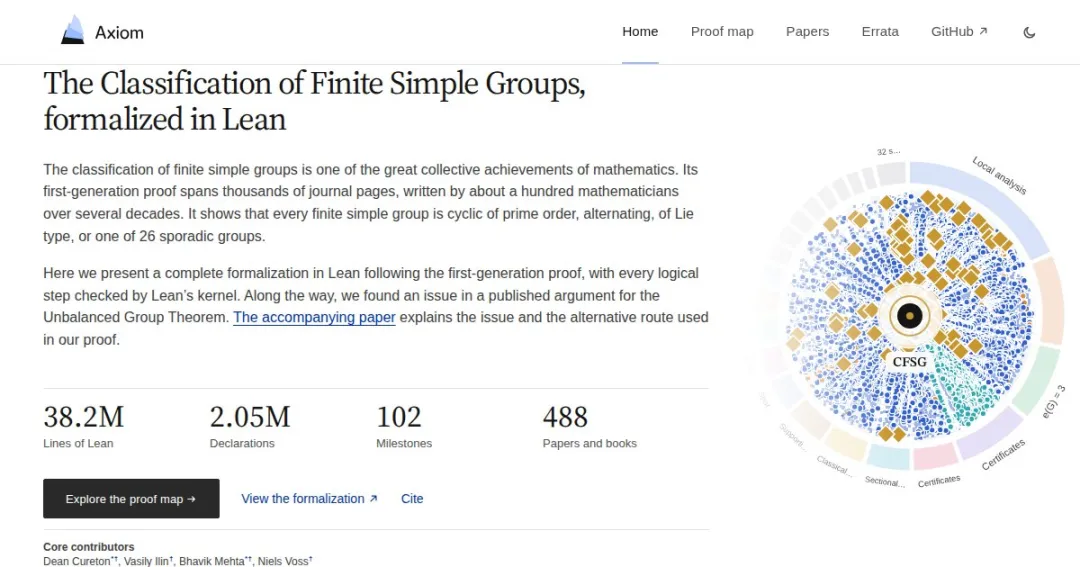
Over the course of more than a century, more than 100 of the world's leading mathematicians have written 15,000 pages of "mathematical diaries", a multi-intelligent system developed by the startup team Axiom.In just 24 daysIt's all gone.
What's even more astounding is that AI has built the first Lean code library in human history with over 40 million pages.
Calculated by the number of lines of code, it is now the largest open-source software project in history. It is larger than the Linux kernel, Chrome, Firefox, LLVM, GCC, FFmpeg, etc.
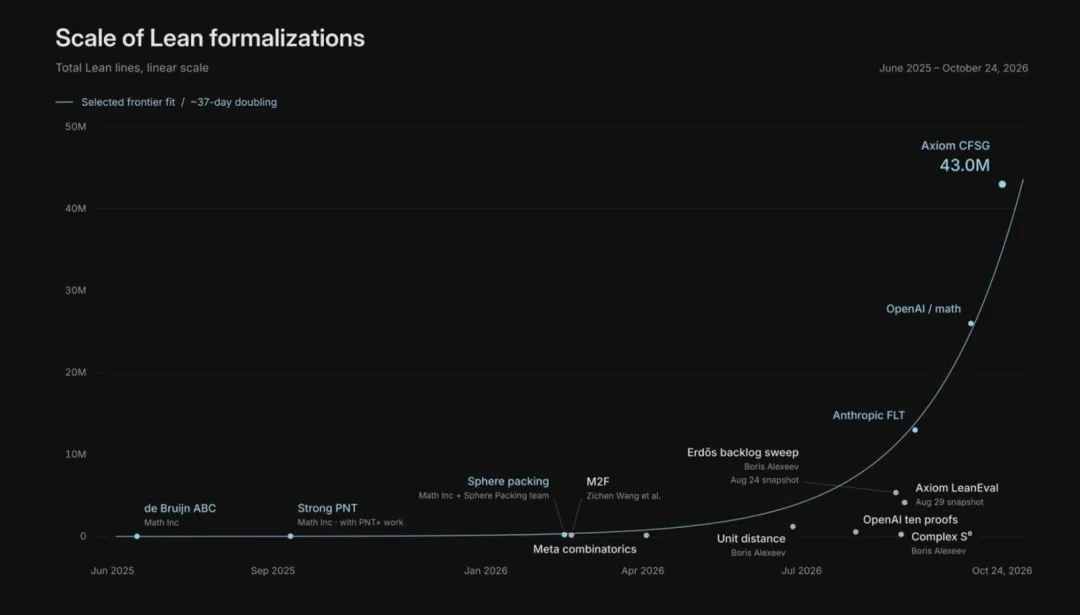
It even uncovered human flaws in the original proof and personally proved a new mathematical theorem to complete the correction!
Ken Ono, a renowned mathematician, issued a condolence statement in memory of his father, who died in January this year.
He recalled his childhood when his father drew him closer to the age of the masters of group theory, and when the Witness Machine Collaboration crossed this historical finish line, the mathematician master could not bear the collapse.

In mathematics, this theorem has a thorn in the side like a thunderstorm.The Enormous Theorem。

Until now, no one in the world has been able to read all the proofs from beginning to end.
What exactly is "group"?
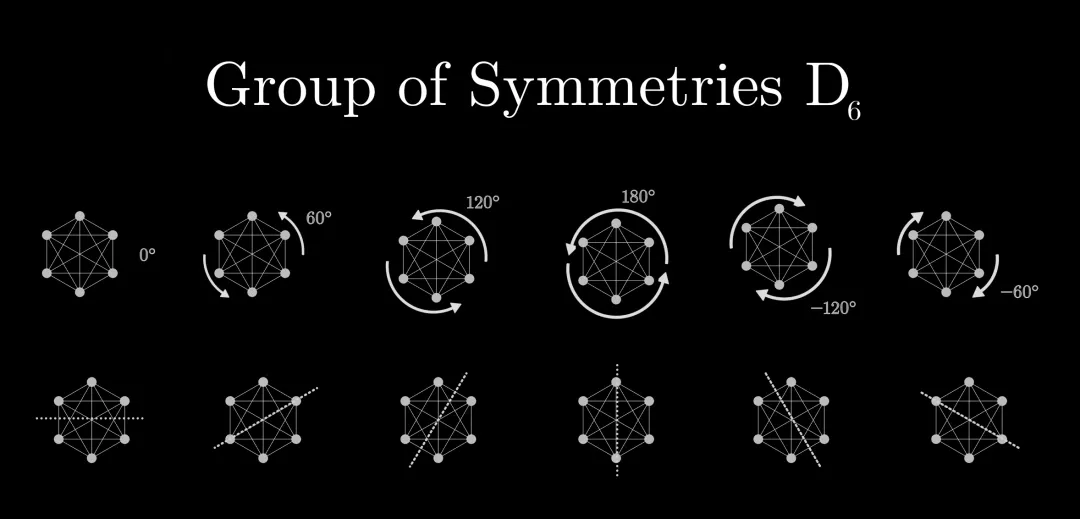
In a nutshell,A group is a mathematical language that describes "asymmetry".
For example, describe the symmetry of a right-angled hexagon corresponding to a two-dimensional group:
For example, in graph theory, each state is a vertex, and every move is a side of this giant graph.

This animation shows how the sequence crosses 43 billion configurations and finally arrives at a solution.
And all finite groups can be broken down into atoms, like chemical molecules are broken down into indissoluble "basic components".Finite Simple Groups (also known as finite simple groups)。
The great thing about the classification theorem is that it provides a "cycle table of elements" for the symmetry of the universe.。
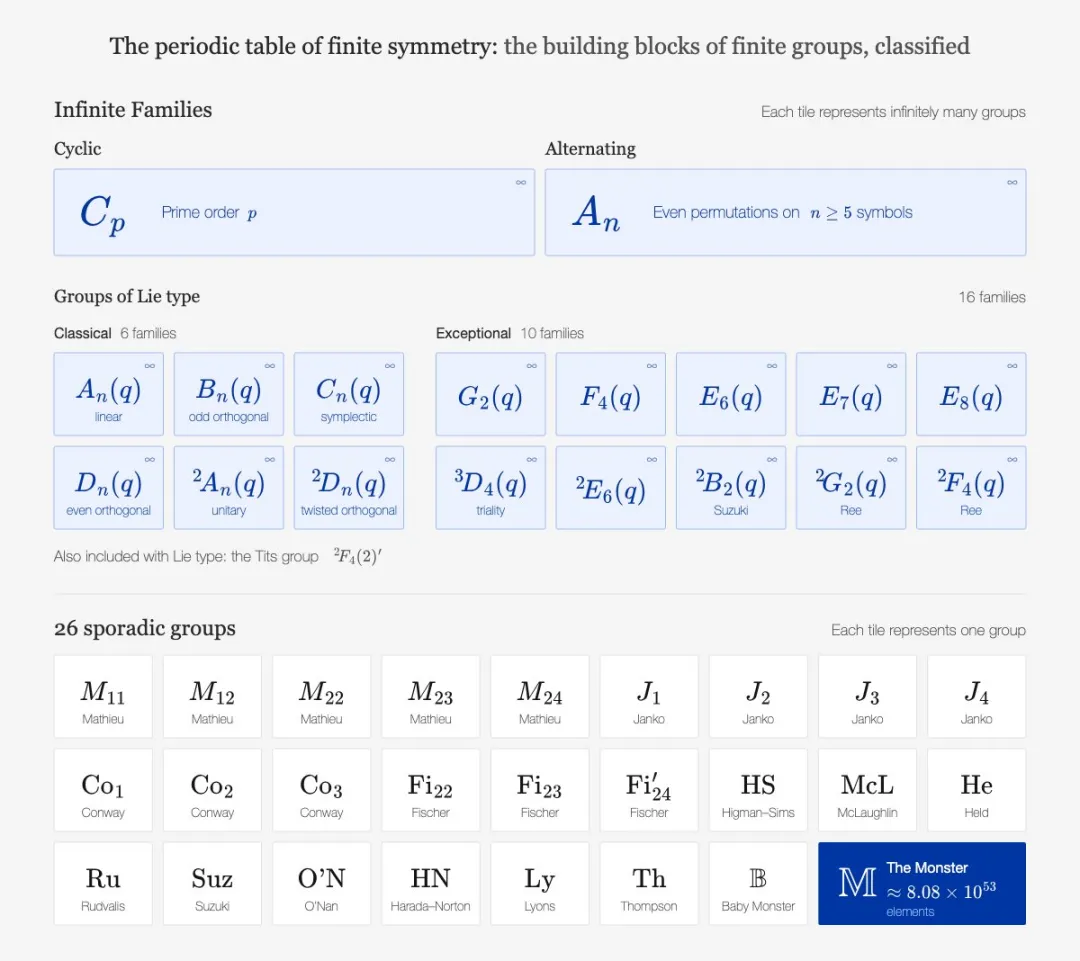
It clearly proclaims:
All finite singles belong either to a primitive cyclic group, or to a crossing group of at least five symbols, or to a Li-type group of 16 infinite families, or to 26 extremely special, unclassifiable "sparse groups" (sporadic groups).
The largest of the 26 scattered groups is revered by mathematicians.It's called Monster Group. 。
Incidentally, in 1998, Richard Borcherds won the Fields Prize for demonstrating the famous "Monstrous Moonshine conjecture". This conjecture reveals a startling connection in mathematics: the largest scattered single set of "monsters" has a deep mathematical connection to the model function in mathematical theory.
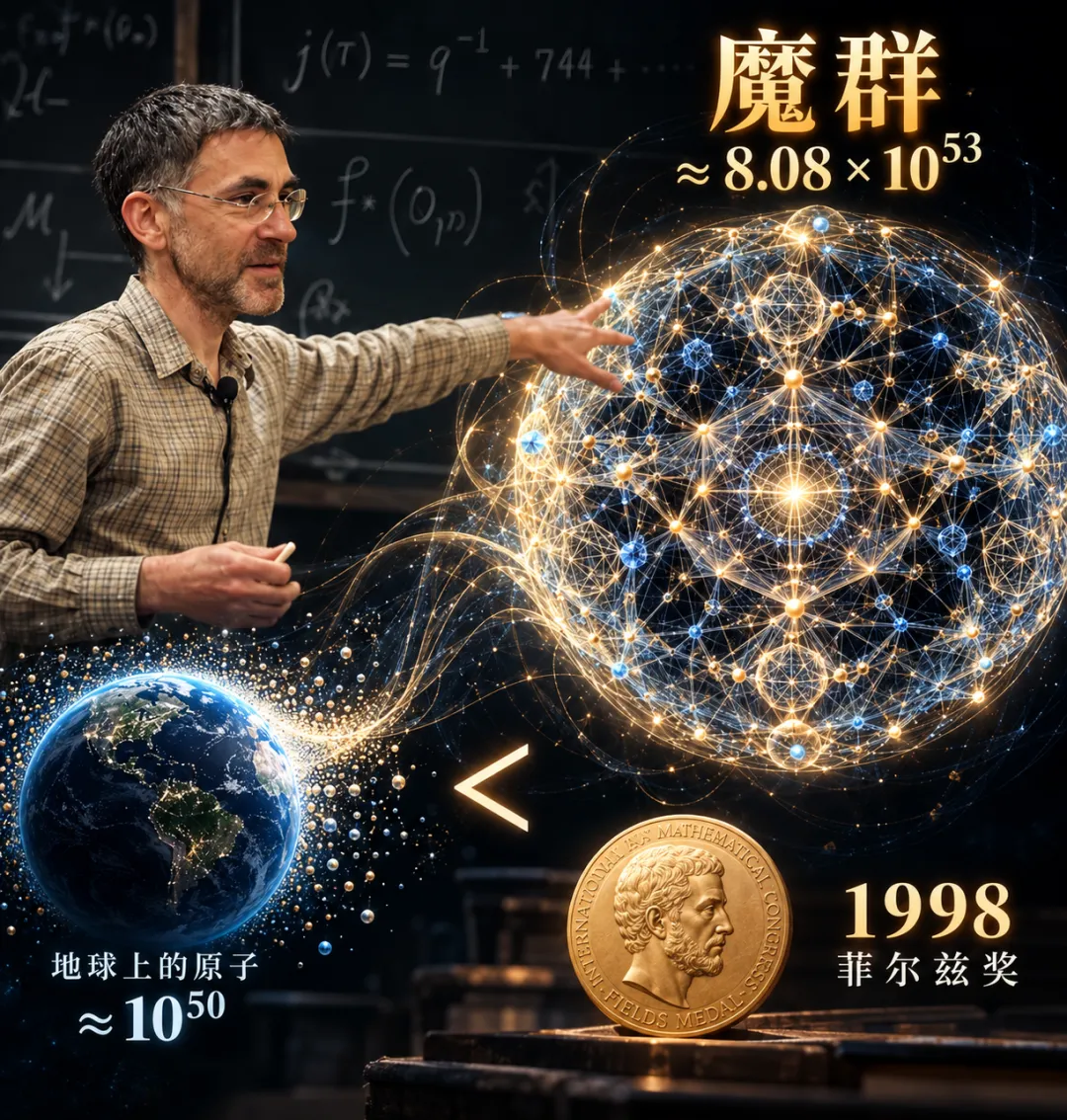
In 2007, physicist Edward Witten suggested that a set of theories involving magic clusters could be used to describe gravity in a simplified universe that could be used to encode the quantum distribution of black holes at different energy levels, thus calculating the density of black holes.
From the 1950s onwards, to proveThe giant theorem.In more than 500 academic papers, about 100 mathematicians have collated up to 15,000 pages of proofs that about 14 red brick buildings are dreamlike.
It was so vast and scattered that when the mathematician Gorenstein announced its completion in 1983, a huge gap was missing, and it was not until 2004 that a 1221-page paper by Ashbacher and Smith was completed.
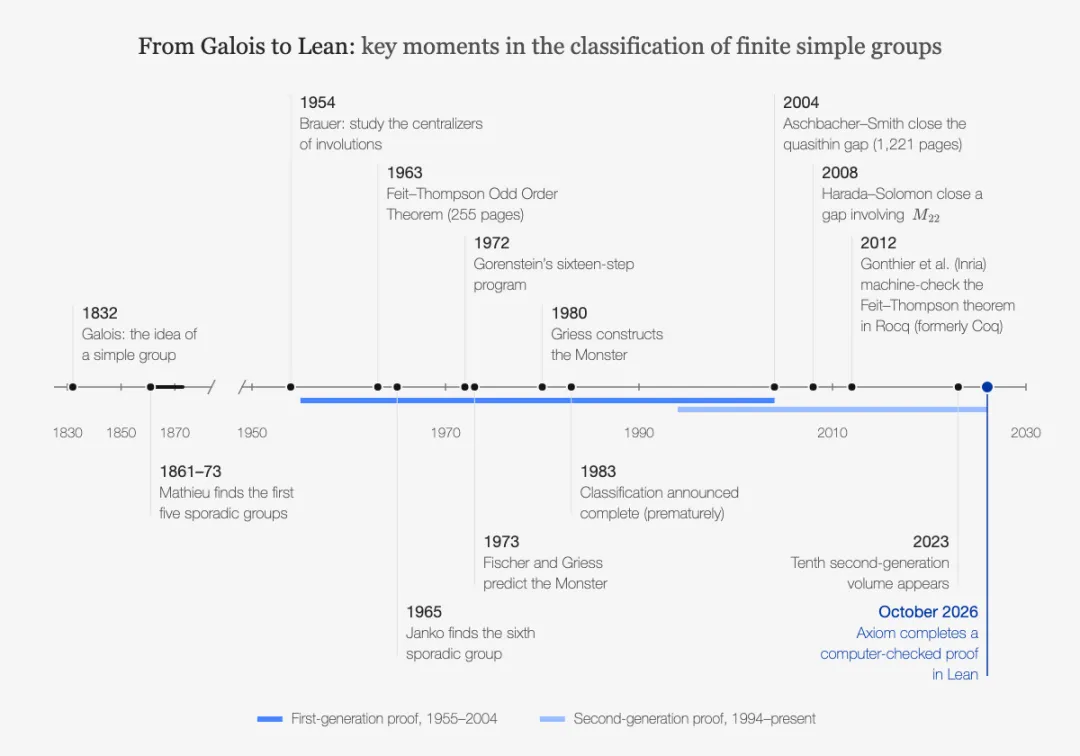
Because the proof is too long, it is very easy for humans to make mistakes. As Ashbacher put it: "It is impossible to write a very long and complex argument without making mistakes".
Now that the human brain is approaching the limits of complex logic, it's time for AI to take the stage.
AI is on a 24-day expedition that took half a century of human life.In the face of this 15,000-page "mathematical Everest Summit", the Axiom team chose not to use traditional brute force computation, but instead to use multi-intelligent bee colonies.AxiomProver。
Translating the proof of human natural language into Lean code ("formalising") is equivalent to having a selfless machine use an enlarged mirror to test each of the pointers on those 15,000 pages.
October 1, 2026The Axiom team knocked down the start instructions on a Slack channel.
Human engineers and mathematicians dismantled the huge "giant" into 108 milestones and about 380 small missions to produce a huge "proof map".
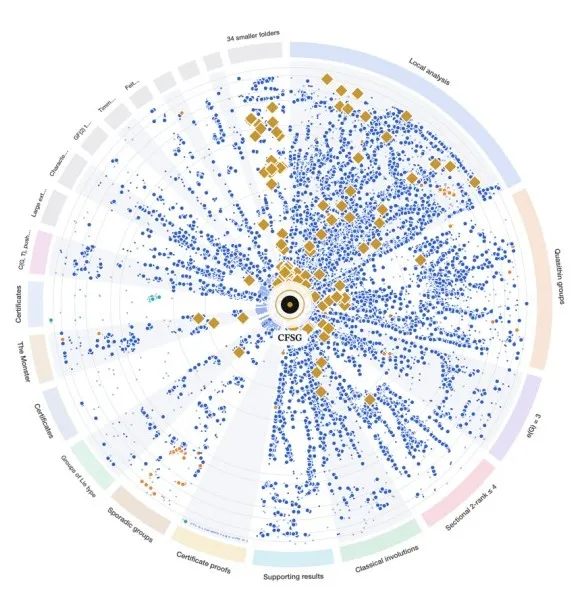
On 2 October, the first AI "Bee Group" officially went online.
The group of AI intelligence entities began to collaborate like a trained army. The leading AI was responsible for dismantling high-difficulty arguments, while the other AI was madly searching for existing results or burying Lean code. If one AI met unproven preconditions, it would automatically outsource the task to another AI. All the results would be gathered into a shared codebase.
The whole process didn't go smoothly. Because the speed at which AI writes code is so fast, the Lean system even has an arithmetic bottleneck when re-checking dependencies.
Axiom's engineers had to temporarily reconstruct the underlying engineering infrastructure, develop a distributed caching system, and barely keep pace with the horrific AI output.

October 10thOn the Slack Channel, there was a message that boiled everyone up:
We've proven that the group is a monopoly.
AI not only recognizes the coven from structural information, but also completely formalizes its existence through code!
It's only 24 days!
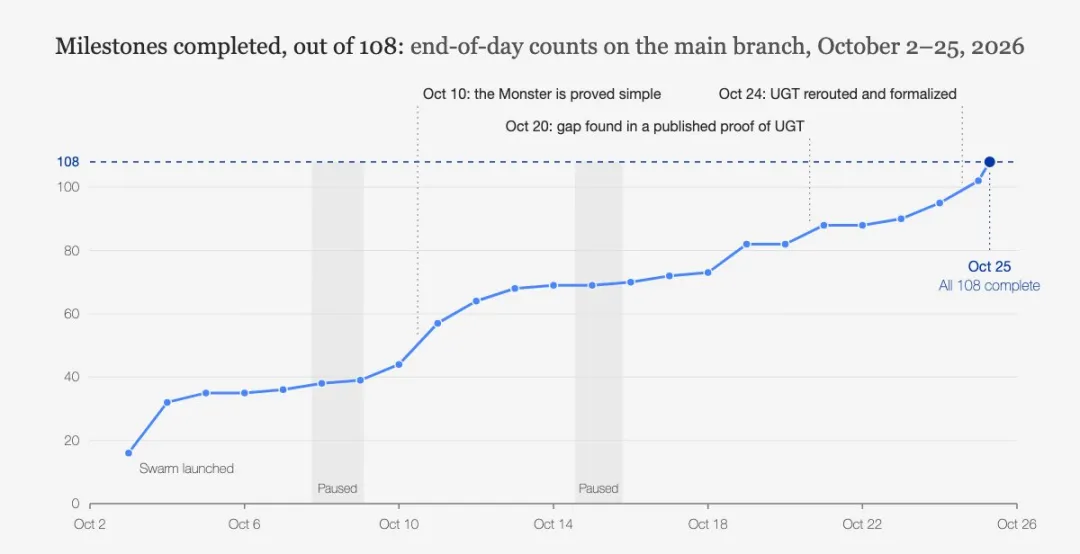
24 hours a day and 24 nights, this group of tireless AI creatures produces amazing results.43 and a half millionLean Code has built the largest library of Lean codes in the world.
Human intelligence has been subjected to ruthless testing by machines, and logical flaws have been discovered!
Epic-level reversal: AI uncovers the "Lethal Bug" of a human master and repairs it himselfHuman languages are always full of omissions.
There's a netizens saying a thought leap in mathematical proofs:
Moon of the West: proof
It's easy to see ordinary, obviously like the example above.
It's easy for readers to prove themselves.
It's also the opposite of natural reasoning.
Q.E.D. is a short process.
It's been a while since I've seen it.
"Obviously possible", "reconcilable proof", and "easy proof" are common words in these mathematical papers that don't work for AI.
Formal proof requires clear logical support for every step.
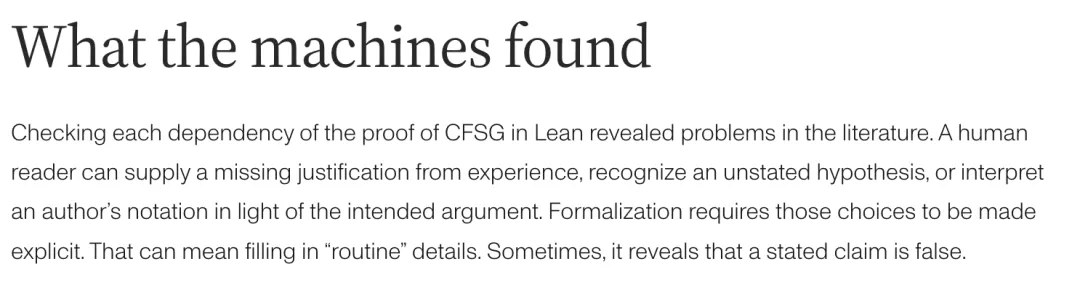
In the process of step-by-step scanning and forced reasoning, AI has recorded hundreds of abnormalities, most of which are human typing errors, formatting errors, or omissions of prerequisites.34 of themIt's a major logical deviation!
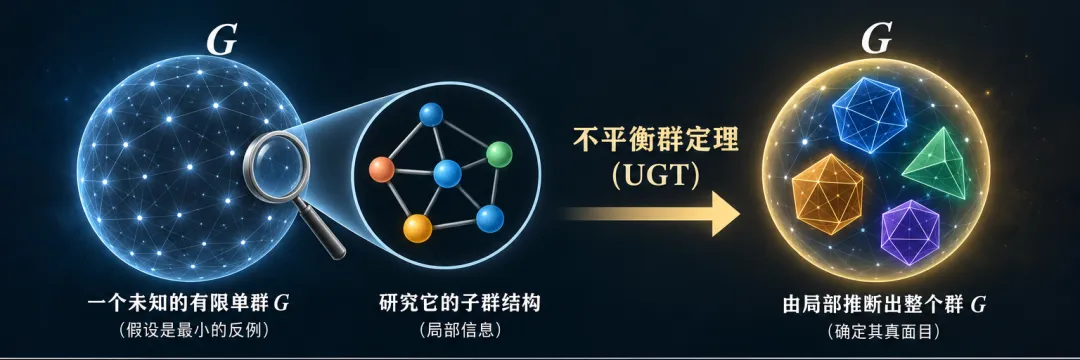
And one of the most surprising, the most central of these bugs, is that it's critical.Unbalanced Group Theorem (UGT)Up there.
UGT is a crucial part of the entire classification theorem, and its role is to "look at the whole locally" by studying the subgroup structure of a group to infer the true nature of the whole group.
The Axiom team originally selected an authoritative paper by John Walter published in 1986 as the basis for its formalization.
However, when it comes to translating this argument that human beings consider themselves to be perfect, there is no reason to believe that they are not perfect.The AI intelligence system suddenly issued a red alert!
AI discovered that one of the key closing assumptions in Walter's proofs is that it is logically unstoppable.
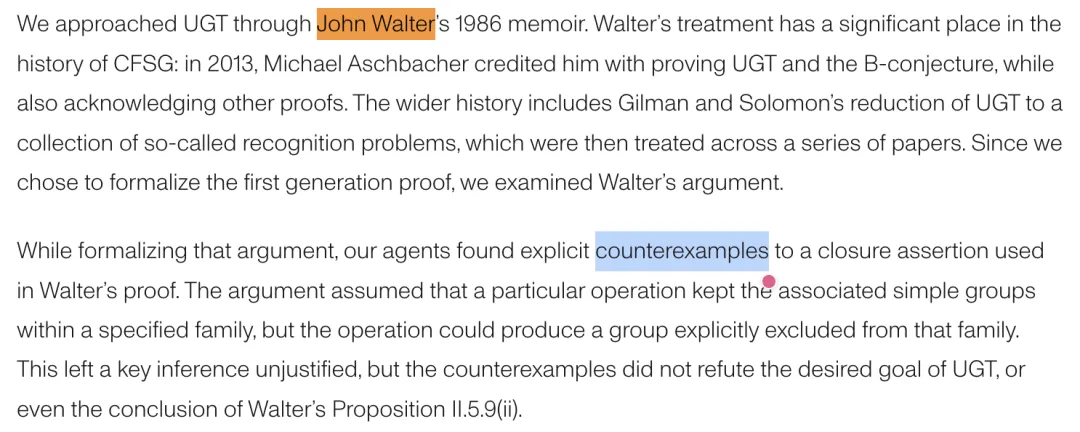
AI not only points out mistakes, but it also gives a clearer picture of what's wrong.CoincidenceIn this counter-example, an operation produces a group that is explicitly excluded from the target family because 7 is the number of mesons.
The proof of human pride is that this chain is broken.
The 150,000-page logical dam is in danger of collapsing at any time.
What would happen if we borrowed the "second generation proof" written by the latter, which would not only introduce a whole new amount of dependence, but also make the 24-day effort worthwhile.
At this time, the peak of human-machine collaboration took place.
The Axiom team is urgently linking up with the living fossil specimens of Tideau Richard Lyons and Ronald Solomon, who were involved in CFSG's original work that year.
After listening to the loopholes discovered by AI, the human master's intuition perfectly resonated with AI's arithmetic. Based on Solomon's 1976 theory, human mathematicians devised a new path to proof.
After that,AxiomProver (AI Systems) personally took the stand and, according to the new idea, rigorously demonstrated a completely new group result called Preservation of simple tops.
This new AI-driven theorem, like a perfectly customized patch, accurately fills the gap left by the human master that year and successfully delivers the UGT form required for classification theorems!
The theory is still valid, but it has been proven that it is not entirely human.
For the first time in human history, AI has not only acted as an "experimental calculator" in top pure mathematical studies, but also as a "collaborative researcher" in discovering new theories and correcting core flaws!
This is reminiscent of a similar scene in the history of mathematics: in 2002, the winner of the Fields Prize, Vladimir Voevodsky, found that his proof was wrong and could not be saved.
In 1999-2000, while lecturing at Princeton University, he discovered that early critical reasoning was flawed and that the original proposition could not be recovered.
In 2013, it was confirmed that another 1989 finding was also incorrect.
He no longer believes that humans can reliably examine complex proofs and turns to Coq, homogeneous type theory and the single-valued basis: allowing computers to test mathematics.
In the pursuit of mathematical truth, humans have embarked on almost two hundred years of tragic expeditions using their flesh and blood and their limited brains.
Today, humanity has a new partner to explore the starry sea, the region of knowledge.