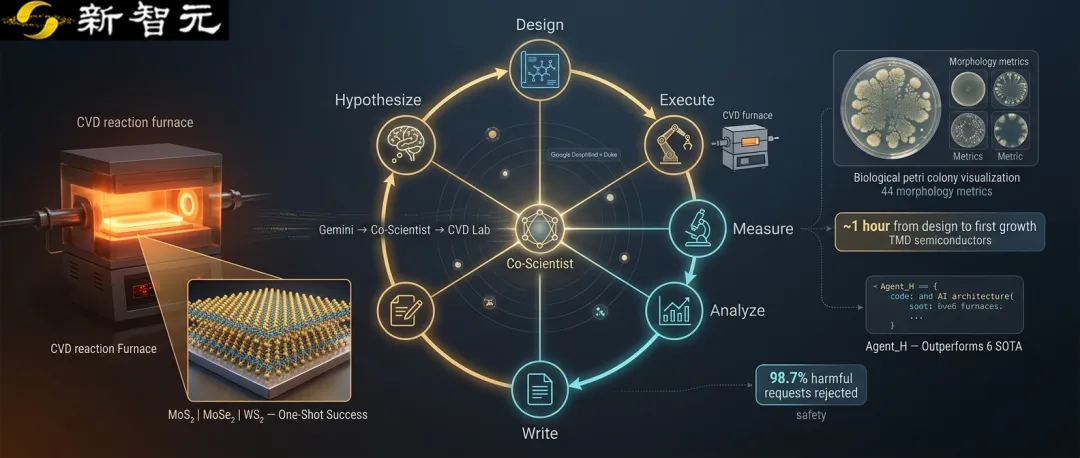
It's the first time in the history of the world.
Google DeepMind, in partnership with Duke University, has released a major upgraded version of its AI research system, Co-Scientist, which is a Gemini-based, multi-physical AI research system built by Google.
Previous versions focused mainly on the creation of assumptions within computers, that is, AI "wants" to make scientific guesses and then verify them by humans.
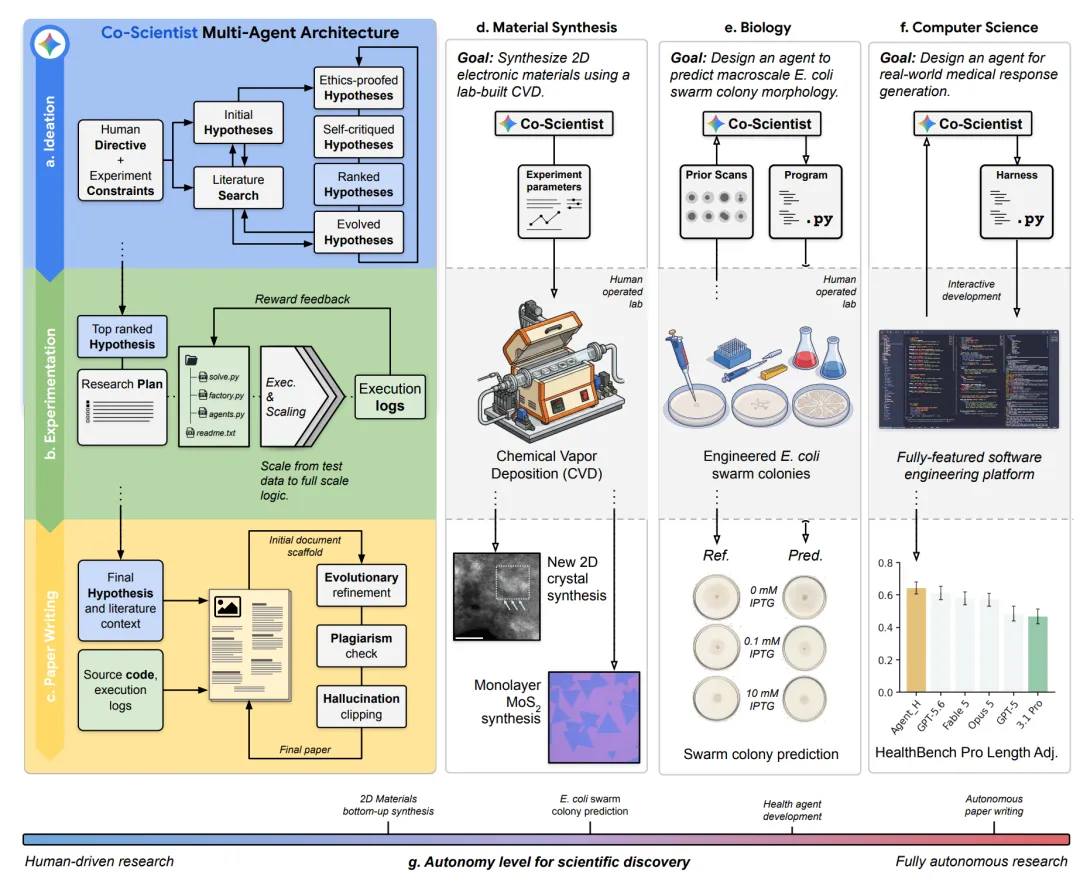
The key breakthrough in this upgrade is that the Co-Scientist became aBased on real-life experimentsA closed-loop research partner is able to go through the entire process of making assumptions, performing experiments to write papers, and produce new results with real-world meaning in the three fields of materials science, biology and computer science.
Link to the paper:https://arxiv.org/abs/2602.03837
The paper notes that the biggest bottleneck facing AI research today is the gap between "what AI can come up with in computing" and "what it can verify in the physical world". Purely computational AI research systems are prone to "reward cheating", producing seemingly reasonable but non-existent experimental results; while existing automation labs are limited to narrow specific tasks.
Samuel Schmidgall, a researcher at Google DeepMind, and Tao Tu, an assistant professor in the Department of Electronics and Computer Engineering at Duke University, Haozhe Wang, are co-authors of the communication;
Google DeepMind researcher Samuel Schmidgall and Duke University Ph.D. student Xi aokai Zhu co-authored the first paper.
The authors of the paper also include Google chief scientist Quoc V. Le, Google researchers Shen Yue, Junken, and others, with collaborations spanning Google, Duke University, Columbia University, and Texas Agricultural Institute.
AI designs semiconductor formulas
Physical experimental verification of the material sciences section was completed at Duke University's Wang Zheng philosophy thesis group.
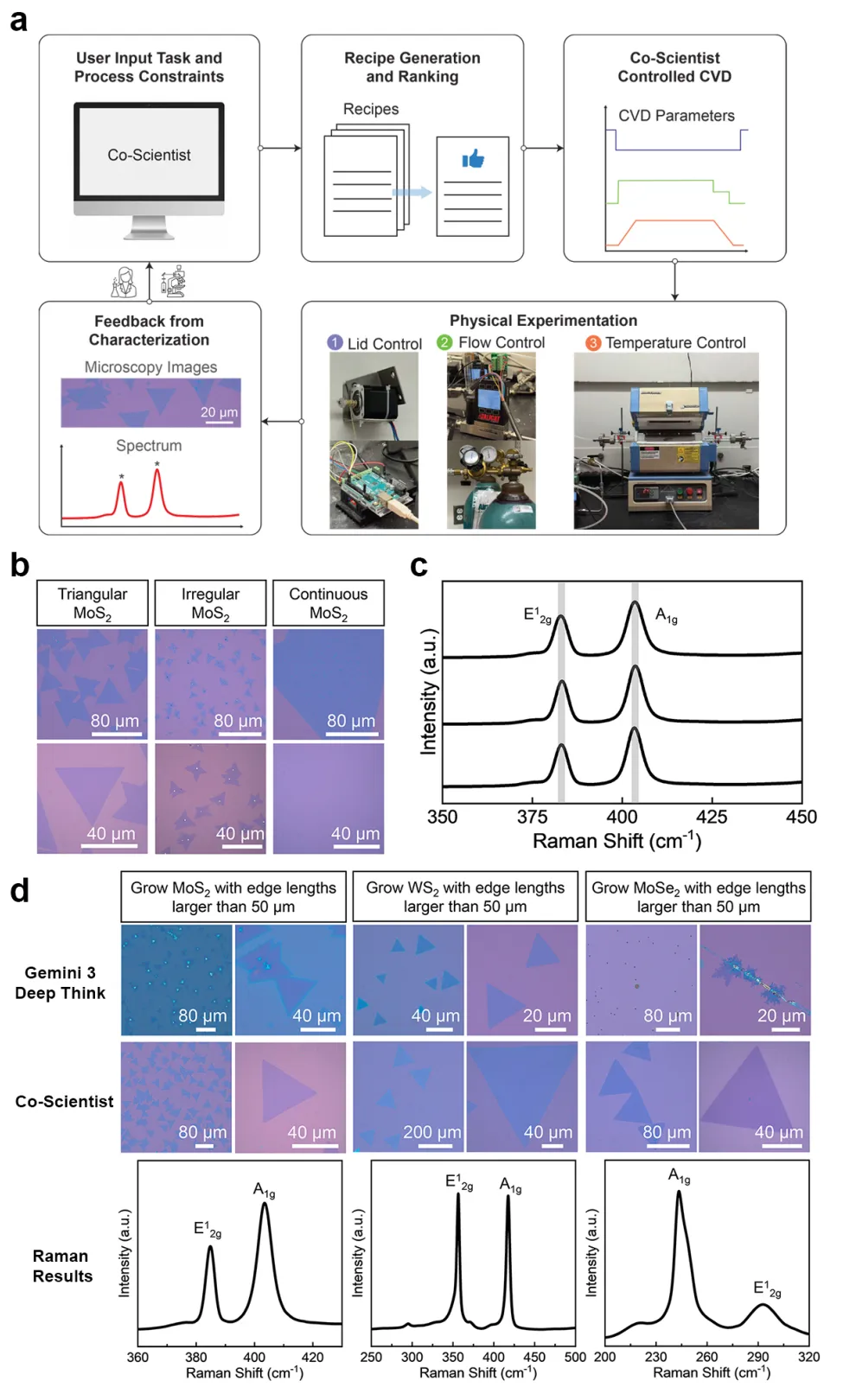
The team paired Co-Scientist with the laboratory's self-built semi-automated chemical gas deposition (CVD) system, allowing AI-designed synthesis solutions to be tested in real high-temperature reactors. This is the most "ground gas" part of this work: AI gives no longer ideas that stay on paper, but growth formulations that can be run directly on the device.
 1. AI proposes a new pathway for the synthesis of new two-dimensional carbon crystals from the ground up.
MXene is a class of superconducting two-dimensional transition metal carbohydrates, of which Ti3C2Tx is the most widely studied member, but has long been unable to achieve direct downward CVD synthesis through the use of dangerous reagents such as nitric acid.
Co-Scientist focused on the specific geometrical structure and existing raw materials of Duke Laboratory's CVD system, and from 272 candidate schemes proposed the substitution of tetrahydrocannabinol (C2Cl6) with volatile tetrahydrocannabinol (TiCl4) as a precursor.
After 25 cyclic optimizations, the team succeeded in developing high crystalline two-dimensional crystals whose X-ray diffraction, scanning telescopes, energy spectroscopes and spherical diffraction spectroscopes showed highly consistent crystalline characteristics with Ti3C2Tx MXene: a layer distance of about 1.13 nm and an inner crystalline distance of about 2.51 Å. The team also noted that the final atomic phase structure still needed further cross-atomic resolution telescope verification.
One success: In a matter of minutes, three single-layer semiconductors were developed.Two-dimensional transition metal sulfur compounds (TMDs) are the next generation of semiconductor channel materials that are expected, but their CVD growth is highly sensitive to equipment, and documented formulations are often not directly replicated between different laboratories, often requiring several months of repeated touching.
Co-Scientist generates complete process parameters based solely on the hardware constraints of the Duke Laboratory's self-constructed boiler structure, available chemicals, substrate types, and without any historical formula reference.The first attempt to synthesize high-quality single-layer MoS2 was successful.The triangle has a single crystal dimension of more than 50 micrometres, and the Laman spectrum confirms its single-layer thickness.Never been synthesizedMoSe2 and WS2 were both successful.
Additionally, thanks to the quick reasoning capabilities of Gemini 3 Deep Think, Co-Scientist will be able to work with a variety of applications.In a few minutes.Producing the formula and directly translating it into a machine instruction to control the CVD equipment, the entire experimental process took about an hour to complete the first growth of the three materials, showing AI direct control of semiconductor manufacturing equipment, achieving the "lab in the loop" (lab-in-the-loop) semi-autonomous generation pathway.
Dr. Zhang Zheng, an AI scientist in the semiconductor industry, said:
"This work brings large-scale multi-smart system models into the realm of semiconductor material development and preparation, from design formulations to device execution and demonstration verification. Traditional CVD processes are highly sensitive to devices, formulations are difficult to migrate across devices, and debugging often takes a lot of manpower, money and time. While Co-Scientist generates formulations in minutes using only equipment information and hardware constraints to successfully develop three single-layer semiconductors.
The paper also proposes new ideas to enhance the reliability of AI research: writing illusion and copy punishment into optimization goals, matching each conclusion to an experimental log, making AI research traceable, verifiable, and auditable. With the deep integration of such systems with manufacturing equipment, AI is expected to be the core engine of process research and development, accelerating the next generation of materials from the laboratory to applications".
This work demonstrates that AI is not only able to "design" materials, but also to directly "manufacture" semiconductors for specific devices, compressing the development of processes that would have taken months to process to a few minutes to hours. This is a key step in the vision of AI-driven autonomous nanomanufacturing and the future of "AI design and manufacture of its own hardware".
Synchronous verification of biology and computer science
In the field of biology, the Co-Scientist teamed up with Columbia University to predict cluster forms of E. coli from scarce imaging data at concentrations of different inductors, with predictions matching quantitative measurements from unpublished wet experiments in three of the four form indicators.
In the field of computer science, Co-Scientist has independently designed and extended the Agent_H architecture when reasoning with only given directions and no human intervention, going beyond six cutting-edge models on the HealthBench Hard and Professional scales, and significantly reducing potential clinical risks in physician-blind reviews.
Making AI more reliable and secure
The team introduced reliability modules for the problem of "constructing results" and "copying" AI research systems: incorporating illusions and copying punishments directly into optimization goals, and matching each quantitative conclusion in the paper to the logs running the original experiments.
A double-blind study involving 30 field experts and 450 independent reviews confirmed that these mechanisms significantly reduced the incidence of severe hallucinations and copycat; the built-in security system rejected 98.7% of harmful research requests.
The next step in AI research is to enter the real world.
From "setting assumptions in computing" to "complete verification on real devices", this Co-Scientist upgrade marks a key shift in AI research paradigm: AI is no longer just a "thinking assistant" to human scientists, but a partner who can act, be tested, and be responsible for the results.
Synchronous verification in the three domains of materials, biology, and computer, combined with traceable and verifiable reliability mechanisms, together answer two of the most questionable questions about AI for Science today: Is it possible for it to actually do what it does in the physical world outside the laboratory?
Of course, this work is still in its early stages: the CVD system is only semi-automated, the atomic-level structure of the new carbohydrates remains to be confirmed, and there is a long way to go from "once successful" to "stable mass production".
However, the direction has become clear with the deep integration of AI with experimental equipment, displaying instruments and manufacturing processes, and the vision of "AI designing and manufacturing its own hardware" is moving from science fiction to engineering. It is predicted that in future laboratories, human scientists will play more of the role of goal-setters and auditors, instead of handing over vast quantities of formulae to tireless AI to explore and transform.
Introduction by the author
Haozhe Wang is an assistant professor in the Department of Electronics and Computer Engineering at Duke University, leading The Wang Lab, a senior expert at AI4S, with a long-standing focus on the use of AI to power nanomaterials and two-dimensional material research to enable AI to autonomously design, manufacture, and optimize its own physical hardware. He is a core developer of the ATOMIC autonomous microscope platform, an AI co-scientist, and an award-winning NSF CAREER.
Tao Tu is a senior research scientist at Google DeepMind with a long-standing focus on the use of artificial intelligence (especially Gemini models) to give computers superhuman-level medical and scientific intelligence. He was a key contributor to Google's well-known medical model Med-PaLM, AMIE (AI diagnostic dialogue system) and Med-Gemini.
Keran Rong is a member of the SpaceX AI R&D team and is involved in the development of Grok. Previously, he worked as a Google DeepMind researcher and technical project manager, focusing on big language models and AI scientific reasoning.