Harness, which is commonly used today, is usually the default of a large model API, such as Fable 5, Sol, Kimi K3...
Perplexity's Portable Computer is working on a way to use Qwen 3.8 27B as a locally deployable model to achieve a close-up effect.
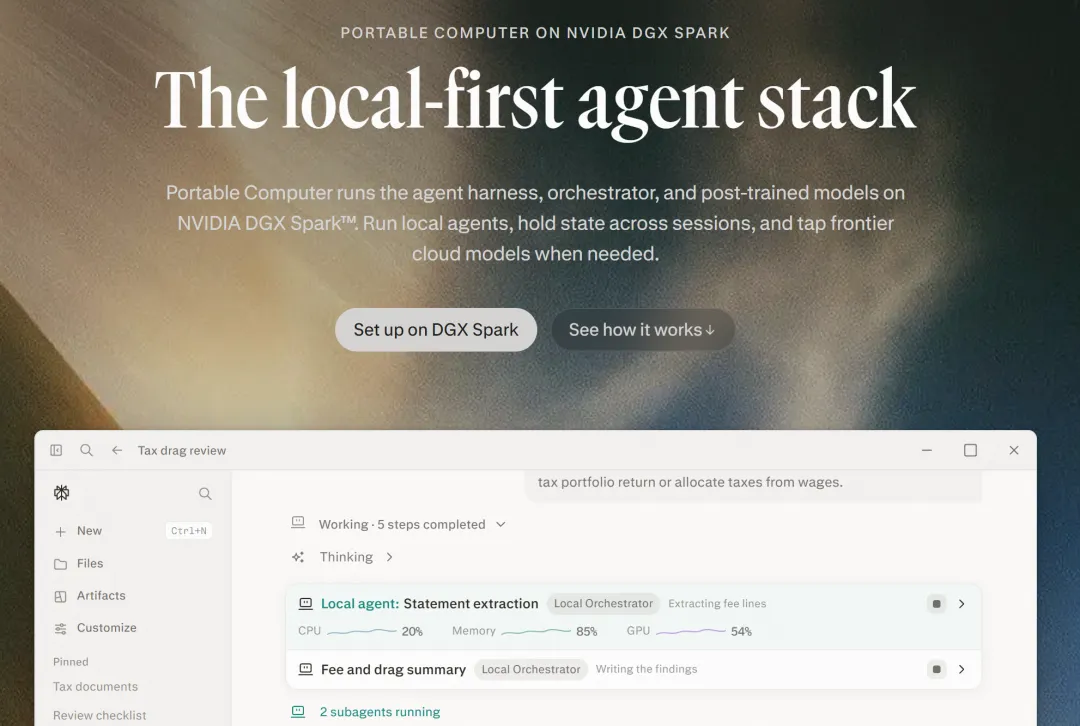
By default, the entire technology of the Portable Computer runs locally. Models, frameworks, conversations, and tracks are all located on the user's computer. External access features such as network search, connectors, or upgrades to a more powerful advisory model are called only when necessary, and are always controlled by the user. Therefore, sensitive data will never leave the device without permission, and the local model will not incur a reasoning fee.
An efficient local-priority intelligence body requires model and framework collaborative design. The general framework assumes that the model has cutting edge capabilities, is able to understand the context, drives a large number of tools and performs long chain planning. Local models are less reliable under these requirements. Perplexity does not allow small models to be managed as a framework for large model design, but rather allows the two to work together: the framework is tailored to the characteristics of the model's capabilities, and the model is trained to use the framework effectively.
In recent months, intelligent agents have developed rapidly in a variety of knowledge-based tasks. While these advances have led to significant improvements in productivity and efficiency, they have also brought new challenges.
The consumption of tokens is growing rapidly, and overall spending is rising with it. Each request takes the user's private information and intellectual property away from the device when the data is accessed by running a closed-source model API on a server cluster.
At the same time, the development of open-source models is even faster. Progress is particularly notable in small models such as the NVIDIA Nemotron 3.5 Lightning (total parameters 30 billion), Qwen 36 billion (35 billion) and Qwen 388 billion (27 billion). Small models have improved performance and are now able to handle complex smart body workflows. Local reasoning hardware is also evolving simultaneously: systems such as the NVIDIA DGX Spark M5 Ultra Mac Studio can now run these models locally. These trends have contributed to the availability of running completely on the device end.
Of course, you can also choose to use external features, such as network search, connectors, or cloud model upgrades, when you need them.
This local-priority approach significantly reduces costs and naturally addresses privacy and intellectual property issues; private tokens do not need to be transferred to remote clusters and are always kept safe within the boundaries of local devices.
In June this year, Perplexity launched the first hybrid local-server reasoning compiler that can determine which tasks should run on the device and which tasks should be handed over to the cloud to execute. This article will detail how Perplexity builds such a local-priority smart body, including frameworks and mutually optimised models.
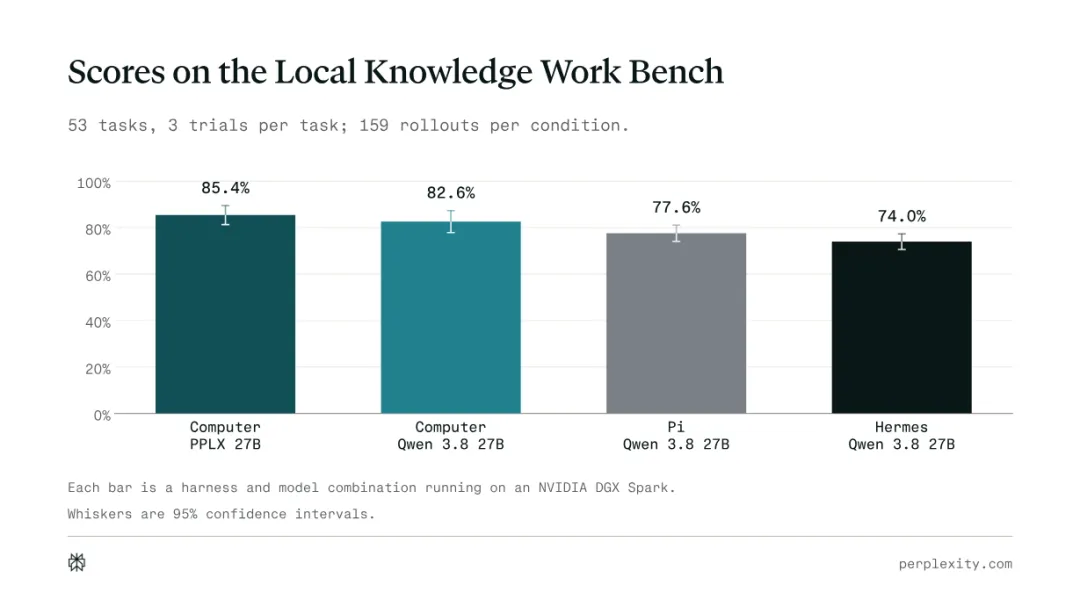
Perplexity outlined the key design choices and compared the Portable Computer to the popular Open Source General Framework (Hermes and Pi) on three public benchmarks tests and the Local Knowledge Work Bench within Perplexity. In the benchmark test, using the Qwen 3.8 27B model running on NVIDIA DGX Spark, the Computer scored the highest score, while the PPLwenX 27B model based on the Q3.8 27B model was further upgraded to 85.4%.[3]
Designed by local model Harness
Although the local models are already quite powerful, their absolute performance still does not match the front-end models with large parameters. Therefore, carefully designed harnesses are needed to effectively handle them and overcome their limitations.
Popular open-source harnesses such as Pi and Hermes have proven to be very versatile: they can be well compatible with models of all sizes and types, but they are not optimized for device-end models.
Efficiency in context
The main focus of Perplexity in designing harnesses is to make full use of the model's background information.
Although device end models such as Qwen 3.8 27B provide a context window for up to 260,000 tokens, Perplexity experimentally found that when the number of tokens exceeds 100,000, their performance begins to decline. Therefore, the simplicity of the core framework needs to be maintained in actual use: it contains only a minimal system harness and a set of core tools.
All other skills are modulated into on-demand skills that can be loaded and unloaded at any time throughout the learning process. Perplexity designs these skills for common knowledge tasks: research, data science, data visualization, document creation, software engineering, etc.
The framework also supports context compression, which, as the trajectory changes, summarizes the outdated context so that the model remains within the valid window.
Connectors as a command line tool
Daily knowledge work usually involves Gmail, GitHub, Outlook, and Google Cal.