In 2026, the field of AI is undergoing a change that is easily overlooked by ordinary users, but may be quite profound. In the past few years, the most common questions in the industry discussing AI capabilities have been: How big is the model? How powerful is reasoning? How much more advanced is the next generation of models? But by this year, more and more attention has begun to shift from the model itself to the entire system around the model. In February, OpenAI began discussing how to make Agent more reliable through the environment, rules, verification mechanisms, and engineering constraints.
The real question behind this change is which model is stronger than AI: how much of an AI system's capability exists in the model's brain, and how much of it exists in the way it works?
We can make a very simple analogy. If a language model is an employee, then the mainstream route of AI in the past is to send that employee to training: to give it more data, better feedback, more expensive training, and finally to actually change it.
Complex tasks are automatically classified first;
the part that is easily miscalculated is given to the calculator;
Write information that requires long-term memory into a form;
Fixed rules are written directly into the program;
Finally, set up a checklist to prevent errors in answer formatting.
In the process, the employees' brains didn't change a bit, but the whole system suddenly became much more reliable. From this perspective, researchers from Salesforce AI and UIUC explored a more radical version of the problem in their latest study:
Is it possible for a stronger AI to automatically design this set of cognitive exoskeletons for a weaker AI so that it can migrate some of its capabilities to the past without training the weaker model entirely?
The paper called this problem Strong-to-Weak Scaffolding. This concept is also the most basic look and feel of "AI4AI".
AI4AI at Test-Time: Strong-to-Weak Capability Transfer through Harnesses
Link to the paper:https://arxiv.org/pdf/2608.12307
The results of the experiment were quite surprising: in the main experiment, a GPT-5.4-mini with an average accuracy of only 0.488, with the Harness automatically designed for the powerful model, the best result was almost doubled to 0.912, while the GPT-5.4-mini automatically constructed the experiment as a whole 57 times higher than the original model, while the best solution far outperformed the many more powerful models without the Harness, the direct naked run.
But the point of this work is not just to double the model's performance. What's really interesting is that the researchers further unravel this nearly 100% improvement in an attempt to answer exactly what has been eroded by migration. The secrets hidden in this may be more worth digging out than mere scores.
One, not to re-train the small model.
It's about giving a strong model the way it works.
The setting of the whole experiment in the article is actually very much like the real-life puppet puppet puppet.
The researchers first prepared a weaker Target AI, the "target model", which was actually responsible for answering the question, and then gave a more powerful Builder AI, the "building model", an open programming environment. The Builder was not responsible for the final exam, but was responsible for observing why Target made mistakes and designing Harness around it.
The so-called Harness can actually be understood as a whole set of working mechanisms outside the model:
the type of problem to be judged;
You can choose different Prompt for different problems.
You can write some reasoning for processing Python programs.
the establishment of explicit states and rules;
The answer can be checked and the format modified;
It can even be found that certain tasks do not need to be solved by the model itself and that a reliable algorithm can be written directly.
The most critical point of this is that the Builder can't always see the final test subject. The researchers randomly open only 5% of the data from each Benchmark as a Validation Set. The Builder can continue to test Target, analyze errors, modify code, and Harness on this small sample; wait until the Builder thinks that the entire Harness will be frozen after the system design is completed, and then directly run a completely unseen Hidden Test Set.
So for Builder AI, the Harness it's built can't just be simple enough to get Target AI off the hook. What it really needs to do is find out from a few cases:
What is the structure of this task, what is the weakness of this small model, what are the thoughts that should continue to be given to it, what are the thoughts that should be moved beyond the system?
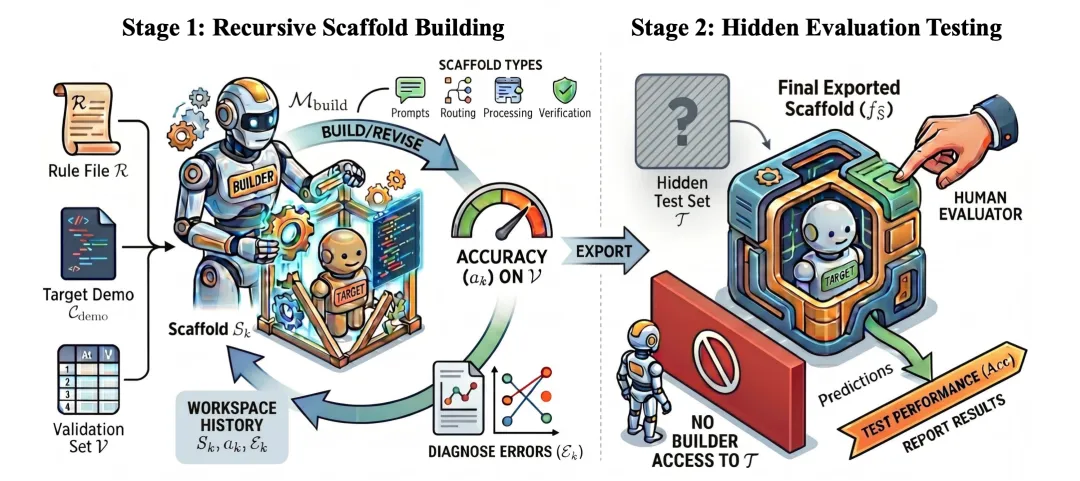
Figure 1: AI4AI's overall design process: Builder AI does not directly solve the problem, but instead builds a scaffold on Target AI to reduce its cognitive burden, achieving the most basic AI4AI capability migration from a Harness perspective.
Second, the cognitive load allocation of AI is measured using mental theory.
The article selected four Theory-of-Mind "Mind Theory" Benchmarks: BigToM, Hi-ToM, MMToM-QA and MuMA-ToM. Theory of Mind can be understood simply as: the ability to understand others, to know what they know, to believe what they believe, to want what they want.
For example: A young man puts his key in a drawer and leaves the room; while he's not there, Little Red Riding Hood moves the key to the cabinet. The question isn't where a young man's key actually lies, but: Where will he find it when he comes back? Humans must simultaneously distinguish between the real world and the world in a young man's mind.
Little Red thinks Little Red doesn't know where the key is?
This type of task includes both formalizable status tracking and recurring beliefs, implicit intentions, conversational understanding and even Bayesian Goal Inference, so it is convenient to observe how much AI can outsource to a program and how much it really needs to do with the language model itself.
The paper subsequently allowed Builder to freely design Harness in the Agentic Coding Environment such as Cursor, Claude Code, GPT Codex, and constructed 72 experiments from multiple perspectives, including effects, stability, verification budgets, Harness techniques, platform differences, target differences, Builder reasoning strength, cognitive load and residual errors.
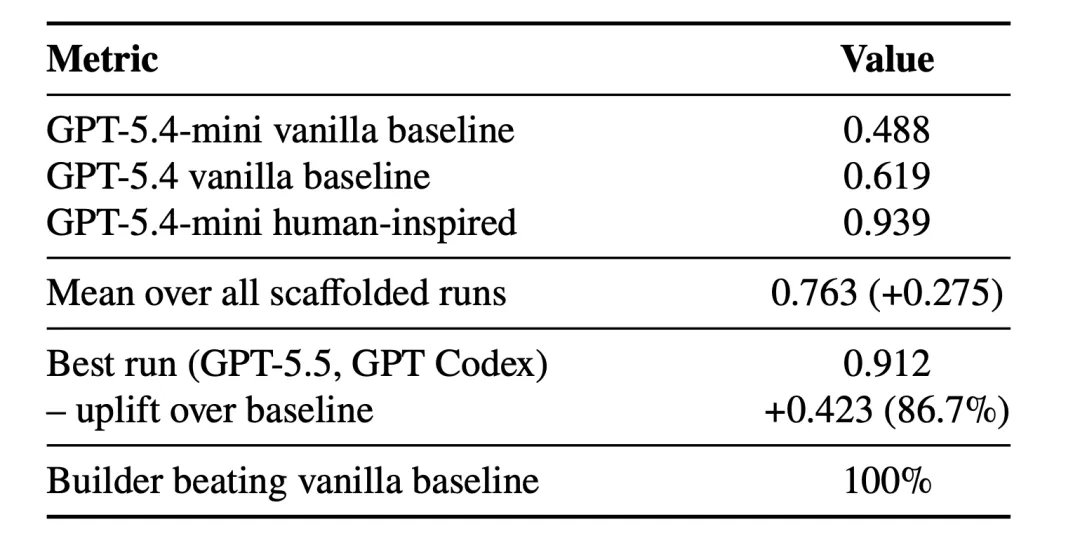
Table 1: Summary and comparison of the results of experiments with GPT-5.4-mini for Target AI
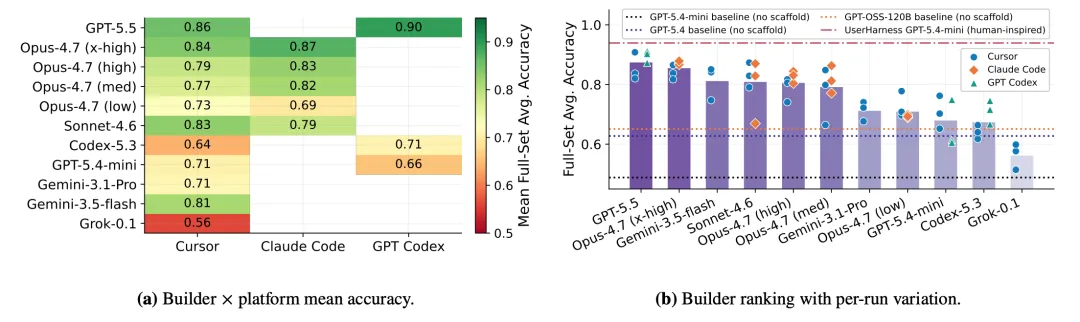
Figure 2: Complete results of the main experiment
Three, it's much more effective to change the way small models work than direct models.
First, let's look at the simplest set of numbers:
The GPT-5.4-mini adds nothing, responds directly to four tasks, and has an average accuracy of 0.488.
The average performance of all automatically constructed Harness experiments was 0.763 (0.912 at best), an improvement of about 86.7% over the original model.
In contrast, the stronger GPT-5.4 is only 0.619 without Harness.
That is, in these tasks, a weaker model that is well-organized and well-organized can significantly outperform a stronger model that runs barefoot. More importantly, this is not a particularly good run by chance. All 57 Scaffold Runs for the GPT-5.4-mini outperformed the original Baseline, and 11 Builder Configuration averages all yielded positive improvements.
Of course, this does not mean that Harness has completely replaced artificial design. The paper also compares it to previously designed UserHarness: GPT-5.4-mini + Human-Inspired Harness can reach 0.939.
Four, what should be transferred from the AI's brain to Harness?
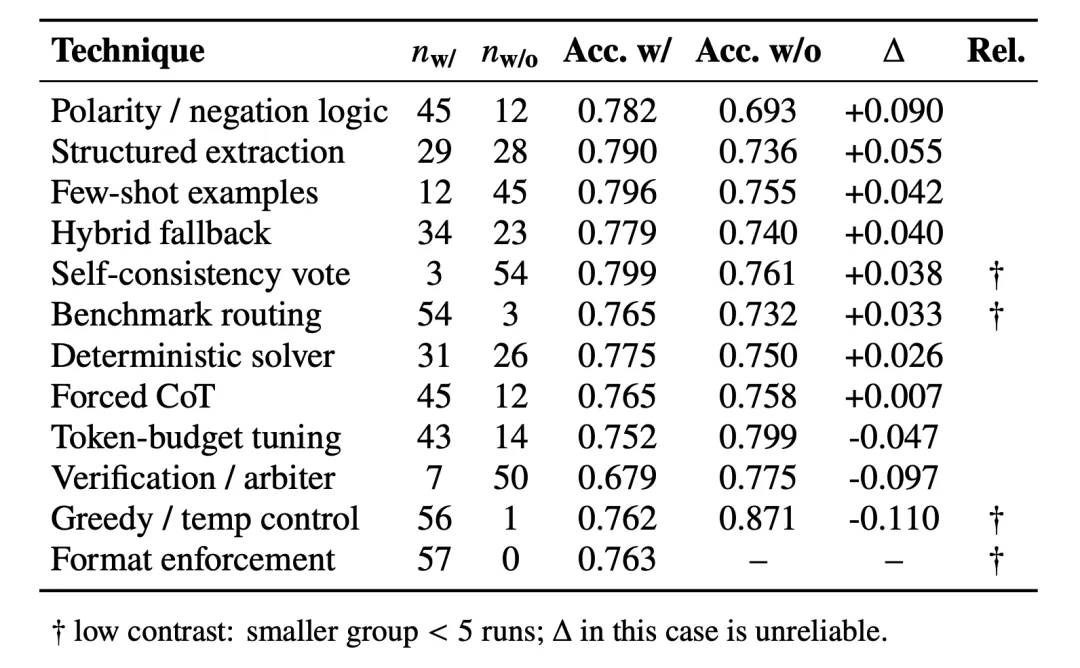
Table 2: Statistics of Harness techniques used by models and improvements in the effectiveness of Target AI
Finding One: The most effective Harness is not to make a weak model think longer.
One of the most natural assumptions is that a small model isn't smart enough to write a super-prompt, that it does more Chain-of-Thought, more sampling, more self-checking, right?
The results of the experiments were not, but pointed to something else: Builder AI's most commonly used methods, first, some of which sound even somewhat naive: answer format constraints, greedy decoding, task routing, structured input and output. While the real distinction between good Harness is often much further: Deterministic Solver, Structured Extraction, Polarity Logic, and explicit state tracking, etc.
In other words, a good Builder is not constantly telling a weak model. Please think about it again, but will ask further why you still need to think about it. If a certain point of reasoning actually has a stable rule, write it in code; if a certain step just mechanically records who saw what, save the state display; if the problem can first be divided into four categories, don't ask the model to re-understand the entire task every time.
The paper also found that the proportion of work done directly by external code and rules in Harness has a strong positive correlation with the final accuracy rate (r=0.72); instead, pure codes write more codes with a very weak correlation with the accuracy rate, only about (r=0.22).
If we put these two sets of numbers together, it's easy to see:
Effective Harness is not about adding more thought to the model, but about removing thought that shouldn't have been borne by the probability model.
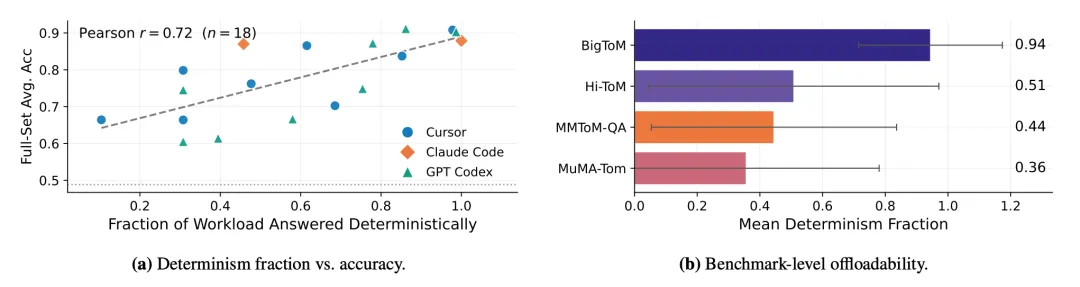
Figure 3: Builder AI reduces the cognitive burden of Target AI by outsourcing the task structure, and this shift in cognitive burden is key to successfully improving AI4AI's small model capabilities through Harness
Discover 2: What really happened was not knowledge migration, but cognitive structural migration.
The logic of traditional distillation is to allow teachers to instill knowledge into the brains of students. But the parameters of Target AI here have not changed at all from start to finish. The real model that is left behind is probably a classifier, a set of rules, a set of state representations, several procedures, and a whole set of processes that restrict how weak models work, etc.
In other words, the migration is not an answer to a question, nor is it a complete knowledge of the language, but is closer to:
Strong models have compiled their own understanding of how the task should be thought of, and have compiled a small set of external structures that the model can perform.
The paper calls this phenomenon Cognitive-Load Reduction "a cognitive load reduction": that part of the work is completely offloaded to the program and workflow; the remaining problems still need to be modeled and reorganized into smaller, clearer input and output subtasks by Harness.
From this point of view, Strong-to-Weak Scaffolding is like making a weak model of an outer cognitive skeleton: the outer skeleton does not make a person's muscles suddenly stronger, but it changes the load that was originally needed to be carried by the muscles alone and is now re-allocated by the entire Harness system.
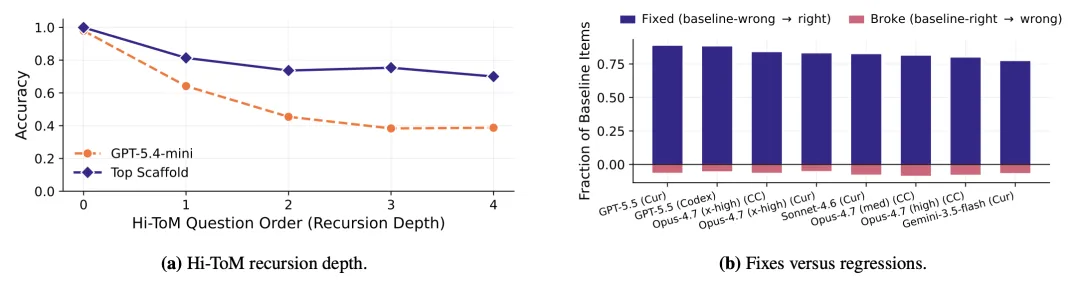
Figure 4: Statistical analysis of residual errors in different benchmarks
Discovering 3: Not all thoughts are equally easy to compile into rules
The article also failed to draw an overly optimistic conclusion, as not all smartphones can easily be written into the Harness. Indeed, there are already very clear differences between the four Benchmarks.
For example, in BigToM, about 94% of tasks can eventually be handled by Harness through consolidated workflows. It's because the task has a lot of stable "who sees what" and "who doesn't see what" rules, so it's easy for Builder to compile them into programs.
This actually also marks a very interesting boundary: part of the difficulty in AI reasoning comes from the unreliability of computing and organizing; part of the difficulty comes from the problem itself that really needs to be understood and inferred.
The former is well suited for Harness elimination, but the latter does not automatically disappear because hundreds of lines of code are written. The paper also confirms this for the analysis of residual errors: as belief recursion grows deeper in Hi-ToM, accuracy rates drop significantly; more complex Bayesian goal inference in MMToM remains difficult.
Future AI systems should learn to judge which cognitive and reasoning activities should be given to models, which should be compiled into tools, states and rules, and to automate them through Harness.
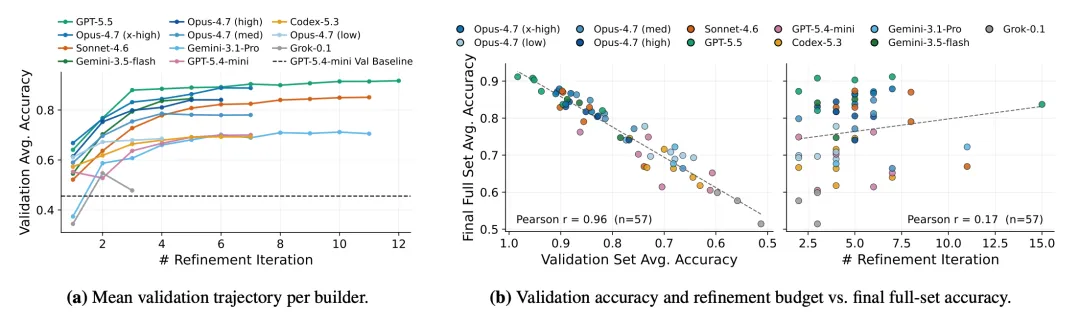
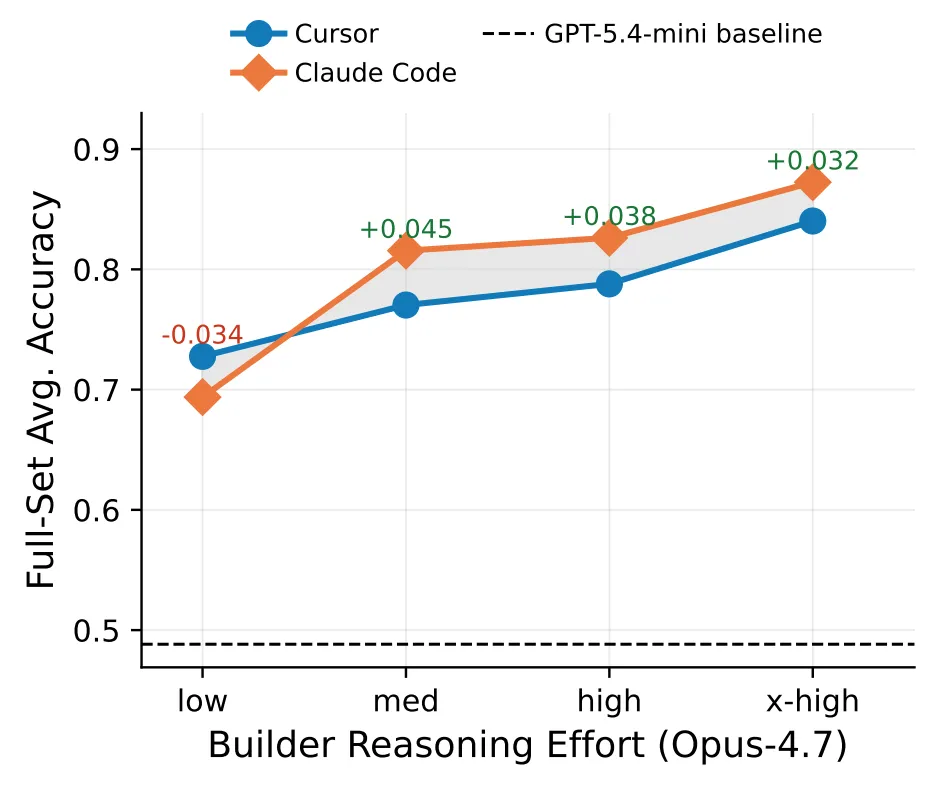
Figure 5: Builder AI can continue to allow Harness to evolve itself, improving the downstream performance of Target AI. However, this performance is not consistent with the number of rounds of Harness evolution by Builder AI, but is correlated with the strength of reasoning.
Discovering Four: The real value of a strong model is to understand the task better.
Builder AI can continuously self-reflect and re-evaluate Validation in the process of building Harness. Intuitively, the more times it is tested, the easier it should be to find a good solution.
The performance of the ultimate complete test set is highly correlated with the best performance of Validation; however, the correlation with the number of Refinements performed with Builder as a whole is only (r=0.17). Conversely, the quality of the Harness built by Builder AI on different platforms continued to increase when the researchers fixed Builder to Opus-4.7, only improving Builder's own Reasoning Effort.
This means that the advantage of a strong Builder AI doesn't seem to come primarily from trying harder to make mistakes, but rather from finding out more quickly what structures can be used for this task.
This provides a very different perspective on where to spend your arithmetic: instead of letting a weak model repeat expensive and unstable thinking on every problem in the future, rather than letting a strong model do a more expensive secondary reasoning first.
It's time to figure out what to think later.
And then the conclusion is reinforced in Harness.
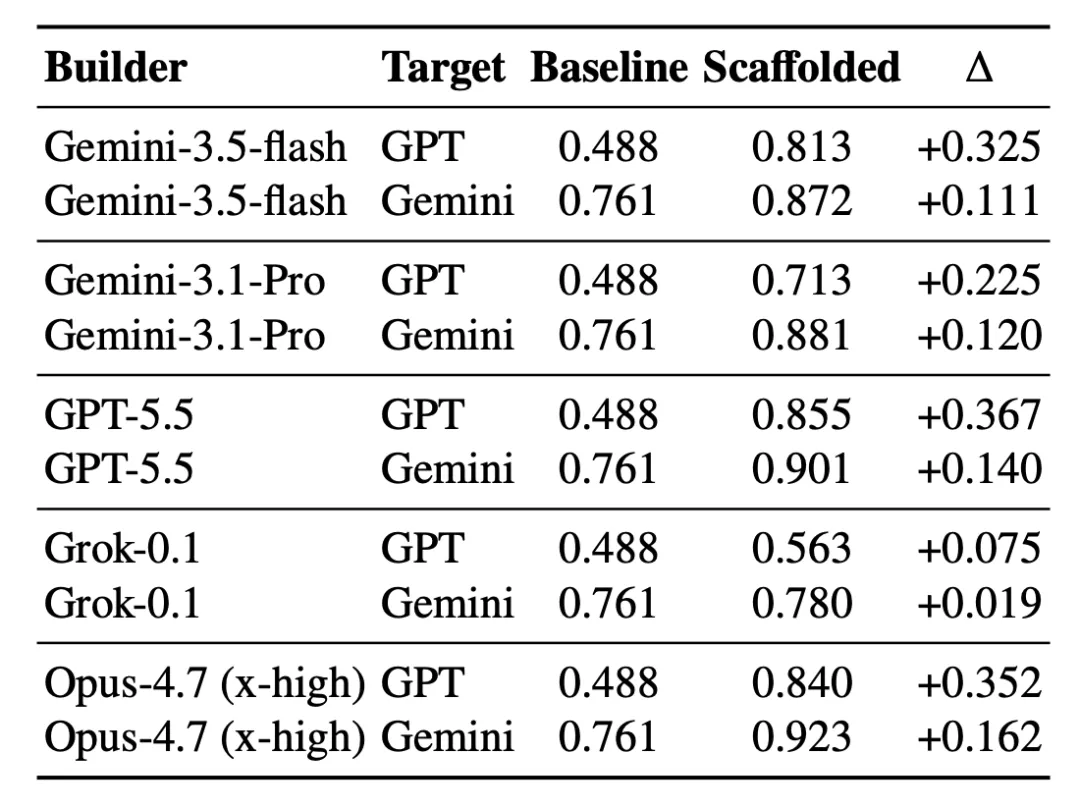
Table 3: The same Builder AI The benefits Harness brings to small models when faced with different Target AI are often determined by their existing capabilities: the stronger the already capable Harness is, the more likely it is to become a bundle.
Figure 5: The weaker the model, the more likely it is to benefit from a good Harness
The article further replaced Target AI and experimented again with the Gemini 3.5 flash, which was already stronger in its own right. A very clear rule emerged: the bigger the headroom the target had left, the greater the improvements Harness could achieve.
The paper's relevance under different Target×Benchmark conditions is roughly (r=0.75). For GPT-5.4-mini, many Builders can produce 0.2, 0.3 or even greater improvements; and when Target itself is already very good at certain tasks, the gains from complex Harness will decrease rapidly, with individual tasks even showing slight regression.
This is very much in line with real organizational experience. An expert who is already able to handle tasks independently and is forced into 10 levels of approval, 20 tables and fixed processes will not necessarily work better. Harness is also essentially a constraint:
For the weak, it is a footstool; for those who are strong enough, it can also become a snare.
Therefore, the future Harness will not be a fast-moving Super Prompt for all models, but will require dynamic judgement of where the model needs help and where it should be let go.
Fifth, AI4 opened the way for a model to evolve with the environment.
Revelation 1: The future of AI evaluation is not just about naked models.
In the past, Benchmark's default measurement was:
Can the model answer a question right?
But since the Agent era, AI in a deployment has almost never existed alone. It has Memory, Tool, Context Management, Verification, Skills, Router, and a variety of definitive codes.
Given a model and a set of working environments that can be shaped, what is the end result of this whole system?
The results of this work are particularly revealing to us: Model Capability and System Capability are increasingly not the same concept. A 0.49 model can indeed exist in a 0.91 system.
Revelation 2: AI doesn't have to work for itself, but it can be responsible for designing how others work.
If this Strong-to-Weak Transfer could be built on more real-world tasks, it would lead to an interesting AI-dividing approach: the most expensive, most powerful models don't necessarily have to handle every request, but can take on a more architect-like role: analyze tasks, discover laws, design processes, write tools, build verification mechanisms, and then hand over large amounts of daily execution to cheaper smaller models.
The paper does not directly demonstrate that this architecture must be more cost-effective in the real industry, but it does offer a very worthwhile possibility:
Can one-time thinking about expensive intelligence be consolidated into infrastructure and then repeatedly executed by cheap intelligence?
If the answer is ultimately yes, then the economics of future AI Scaling will no longer just call for multiple models of every problem; it will become: what expensive cognitive tasks can only be done once.
Revelation 3: The next stage of AI4AI is when AI starts designing the survival environment for AI.
AI4AI often brings to mind a very grand narrative: AI automatically trains AI, AI automatically writes AI, or even AI automatically improves AI. But the introduction to this work is actually simpler and possibly more realistic. It doesn't modify model parameters, it doesn't train a new base model, and it doesn't show any kind of infinite recursive self-improvement, but only one layer:
Let one AI no longer solve the problem directly, but observe how another AI solves the problem and then change the environment in which the latter works.
But it is precisely this layer of change that is worth paying attention to. Because once AI is not only able to operate in an established system, but can begin to modify the system itself, the objects of intelligent body optimization will gradually rise from the answer chain to the mechanism that generates the answer chain.
Finally, the paper proposes a highly anticipated direction: future models and Harness may no longer be independent of each other. Better models can design better Harness, better Harness, and help models to function more steadily, and the two enter into ongoing co-evolution, "co-evolution".
Six, the ending.
Over the past decade, AI Scaling has largely taken place within model parameters. The next Scaling that is truly worthy of attention in the Agent era will perhaps take place more and more outside of the model: how tools are organized, how memory is stored, how tasks are disassembled, how errors are verified, how reasoning is compiled, and how strong models submerge their structural cognition into the next layer of AI.
If traditional distilling is an attempt to insert the skills of a smarter teacher into the brains of students, then another alternative to Strong-to-Weak Scaffolding might be:
Students don't necessarily have to have teachers' brains first. Teachers can create a smarter world for students first.
And this is exactly the direction AI4AI at Test-Time deserves to be pursued.
Author's note
Chen Chen is currently a third-year PhD student at UIUC, where he teaches as an adjunct professor. His undergraduate degree is from THU, where he teaches as a Distinguished Professor. His research focuses mainly on LLM Agents, with a particular focus on reasoning, tools, users and creativity. He has published ToolRL, UserRL, and Google Scholar papers totaling 3600+ citations. He has won a Capital One Fellowship, ACL/EMNLP AC, and NAACL 2027 SRW PC.