
It's the first time in the history of the world.
ChatGPT has 900 million weekly users, less than 50 million paid subscribers, and only 5% to 6% conversion rate.
On 26 August, OpenAI made the "scheduled" function of timed tasks available to all free users.
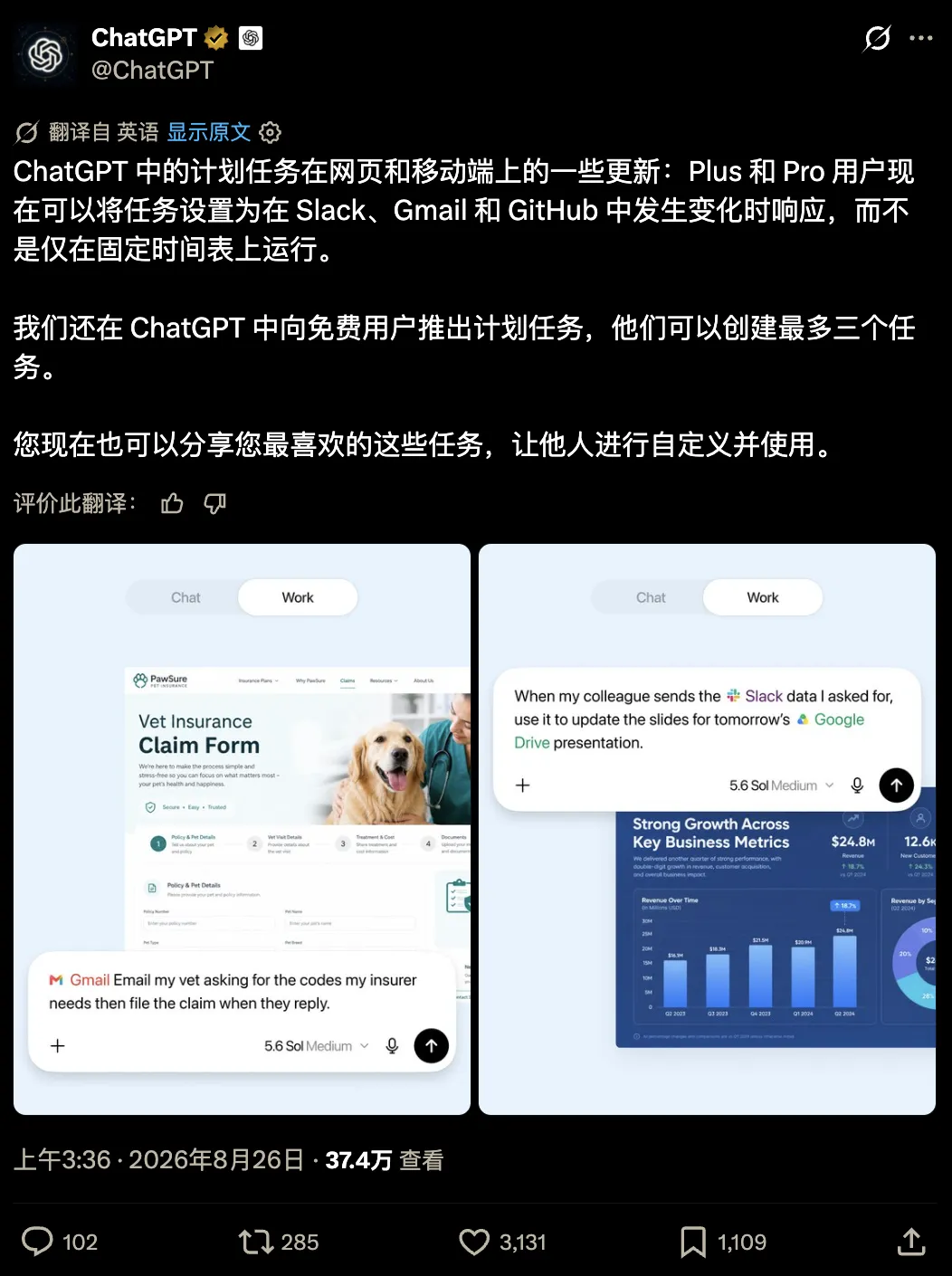
This feature previously only belonged to less than one percent of users, covering overnight the remaining more than ninety percent.
Timing tasks allow ChatGPT to automatically run a cue word in the background at the time or condition you set, and then run it and send the results to you.
You're not on the line, and it's running.
For the vast majority of free users, this is the first time that ChatGPT has been able to function on its own without opening a dialog box.
What can it do for you?Timed tasks are divided into three categories, corresponding to three different use scenarios.
The most basic is a one-time reminder.
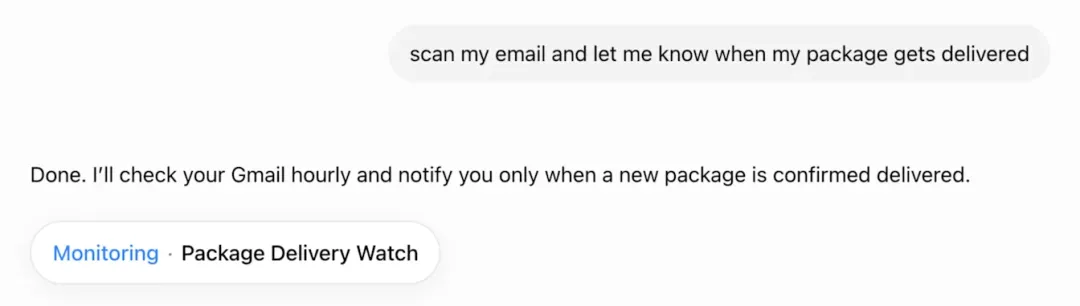
Tell ChatGPT a time and a thing, until it pushes it to you.
For example: "The package was sent to tell me".
It's more of a cyclical task.
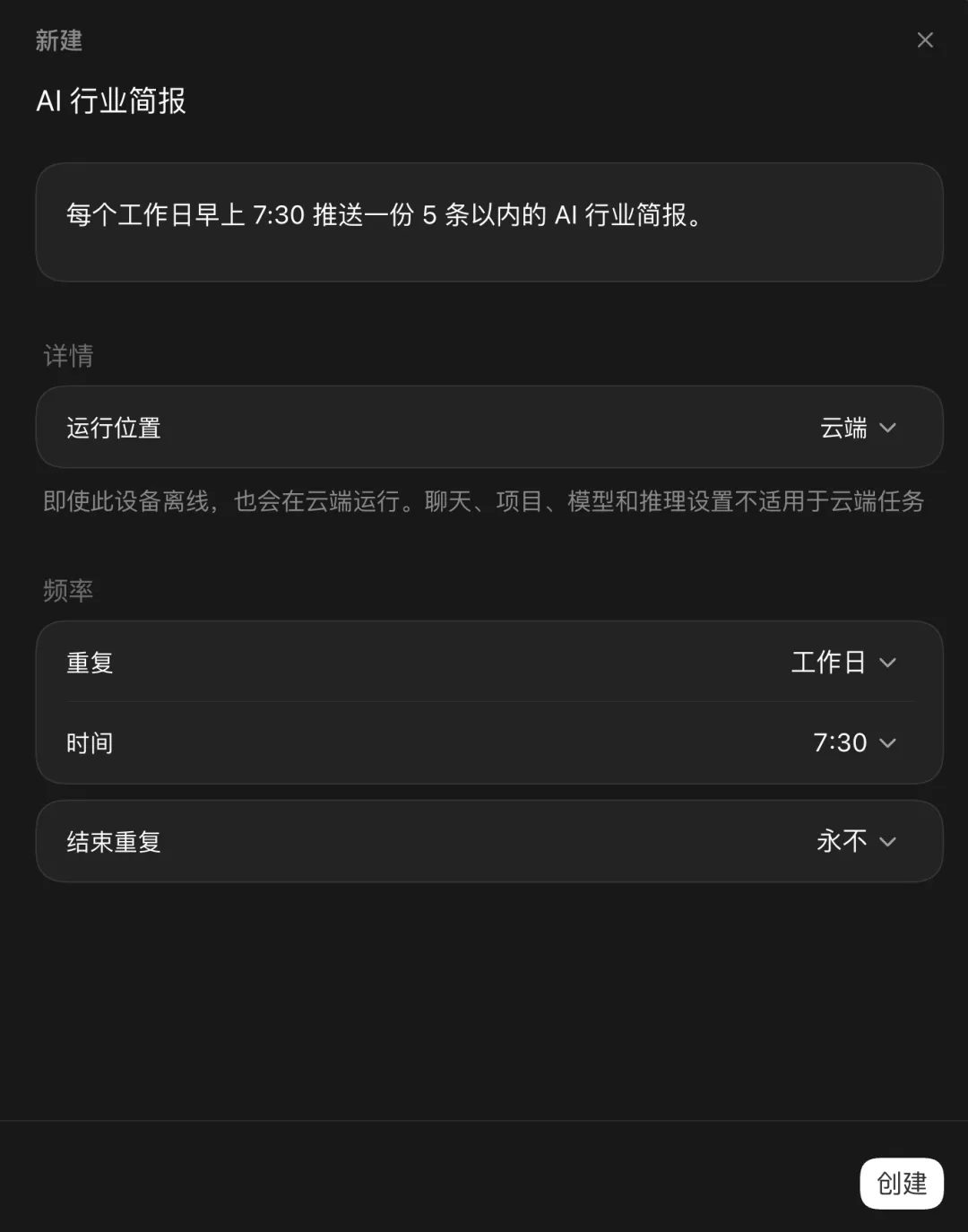
Every weekday at 7:30 a.m., a five-page AI industry brief, a limited area, a limited number of words, is sent as a zero-cost custom morning paper.
Every Sunday morning lists next week's weight loss recipes and purchase lists, and every night at 7 p.m. gives children a new bedtime story and an illustration, all set in one natural language.
You can take it as your own foreign language lesson: every evening, you push five medium-difficult English sentences, ask for a translation, don't give an answer, wait for you to reply and criticize.
The third category is monitoring tasks.It's also one of the best expressions of "Looking for You".
You can post a link to a commodity page to ChatGPT and let it hold the price, for example, if it drops $1,000 to notify you.
The same logic can be used to buy tickets, to buy houses, to buy stocks, to buy discounts on a game on Steam.
ChatGPT checks regularly and doesn't bother you when there are no changes.
The person making the content can have it blocked from the product page or press release of the auction, with updates and return notifications;
People looking for a job can have it stuck to a specific position on the recruitment website, and a summary will come out as soon as a new release.
On August 26, these updates added a more radical capability:The incident triggered.
Payment users can access ChatGPT via Gmail, Slack, or GitHub to run tasks on an event basis.
Customers send feedback on the Slack channel (Group) and ChatGPT automatically summarizes the points and draws up a response plan.
Someone on GitHub has given you a PR review, which will include a list of revision plans.
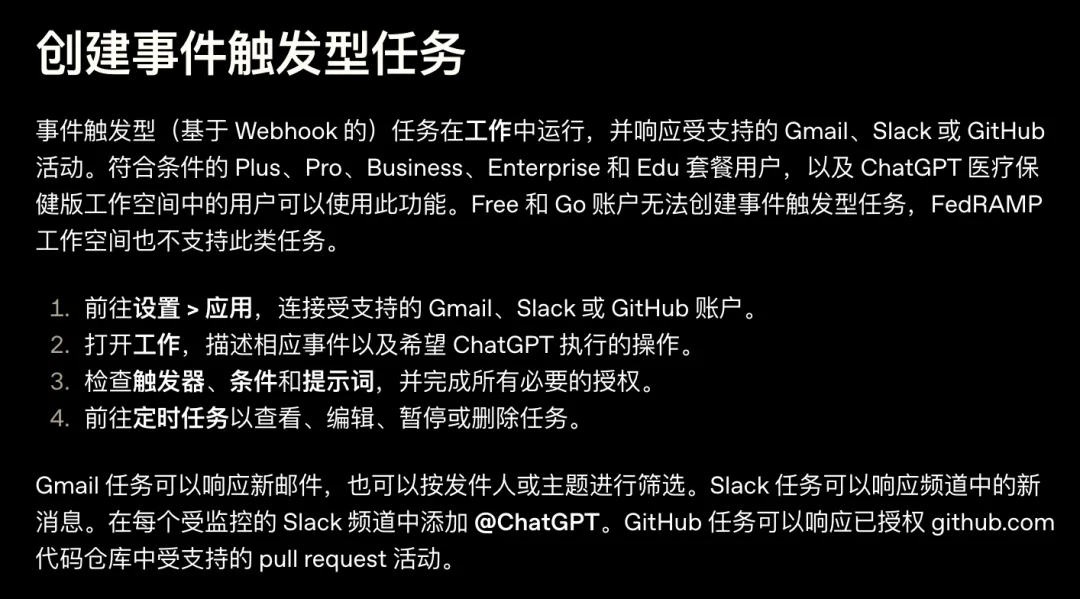
The email scenario is the same: the employer sends a progress email, and after reading ChatGPT, the employer draws up a response according to your default template.
From "checking at 8 a.m. every morning" to "there's something talented about", that's the difference between timely rounds and event-driven.
The first three types of tasks run in time and the event triggers run in conditions, and the two cannot be combined in the same task.
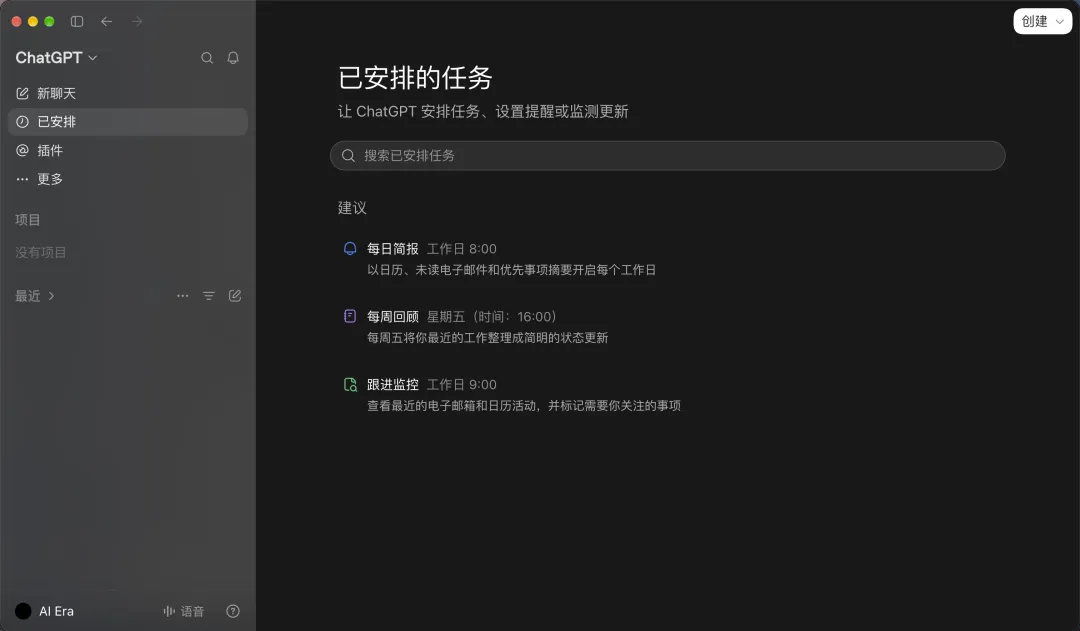
All tasks are administered uniquely on the sidebar of the Scheduled page, which can be suspended, edited or deleted at any time.
It's also easy to create: In a natural language, in a dialog box, describe what you want to do, when to do it, and the ChatGPT confirmation task begins.
Where is the free version ceiling?OpenAI is very restrictive about the quota of free users.
The upper limit of three active tasks is that cyclical tasks run at most once a day, and time can only be chosen for vague times such as "morning", "afternoon" or "evening", and cannot be accurate to a few hours.
Payment users' permissions are gradually increasing.
Plus users (US$20/month) can build up to 5 tasks, supporting accurate to minute time settings, running at least once per hour;
A maximum of 10 Business and Edu users;
A maximum of 15 Pro and Enterprise users.
The new Aug. 25 event trigger feature (accessing Gmail, Slack, GitHub's webhook) is only open to Plus and above packages, free users and Go users can't touch.
Task sharing is the only feature of the update that doesn't have a threshold.
A user-appropriate task can generate a link, and another person can open it and get a separate copy, change instructions, change time, and connect to their account.
The free version is equivalent to a small trial.
Three tasks are enough for you to set up a morning newspaper, a discount monitoring, a pre-sleep wake-up, just enough, but no excess.
If you want accurate controls and event drives, you have to make money.
ChatGPT's routes and lessonsTimely tasks are not a new idea.
In January 2025, ChatGPT launched the Tasks test version, but the functionality is simple and few people use it.
In September of the same year, OpenAI changed course: Pulse, a proactive push functionality aimed at only $200/month Pro users, was launched.
Read more: Just recently, ChatGPT Pulse went live!
Pulse's logic is that AI decides what to watch for you based on your chat records, memory, and connected applications, generating a set of information cards every morning, similar to a personal diary edited by AI.
Nine months later, Pulse was cut off.
On June 17, 2026, OpenAI announced that Pulse would be offline in 14 days, along with the launch of the rebuilt Scheduled Tasks.
The official conclusion is: "Active experiences are most useful when they are personalized, operable, user-controlled".
Pulse decides for users what to look at and users don't buy bills;
Scheduled Tasks, in turn, allows users to define what to do and when to do it.
On June 17, the reconstruction was open to paid users only.
More than two months later, on August 26, free users were eligible to enter.
On the same day, the event-triggering capability was upgraded from the Tasks test version to today, a feature that lasted 20 months and experienced a major shift in the middle.
The timing mission is the first public entry into the ChatGPT from the dialog box to the backdrop of Agent's residence.
But the free version of the three-task, once-daily, vague time-configuration, is a trial sample from OpenAI that lets you taste the dessert of "Somebody's Watching You" and then pay for accurate controls and event-driven automation.