It's the first time in the history of the world.
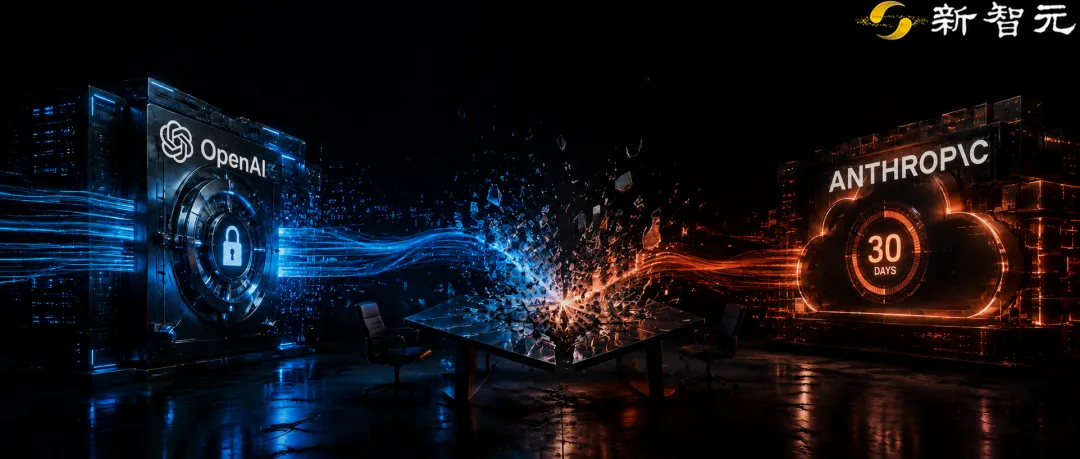
In the early days of Silicon Valley, a war of privacy was fought between the Silicon Valley A.I. duo.
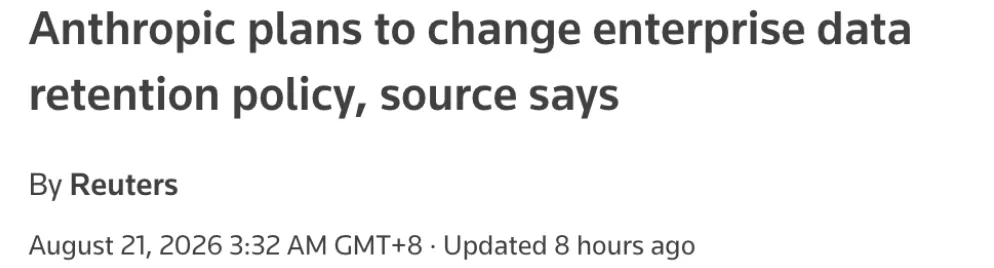
On the 19th of August, OpenAI's time-targeting machine opened the table and made a very heavy pledge: Once you're done, your tips, your replies to the model, we won't have a word left.
OpenAI's official announcement of the new "zero retention" scheme, which Anthropic just issued to its corporate customers two months ago, says:
If you want to use the strongest model, give 30 days of data first.
The next day, Anthropic was quiet: Although the data will remain for 30 days, it can be stored in the customer's own cloud.
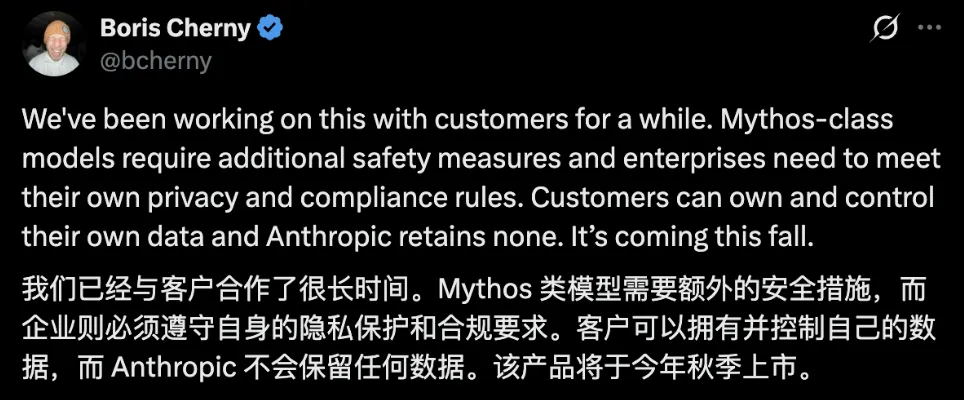
And then Claude Code's father, Boris Cherny, came on the scene and made it clearer:
Customers can own and control their own data, and there's nothing left for Anthropic.
"There's nothing left".
The day before OpenAI's promise, Anthropic shouted as it did.
But "nothing left" in both mouths is not the same thing.
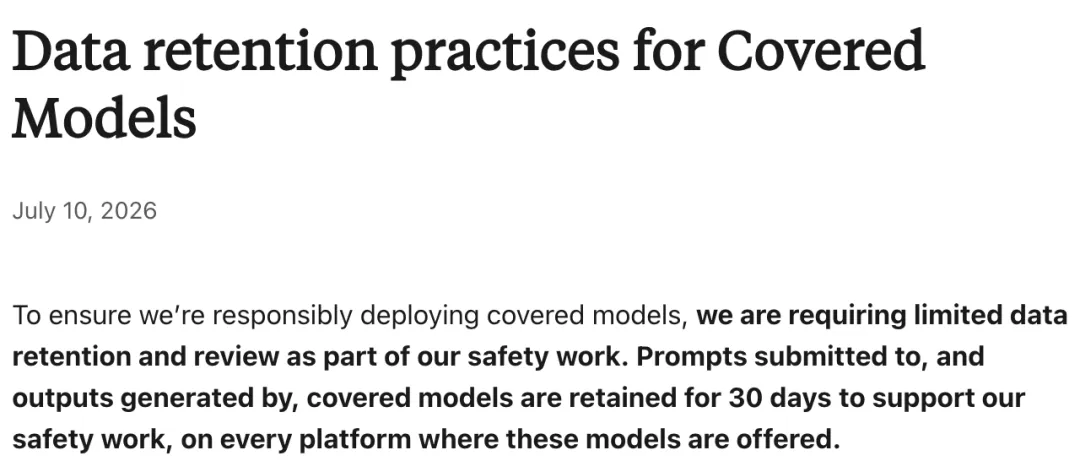
In 48 hoursThe two men are tied for the championshipOn 9 June, a new Anthropic rule officially entered into force.
Business customers who want to use the Fable 5 and Mythos 5 models must accept one condition: submit the input prompt, generate the output, and hold it for 30 days.
On August 19, OpenAI countered, announcing a preview of Private Safety Processing, with a key statement: no customer data being retained.
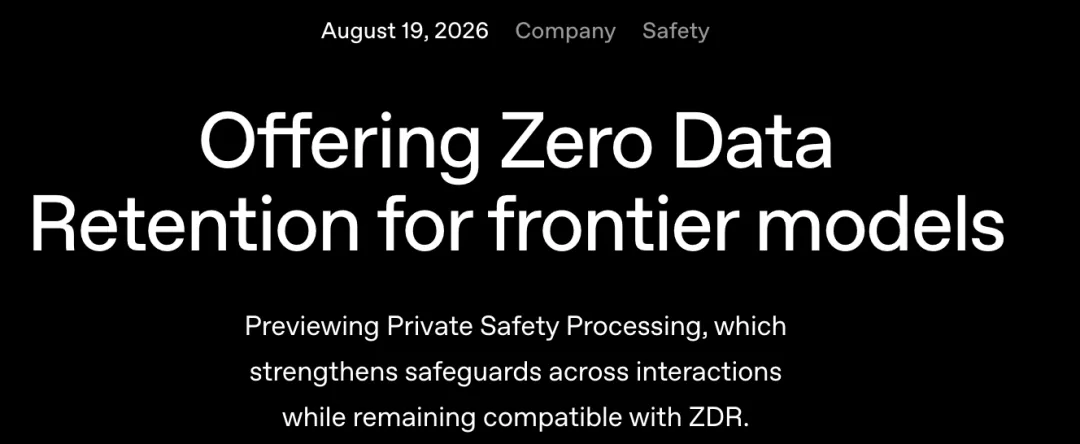
It's not hard to understand what OpenAI means: It wants to get rid of those corporate customers who are unhappy with Anthropic's data retention.
On the other hand, Anthropic, which has been frequently criticized by customers since the new rules came out, has been criticizing alternative solutions, and has argued with more than 100 customers, including Salesforce.
OpenAI is more like pushing this alternative out ahead.
On the Anthropic side, why not keep the data for 30 days?
The reason for this is security: some attacks, one look at a request, and you can't see anything.
The Best-of-N prison escape is an example.
The same prompts, changing hundreds of subtle variants, a brainstorm is passed, and one of them is always able to bypass the line of defense.
It's like a normal question, a rule of thumb, and it doesn't cause problems. Just look at them together and the intention will come out of the water.
Larger ones, such as data blackmail, never show up in a single conversation, and require a security classifier to pull the lens away across a large number of requests in order to see a little eyebrows.
In order to "pull telescopes", the content needs to be temporarily stored somewhere to be analyzed together, rather than going through it alone over and over again.
Anthropic has also outlined the scope, targeting organizations that have configured zero data retention and want to use Covered Models, and providing fine-grained protections, but it is still pushing a large group of customers to the edge of the wall.
Loose is custody.It's not about staying alive.What did Anthropic change this time?
According to sources, 30 days of storage, not less than a day. But a new option is given: these data can be stored in your own cloud.
Looking at just a small step, it is just what is needed for the compliance department of the enterprise.
The data is stored in an anthropic's engine room, the equivalent of the root of fate in the hands of the family.
Encryption keys, access logs, who can see, how to see, the rules are its own, and you can only trust the promises it makes on the page.
The data is stored in your own cloud, and the key is yours, who touched it, when touched it, running your own audit system.
You can see for yourself what really happened.
Data keys to the customerOpenAI only receives alertsOpenAI is another way of thinking.
Simply put, it's about sending the algorithm to the data instead of moving the data to the algorithm.
Private Safety Processing is broken down into three steps.
The first step is to put the original content in two ways: either on your own controlled infrastructure; or in the storage provided by OpenAI, but with the key encrypted in your hand: this key is not copied by OpenAI, so it cannot be opened.
In the second step, the automated system looks at the interactions of the various wheels to find out the risk patterns, and no longer judges one by one in isolation, as in the past.
This is exactly the same problem that Anthropic originally had to solve for 30 days.
The third step is that once a hit is at risk, OpenAI receives a narrow range of signals: which type of activity it belongs to and to what extent it is serious.
At the bottom of the page are hints and responses that OpenAI people can't see, even if the content is already labeled.
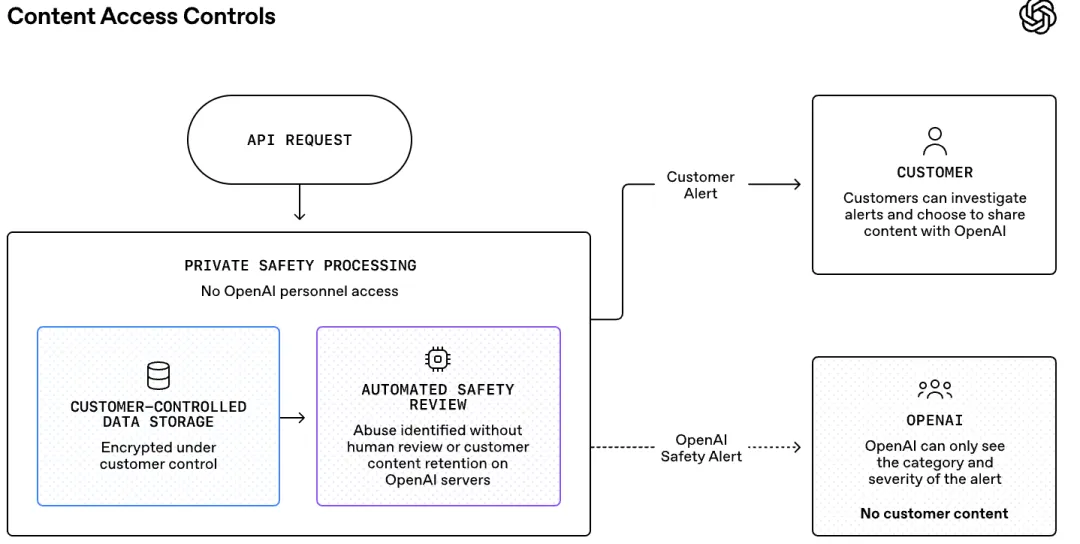
Private Safety Processing's content access control processes. The original content is encrypted by the customer, and OpenAI only receives the alert category and severity.
Customers can check these alerts in their own systems.
If you want to complain, to clarify the legality of an activity, or to assist in investigating the alleged abuse, you decide not to release the relevant content.
However, the design is currently being tested by early customers, with plans to launch in September, and the technical white paper will have to wait until then.
Remaining is not like trainingIt's only true for businesses.Seeing "your data is kept for 30 days", many people's first reaction is "so my conversations were taken to a training model".
Both sides have different ways of dealing with this issue.
Anthropic says the tips and outputs left by Covered Models are used to support security work; OpenAI says enterprise data will not be used by default for training models unless customers actively choose to join.
The purpose of retention is to investigate abuses, not clutter models. In terms of technical processes and data authorization, these are two paths.
This claim is valid only for corporate customers. The official Anthropic page makes it clear:
The consumer end packages do not need to be configured this time, as the inputs and outputs on these interfaces are stored.
Is it going to be used to train those who are left behind?
I'll see you.
The official page lists three scenarios: you allow it in your settings; the conversation is tagged into the security review; or you actively join a program like Trusted Tester.
The first is to listen to your own decisions.
But in August 2025, the rule was changed to change the initial setting of the switch: you don't actively say no, even if you promise.
The switch for data sharing in the bullet-window was opened in advance, when some called it an inductive design ("dark pattern").
In August 2025, an old user pop-up window displayed in Anthropic's official announcement. Under the remarkable Accept button, a switch that allows data-trained switches to be opened by default.
The second is another way: once a conversation is marked into a security review by an automated system, it can be taken for analysis, a model used to train a security team. It has nothing to do with your switch, it's a two-way thing.
And there's a bigger gap in time.
Corporate customers are stuck on the ground for 30 days, and on the consumer side, you can lie in the training pipeline for at least five years once you allow the training and the chatting record to erase the name.
If a conversation is found to be in violation of the use policy, what you say and the AI return will last for two years, and the risk score the system gives you will last for seven years.
OpenAI is similar here.
The personal version of the training switch, which was switched on by default, had to be turned on and off by itself in the settings.
In this confrontation, the two companies actually agree on one thing: complex attacks can only be seen through multiple requests, and security surveillance is not negotiable.
The only difference is that this monitoring should not be used to replace your raw data.
OpenAI doesn't leave, it doesn't leave, it doesn't ask you to leave your request after it's done, it really does, it only receives one alert.
Anthropic doesn't exist, it doesn't exist, but you have to leave a 30-day retention obligation for it, a day at a time, and it's only the custodian who changed from it to you.
Some things have changed.
Then choose AI, not only to look at the score, the sex ratio, the context window, but also to add one: where your words are, who can see, how long they stay.