
It's the first time in the history of the world.
You just give it a task, and it remembers even your boss.
After that, you give the baby to Claude and you don't have to come back empty-handed.
You've been talking about three months on Chat: who the customer is, what the boss wants, how the reporting forms should be sorted, which numbers can't be put into conclusions...
These are the things you cooked in the Chat, and it remembers everything when you give the live ones to Cowork.
New developments that emerge during Cowork's work will bring Chat back to its original roots.
In the past, Chat and Cowork were like two people.
The man in the chat who's familiar with you, the man in the Cowork, has to get to know you again every time he meets you: the opening line is "Who am I, how do we measure our team?"
Now, this cold start between talking and working has been canceled.
Memory has evolved from a function in the chatbots to an upper context layer when the smart body is active.
On August 25, Anthropic officially announced that Claude Chat and Cloud Cloud Claude Cowork will share the same set of memories starting today.
Claude's memory is everywhere, and you can decide what it remembers.
Claude Code's father, Boris Cherny, relayed the announcement, saying it was a small improvement: memory is now simpler and stronger.
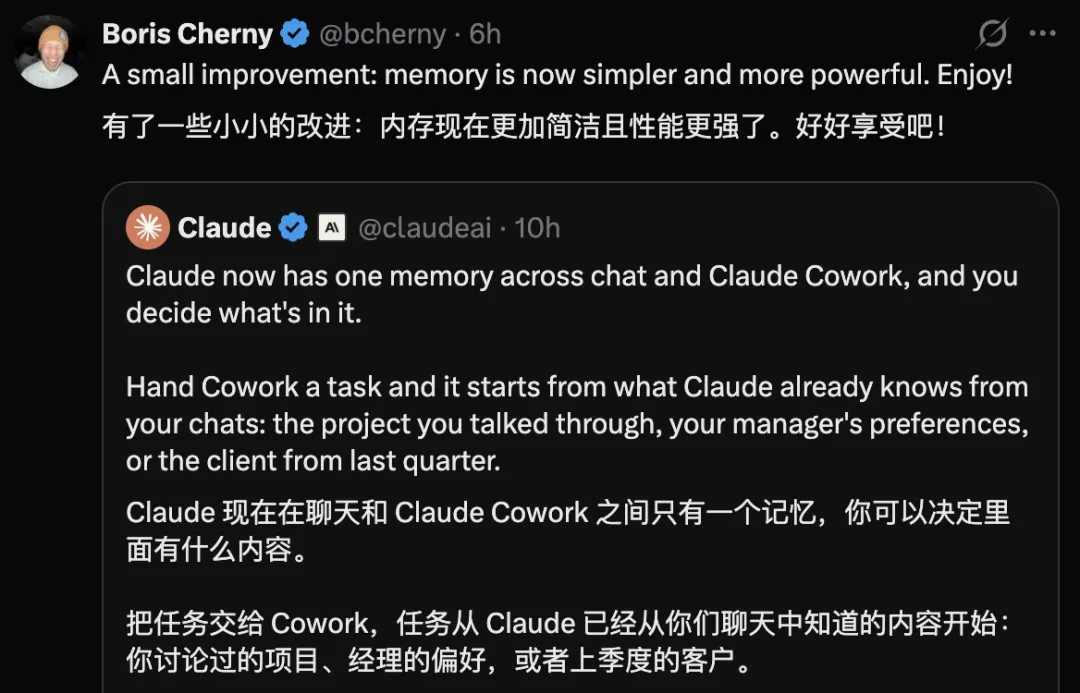
This update, put into everyday scenes, will make it easier to understand.
Let Cowork write a job update to her manager, which knows who the manager is and what kind of writing she wants to see.
In the chat room, the agenda of a meeting is stormed by a storm of thought, and as for the budget and execution of the documentation, the number of people, the city, the list of speakers, it doesn't require you to report again.
After explaining how your team defines the metrics in Chat, and then reviewing the material for each quarter, Cowork does everything according to these metrics, without having to rearrange it.
And the shared memories will continue to be updated.
The new contexts that emerge in the Cowork mission will flow back to Chat.
The timing is also important.
On 18 August, Cowork had just unveiled a paid package on the web, desktop and mobile devices. Seven days later, memories were opened.
This update doesn't change the model's capabilities, it changes how much you know about it before it works.
I know you and I can do better for you.
The Black Box of MemoryIt has become an ever-changing ledger.Many people's first reaction to seeing "memories open" was: "My chat records have been removed".
It's not like that.
The Official Help Center makes it clear: "Claude has a collection of topically generated posts called Topics".
It's not the same as the past, but it's the end of the conversation and the end of the conversation.
What's the difference?
You change the deadline of a project to September, and the next time you start a new conversation, it's already known that you don't need to change it, and of course you can't be sure that you want to change it so much that you can remember it.
More importantly, these entries can be viewed and modified.
Open Settings > Memory, Topics below lists all the content that Claude remembers.
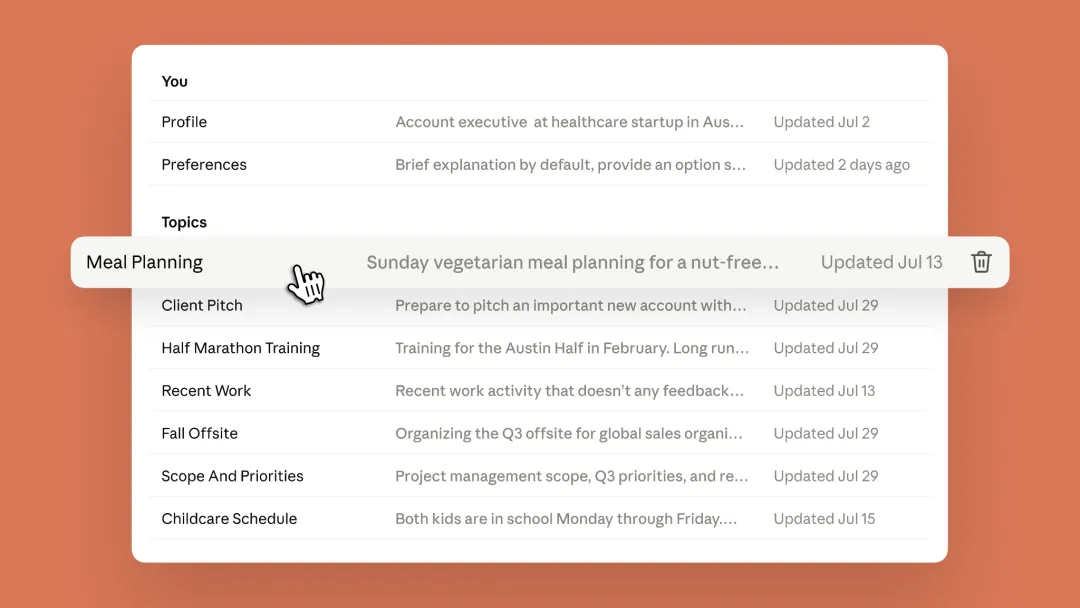
The list of topics in the Memory Settings page, where Claude remembers everything, can be read, modified or deleted.
Because these documents are short and easy for you to maintain.
For example, if a company changes its name, you change that article, and every conversation from then on, you change it.
I don't want it to be remembered, there are two options.
Suspension, the existing memory remains, but is no longer used or renewed, and the dialogue during the suspension will not be re-recorded.
Furthermore, each project has its own separate memory space and project summary, which are not mutually exclusive.
In the past, AI remembered things about you, and you can only guess from its answers.
Now that you're aware of it, it's a document that you can edit at any time.
Memory functions, from a black box to an ever-changing ledger.
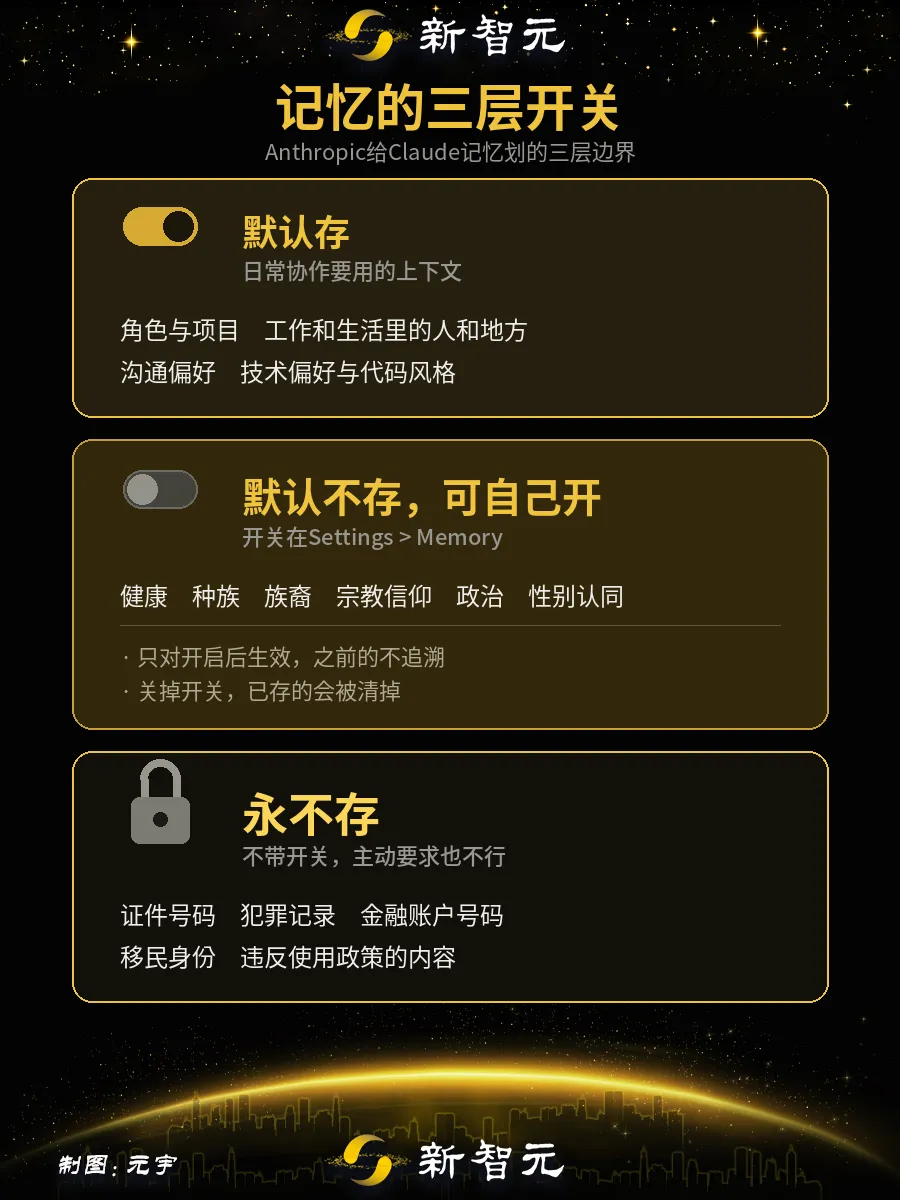
Three levels of memory switchingOne of the most important designs of this time was the three-layer switch to memory by Anthropic.
First floor, by default.
Your roles, projects, people and places in your work and life, your communication preferences, your technology preferences, your code style, what you're getting yourself into... This layer usually includes those contexts that require daily collaboration.
The second floor doesn't exist by default, but you can open it yourself.
It's about health, race, ethnicity, religious beliefs, gender identity.
The official statement is that some people feel sensitive and others feel useful.
For example, if you turn on this switch and Claude gives you a week's worth of meals, he'll remember that you're allergic to peanuts.
There are three rules behind this switch.
Only the contents after the launch are valid, with no trace of the past.
Every time you save this type of content, a prompt pops up at the top of the input box and you can review or change the settings on the spot.
If you reject the tip or turn off the switch later, the sensitive entries that have already been entered will be deleted.
The third floor never exists.
Document number, criminal record, financial account number, immigration identity, and any contents of policy violations.
This layer has no switches.
Even if you actively ask Claude to write it down, it won't exist, and it will tell you exactly why.
It's not perfect, but it's cloud-based Cowork.
The official blog post and the Help Center wrote the same line: "This shared memory is only valid when Coork is running in the cloud".
It doesn't include running local meetings on your own computer.
Is it possible for free users to use the unified memory workflow?
I can't.
The free, Pro, Max 3 is set to Claude's memory by default, not Cowork's.
Cowork is still only open to Pro, Max, Team, Enterprise.
It's different for different terminals and different situations.
The macOS and Windows desktop edges are open to all paid packages, and the web and mobile edges are Pro, Max, Team, and Enterprise to see if the administrator is open.
Team and Enterprise are closed by default and must be opened by the organization's owners in the settings.
There is also a threat: once the owner turns off the organization-level memory, the entire organization's memory entries will be permanently deleted immediately.
In addition, organizations that have signed HIPAA, public sector or partial custom data retention agreements are temporarily unable to use memory.
When a conversation expires or is deleted, the memory entries generated by it will not be deleted.
If you want to delete it, go to Settings > Memory and delete it separately.
This article is probably the best known and most easily missed by the average user.
Can you talk to Claude about sensitive topics after the opening?
Let's have a chat.
The only thing that is deactivated by default is the action of "writing in long-term memory", not the chat itself.
If you want to talk about your health, Claude can't stop talking to you.
Next round of competitionWho doesn't need to know you again?What is Cowork?
The official definition is to move Claude Code's smart body architecture to work with knowledge outside of programming, without the need for a terminal.
It can disassemble tasks, synchronize smartphones, run all the time in the cloud, connect laptops to it, set time tasks, and execute when the computer is not running.
Now, give it another set that's been in the background for months.
There is a new change behind this little improvement.
Today you're two months ahead and tomorrow your opponents will be added. But it's hard to match the user-generated context.
One who already knows how to write a weekly newspaper, how your team calculates metrics, the system you dealt with in the last quarter, the cost of replacing it is not that much subscription fees, but that you have to rephrase yourself.
Interestingly enough, Anthropic kept the door open.
Official support for importing and exporting memories between Claude and other AI services, though still in the experimental stages.
In the last round of the competition, everyone is fighting for the task: who can finish the job and who can do it longer.
The next round of competition has changed: it's your memory, and you don't want to explain things a second time, and who lives in the end.