The smart hand is the final nail in the coffin of the smart landing gear that needs to be attacked urgently.
After supplementing the mobility of the lower half of the humanoid robot, the industry began to focus on the upper half of the robot's operational capabilities, while the agile hand was considered to be the key to the general, precise operation of the robot, high barriers and high value-added characteristics made it the focus of the capital bet.
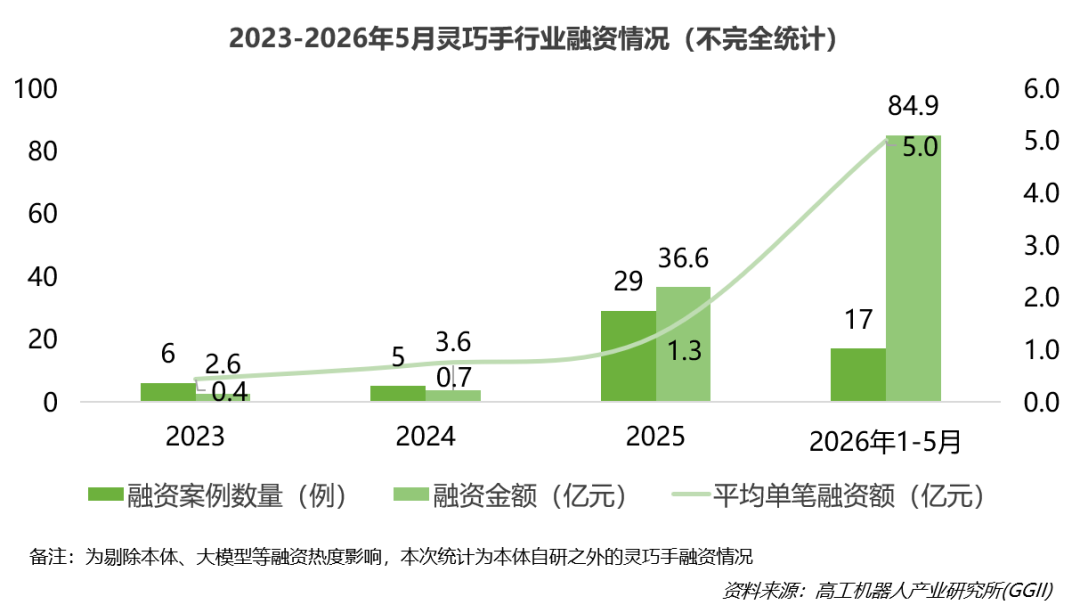
According to GGIII's incomplete statistics, in May 2023-2026, there were about 57 financing transactions in China involving about RMB 12.8 billion, of which the RMB financing boom began in 2025 and continued to soar in 2026, with a significant increase in the amount of single financing and total financing. Some companies completed multi-phase financing, such as RMB 7 in just one year, becoming one of the few smart enterprises with a valuation of over RMB 20 billion.
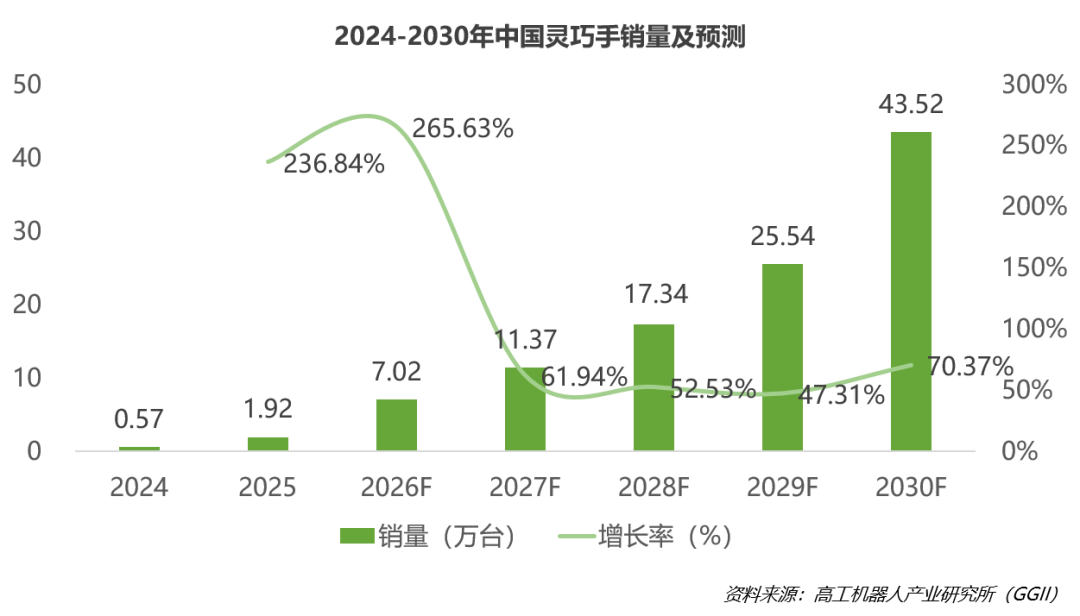
 The rapid development of the robotics industry will inevitably drive the demand for smart hands, capital is expected to continue to invest in the smart hands industry, and the industry's economy will continue to rise. According to GGII data, sales of the smart hands market in China in 2025 are expected to reach about 192,000,000, an increase of 236.84%. It is expected to reach 702,000, an increase of 265.63% in 2026.
While the industry is still in its early stages of development, it is not possible to balance the triangle with the overall industrial chain.
For the time being, the slender hand industry is still in its early stages of development, with an unlikely triangle of low-cost, high-performance, and high-stability steel, and the immaturity of the entire industrial chain has exacerbated this imbalance.
The industry chain includes upstream core components and software algorithms, upstream design, processing manufacturing, downstream robotics applications, and so on. There is still room for technological innovation and precision manufacturing of upstream micro core components; software algorithms are still immature; data on sophisticated hand operation is severely insufficient; downstream technology routes have not yet narrowed; manufacturing relies on artificial intelligence; downstream robot application scenarios are blurred and difficult to form sustainable casino scenarios - data-models - downstream hand closures.
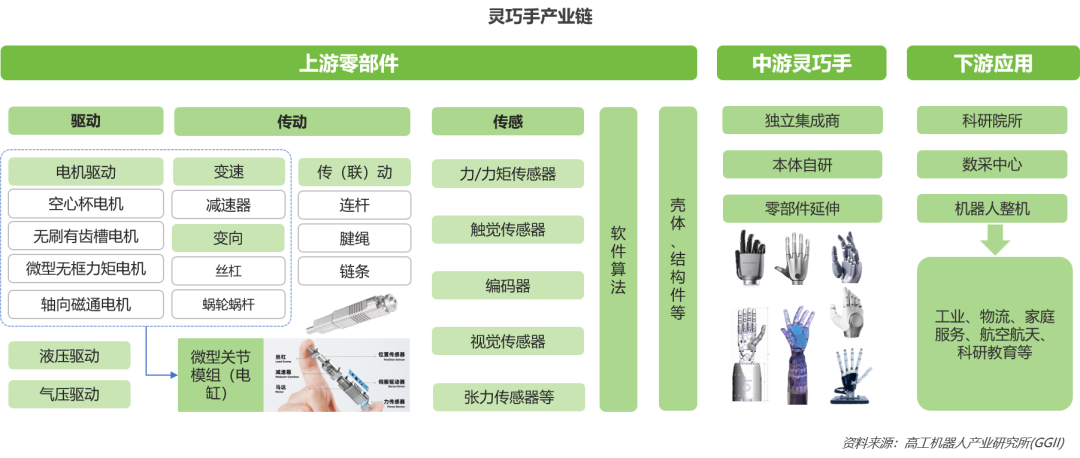
In terms of hardware, the delicate hand-held structure is complex, and the performance of the core components determines the final thickness of a millimeter of silicon.
The hand is powered mainly by a micro motor, but due to the lack of torque, it is usually necessary to amplify the torque with a micro precision decelerator, and since the motor is usually placed vertically on the palm of the hand and inside the fingers, it is necessary to convert its rotational motion into linear motion by means of turning/turning levers or silks, and then transfer the force to the joint motion by means of connecting rods or ropes or chains, thus transforming it into the bending motion of the finger joints.
Specifically, smart hands need high-torque density motors that can react quickly in a small enough space to generate enough power for the industry to evolve in a high-torque density direction. At present, smart hands are still dominated by vacuum cup brushless motors, with structural compactness, fast response speed, high energy efficiency, low noise, long life. As Tesla moves the motor from the hand to the arm, the release of space allows for low-cost unbrushed crankshaft applications.
Precision accelerators are based on micro-planet accelerators. Although the power density of the micro-planet accelerator is somewhat reduced, the transmission accuracy can be reduced, but the load can be increased, costs can be reduced, and reliability is higher.
The traditional choice of turbocharging equipment is turbocharger/turbocharger, which can achieve natural self-locking, low cost, but low transmission efficiency, and poor transmission accuracy. To address the short boards of traditional turbochargers in efficiency, accuracy, and carrying capacity, Taos Intelligent has introduced an all-wheel-drive turbocharger that can simultaneously achieve torque gain and torque reduction.
In addition to turbine/turbine levers, the industry opts for rolling silk and planetary rolling silk. These have high accuracy, reversible and high efficiency characteristics but poor maintenance; planetary rolling silk has high accuracy, transmission efficiency, high load, high reliability, etc. As technological innovations such as the freezing process are expected to continue to decline, planetary rolling silk is expected to gradually replace rolling silk.
In the three main transmission technology routes, cable, and direct-driving, the cable program has achieved bulk shipments, leading shipment enterprises are more like a cable program, such as robots, smart hands, arrogant tech, big bang robots, racing smart, etc. Direct-driving smart hands also have certain shipments, cable line production is challenging, prices are high, and shipments are less.
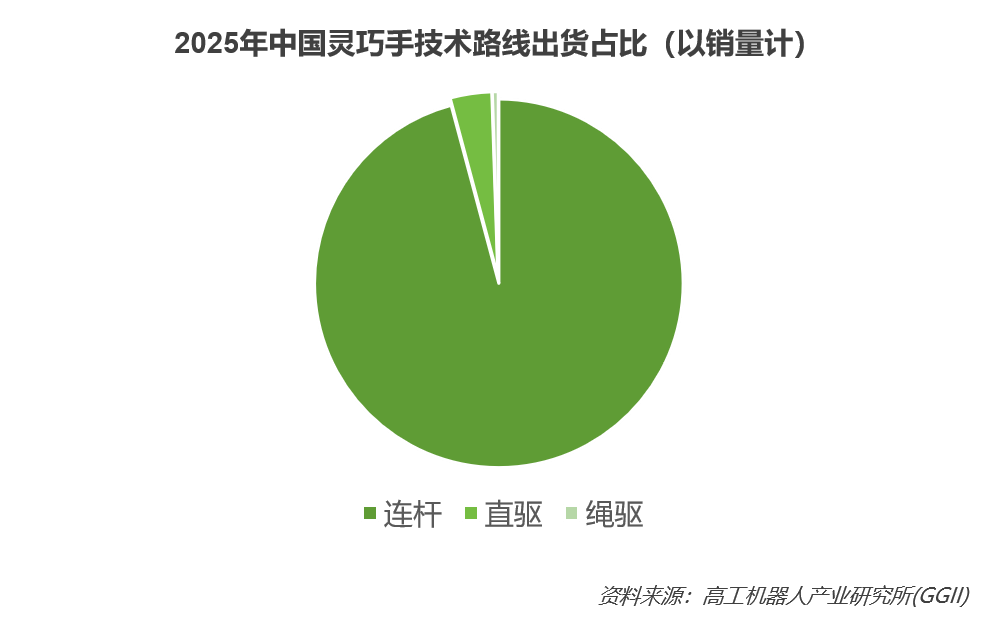
Among them, the freedom of the leverage scheme, the carrying capacity, the cost etc. can meet the needs of the current industrial and commercial scenario, its core advantages are engineered maturity, relatively high reliability, the pricing of some products has been below 10,000 yuan, the advantages of companies with mass production capacity are apparent, but the volume of leverage transmission is large, the dynamic freedom is low, and the flexibility is poor.
The main advantages are the compact arm size, strong impact resistance, flexible engine layout, but the challenge lies in the complexity of the transmission system, low modularity, large volume production difficulties, and high demands on control algorithms. Tesla is the representative of the rope routing. In April 2026, it unveiled five patents around the Optimus V3 flexible arm, laying 25 linear execution layers on the front arm, allowing for lighter weighting of the arm, greater space for the arm to dissipate heat, and drivers focused on the front arm for later maintenance.
SharpaWave is a representative of the direct driver, which has become a versatile hand with the NVIDIA Isaac GR00T reference humanoid robot. XHAND1 PRO of the Star Wars era, Wuji 2 of dance music technology, OmniHand 3 Ultra-M of the critical moment, the ingenious hand Linker Hand O20, O30, the DexHand of its smart navigation, the HUD-3-7 of the giant robot are both direct drivers.
The hybrid drive system is also one of the direction of the industry layout. It is capable of implementing multiple complementary schemes, mainly rope drive and direct drive mixing, while ensuring lightweightness, flexibility while improving response speed, control accuracy and reliability. At the critical point, the OmniHand 3 Ultra-T, the Flex 2 of the future, the Casia Hand-M11 of the mid-career era, all use the rope + motor direct drive hybrid drive system.
In terms of software algorithms, touch, data, and models are becoming industry hotspots under the trend of hand-brain collaboration.
Hardware determines the performance boundaries of sophisticated hands, while software algorithms give sophisticated hands the ability to operate autonomously. Currently, the industry is generally emulating intelligent algorithms such as learning, spreading strategies, reinforcement learning, and V (T) LA to enable sophisticated hands to learn complex operational skills to solve problems of generalization in unstructured environments.
Unlike the language and visual data of large language models, touch is becoming the key entrance to understanding the physical world with a large model, with the prospect of being a convenient hand-painting, constructing sensing-decision-executing shutter rings. Currently, touch sensor technology is parallel and needs to be exchanged in all aspects of flexibility, high resolution, dynamic response, low cost, stability, etc. In the short term, the compressive, capacitor, and Hall models have great potential for future growth due to the mature technology dominates the market, the theory of visual touch sensors is high, data accumulation and large models mature, while the integration improves.
In the face of the costly cost of traditional real data mining, Sim2Real Gap, which simulates data, the industry is adopting unobtrusive data mining, such as UMI-Dex, Ego video, touch feedback collecting gloves, etc., to obtain large-scale, diverse, real-world, multi-modal operating data, thus improving model capabilities.
Flexible hands, touch sensors companies are building a flip-flop of smart hands/touch sensors - data collection - model-driven business closures, moving from component manufacturers to lower, longer-term infrastructure platform roles such as Pasini, Flexible hands, AI robots, Foley new materials, Thousands of robots, vision technology, and more. Flexible hands, touch sensors companies are successively releasing data collection devices, including multiple gloves, Dex-UMI, etc. Some companies have open source data collected and published large models.
The company is also strengthening the ability to synchronize the brains of the hands. As the Stellar Age has built the ability to synchronize data-brain-operation-control-flexible-hand-brain-brain-brain-brain-brain-brain-brain-brain-brain-brain-brain-brain-brain-brain-brain-brain-brain-brain-brain-brain-brain-brain-brain-brain-brain-brain-brain-brain-brain-brain-brain-brain-brain-brain-brain-brain-brain-brain-brain-brain-brain-brain-brain-brain-brain-brain-brain-brain-brain-brain-brain-brain-brain-brain-brain-brain-brain-brain-brain-brain-brain-brain-brain-brain.
In the future, competitive or inadequate hardware manufacturers will need to collaborate with model companies to build data flyers that can synchronize their hardware with their brains.
Written at the end
In summary, the brilliant hand as a precise, sophisticated, integrated software-hardware engineered brake system requires the collaborative innovation of the entire industry chain to create a single brake that can be used, well-used, and long-lasting to achieve sustainable industry prosperity.
On the basis of a thorough investigation, the Institute of High-Tech Robotics Industry (IGII) has prepared the H12026 China Smart Hand Industry Research Report. GGI wants to provide industry data and research reports that are of reference value to companies, investors, securities firms and people who want to know about the smart hand industry, through real-world surveys, in-depth research analyses.
Highlights of the Report
One article provides insight into the logic behind the development of industry, technology and enterprise:
The entire industry chain covers: upstream micro-motors, decelerators, turbine/turbine brakes, silks, force/force torque sensors, touch sensors, software algorithms; midstream agility; downstream applications;
All-technical route analysis: drive - vacuum cup motor, brushless slot motor, unbrushed rectangular motor, axis-oriented magnetic drive motor; drive - connector, wire rope, direct drive, mix drive; touch - compressive resistance, capacitance, voltage, photovoltaic, hole, visual touch, and other innovations;
List of enterprises and products: List of enterprises and product parameters in China, representing enterprise analysis;
Quantitative industry data analysis: market shipments, scale and forecasts, patterns of market competition, patterns of technical routes, etc.
Copyright notice: The copyright in this report is owned by the Institute of Advanced Robotics Industries (GGII) and is for use only within authorized enterprise companies and may not be extended to any third party.
GGII:2026Catalogue of research reports on the Chinese smart hand industry in H1
(You can scroll down and watch it)
Chapter One: A Profile of the Skilled Hand Industry
Section 1 Definition and classification
Section 2 Development of the industry
Chapter 2: Flexible policies and capital environment analysis
Section 1 Support for industrial policy
Section 2 Industry financing trends
Chapter 3 Structural analysis of industrial chains
Section 1 Industrial Chain Chart
One, industrial chain chart analysis
Cost analysis and price trend forecasting
Section 2 Core components
One, the drive: the motor.
Second, the transmission gear: precision gear reducer
Three, transmission switching devices: gears/gear levers or silk
1 Wheel/wheel levers
Two, silk
Four: Connecting connecting device: connecting rod or rope or chain
One, the stick.
Two, the rope
3 - Chains
Five, the sensor.
One, six-dimensional power/torque sensor
Two, touch sensors
Section 3 Software algorithms
One, the control algorithm.
Two, the smart algorithm
Three, clever hand data
What is the meaning of the Bible's words?
Section 5 Downstream Applications
Chapter 4 Analysis of key technological developments
Section 1 - Key technical indicators for skill
Key technical indicators
Secondly, the skill assessment.
1 Kapandji points to the test
2 GRASP classification
3、 ManipulationNet
4、 DexBench
5、 DexJoCo
Section 2 - A detailed analysis of the routes of hand-driven technology
One, an empty cup motor.
Two, there's no brush and there's no sink.
Three, the unbounded rectangular motor.
Four: Axis magnetic drive motor
Section 3 - A detailed analysis of the routes of mobile technology
One, connecting rod transmission system
Two, the rope transmission system
Third, the direct-drive program
4 - Mixed transmission
Section 4 - Flexible hand sensing technology routing analysis
One, six-dimensional / torque sensing technology
Two, the touch-sensing program.
1 - Pressurized touch sensors
2 - Capacity-based touch sensors
3 Pressurized electrical touch sensors
4 - Optical and electrical touch sensors
5 - Hall-style touch sensors
6 - Visual and touch sensors
7 Other innovations
Section 5: Contrast between domestic and foreign technological developments
Chapter 5 - Flexible market analysis
Part One: China's market size and forecasts
Section 2 Competition patterns in the market
Section 3 Technical route shipments
Section 4 Analysis of industry barriers
One, technical barriers
Second, barriers to mass production
Three, data barriers
Four barriers to talent
Chapter 6 Opportunities and Challenges
Section 1 Opportunities for development
One, the downstream demand for humanoid robots is pulling.
Second, policy support and accelerated funding
Three, technological transformation and cost reduction
Four, an open-source ecosystem reduces barriers to innovation
Section 2 Major Challenges
A triangle of impossible triangles
The second problem is the immaturity of touch technology and the complexity of multimodal integration.
Third, there is a contradiction between the trend of hand-brain synchronization and lack of data.
Fourth, the lack of standardization slows down the process of industrialization
Chapter 7 Hands of skill representing manufacturer analysis
Part One: The Time Robot
One, the company profile
Second, the characteristics of the company.
Three, the financing process
Four: Product layout
Fifth, development planning
(Footnote)
Part Two: The Crisis
The Bible teaches: "Let your heart be steadfast, and your spirit be strong".
Section four...
Section five...
Section 6...
Section seven...
Section eight...
Section 9...
Section 10...
Section 11...
Section 12...
Appendix 1: List of smart companies in China compiled (not exhaustive statistics)
Appendix 2:2023-2026 Summary of the financing of SMEs in China for May 2023-2026 (not complete statistics)
Appendix 3: Product information on the main enterprises in China (not complete statistics)