It's the first time in the history of the world.
Recently, Karpathy conducted an experiment on X.
He gave Claude Opus 5 the start of a magic ring, a million-dollar Token budget, and had it draw the story scene with three.js.
For two hours, the 5,500 lines of code, a low-lying valley that you can walk through, ran through the browser.

Everyone is shouting: AI is making the world so cheap.
But is this the world we want to create?
When it comes to model generation, AI 3D is at a very embarrassing stage.
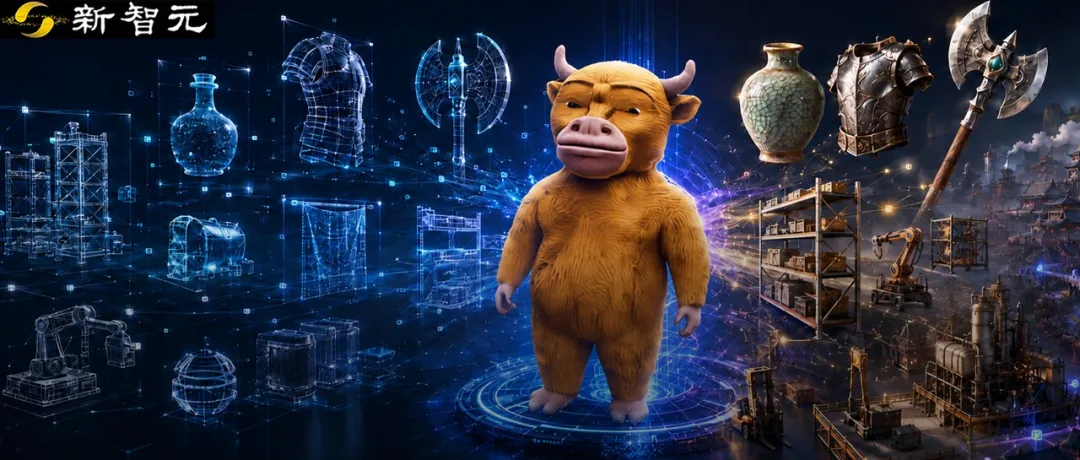
But on the production line, a small game requires hundreds of thousands of items, and a digital factory could be full of shelves, pipelines, and equipment...
So what's really hard is the ability to mass-produce thousands, tens of thousands of assets.
Today, after Tripo, Meshy, there's another new player on the AI 3D track.
A 3D-generated model, Lux3D, was launched in April this year by a group of nuclear technology companies that had just been listed on the port exchange.

It's the door.
Uploading an image, or entering a sentence, means that Lux3D can quickly generate multiple forms of 3D assets, such as grids, materials, and 3D gauges.
But this time, Lux3D is not just another AI 3D generation tool. Nuclear technology is also synchronizing world model products to create dynamic interactive 3D worlds.
Let's see what's new with Lux3D.
Lux3D debutThe hardest material for pioneeringOver the past two years, AI 3D models have progressed rapidly, but there is also an embarrassment: the more geometrical the grid is, the more the surface is often false.
The same gray, brushed on metal, plastic, and ceramic, things come out completely differently. The reflection, the roughness, the transparency, the refractive gloss, the less the layer, the texture collapses.
If AI only paints the outline, paints the bottom, and produces what looks like, it's just a layer of plastic.
This is exactly what Lux3D is for.
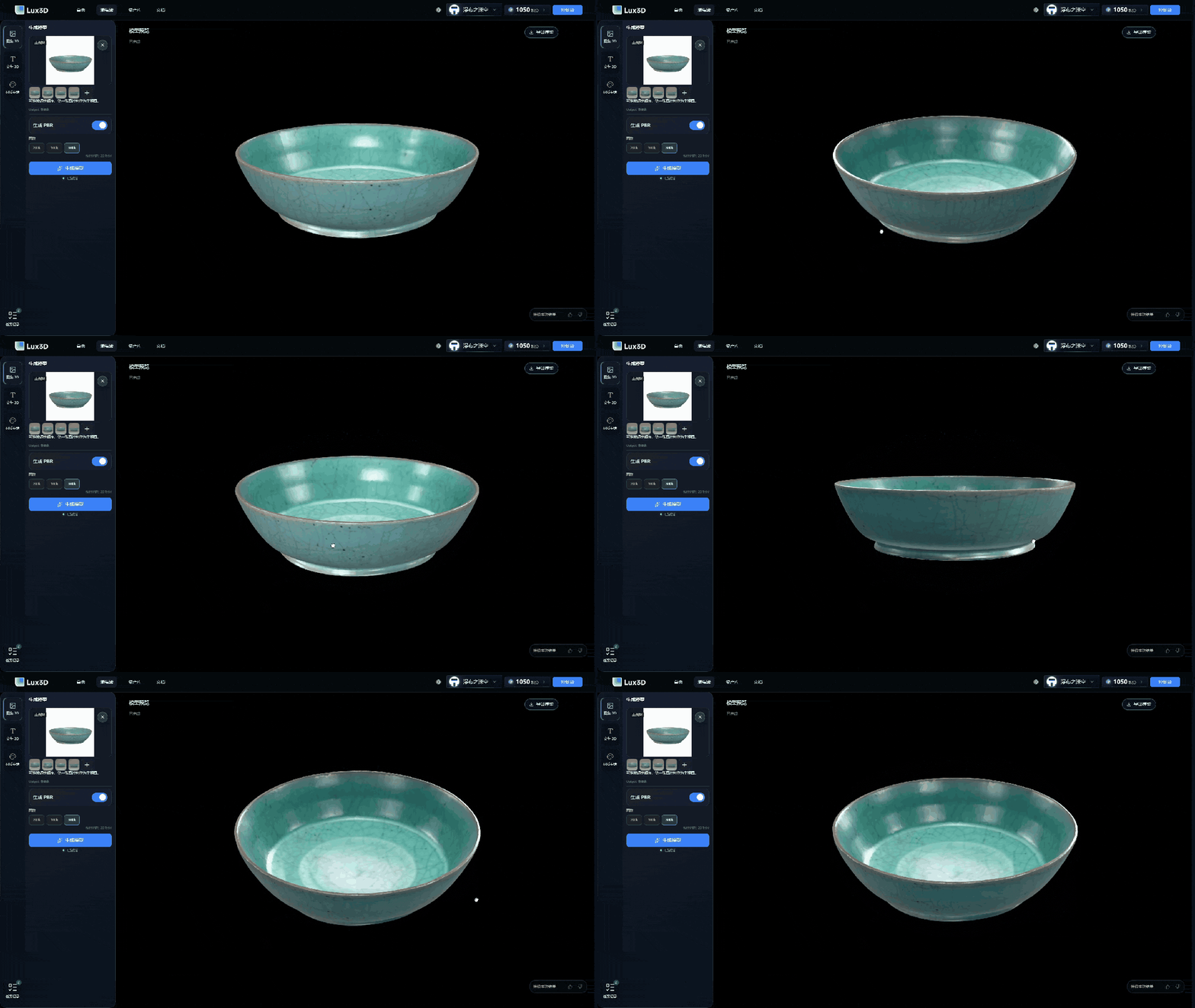
After drawing the outline and the bottom color, it will further predict the properties of PBR materials such as metallicity, roughness, transparency, to allow surfaces such as metal, ceramics, plastics, and stones to have a lighting performance closer to the real world.
For packaging of goods with text and complex patterns, Lux3D can also retain large patterns, large blocks and logos.
If you change a point of view, change a beam of light, the material can still remain relatively natural.
For example, a pair of metallic shields, silver-gray metallic plates and golden plates, with a completely different gloss. The plates are the polished fluorescent metal, the gold plates with polished brightness, and the middle leather straps are another roughly dark.
There are three materials that come together, each with different reflections, each with different textures, and you can tell who is metal and who is leather at a glance.
This is the core capability of Lux3D as a material: it doesn't just color the model, it lets each surface know what it's made of.

This frog plate illustrates the problem. The surface of the frog has a semi-transparent blue-green glow, through which ice cracks emerge, and a circle of tires appears along the plates. These three things are overlapping, which is why the frog is a frog.
Typical AI models take a green patch to even cross, and Lux3D restores the sensation of penetration and cleavage muscles, rotating around, the light follows the curve, and the depth of the cracks also changes.
This is a very fast version of the 3D Gaussian model, which is partially biased towards the hair. It is actually the hard bone that made AI 3D famous.
But if you look at the ponytail and tail, the brown ponytail does have a loose feel, not a sticky patch. The 3D Goose is cheaper here: it's actually stacked with a lot of small, semi-transparent ponytails, expressing a loose, scattered fiber texture, naturally better than a hard grille.
The difference in reflection between the red fabric and the metallic foam is also evident.

When you look at the cow, the entire body of hair is along the length of the muscles. The skin around the nose and mouth changes to a smooth texture, and there is a clear transition between the coat of hair next to it, not a knife cut.
Three completely different surfaces run simultaneously on a character, and tens of seconds of extreme speed are enough to make this distinction, throwing it into a pipeline of independent games or animated previews.

Lux3D also makes it possible to "re-draw materials", such as painting cups in color patterns and moving a button to a table.

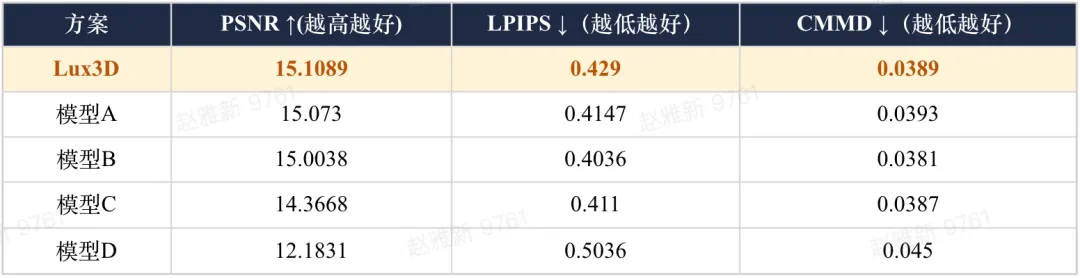
In contrast to several existing models on the market, Lux3D is number one on the PSNR, LPIPS is number four, and CMMD is number three.
Simply put, the PSNR looks different, the LPIPS looks bad, and the CMMD looks at the quality of the whole set of materials.
All three have been successful and integrated stations are at the forefront of the industry.
But just making one model more real doesn't solve the most expensive problem of 3D production: quantity.
If you want to really open up 3D assets, it's not enough to rely solely on a technological route.
Harness moments of 3D modelingCurrently, most 3D generating models on the market tend to bet on a single route.
Lux3D did not do the "single-choice" this time around.
In addition to traditional Mesh grids and PBR materials, it also introduced the same generating architecture as 3D Gauge.
Traditional Mesh uses tops and faces to create objects' surfaces.
Using a large number of three-dimensional spots with location, size, direction, color, and transparency, an object is spelled out.
The biggest advantage of this route is that it has two words: province, fast.
It is capable of producing and rendering rapidly, particularly for rapid previews and large-scale paving.
So Lux3D made a very fast version.
In 20 seconds, a 3D model can be created.
When 3D assets are squeezed at this rate, an amount that has not been opened in the past, there is room for imagination.
The usual "treasure box" in the game, which allows Lux3D to replicate the other three visuals as a 3D asset, can be completed in a matter of seconds.
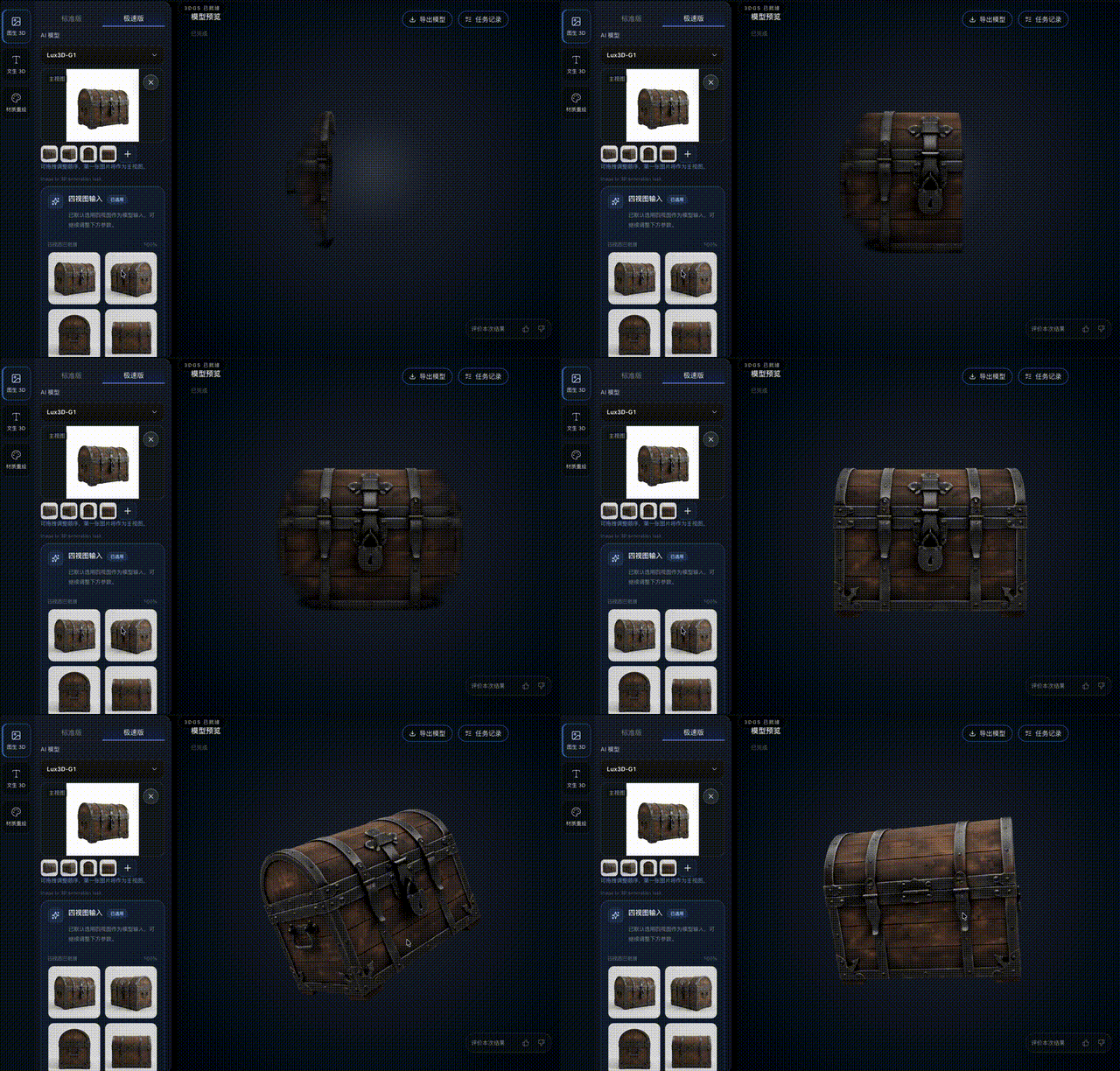
A picture, tens of seconds, is enough to make a 3D model.
In this game, the common javelin is also the second. The texture of the metal, gemstone and wood is perfectly restored.


In addition, the production of bulk assets in future industrial crops will also change.
With a digital factory, the core equipment can also be reconstructed using CAD drawings or scans.
There are shelves, trays, pipelines, control cabinets, security fences...
Individuals may not look remarkable, but together they can be hundreds of thousands. In reality, the production line is adjusted once, and the digital space is also changed afterwards.
Most of these assets do not require film-grade accuracy.
The geometric structure is reasonable, the material is recognizable enough to support the construction of scenarios, layout verification and simulation training. A few critical devices are then handed over to standard editions or specialized tools for refinement.
There is also a real question:It's not expensive to produce in bulk.
Now there are a lot of AI 3D tools that make a model that's not expensive, but you have to make a hundred, a thousand.And the cost can't come down together.。
This is another advantage of Lux3D, which generates a model with a minimum cost of 1 point, about 0.07 USD after folding.。

In addition, the kernel has also opened the API of its self-processing rendering engine.
Asset generated by Lux3D can be directly integrated into the same rendering ecosystem. 3D assets generated by third-party tools can also use this capability to complete rendering.
It's like this:
Codex as a packaging headset, Lux3D out of the box, Bl