
It's the first time in the history of the world.
Oh, you hear that?
It's a good day for human researchers, and two years to go.
Two years later, humans were doing AI research, just like chess today.
Of course you can go down, but no one cares how you go down.

This is the latest statement made by Jerry Tworek, former OpenAI Logic Model 1.
He joined OpenAI in 2019 and waited for seven years. At the time, reinforcement learning was dead-on-scale, he was dead-biting and pushing hard, and he personally brought out the two great killers, O1 and O3.
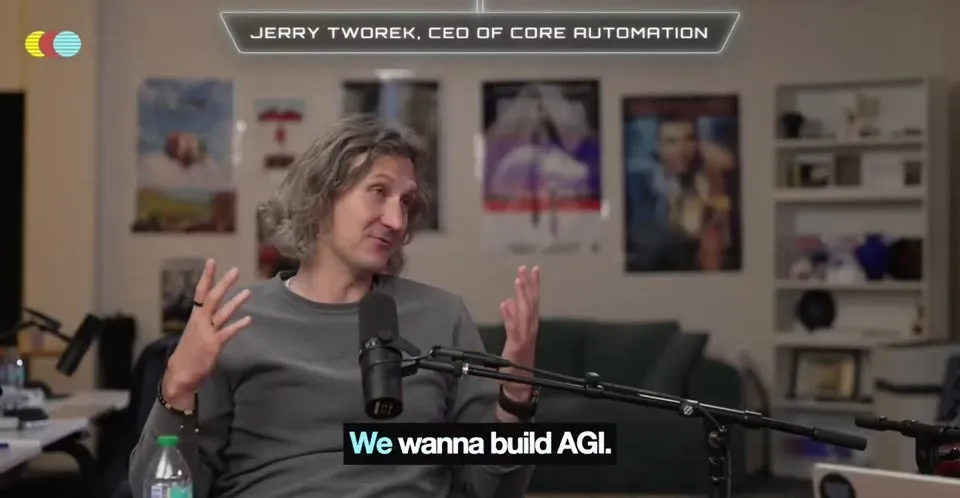
"We want to create AGI". This is the complete roadmap that Ilya gave to the general meeting in 2019 when he first joined OpenAI.
What's even more annoying is that he wasn't the only one who said that.
We have only the last few days left to go to work, so as long as we can do it now, hurry up and get some collective retirement rest.
All the guys said it was black humor, but everyone who made jokes was like a mirror in their minds.
It's a joke, 80% is reality.
This is just an appetizer. In the whole interview, this idiom is what he said:
Agents do have creativity, but it's an incredibly low-quality, massive pile of creativity, ideas, and it's all bad.
The whole world is really touching a frontline model from training to deploying people, maybe 30 to 50, and everyone else is shaking hands with them.
The idea of using Transformer as the best option is almost impossible.
In the seven years that OpenAI has been around, the number of genuine attempts to change the underlying architecture is only three to four times.
The world doesn't have to move because of us, and this would not have been the case.
Here's the finished version, Enjoy.
Half a lifetime, no one has done it.The two-year figure has nothing to do with running scores, and it has nothing to do with calculating.
He is counting the number of people who are still alive in this study.
It's been a long time since this baby was torn into two pieces.
One is to come up with ideas and figure out where to go. The other is to act, turn ideas into running code and get the data back.
It's been a long time since I've worked on that part, and it's basically gone to Agent.
In April, Tworek launched the company Core Automation, which aims to build the world's most automated AI lab.
There, the full cycle of one experiment went straight from one month to one day, and the overall efficiency improved thirty-fold.
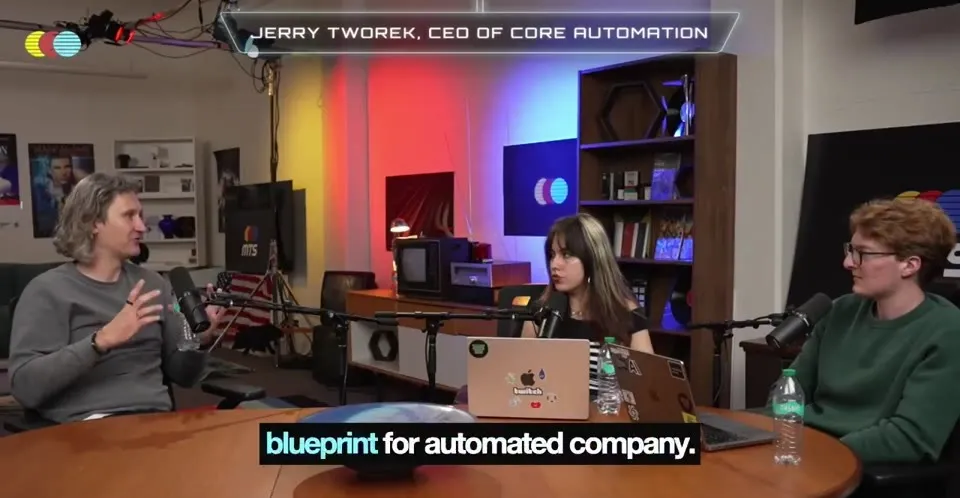
However, the idea for this episode was not picked up by Agent for a while.
They are definitely highly creative species.
But they're wasting their creativity in a way that's extremely inferior, mass-produced. Though ideas do flourish, they are also generally rotten.
There are 30 to 50 people in the world.
So listen, the idea of this section seems to be stable.
But there were only a handful of people who could really come up with ideas.
In an interview, the host revealed that an internal researcher at OpenAI had dealt with him.
There may be as many as 30 to 50 people in the world who really understand how to train and deploy a cutting edge model.
Everyone else is shaking hands with these dozens of brains, including the overwhelming majority of the official staff at the coolest company.
Tworek has no objection.
He also felt that any top team was so turned around. A few people set their course, dragging behind them a whole buzzing executive machine.
If you want to know how many of these dozen people have robbed, look at his own invitation list.
Core Automation co-founder Rohan Anil, from Anthropic, previously worked at Google DeepMind.
Anmol Gulati, who worked on DeepMind's Gemini, was also excavated.
All the labs are in the same pond, and there are dozens of fish in this pond.
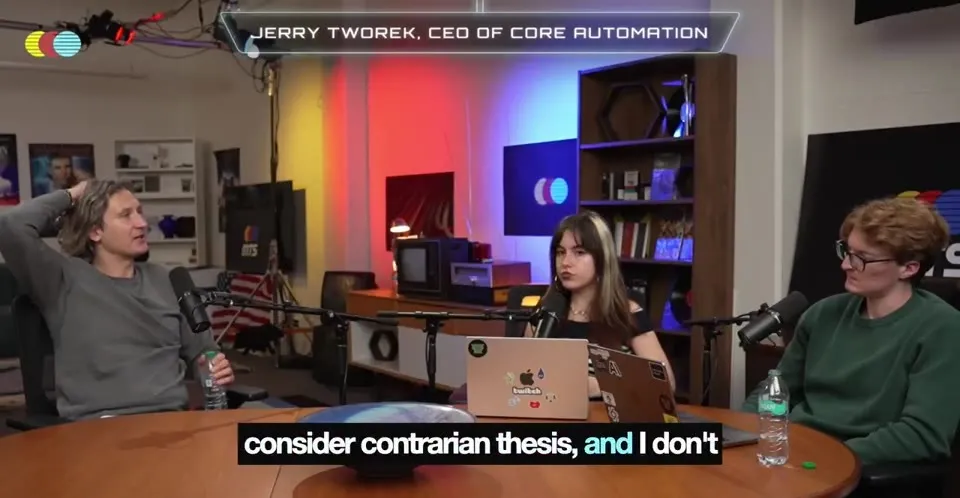
So the two-year figure has nothing to do with humanity as a whole.
It's about how much longer these dozens of people will be able to eat.
In seven years, the architecture has been seriously revised only three or four times
If there are only a few dozen people left, what is the last wall in front of AI?
Tworek's answer is one word: Transformer.
In his opinion, it is almost impossible that this is the best solution.
First of all, the model can't continue to learn after deployment. You talk to it much more and it won't get stronger, and the next round of conversations will be the same.
Secondly, if you want to make adjustments on a continuous basis, you will find that not only is the efficiency extremely low, but it is also disastrous to forget, to learn new and forget old.
So most of what the industry has been doing around Transformer in recent years is actually making it cheaper, and very few people are actually making it stronger.
And what Tworek really wants isn't in the architecture itself.
He wants a model that can continue to learn in test time, a model that can go back and forth from user interaction to user data.
No one in the industry understands this. But why is Transformer still standing there after all these years?
The reason behind this is simply that it's a little ridiculous to not try to root it.
In the seven years of OpenAI, the number of genuine attempts to replace underlying architectures was only three to four times.
This is the process.
The researchers first wrote a small-scale verification experiment, which lasted at least three months.
And it is called magnification, that you should persuade with a three-inch ruthless tongue ten men who have the power to kill, and then they would keep you in this abyss for three to six months.
In the end, the motion that was already rolled into the snowball by the Transformer could either be shattered or partially absorbed and turned into a screw on it.
Seven, three, four times. This is the world's strongest AI lab, with full capacity for architectural innovation.
"Jare, these calculators are burning".He himself hit a similar deathbed at OpenAI.
At the time, the half-dead experiments struggled to come up with something called "life signs".
It was at this point that he was discovered by Jakub Pachocki, who later became the chief scientist of OpenAI.
"Jare, I'll give you all these GPUs, and you'll see if you can make the results a little bit bigger, a little bit harder".
"Now that you have these GPUs in your hands", he repeated, "o1 has no name yet".
And it brought him out of a paradox.
You have to get the results first to be qualified to calculate.
But you can't figure it out until you've got the math.
According to Tworek, much of the front line is trapped in this paradox. The laboratory's bloody battle for the power of computation is about finding a way out.
And exports are sometimes a little bit more confident than leadership.
As long as someone speaks from above and says that I hope you can get a math quota like that to do it, that's enough.
I can't hold back when I turn it off.
Reinforcement learning starts at this node and crosses several quantitative levels.
Then O1's breakthrough came, reasoning that the model, which had been condemned to death by countless people, had barely survived.
$100,000 for an expertAnd this time, he didn't have to wait for anyone else to speak.
The most expensive link in the entire chain is to translate abstract ideas into real-world code, which is precisely the most beautiful way to do it today.
For example, Core Automation used this technique to scan the CPU's kernel.
Specifically, they dumped a QR decomposing core into a programming agent for four weeks, burning up the call cost of about $100,000, eventually pushing the core to 60 times its original speed.
It's an underlying performance engineering, and it's a matrix calculation of how to run faster on a graphics card, usually based on a very small number of experts.
And there are only a handful of experts like this in the world.
Now $100,000 is enough to get one. It doesn't need to be persuaded, and it doesn't need three to six months.
After seven years the gate was closed, it was cleared.
What else can we do after that?
Even the most difficult structures loosened, and the steering wheel in the hands of dozens of people could not hold for long.
At the end of the interview, the host clarified the matter and asked him what was left to do until the day actually came.
Two images are described by Tworek.
The first is ancient Greece.
The guy hits his head in the square, slowly talks about philosophy all day, then runs off to exercise, eat olives and drink wine.
He laughed as he finished painting it, admitting that it was probably just a reflection of his own desire.
"Let's hit each other in the square and then talk". He laughed after describing the daily routine of the AGI era.
The second is high school, or college.
He felt that people should retain a pursuit of "excellence" in themselves. He continued to learn new things greedily, practicing both body and mind to death.
It's kind of like professional sports, where there's no economic reason not to make you sweat and bleed, but the pride in your bones is to be good enough for what's called "great".
We have to find ways to do this.
Because in the next world, there will be no more "you don't do it, the world will collapse". The world will run away on the infrastructure we have built.
"We should keep learning". He said this as an obligation rather than a hobby.
Then he quietly opened the bottom of the deck.
We have to work to make the world work. This assumption is not necessary at all.
"A lot of people's self-worth comes from work". He admits that it's the hardest thing to do in the past, including with himself.
He's also on this list.
To tell you the truth, it's not the last two years that have been the most touching.
He is also aware that he is stepping on the door to this countdown.
The thing he was going to create was the definition of self-learning, self-empowerment, and no longer having to be thrown around.
But he made a stronger case, and the first was his own judgment.
If you're not the biggest and scariest laboratory in mathematics, it's hard to see you die.
At the time, Core Automation was only four months old and had zero revenue.
He said that almost every week since he started his business, someone ran up to him and said, "Jare, it's too late, the whole staircase is already closed".
He replied with only one line of his own mantra.
Our company's favorite saying is that everything is a skill issue.
The translation is that failure is ultimately not the fault of the environment, it is the fault of your own technology.
Don't say that, put that in this interview, it still smells a bit like that.
It's the first time I've ever heard the phrase, and it's the first time I've heard it.
We have only the last few days left to go to work. Hurry up while we can do it now.
We don't know if it's excitement or sadness.
For to those who say these things, the two mean the same thing.
Tworek said that the pace of the march was extremely exhausting, and it was very, very exhausting after all these years of dryness.
"But if we really believe it, this is the most important time in our entire career".
"It's probably worth it".