14The year's "Director's Dream" solves a mystery
In 2017, Chairman of the Kvos Group, Chen Tongch, took the podium for the first time at the World Robotics Congress, discussing the limitless possibilities AI+ service robots can bring to life in the future.
Nine years later, in the summer of 2026, he stood on the same podium again. This time, his keyword was "future applications, user-defined".
From "let robots serve families" to "let users define robots", it's not a sudden shift, it's more like a decades-long dark line inside Covas that finally surfaces in the summer of 2026.
Over the past two decades, the company's best-known products have long been focused on a single functional scenario. Many industry observers had never anticipated that the company, which has been deeply involved in the ground cleaning circuit for many years, would expand its business in a new direction with a fully open source platform, shifting the boundaries of capability from standardized functional hardware products to open-source intelligent ecological services.
But in retrospect, this "dark line" is already buried.
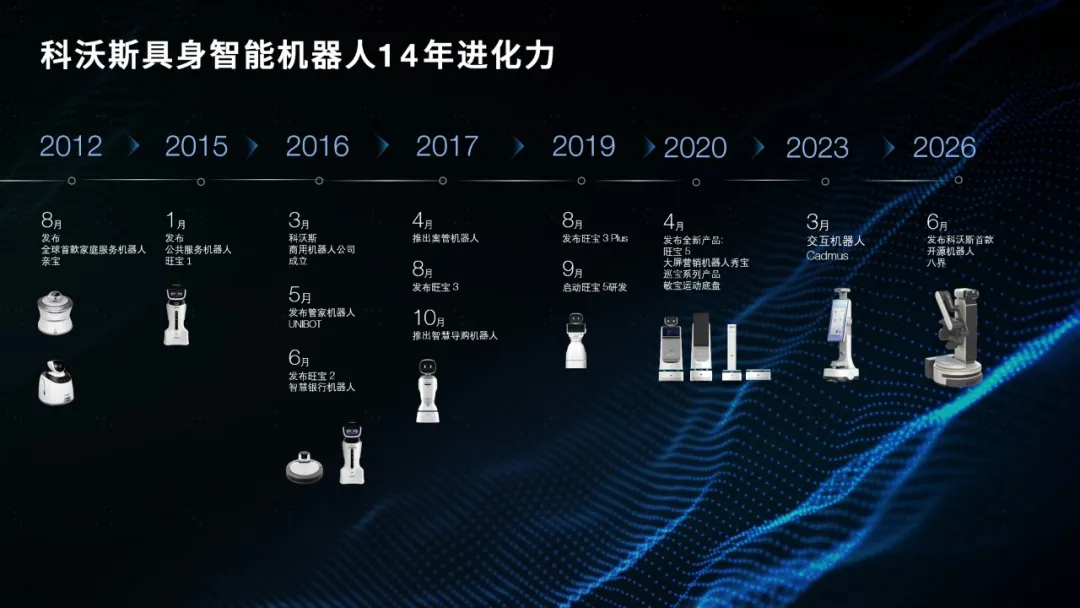
In 2012, Covas began attempting to answer questions about what roles robots can play in people's lives in addition to cleaning the ground. That year, Covas launched the family service robot "Dear" and positioned it as a robot administrator.
In 2016, ChangTong personally demonstrated to the outside world the housekeeping robot UNIBOT. It went a step further by adopting a modular design that could use different functional modules from the same basement to respond to different household service demands.
A decade later, a new generation of AI technology, represented by big language models and physical intelligence, is reshaping the boundaries between the cognitive and physical two-dimensional capabilities of robots.
The answer seems to be a mystery, but there is a bigger mystery.
Why would a company that has been a "manager" for 14 years create a fully automated, intelligent "manager" when it's no longer out of business?
A successful hardware player who relies on the ability to define extremely powerful products.Why is it that we are now willing to take the initiative to give the right to define the application of this right?
Repeat the line "Guardians" and "Guardians" refusing to be Don Quixote
As early as 2016, Covas first publicly proposed a "tool-manager-partner" three-stage evolutionary pathway. A decade later, it almost accurately predicted the complete path of home robots from function execution to scene understanding to emotional interaction.
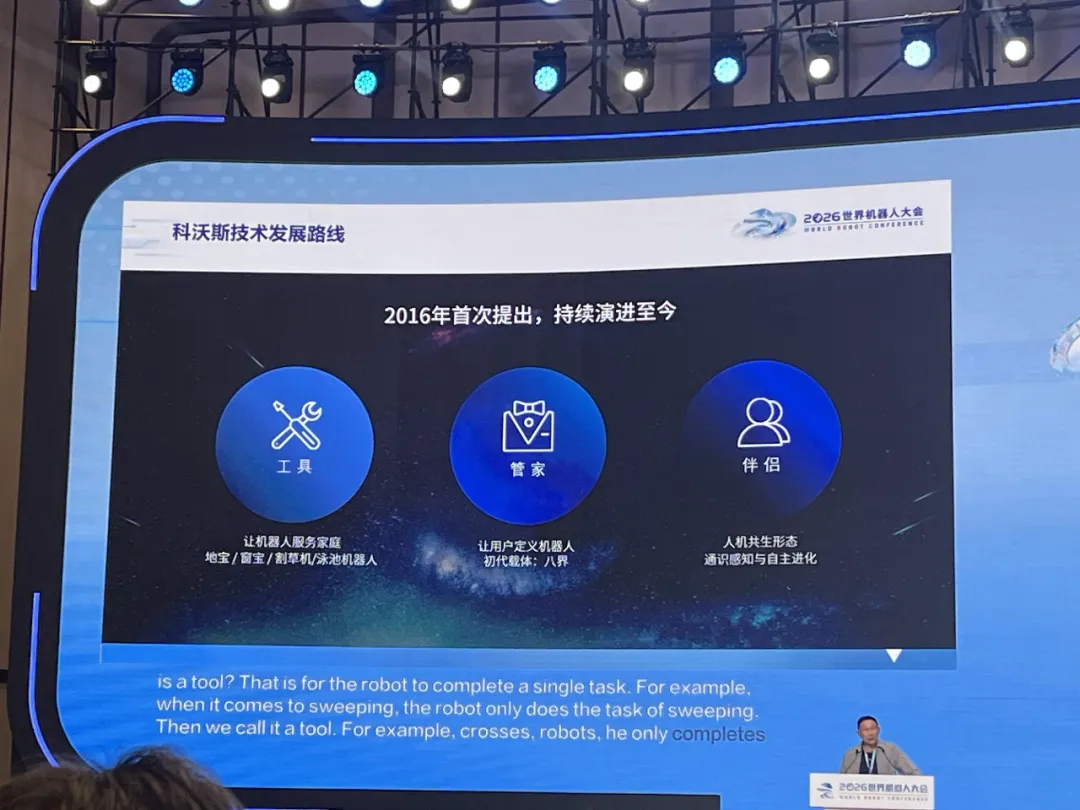
2026At the annual World Robotics Congress, Chen Tongchi spoke once again about the evolution of human-machine relationships.
Over the course of a decade, the "tool line" of Kovacs has skyrocketed, and, as Chen Tongch has said at the convention, it is entirely possible to create self-return of value. So-called self-return is to generate commercial value, cash flows back, and profitable returns. From sweeping robots, window wipers, lawnmower robots, pool robots, to commercial cleaning robots, all have validated the right cycle of commercial value.
But in this line of "managers", despite the introduction of replacement products almost every two years, Chen Tong also frankly does not really form a value loop.
The industry has also tried to build the pioneers of all-powerful controlled robots, but the "dead holes" of traditional deep learning are the ultimate survivors.
According to Chan Dong-Chi, being a manager robot does not rely on "algebra" and should, like tool robots, require continuous technological absorption and accumulation of applications.
The emergence of big-language models has pushed robots' thinking a huge step forward in understanding complex human instructions and breaking them down into a series of task steps.
But from "understanding" to "doing it" in the physical world, there is a need for control similar to that of the "small brain". To this day, we have not solved this problem, and no one robot has solved it.
Now, the industry relies on "physical AI" to solve the problem, hoping that it, like the big language model, will emerge in the physical world with the "powerful miracle" of Scaling law. But Chen Tokuchi remained cautious about this. His early experience of studying physics and philosophy at Nanjing University shaped his habit of thinking independently in the way he studied physics.
There is no evidence that Scaling law can be generalized to language. He says that the big language model succeeds because language itself is a carrier of human knowledge. Through semantics, vectorization and mass training, human intelligence is transferred to computers and generates Scaling law. But the physical world does not necessarily follow the same rules.
If the Scaling law is not established, it means that this intelligence cannot be generalized, it cannot be generalized, and it has no way of producing value in all scenarios.
Chan-Tong eventually left the Don Quixote-style "talk" and moved in a different direction. Based on more than a decade of home robot experience, he proposed a variation: "Carbon Collaboration".
This path isn't as deep in his heart as pure "physical AI", and he believes it's the way to go.
It's called Carbon Dioxide Collaboration.
A key component of human "replacement" robots
Currently, robotic hardware capabilities have made significant advances, but at the cognitive level, they are still as difficult as humans to understand naturally and to cope with complex and varied unstructured home environments.
Human beings have learned to identify objects, adjust their strengths, and adapt to different environments through extensive cognitive exploration and experimentation in early life, which is a "pre-learning, post-generalization" threshold that robots have not yet crossed. Introducing the human cognitive system to robots for "substitution" (i.e., "carbon synergy") is an important pathway to unlocking hardware potential and improving the ability to generalize across scenarios.
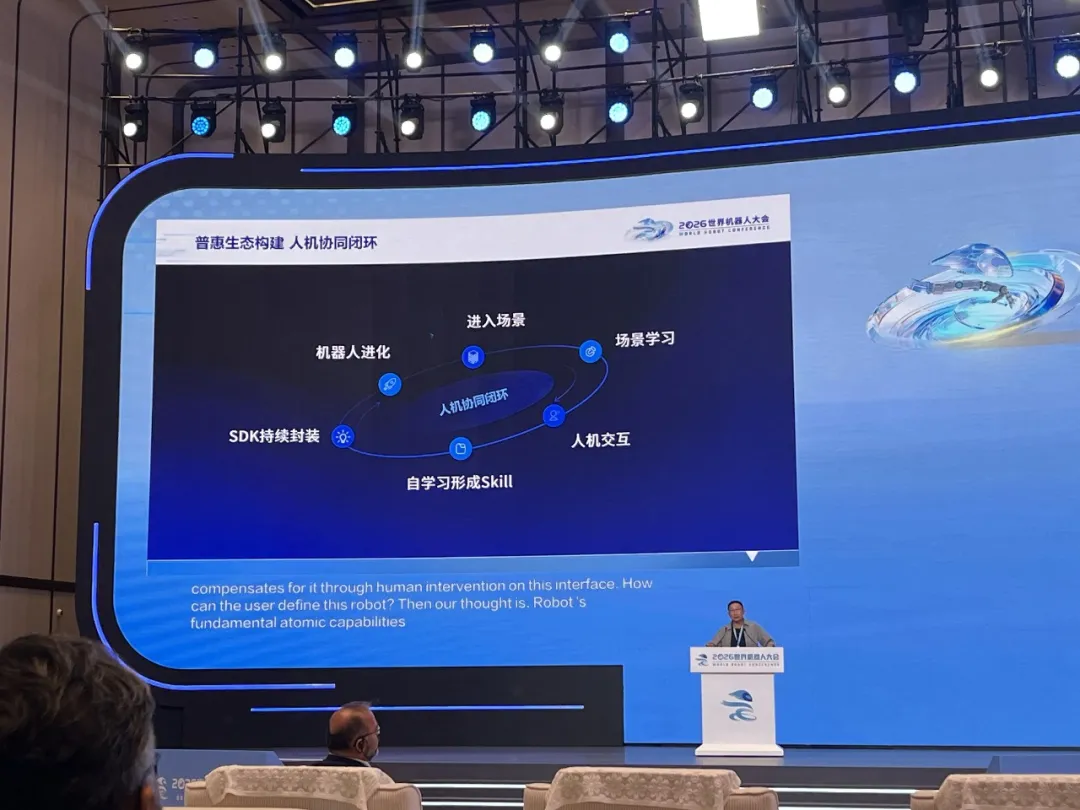
At the 2026 World Robotics Congress, Chang Tzu spoke of the "closed circle of human-machine collaboration".
In Kovac's conception, this path is not for users to build a robot from scratch, but for manufacturers to build an underlying architecture and technical foundation that facilitates human-machine interaction and allows robots to continue to evolve in use. In the age of AI, evolution is no longer limited to stacks of data, but also requires systems with human-machine collaboration.
This is how the system works: robots enter the scene, learn the scene, learn the scene, learn autonomously through convenient human-machine interaction, generate new Skills, and then continuously encapsulate the SDK, embedding the new capabilities as part of the robot.
When a robot learns a new skill, it becomes the ability of all robots, and it returns to the scene with the new ability to continue to observe, continue to learn and continue to evolve.
This is the meaning of the closed loop of human-robot collaboration, and every human-robot interaction turns into the capabilities of all robots. This is the universal ecosystem that Covas is building: to let users and robots work together to continue defining the future of physical intelligence.
On the basis of this idea, Chan Tong proposed a three-tiered infrastructure for building robotic capabilities.
The first layer encapsulates the basic atomic capabilities of robots;
The second layer, a set of movements based on atomic capabilities;
The third layer, through the continuous interaction of humans and robots, embeds a set of values in the action set;
The three layers progress gradually, forming a complete circle from ability to action to value.
Multilayered architecture+Full Open Source: "The Eight" is opening a new path
Now, these concepts are moving towards landing craft as the initial carrier of the route, with the "eight-world" abandoning the closed form of "out-of-the-factory as a whole" and instead building an open architecture with the ability to evolve through soft-hard decomposition and multi-layer collaboration.
Body and interface layerBased on the technology of home navigation, sensing, and more, Kovacs packages 45 capabilities such as disk mobility, object 6D positioning, mechanical arm and claw control into APIs that allow developers to perform complex long sequence actions, such as building blocks for flexible calls and free portfolios.
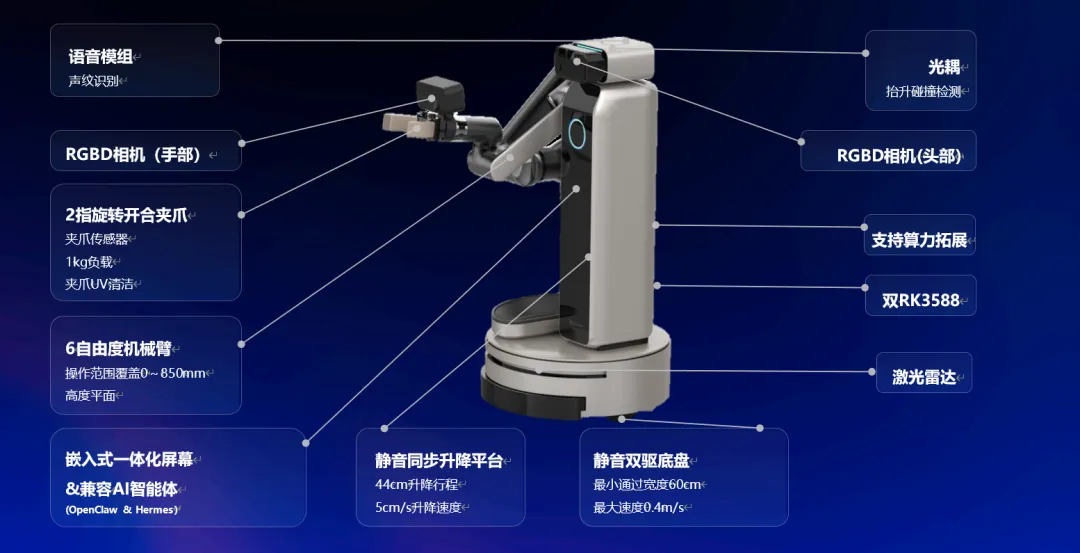
Physical ability overview
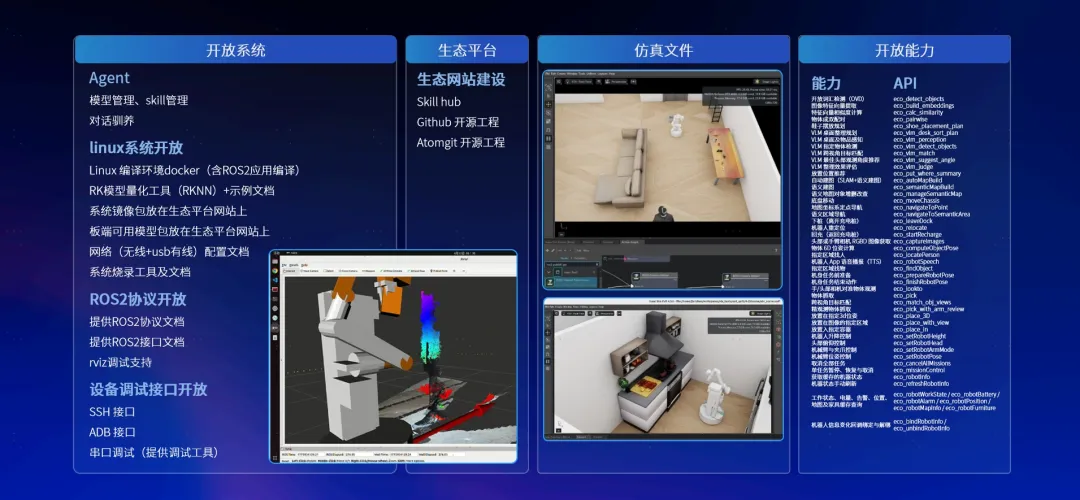
Open source capabilities
It's the central coordinating layer.Agent ):Based on the accumulated know-how of massive real-life family scenes, it serves as a central hub for the precise breakdown of open and complex human missions into executable sequences.
The clouds mixed "brains":Large cloud models are responsible for complex environmental cognition and task reasoning, end-side models for lightweight reasoning, and underlying algorithmic operations at the execution layer.
Accordingly, the "eight-world" has also built a staircase-like, open-source ecosystem, breaking traditional boundaries of manufacturers defining products in a one-way manner.
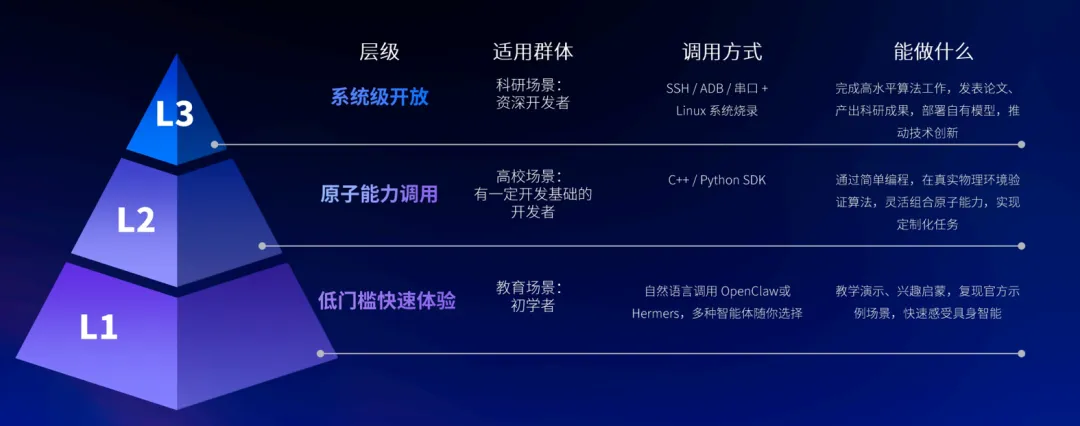
Developers can use APIs to directly summon these capabilities, such as code blocks, to develop a whole new robot Skill around real pain points, covering long-tail applications.
It is geared towards the polarity and scientific circles, an open underlying system environment that supports Linux and ROS 2, Python and C++ bilingualism, and provides a physical platform for algorithm verification and intelligent research.
Opening up software hardware interfaces is just the first step. The "eighth world" is simultaneously building an entire open source ecosystem, so developers don't have to start from scratch.
On-line, the open source community (www.ecovacs-tech.com) has been synchronized and documents, codes, and tools are available to developers.
There are eight functional subdivisions planned in Suzhou, including robotics training areas, hardware conversion areas, OPC independent office areas, embedded connectivity areas, road development areas, shared workplaces, exchange chat areas, outcome exhibition areas, and full-link developer empowerment.
In this regard, we can also unravel the mystery of why a successful hardware giant that relies heavily on product-defining capabilities is now willing to give up "application-defining rights".
On the surface, it's about delivering the right to define the product. But in essence, it's a strategic option that leads to a deeper goal that is still being explored at a time when the smart application landscape is still being explored. Running through an open-source foundation that allows developers to participate at low cost and continue to evolve is more grounded than defining "final form" on its own.
Those who can provide a robust, affordable and easy-to-use foundation, who can bring together a more active developer ecosystem, who have more opportunities to lead the transformation of innovation into real family productivity.
It's a race about "being the first to verify the likelihood", not a win-win contest.
Crossing the Tunnel
Chan Tong said that the experience of being a human or a humanoid robot today is the same as the experience of being a land-sweeper when Kovac first built one, and that we are facing two big mountains of technological breakthroughs and high costs.
In the early days of the scanning robot market, a CMOS chip for laser navigation (LDS) was worth more than 300 yuan.
The great decline in costs depends on scale. Scale formation depends on the ability of early products to create real demand, allowing industrial chains to see market opportunities of certainty.
As a result, intelligent robots are destined to experience setbacks and recessions, and Chan Dongchi describes this process as "crossing the tunnel". He notes that the "eight-world" also needs to hone one to two generations of products.
Covas has had enough experience and resilience to navigate the tunnels.
Since its inception in 2000, it has been almost a decade since the doors of ordinary people's homes were really opened; "Window Baby", which came out in 2011, was launched this year. Every time a new brand is launched, it has gone from grinding to pioneering user attempts, to the maturity of the product, the long closure of market acceptance.
As for the open model it explores, will it be the mainstream direction of the future of home robots?
Interested developers can access the open-source ecosystem for free.