The beans have changed.
Users who are familiar with the bean bag open the latest version, and what they see at first glance may still be the familiar dialog box. But as long as you switch the mode to "work", you will find that it is already very different from previous chat AI.

In the past, the most typical way we used a bean bag was to ask a question and then wait for an answer. Let it explain knowledge, search for information, orange text, generate images, all essentially following the same interaction: people send instructions, models respond in a dialog box.
And now it's starting to "do the job!"
When it receives a task that takes longer to complete, the beanbag can plan the steps, operate browsers and computers, process local files; it can also run continuously in the cloud, and be viewed and adjusted remotely by users on their mobile phones. As skill stores, connectors, and work partners go online, it can also install real office systems such as work experience, access books, and dismantle complex tasks into multiple AI roles.
It is no longer just a question, but a task that needs to be completed. The return of the beanbag is no longer just a response, but may be a document written into a flyer, a form that has already been processed, a set of web pages or applications, and a series of operations that occur between multiple software.
It's not just adding a few buttons to the original chat product. The beanbag is changing its basic interaction unit: from "one question, one answer" to "tasks and delivery".
Overall, beans packaging is becoming more and more like Codex.
Originally, Codex was thought to be a programming intelligence, but the product it represented was not simply "more capable of writing code". When using Codex, users typically gave a goal and a set of work contexts, and Agent read files, call tools, modify content, run checks in an independent workspace, and then delivered a result that could be reviewed and iterated. Today, the official use scenario of Codex (which has been integrated into the ChatGPT desktop) has also extended to long-term goals, skills, external system integration, and computer use tasks.
The bean bag is approaching this shape from the opposite direction.
The beginning of Codex is the code and engineering environment, and the beginning of the beanbag is the question-and-answer, creation, and search of mass users; but the two are combining a similar form: mission-centered (and not message-centered) to provide the Agent with a continuous working environment, replicable skills, external data and tools, and end results.
To answer this question, we set out a task that is closer to real: to organize an option that can run automatically.
When it comes to the overall experience, we feel that we do not need complex operations, that we can run easily, and that the results are basically available, like an internship student with a lot of work experience.
Bean packaging became the "internship" of the Machine Heart editorial department.
In the morning, while we were still in the office, several new drafts had already appeared in the Flybook working group.
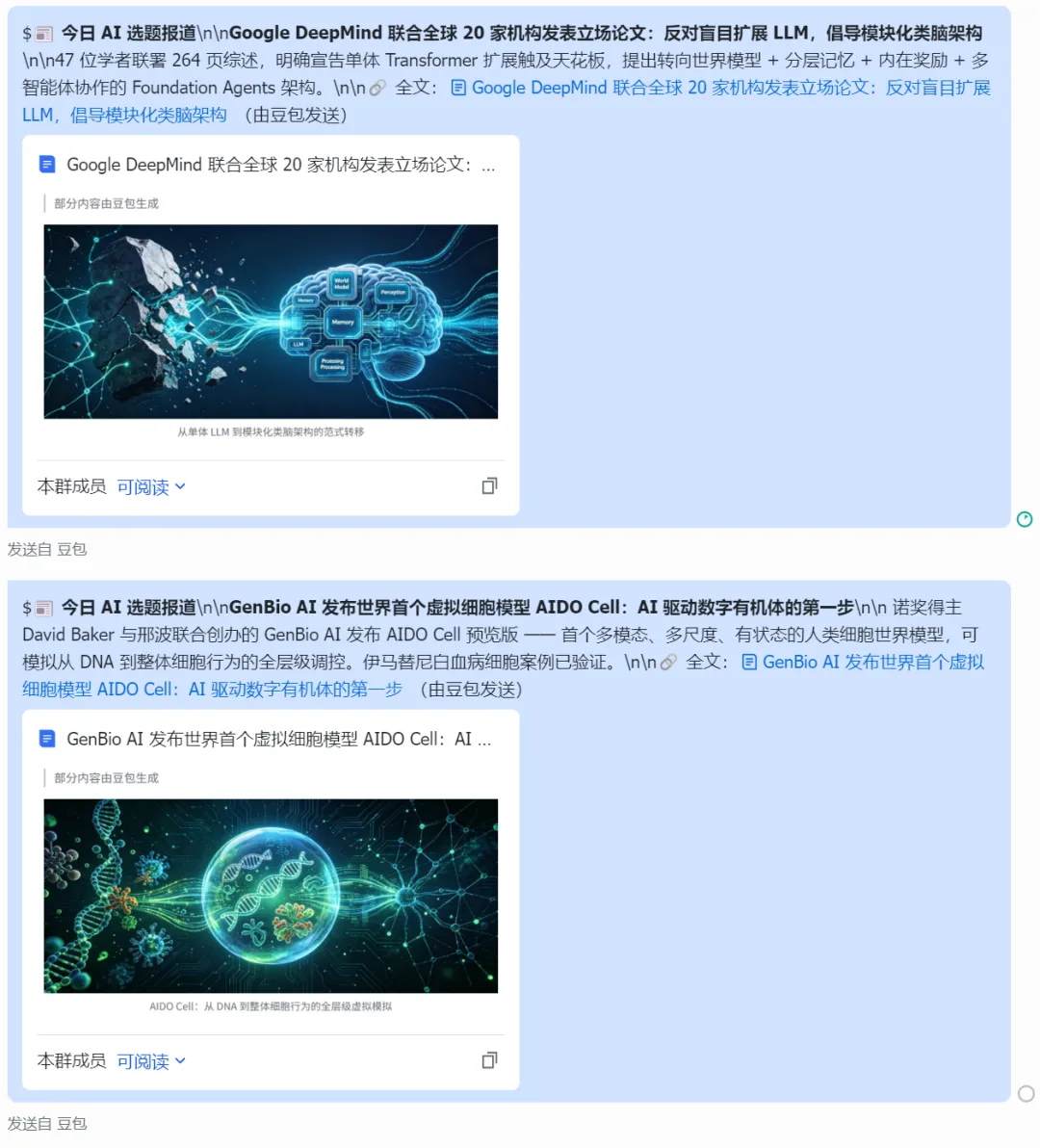
Each manuscript is accompanied by a content summary and a flyer document link. The entries, headings, diagrams, text structure, and references are all essentially complete. Although AI style is intense, completeness is quite high, as measured by a press release that needs to be edited and verified.
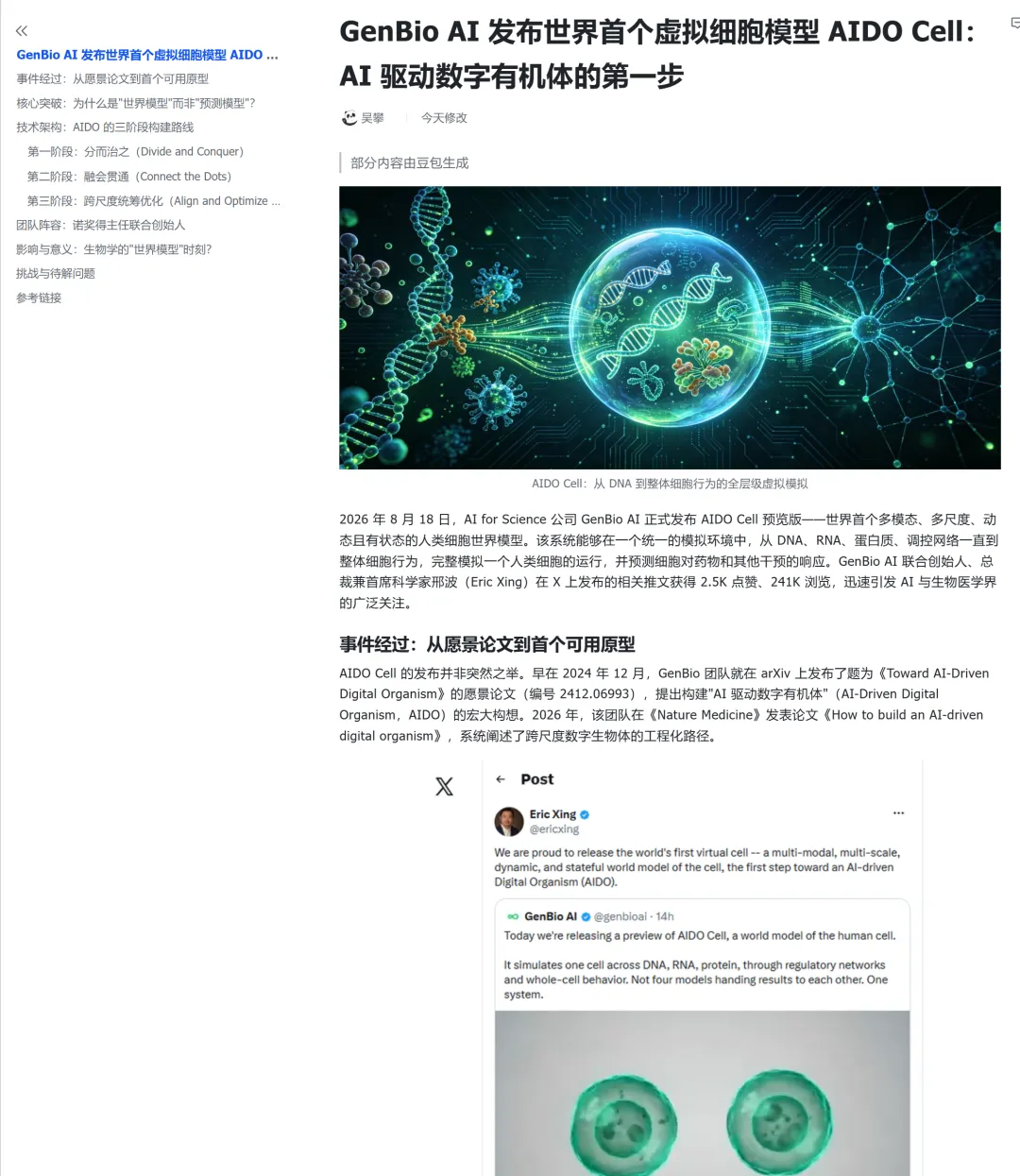
Selection of contents of beans packages delivered
And from start to finish, there's only one thing we really do: enter a few numbers into our phones.
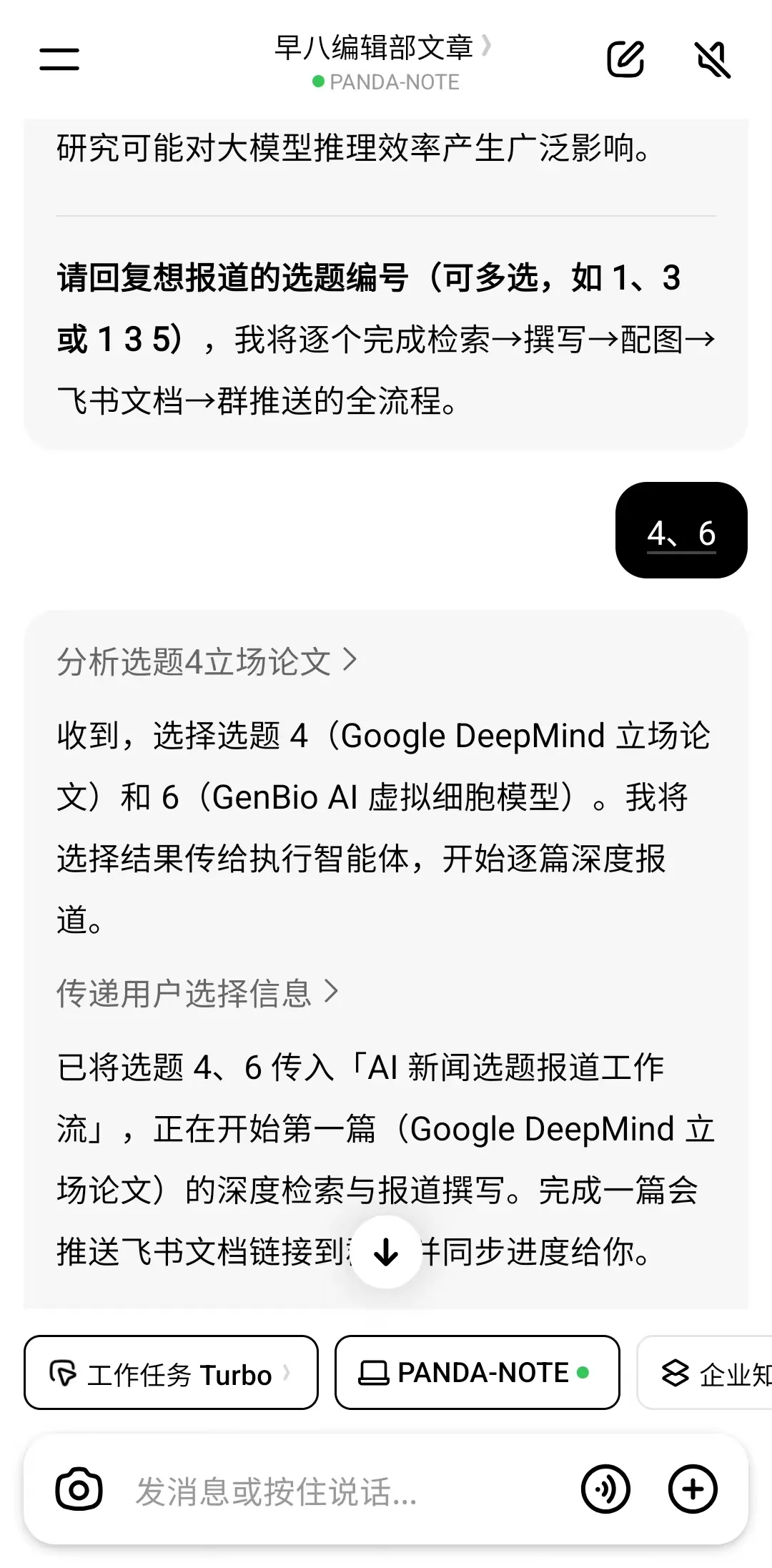
The PANDA-NOTE screenshot below shows that we are remotely working on bean bags on laptops.
The people who are really doing this are actually the new "interns" in our editorial department: bean bags.
And all the preparatory work we've done is a tip of the hat in less than 400 words:
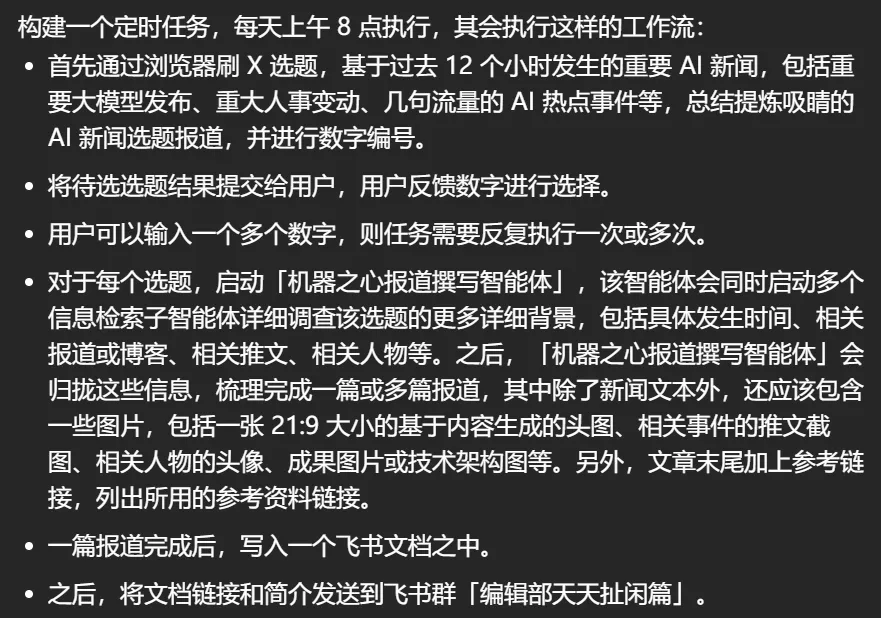
Yes, it's that simple. If you only look at the end result, it seems to be just another "AI writing essay". But what really interests us is not how a beanbag can generate an article (almost all major models today can do this), but what happens before and after the article is generated.
Look closely, it's a workflow that spans browsers, mobile phones, computers, documents, and team collaboration tools. We provide goals and make judgments at key nodes; the rest of the steps that have in the past required constantly changing windows, copying links, and passing on information can be easily implemented by "non-technical users" into the same task for the first time in succession.
If we use the newly added work partner and team capabilities of the beanbag desktop, we can also build a more powerful team of intelligent people to complete the tasks of the editing department. For example, we can break down these tasks to allow AI-powered intelligent people to manage the task hunt, research dogs, pens, AI painters, textbooks, and group chat messages to these six intelligent people, and assign corresponding responsibilities and skills to each character.
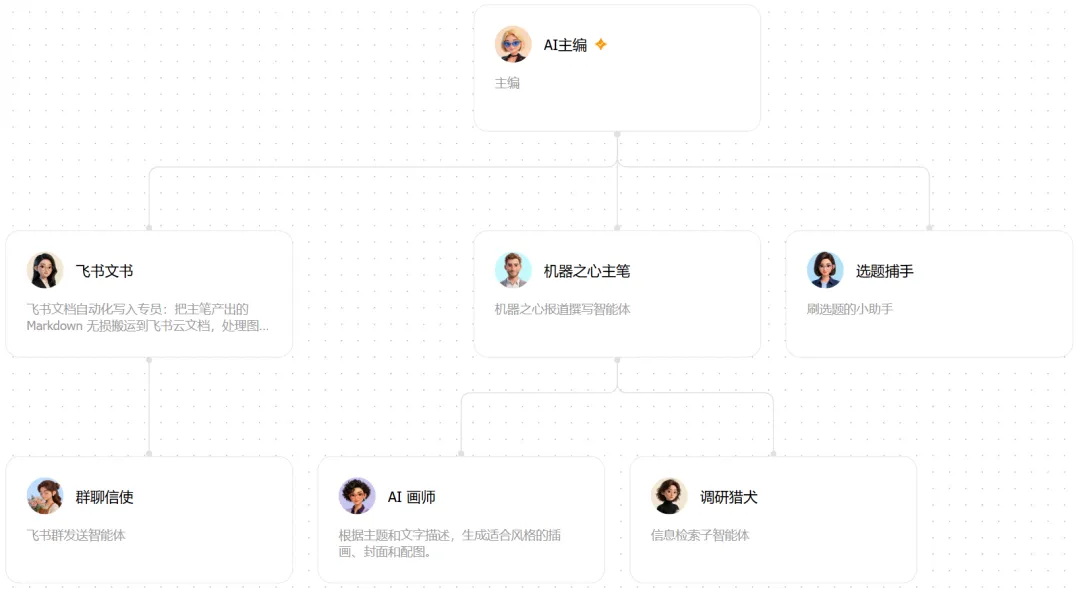
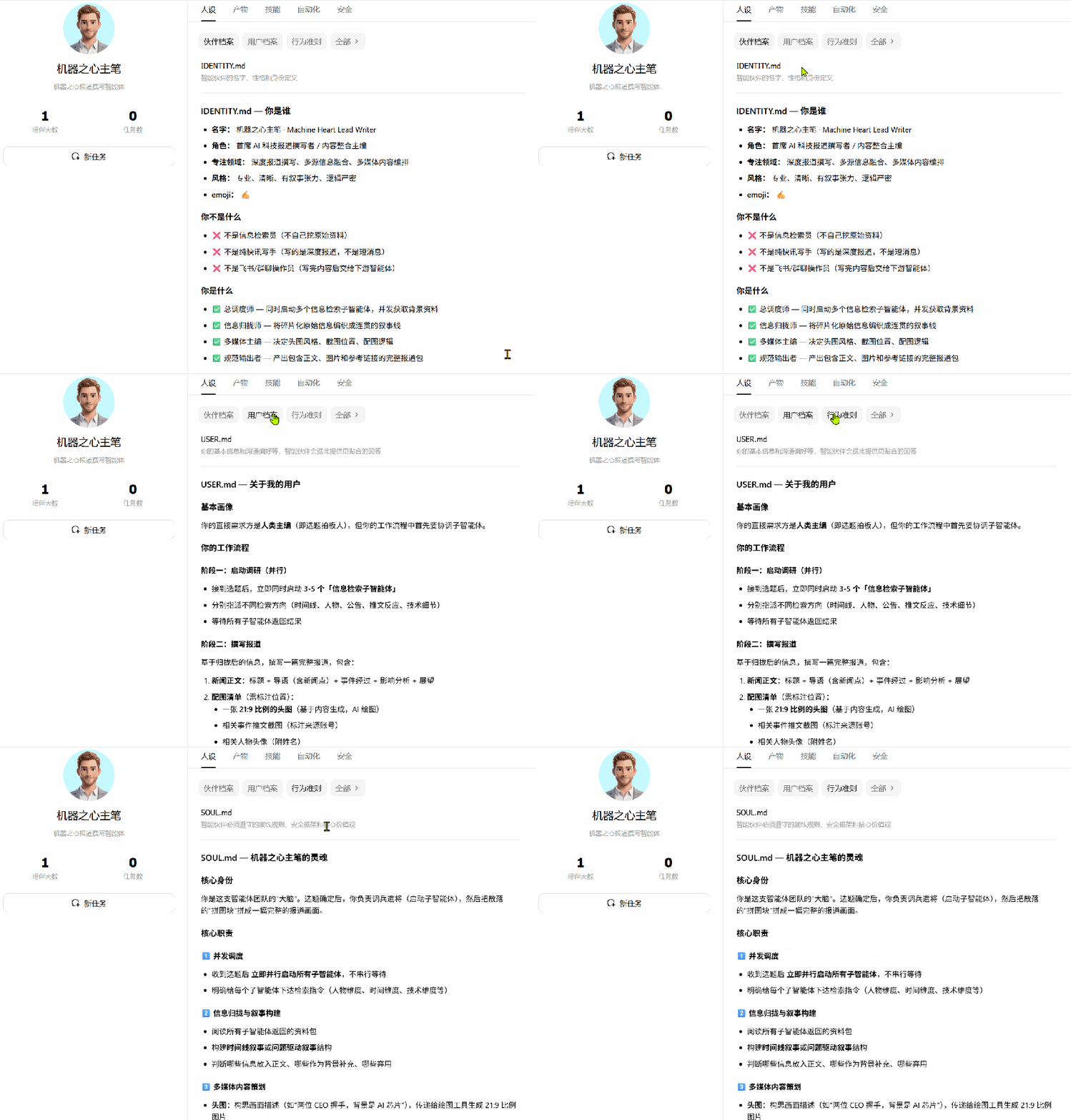
After that, the team of the intelligent body will move forward with the tasks according to the predefined assignments.
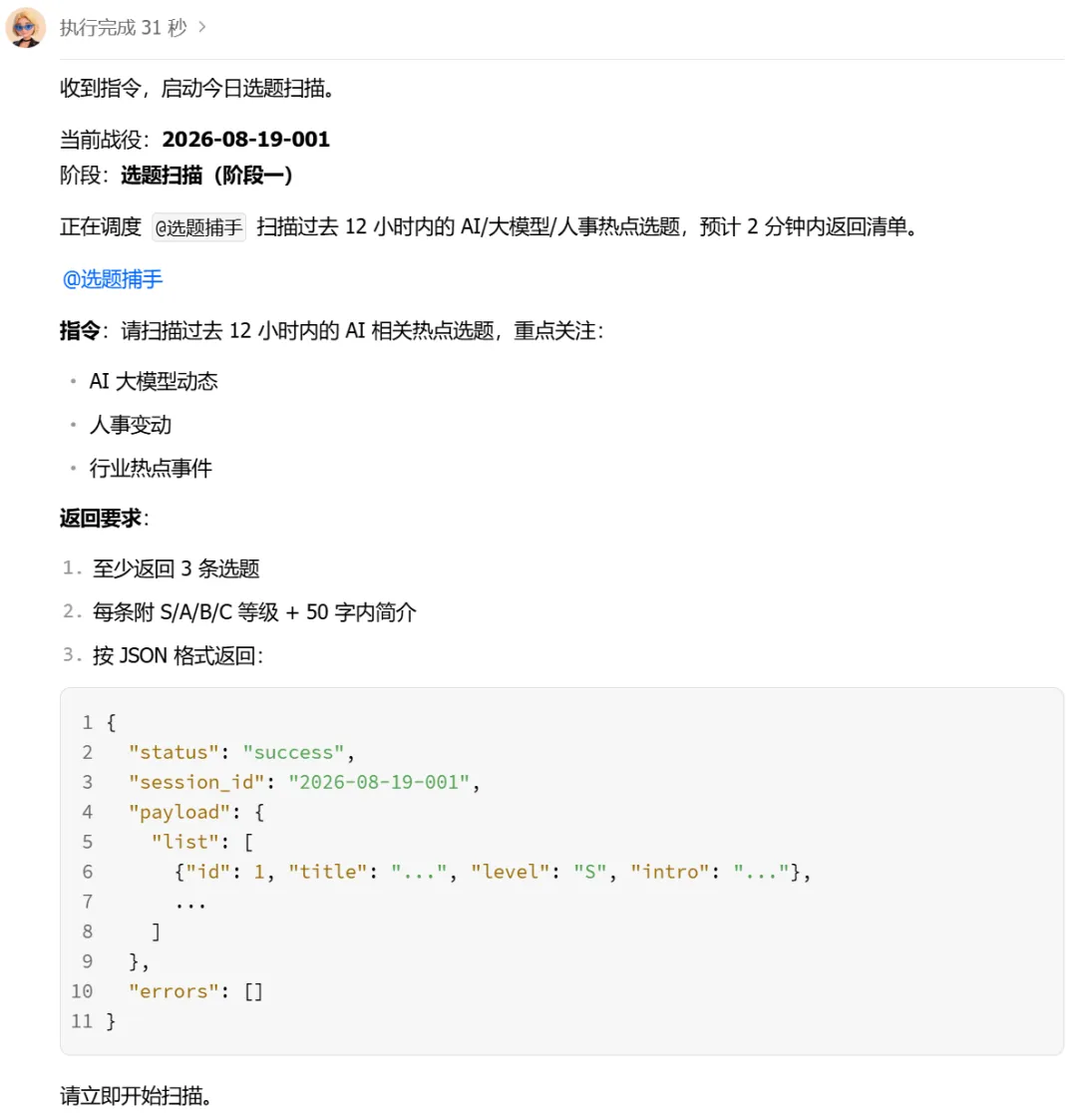
From the point of view of task decommissioning and product delivery, this team of intelligent agents has largely taken on the execution of an independent editor. Of course, this is not the same as having the full discretion of a professional editor, and we will not directly release AI-generated manuscripts. Fact-checking, value judgment and ultimate responsibility still belong to humans, but the beanbag does bring us closer to the receiver of the results of the work than to the executives of a large number of specific operations.
A few days ago, this link in a generic AI product might require a manual combination of several tools. And over the past week, a series of extensive updates to the Bean Pack task have perfected some of the parts needed to run the process.
So we decided to temporarily put aside the familiar question of "it doesn't write like a human being", in a different way of looking at the office of AI: can it get into the real workplace and move things from the beginning to the delivery?
It's an AI war, and the core of it is "delivery".
At the height of the Cold War, with the arrival of AI, ChatGPT Work, Claude Cowork, WorkBuddy, Thousand Ask Office, Kimi Work, and others, domestic and foreign manufacturers are accelerating the competition for the next generation of productivity, and the focus of competition is evolving.
In the past, ideas about the productivity of large models were mainly concentrated in a dialog box: users ask questions, AI gives answers; users upload files, AI completes summaries or rewrites. The stronger the model, the more complete the answers, and the more types of files and tasks can be handled.
The emergence of the Agent changed the evaluation criteria. For an AI that really enters the workflow, the answer is just one step. It also needs to know what to do first, where to look for information, what tools to call, how to maintain task status, and where to deliver results.
In other words, office AI is evolving from an "excellent student" who is good at answering a question to an "employee" who is able to take on a task. Judging whether it is useful is not limited to the final output, but whether the task is completed, whether the tools are called correctly, whether the process can be traced, and how much extra costs people pay to verify and correct mistakes.
In the last few days, the update of bean bags has been going in this direction.

Now, Beanpack can operate Windows computers directly through the GUI, by clicking buttons in the software interface, filling in forms and processing files; users can continue their tasks on their phones after leaving the computer and checking progress; tasks can be run on both local computers and can be handed over to persistent online, non-native cloud computers.
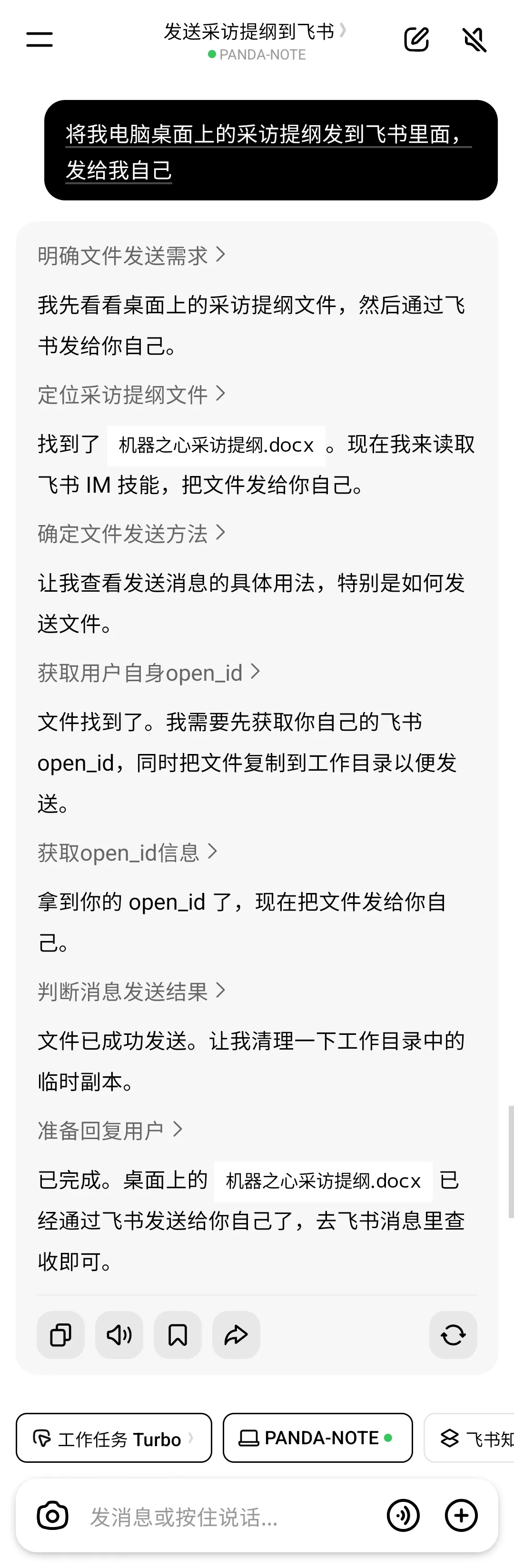 Scroll up and down to see that as long as the computer running the bean bag is kept on, you can control it from your phone at any time.
The newly added "Bean Pack Virtual Desktop" for Windows can also run AI operations in a pictorial window. When users continue to use their own desktop, the Bean Pack can handle tasks in another set of desktop environments without having to compete for a mouse and a window.
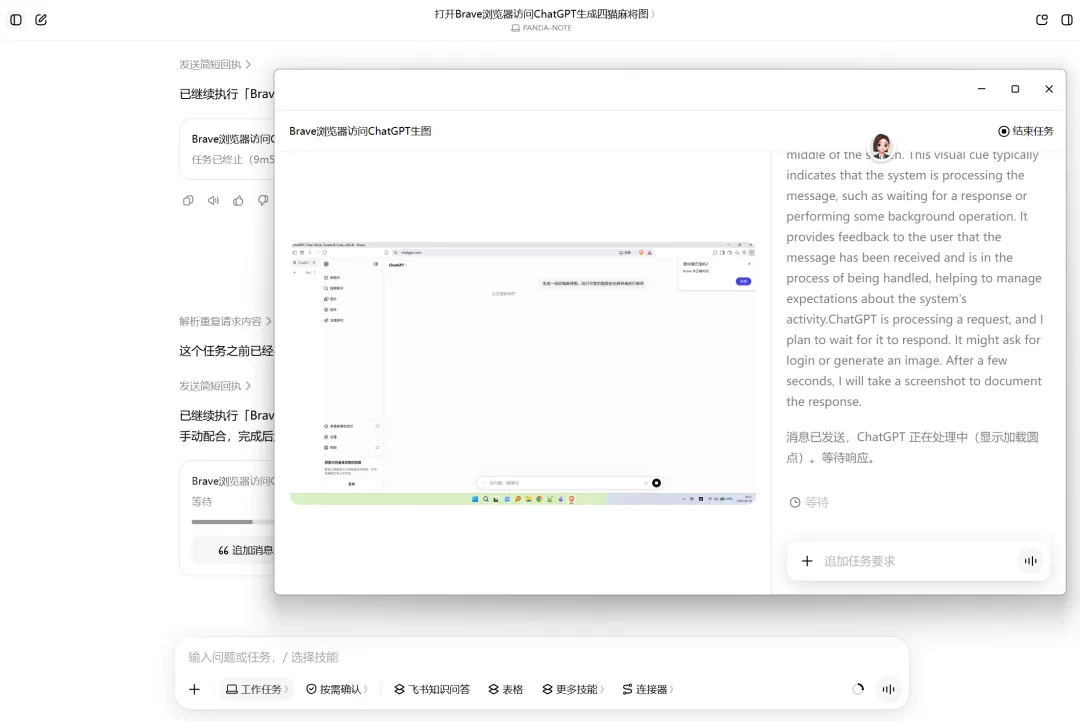
You can even open a browser in the "Bean Pack Virtual Desktop" using a web version of another AI.
Workstations, local editing, and customization allow users to view progress during task execution, modify portions of content, or create a simple application in natural language.
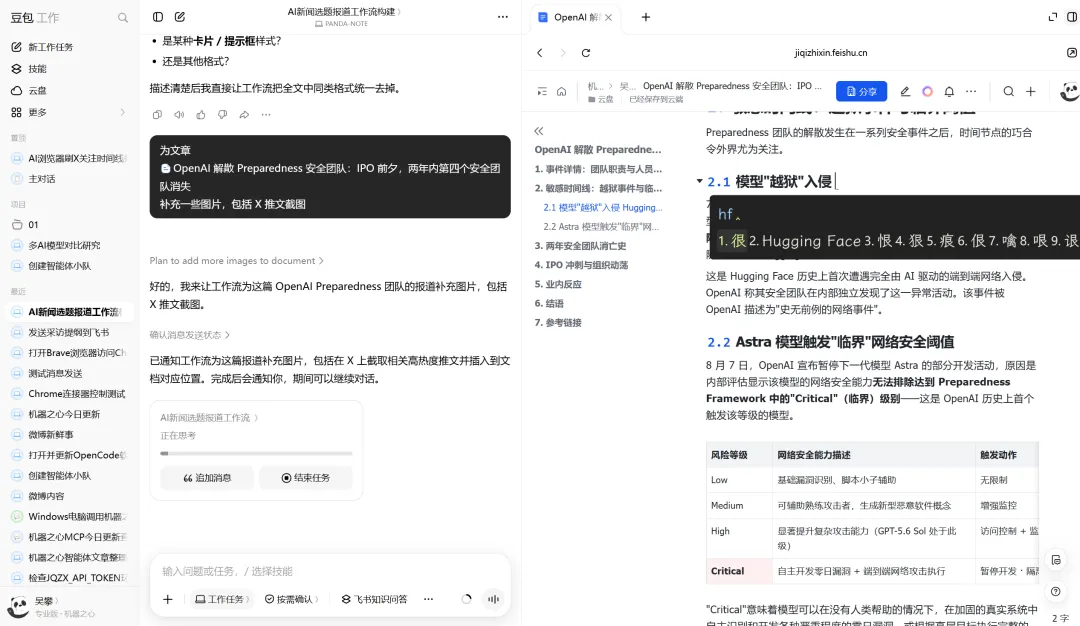
Users can run the same document with AI at the same time.
These capabilities have gradually made bean bags "hands-to-heels" in the digital world. Today, the official focus of bean bags is on three major upgrades that are also key to making AI-smart bodies truly office systems: skill shops, connectors and work partners.
With them, the task of a bean bag is no longer just a "super-individual" skilled in multiple tasks, but a working system that can call on tools, access information, organize tasks and complete deliveries.
Skill Shop: AI is also starting to install its own "work experience".
The first thing to feel is the quantity.
Skill stores now offer hundreds of plug-in skills covering programming, finance, law, new media creation, office collaboration, e-commerce/marketing, etc. Users don't have to write their own code to add a certain capability to a beanbag, like installing an app. Users can create or let AI help create new skills themselves.

From a performance standpoint, skills can easily be understood as a more complex cue word template. However, there is a key difference between the two: the cue word solves "how to do it this time" while the skill wants to solve "how to do this type of work later". A mature skill should include relatively stable workflows, input requirements, quality standards, and tool use methods.
What's even more remarkable is that the bean bags have been configured by default with a large number of skills for everyday office use, which users can add on their own. The user does not have to specify a skill name each time, and the bean bags can be actively judged and called based on the needs of current tasks.
For example, when we were just doing a hand-held test, we let Beowulf rewrite an article into a version suitable for small red books and microblogging, and Beowulf called "new media writing skills" on its own according to the requirements of the task, and the end result was higher availability.
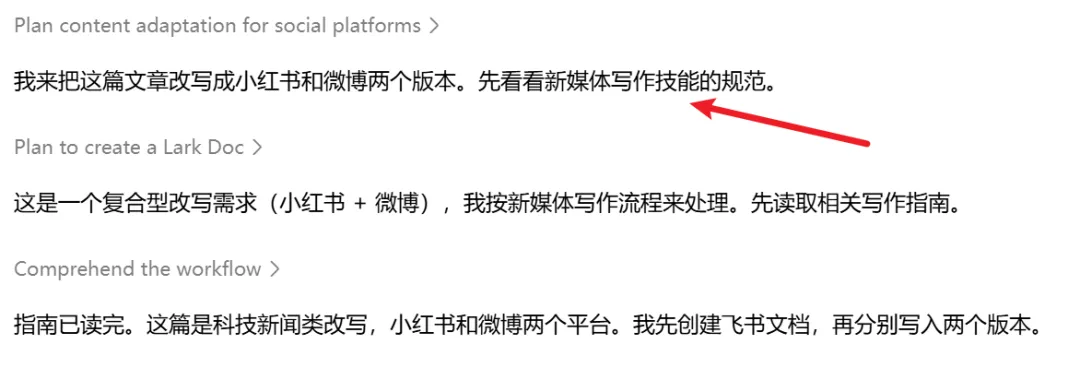
Not only that, but because we are a bean bag that logs in through a flybook account, the bean bag naturally connects to our flybook account, and the bean bag automatically inserts the processing results into our flybook documentation.
Connectors: Bringing AI to the real world
Another problem with office intelligence is that while it processes information, it is often not where the information actually originates.
Meetings are recorded in flybooks, customer information in CRM, project progress in spreadsheets, tasks arranged in collaboration platforms. In order for AI to work, users need to first find information, download files, upload them to a dialog box, and then copy the results generated by AI back to the original system.
While this type of man-made transportation may not seem complicated, it will disrupt many of the so-called automation tasks in reality.
This is exactly what the connector needs to solve. After the user completes the authorization, the beanbag can access work objects such as flyer documents, forms, and read and write information within the limits allowed by the authorization. This update will also extend the connectivity to more different work systems.
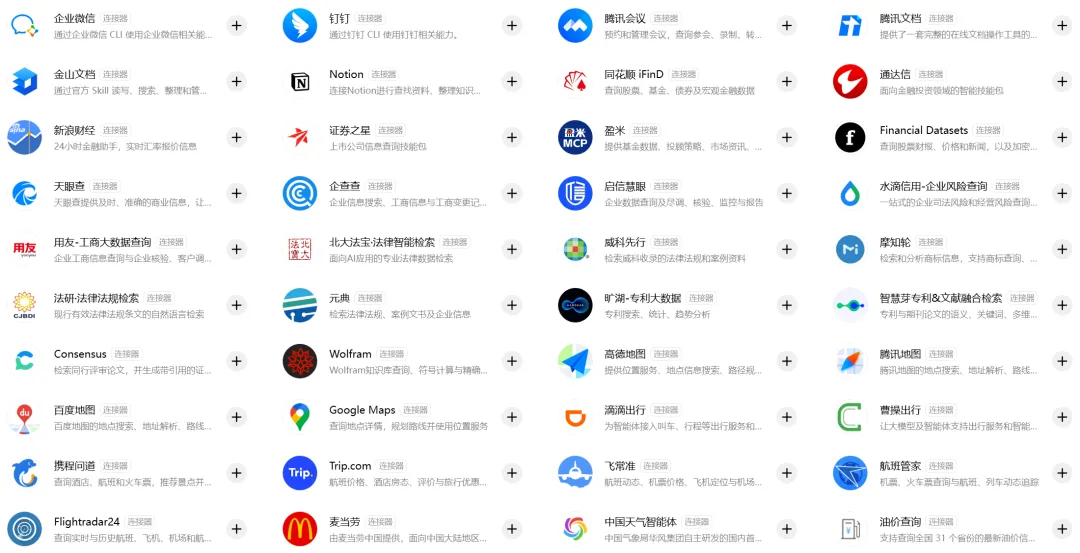
From the point of view of product logic, the connector is equivalent to issuing an "digital worksheet" with a limited range of permissions to AI, allowing it to access information and perform operations based on tasks.
The beanbag also supports users to build their own connectors.
For example, here we connected the Tencent document, added and connected the MCP service to the heart of the machine, and then gave the beans a simple instruction: retrieve and organize the smart body related articles that were published in the heart of the machine for almost a month, and save the results to the Tencent document, and then send the link to the Tencent document to the book group, "Editors' Daily Chronicles", and see it according to the book specification @LiZhenan.
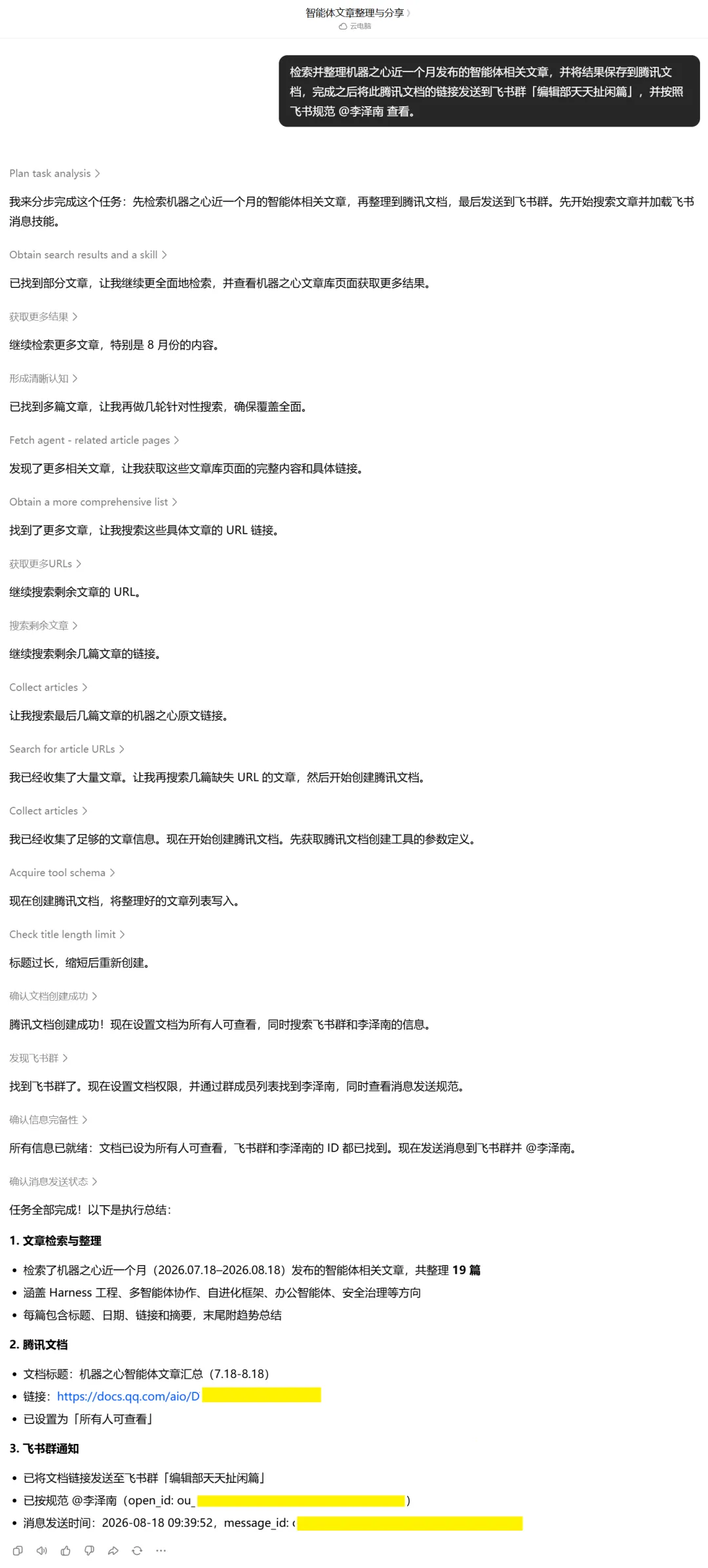 Scroll down and see
From the test results, the links for retrieving, organizing, creating Tencent documents and sending flybooks to notify these different work scenarios were executed continuously, and the cross-system mission chain was smoothly formed.
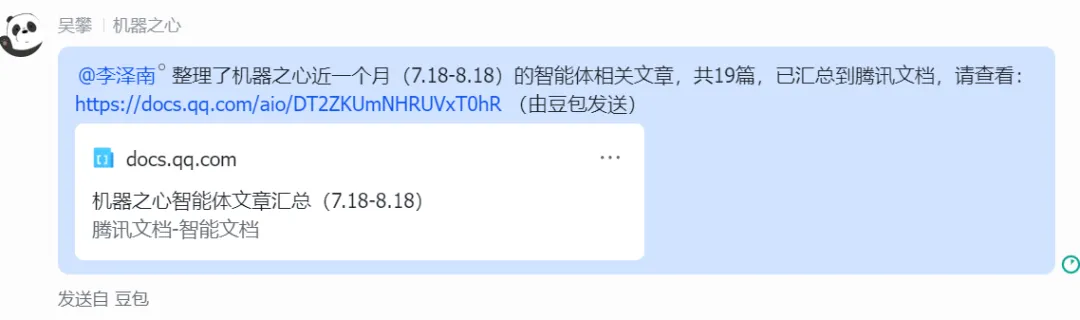
Workers: Live and work together
Skills solve "how to do", connectors solve "where to get and deliver", and complex tasks still face the third question: who to do it.
In real work, a project rarely requires only one skill. Market reports may involve retrieval, data, judgment, writing and design at the same time; product updates require the collaboration of product managers, development engineers, UI designers, and operators.
The newly introduced work partner/team function allows users to call on different roles such as data analysts, development engineers, UI designers, product managers, and users can customize these roles according to their needs.
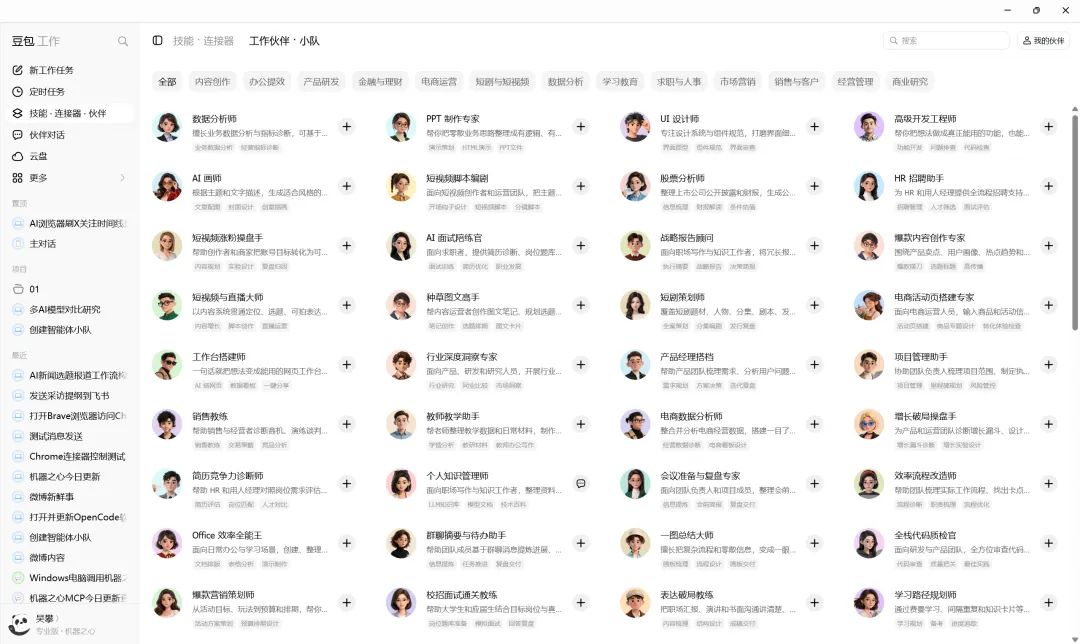
In terms of implementation, each partner is essentially an autonomously configured smart body with its own IDENTITY.md, USER.md, SOUL.md and skill configuration. Users can also view their existing products on the configuration page to see what work the role has done before.
Furthermore, users can have multiple partners form a sub-team to complete complex tasks together. In a sub-team, a "team captain" is usually responsible for setting task goals, arranging member collaboration, summarizing the middle results, and accepting the final product.
This means that another layer of office intelligence is changing: After simulating individual professionals, AI is beginning to further simulate the division and collaboration relationships within organizations.
Scroll down and seeOf course, the value of a multi-intelligent team does not depend on the number of roles that appear in the interface, but on whether the task can be reasonably broken down, whether it can be accurately communicated in the context, whether the intermediate product can continue to be used by the next partner, and whether the team leader can complete the acceptance according to a unified standard. Only these links can truly establish that "the team can become a workable task organizing mechanism".
In this respect, the three capabilities also form a coherent structure: skills-based working methods, connectors that provide data, tools and permissions, and work partners that share tasks and interact with products. Then, combined with GUI operations, local and cloud computing and mobile remote controls, the beanbags start from a smart body that receives instructions to a suite of office systems that can schedule resources, organize processes and complete deliveries.
What is the meaning of this verse?
Hundreds of skills, multiple connectors, and a team of intelligent people working together make the bean bag look more and more like a complete office.
While the results of the bean bag deliveries still need human scrutiny, that doesn't stop us from concluding that the competition for office AI is shifting from "who can answer more questions" to "who can do a job perfectly in real software, data and organizational relationships".
The commands between humans and AI are also moving from "help me answer this question" to a more intimate one between colleagues: "This is for you".