It's a very tight one.
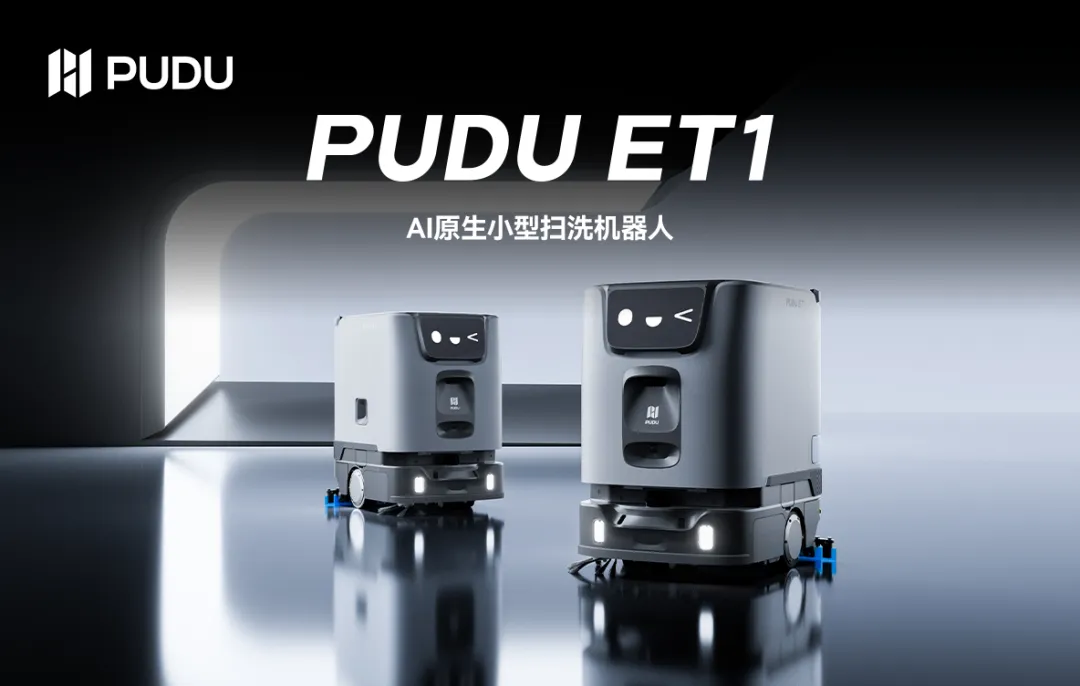
ET1 is freely available through narrow channels of less than 50 cm in width and less than 60 cm in height, both of which are derived from the measurements of real-life scenarios and the limit values under dynamic scenarios respectively. The 60 cm height standard is derived from the measurements of table space: for example, a regular table is about 65 cm high, and the table in Japan is shorter in the study of Purdue robots, testing the smallest table with a net space of only 60 cm.
The 50 cm width standard comes from research on convenience stores, where convenience stores are usually 80-100 cm wide, but when the shopkeeper picks up the box on one side and the customer stands in front of the shelf, the actual width is less than 50 cm. Purdue's robot emphasizes that for these convenience stores, which are only about 100 square meters, more than 10% of the clean area can be leaked if half of the passage is not passed, which is not acceptable for customers.
Purdue obtained precise parameters through global, multinational field research, handed over to R&D for high-difficulty structural stacking, space design evolved from ccm-grade silicon to ccm-grade silicon space (such as wall thickness decreased by 1 mm, parts reduced by 1 mm), in the body size of 38 cm wide, 58 cm high, embedded in large diameter washing rolls, water pumps, water tanks, batteries and other components, behind the all-out structural engineering capabilities.
In addition, there are also a large number of low shelf basements, suspended suspensions and glass doors in the small space, traditional sensors are difficult to detect, in the past it can only draw virtual walls, with blocked zones, while the ET1 does a fully autonomous barrier. It uses a 40-meter laser radar, similar to the Purdue-sized mid-engined CC1, to predict the movement trends of dynamic obstacles, and it also slows down in advance when encountering pedestrians.
Hard nuclear cleanupTo solve this problem, Purdue robots inserted a commercial-grade configuration into the small body of the ET1: a washing machine with a diameter of 8 cm, which is thicker than a single cylinder of CC1, and when dragged down one side of the water to clean the roller, the water is squeezed out and the water is inhaled directly from behind.
The real industry pioneer in ET1 is an 85°C all-chain water heater. It's easy to know that it's easy to heat water with alternating current, and it's a completely different difficulty to heat and stabilize the output from more than twenty degrees with battery power. The common solution in the industry is to fill the machine after the workstation is heated, while the body of the ET1 can also be heated independently, and the starter will automatically heat up when there is no workstation.
Temperature control of the closed loop is another core challenge that E1 solves, with unstable water temperatures not only affecting the cleaning effect, but also potentially damaging the ground. The E1 spray water temperature can reach 85°C, operating to about 40-50°C after the ground.
Under such a configuration, the ET1's ground pressure strength is more than five times that of a household scrubber, reaching 5000Pa, and the roller's maximum rotation speed can reach 800 rounds. Faced with a piece of dried tomato straw, the household system needs to be cleaned repeatedly twenty-three times, and the ET1 only needs two to three times.
Easy to maintain, easy to deployThe industry has a long history of cleaning hot spots, with people on the ground adding water, sewage and sludge to the cleaning components every day. ET1 is equipped with the industry's first all-encompassing workstation, which combines automatic charging, filling clean water, discharging sewage, adding clean liquid, rolling and vacuum cleaners, rolling drying and clean water heating in one, based on the six-stage workstation of the PUDU CC1 Pro released last year, which ET1 has made it a standard.
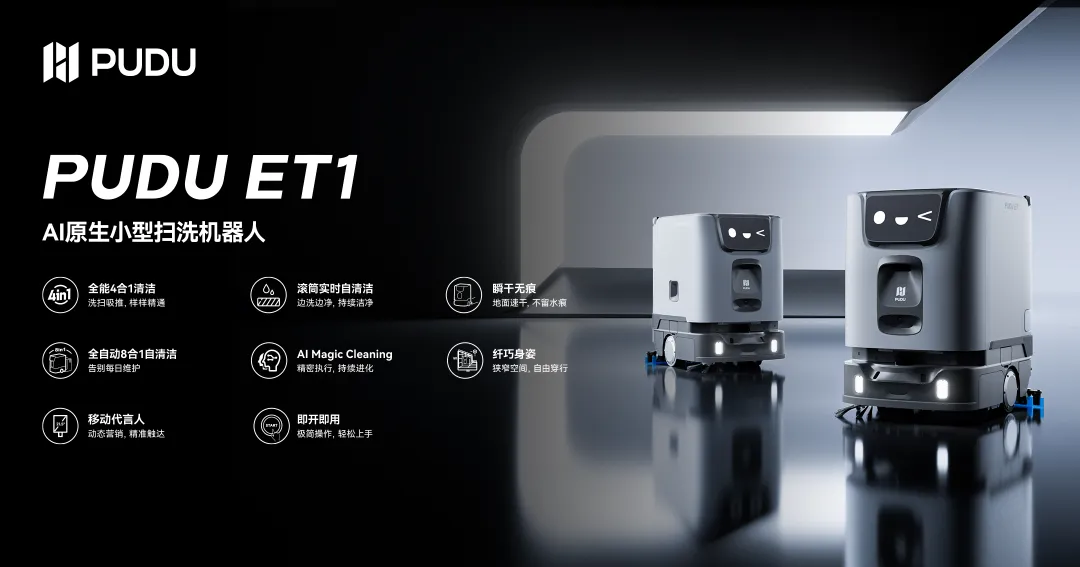
Accompanied by automatic dust collection in garbage cans, the maintenance cycle ranges from daily maintenance upgrades to approximately half-monthly checks on garbage. In a quick demolition design, all clean parts are removed in just 30 seconds and reassembled in less than a minute.
The deployment process has also been further simplified, with ET1 supporting autonomous mapping, pushing a button next to the workstation to start automatically scanning, mapping, feedback, without the need for technical personnel.
With the above advantages, ET1 has achieved a standard cleaning efficiency of 300 square meters per hour, six times that of household cleaners, enough to meet the demands of commercial customers to work multiple times a day.
Additionally, the E1 machine has a rich expansion interface, allowing customers to DIY some external devices, such as adding lights, billboards, and more, according to their needs, to meet the personalized needs of different stores.
The Golden Age of Commercial Cleaning Robots
What is the location of a small robot?
The problem of cleaning small shops has existed for a long time, and the model of artificial part-time cleaning has persisted over the years. So why did Purdue robots choose to release a small robot at a critical time in the popularity of commercial cleaning robotics exploration?
The key is that today's AI capabilities are enough to support the complexity of small spaces. Large models bring task understanding and generalization, allowing robots to identify different types of garbage, dirt and ground materials, understand the environment and not mechanical paths; three-dimensional perception solves narrow paths through dynamic avoidance; and physical intelligence allows the same set of capabilities to fall on different shapes of machines.
The answer lies in their product matrix and delivery data.
As of May 2026, Purdue robots have shipped over 130,000 units, with a cumulative clean area of 3.2 billion square meters, producing over 50 million hours of machine data per year.
According to the Frost Sullivan study, Purdue robots ranked first in global commercial service robot revenue and shipment volume in 2025. It also ranked first in the commercial cleaning robot segment. The study was cross-certified by Counterpoint Research, which also showed that Purdue robots ranked first globally in both the two core indicators of global commercial cleaning robot shipment and revenue in 2025.
Purdue has more than 1,000 agents globally, eight global warehouses across 85 countries and regions, reaching 5W+ terminal customers, real operating data covering more than 900 segments of the industry, so a product that is geared towards a whole new area doesn't have to start from scratch trying to figure out what it should look like.
Furthermore, the ET1 is not an isolated new product, it has a clear coordinate in the commercial cleaning product matrix of Purdue robots.
By area division, the BG1 series is geared towards factories, underground garages and supermarkets; the CC1 series covers supermarkets, shopping centers and office buildings, i.e. 1500-3000 square meters of industry-recognised sugar-sweetened candies; the E series corresponds to 100-800 square meters; the MT1 series is purely dry cleaned, while the CC, E, and BG series are cleaned, sucked and washed.
The core positioning of the Purdue Clean E series is simple, easy to deploy, easy to use, while also encompassing Efficiency, Eco-fri.