Recently, a French research team has done something that sounds like a cyberpunk novel:Giving after deathAn adult's brain sliced into a crop dish with a mechanical handle and a microphone.
A man plays a string on a piano, and a mechanic can play it out loud:
The title of the paper was: The uncontrolled sensation of the human brain's extra-corporeal culture - movement-associated learning that enables robots to simulate motion.
Learning is only the first step. Memory is retained for at least 17 days after learning a brain slice; given medication or infected with a neurological virus, the memory performance decreases significantly.
The really scary thing is not that it plays the piano, but: a piece of brain tissue that leaves the human body, without consciousness, without rewarding signals, runs through the closed loop of "listening → moving fingers → feedback → reconnecting" using neural plasticity itself.

This has sparked outrage on social media, and the reaction of out-of-network netizens can be said to be mixed-up.

This is the first post-mortem video of an adult brain in which an extra-corporeal body learns to feel movement-associated and reverse-controlled mechanics.
How is this done? What is the purpose of this study?
01.
Why not use the brain after death?
Let me tell you why.
Today's AI is powerful enough, but the price is right there: a zebrafish catches, avoids, survives, consumes only 0.2 microwatts; an adult human brain is 20 watts; and the world's most powerful supercomputer is tens of megawatts.
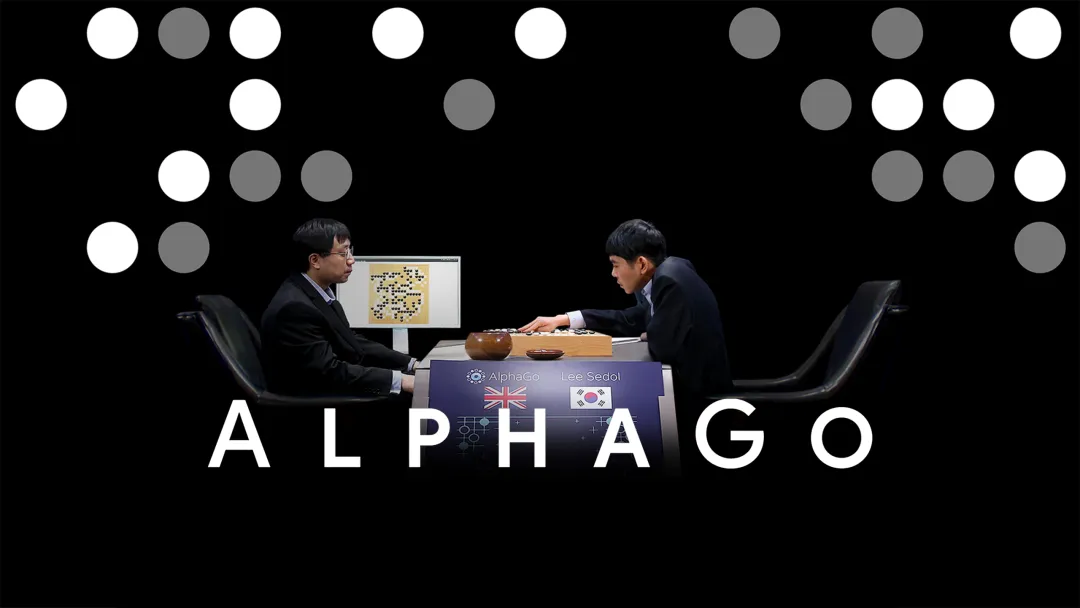
The gap in learning efficiency is even more inscrutable. The research team calculated two books in the text: AlphaGo trained more than 150,000 chess players to win the world championship for humans, which is the equivalent of 8 hours a day for one person, even over the next 100 years, which is significantly higher than the actual practice of a human master. ChatGPT 3 consumed 45 TB of data to be able to chat like a human, which is the equivalent of one person reading 5 e-books a day, reading 250 years.
Hence, hybrid-AI is viewed as a difficult but promising direction to get live neurons into computational circuits.
The problem is what is considered a "living neuron". Currently, there are two mainstream pathways that are flawed: a two-dimensional neural network that is notoriously difficult and unstable to induce plasticity; brain organs (organoids) that are highly heterogeneous, maintain extremely fine, and have less cellular diversity and synaptic maturity than the adult brain.
So the team paved the way for a third pathway: OPAB (organotypic culture of post-mortem adult brain explant), an organ-forming culture of post-mortem adult brain tissue.
The process was as follows: during autopsy at the Montpellier University Hospital Medical Center, the donor's primary exercise cortex was removed at intervals of less than 12 hours after death, cut into small pieces of about 0.5 tonne 1 cubic centimetre, sent from the hospital to the laboratory in 30 minutes, and cut into 300 micrometre thick pieces, each with a layer of cortex and a small piece of white matter, which were then cultured on a membrane plug on a gas-liquid interface.

The ethics paper clearly states: approval by the Ethics Review Committee of the Montpellier University Hospital (No. 202000643) and the French Agency for Biomedical Research (PSF20-025), without opposition from the local prosecutor and family; exclusion of the cause of death from head injuries (such as a car accident, stroke) or known serious neurological disorders (such as seizures, neurodegenerative diseases).
02.
Key findings: Learn connections that can be "reversed"
The brain pieces are placed on a three-dimensional array of microelectrolytes, which can be embedded into the pieces at a depth of about 80 micrometers, with a total of 60 electrodes available.
The team has previously demonstrated that by selecting two non-adjacent electrodes, first stimulating A (stimulus electrodes), then stimulating B (paired electrodes) after 12 milliseconds, 300 pairs a day for three consecutive days, the strength of the connection between A and B is enhanced.
The new finding is that reverse connections are also reinforced. After training, the response to B alone increases significantly in the area where A is located.
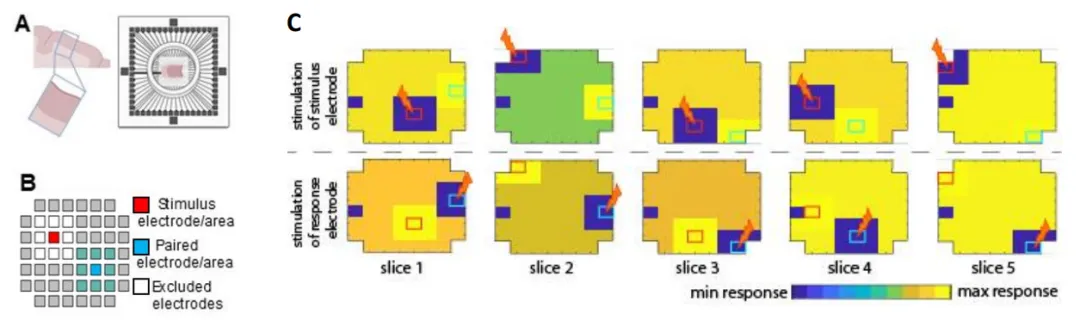
This "synchronous plasticity" has been reported in the literature, but is particularly significant for people who do mixed AI: it means that the learned associations can be immediately reversed.
This is not a small thing for AI to do, but it must be designed specifically for learning techniques; how the human brain reverses has learned to associate, which is still one of the core problems in the development of neuroscience. The mirror neurons of the time are on fire, in part because it seems to give an explanation.
The most typical application of "reverse call associations" is imitation.
03.
It's the brain that's capable of filming and listening, and it's learning.
What the team is trying to recreate is the way babies learn: babies rely on random babbling ("motor babbling" in engineering) to observe the sensory consequences of each move, thus establishing movement-sensory associations, understanding their bodies.
The length of the device is as follows: OPAB is placed on a microelectrode array, in an atmospheric controllable culture box; an external Shadow Dexterous Hand-shaped mechanical hand, with an electronic piano, thumb, middle finger, and unnamed curve under the three keys "LA", "TI", and "DO", respectively; next to it is a microphone that serves as the "ears" of the brain, and the sound is decoded in real time by the self-developed C# program.
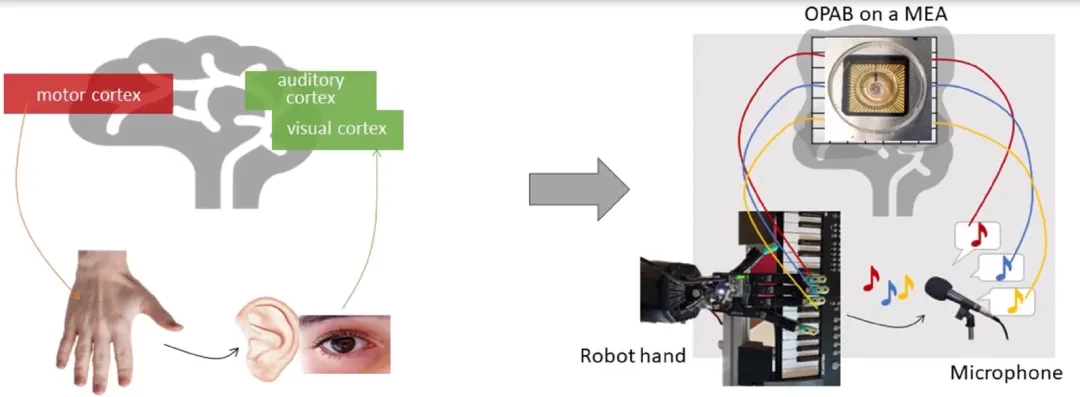
Of the 60 electrodes, 6 are chosen at random: 3 when the "motion electrode" takes three fingers and 3 when the "sensory electrode" corresponds to three sounds (the only constraint is that at least one electrode is separated between any two electrodes).
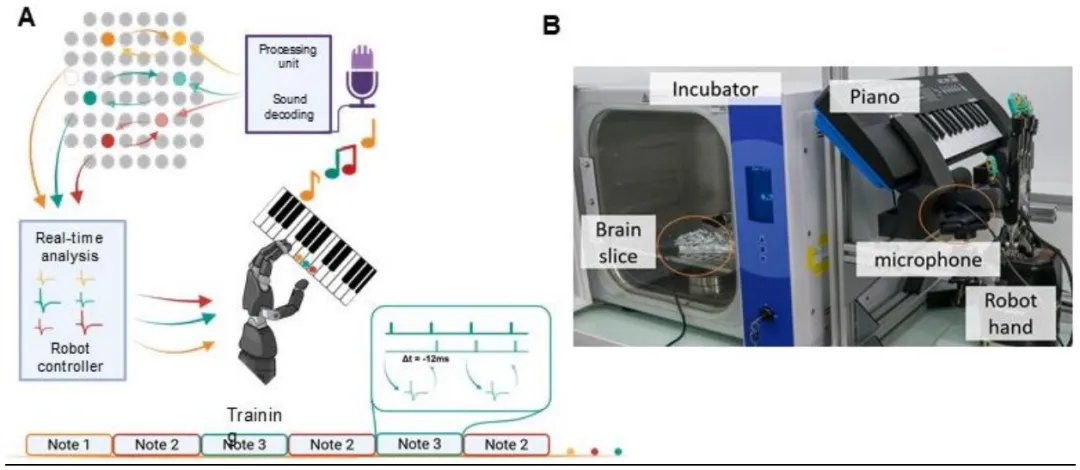
DAY 0 is "priming": three motion electrodes are stimulated simultaneously, and after 12 milliseconds, three sensing electrodes are stimulated simultaneously.
DAY 1 to DAY 3 Official training: randomly stimulate the electrodes of the movement in the order of the blocks → Mechanical fingers at the touch of a button → Microphone sounds → decoding → Stimulating the corresponding sensation of the electrodes. 300 times a day, 100 times each finger.
Here's a nice engineering detail: the entire "action→sound→decode" loop takes about 500 milliseconds to close, while the plastic protocol requires that the pairing of the stimulus must be reached after 12 milliseconds. The team's solution is to locate the sound that a certain motion stimulus decodes, not immediately, but waiting for the 12th millisecond after the next motion stimulus. The price is that the first stimulus of each block is not paired, but timing accuracy is maintained.
DAY 4 begins with a "peak electrode calibration": after stimulating sensing electrodes, the electrode that responds the strongest in the 3×3 neighbourhood of the corresponding motion electrodes is picked up by the mechanical hand (with only one stimulus, which is one-shot learning).
Then there's the test: human experimenters randomly bounce 10 to 18 sounds on the piano, decoders deliberately bounce and send the stimulus into the brain (or else humans and robots will grab the bullet), which brain piece responds the strongest to the motor electrode, and which sound is played by the mechanic.
04.
Results: 62.5% learn at least two sounds, medication and viruses can prevent it from "learning".
16 OPABs entered the test.
DAY 1 ((first day of training) performance was at a random level: 31.22±11.7% ((three-in-one theoretical randomness was 33%).
After three days of training, DAY 4:
Three pieces (about 19%) achieved three tones 100% full pair in each bounce, and the mechanics were able to reproduce correctly; another 7 pieces (about 37.5%) were 100% correct on two tones, and only the third sound would be mistaken for the other. A total of 62.5% of brain pieces learned at least two tones, with an overall average accuracy of 58.5±23%.
The three groups of contrasts are as follows:
No learning control: sensing constant electrodes, randomly switching to untrained motion electrodes to drive machinery. DAY 1 is 33.8±8.9%, DAY 4 is still only 36.6±18%. Two factors repeated measurements ANOVA showed significant interaction:
Drug control: given six trained OPABs plus 50 μM CNQX and 100 μM AP-V (blocking the AMPA and NMDA receptors, respectively), the simulated performance decreased significantly after 4 hours (T(5) = 5.28, p=0.0032).
Viral control: showing more than 66.7% of OPAB at Day 4 infection with Tahini virus (TAHV), DAY 7 retesting, showing significantly less than 7 healthy brains (Z, 10) = 54, p=0.03, Wilcoxon rank and test). TAHV is a neuroblastoma associated with central nervous system disorders, which the team has previously shown to disrupt OPAB's electrical activity.
Additionally, 4 of the 5 OPABs that followed long cycles remained in study after 17 days of training, of which 2 were still full-tone pairs, 2 were full-tone pairs (66.7%).
05.
"The closest replacement to the human brain in the cultivated dish": where is its boundary
The team set up the ceiling themselves.
Only three groups of associations are stuck with two hard conditions: a brain slice with a diameter of only about 5 mm, and a limited spatial resolution for the array of microelectrodes. If you want to do more parallel associations, you have to rely on larger slices, higher density electrodes, or both.
Another key point is that the motion electrodes and sensory electrodes are randomly selected, and the team did not specifically use the natural connectivity advantages within the brain tissue to demonstrate that "any pair of electrodes can establish an association" while being closer to the real-world situation where babies establish an association between arbitrary movements and their sensory consequences. The cost is that some randomly selected locations may cover neurons that are damaged or do not have natural connectivity, so civilization says that 62.5% of the number is indeed biased, and instead of an activity intensity-based electrode selection strategy, results should be improved.
Finally, the entire learning process, which did not give any error feedback to the brain, belonged to purely unsupervised motion-sensory-associated learning. The team believed that the ability to gradually reproduce the learning ability of the human brain outside the body by doing a number of parallel correlations, plus the mechanism of error feedback.
In the paper's own words, OPAB is "probably the closest replacement to the human brain in the cradle", and the device provides the first platform for robots and neural models to exchange information in a closed loop for extra-corporeal study of human sensory motion. It can serve as both a future hybrid AI and a tool in the new direction of "cognitive virology", potentially promoting cognitive science, neurological disease and even medical research.
Scientists have not yet imagined ethics, and netizens have been blaming these human brain fragments: "Super Bull Horse".
The link is as follows: