In the past three years, the AI content generation industry has gone through several rounds of intensive technological transformation. From text images to text videos, from short videos of a few seconds to long videos at the minute level, each round of upgrades pushes the quality and duration of the content generated forward.
However, careful observation reveals that these developments are essentially the same paradigm: the user provides the prompts, the model produces the content, and the user views the content.
This paradigm has a fundamental limitation: it produces content, not the world. Regardless of how realistic the video generated is, users are always bystanders, unable to really access, change, or continue to influence the space in the image.
The industry is also aware that the concept of a world model has begun to appear frequently in the technical reports and product releases of major AI labs, and that Google, World Labs and others have invested a lot of resources in this direction. But behind the heat wave, the controversy is equally fierce: are the products on the market today building the world, or are they just rendering images?
HiDream.ai has just given its answer: HiDream-O1-World, the world's first native, full-form interactive world model.
The model is based on a self-developed native UIT architecture that supports multi-mode inputs of text, images, interaction, etc. to generate dynamic worlds with long-term time-space consistency and physical consistency. Users can both roam freely from the first and third-person perspective and edit characters and scenarios in real-time; from writing real cities, natural landscapes to two-dimensional, fantasy worlds, 3A game styles, from humans, animals to fictional characters, can be generated and continuously developed in the same set of models, allowing world generation to move further towards explorability and interaction.
A more remarkable result came from third-party reviews.
In the interactive world model evaluation benchmark WBench, launched jointly by LongCat and the University of Padua, HiDream-O1-World first reached the top of the Navi rankings, overtaking Tencent Mix 1.5 and Ali Happy Oyster, among others.
HiDream-O1-World has a score of 73.3 in the Physical dimension and is ranked first in the Consistency dimension with a score of 88.0.
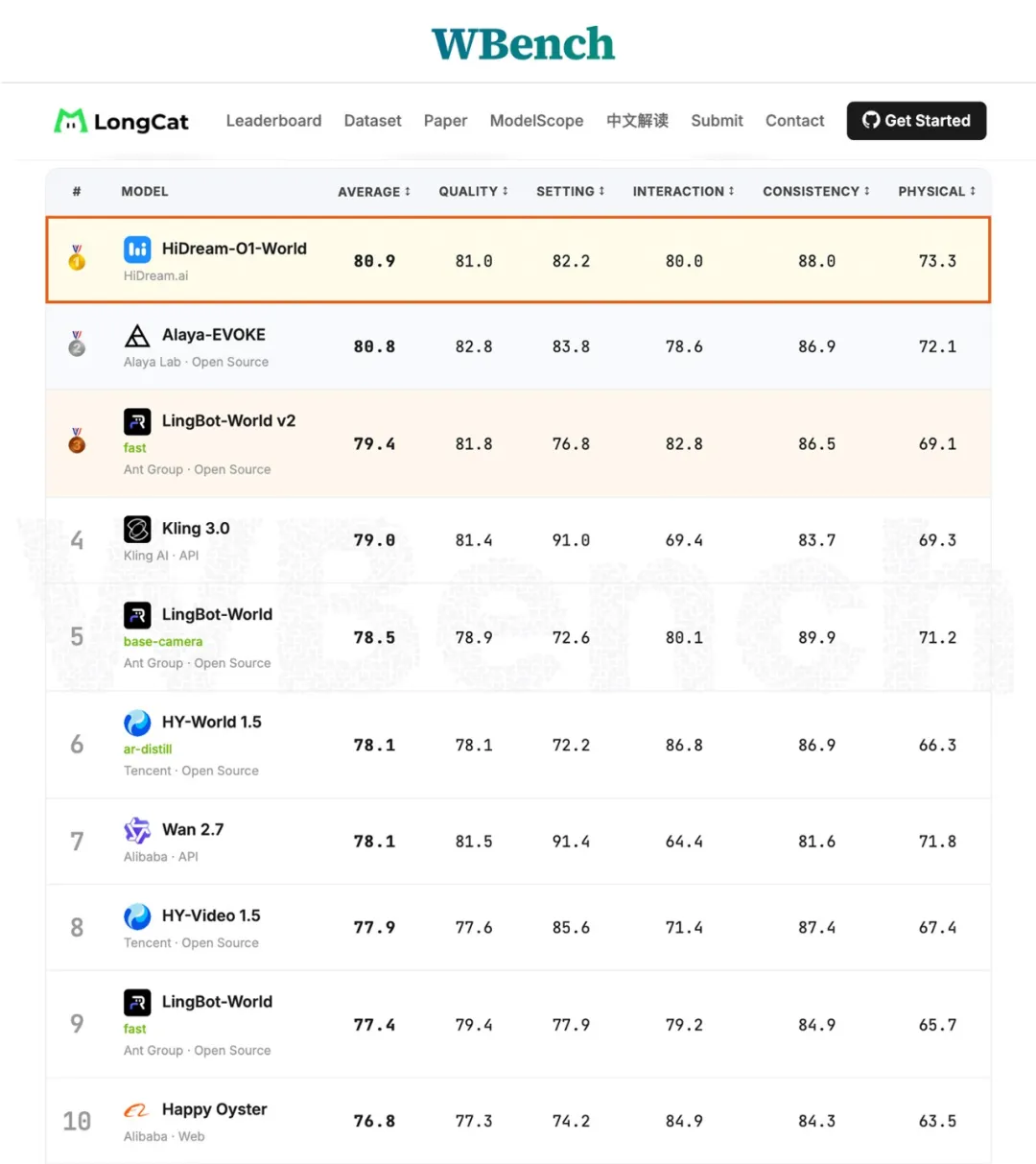
Physical dimensions primarily measure the visual physical rationality and causal correctness of the results produced, such as whether the results conform to basic physical logic after an object collision or surface interaction occurs; and consistency, which examines whether scene memory, spatial structure, and cross-sectional logic can be maintained in continuous production. The two key indicators achieve high scores at the same time, and HiDream-O1-World has established strong advantages in physical consistency and long-term space consistency.
A world of AI that can be controlled and continuously generated.
It's more intuitive to put these scores back into real-world effects.
The first is the roaming mode.
In this mode, the user is like being in the real world, free to roam the scenes generated by the model. Through the mobile controls in the lower left corner of the screen, which can drive the characters forward, turn or stay, and support the first and third-person perspective free switching for a more immersive exploration experience.
The following is a video of snowmobile climbing produced by HiDream-O1-World. The user can control the forward direction of the subject with a mobile control, and as the character moves forward, the forward path and surroundings change in real time; the terrain and scenery previously generated remain consistent when the character returns along the original path.
Furthermore, it is an editing mode.
In this mode, users can edit images in real-time: the driving character completes moves such as grab, run, drop, jump, or schedule environmental changes such as triggering rain, dropping objects, and other dynamic events.
In the following scene of the ride, input the words "hot weather changes to thunderstorms, which were supposed to be instantaneous thunderstorms in the clear day, the sky plunges, the rain falls, the ground rises water flowers".
And then there's the multi-styles, multi-subjects, multi-scenes.
In its visual style, HiDream-O1-World supports highly written urban street scenes, natural landscapes and indoor spaces, as well as realistic depictions of photos and materials; it also supports multi-artistic styles such as fantasy worlds, two-dimensional cartoons, 3A game rendering.
For example, the interior of the church produced by HiDream-O1-World, with its stone tower, columns, and wooden bookshelves together with the finished manuscripts, constitutes a complete spatial structure that is updated in real time as users move and view changes, giving a strong sense of material quality and spatial reality.
When we put these examples together, the core capabilities shown by HiDream-O1-World are clearer, stronger, and physically consistent.
It is difficult to fundamentally solve the problem of dealing with vision, space, movement, time and even physical relationships while continuing to superimpose control modules on traditional video generation models.
UiT: A unified architecture
The future of intellectual judgment of true intelligence must be based on a unified understanding of the entire physical world, not on the spelling of multiple models, but on the internalization of the world's rules into model structures from the outset.
In the words of Intel's future founder and CEO Mei Min, the industry often speaks of model the world, but the real world model should be more like mold the world.
This decision gave rise to Intel's future core technology path: the self-developed Unified Transformer (UIT) architecture.
Traditional multi-module systems, even large models with strong current capabilities, are essentially spliced logic: text has text encoders, images have image encoders (usually VAE), video has video processing modules, which work independently and then exchange information through some translation layer. The disadvantage of this design is that the understanding between modules is indirect, and the causal logic of cross-modules is often lost during translation.
UiT's approach is completely different: it abandons independent text encoders, replaces all original signals such as image pixels, text tokens, video graphics, audio, action instructions, spatial coordinates, and maps them into the same shared Token space, allowing them to interact, understand, and generate in the same set of Transformer networks.
This means that, from the point of view of UiT, seeing an apple fall from a tree and understanding that gravity causes an object to fall are no longer two independent cognitive processes, but unified reasoning completed in the same representational space.
This architectural innovation is the fundamental reason why HiDream-O1-World is able to surpass similar products in terms of physical consistency and space-time consistency.
Two major industry challenges: time-space consistency and physical consistency are being overcome
Existing interactive world models rely heavily on implicit time-space representations, directly generating new perspective videos based on initial images and camera trajectories, and when perspective changes are large, problems such as geometrical structures, object shapes, and cross-visual space inconsistencies can arise.
Intel's future research, which will be incorporated into ECCV 2026, will extract the geometric structures that were originally involved in the video generation process separately and use the Geometry-then-Appearance two-stage framework to model geometry generation and appearance generation separately.
The main page of the project:
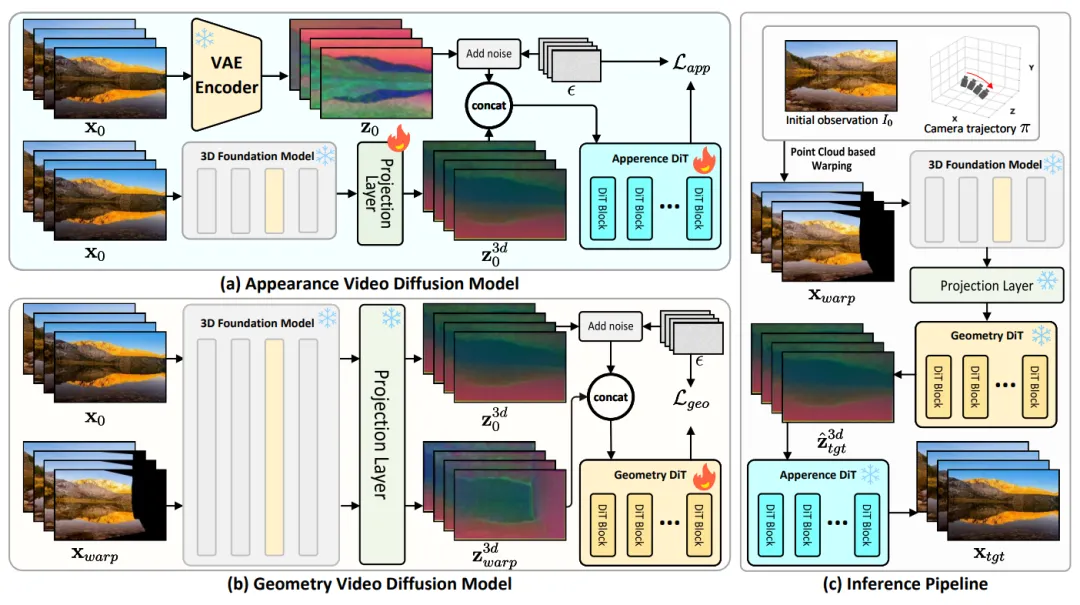
DreamWorld uses the two-stage generation method of Geometry-then-Appearance
The first stage is responsible for generating geometrical structures under the target perspective: the model first projects the initial scene into a new observation perspective based on the input image and user-defined camera trajectory, resulting in a set of incomplete observations. Since the new perspective exposes areas that have never appeared in the prototype, these observations naturally present shadows, gaps, and structural deficiencies. The team then uses the pre-trained 3D Foundation Model to extract multi-dimensional geometric features, and the Geometry Video Diffusion Model to complete and complement the missing structures in the geometric feature space, generating more complete geometric representations under the target perspective.
The second stage video scattering model is generated: the geometry represented by the first stage is generated as a structural condition, the conditions are de-noise in the VAE subspace, and finally decoded as a video string.
The core of the design is geometry - geometrical output solutions. The geometric phase focuses mainly on structural integrity, cross-sectional consistency, and the follow-up of camera trajectories. The appearance phase focuses mainly on texture, visual detail, and real rendering, without the burden of structural reasoning.
When directly using warped partial images as a condition, the output is vulnerable to structural deficiencies and projection artifacts; the study first completes structural reasoning in the geometry feature space and then performs appearance synthesis to obtain more stable cross-sectional results.
Geometric generation is just the first step, and how to make the model remember this geometric structure in long-term interactions is equally crucial.
For this purpose, HiDream-O1-World uses a 3D preview to inject context + TTT into Memory so that the world generated is truly remembered.
Memory 3D pre-memory injection: Memory is responsible for building a model's sustained spatial memory, preserving the geometry of the scene, the spatial coordinates, and the relationships between objects. The model needs to remember what was there, where it was located, and what it had to do with the surrounding environment.
Test-Time Training on-line adaptive reasoning: the reasoning phase dynamically adapts to the current camera trajectory, scene structure, real-time modeling representation, so that every interaction, every viewfinder switch is strictly adhered to 3D geometry constraints, the entire process structure is stable, unchanged, and unbroken.
Furthermore, the model also ensures that the image conforms to the laws of physics so that the future of the mind can start from both the training data and the reasoning mechanism.
During the training phase, the intellect reinforces future physical difficulties that are relatively rare in ordinary Internet video, allowing the model to repeatedly study the relationship between changes in the state of an object and the results of motion through scenes such as rigid collisions, fluid flow, and flexible shapeshifting.
At the reasoning stage, with the help of Test-Time Training's online adaptation mechanism, new scenarios, new materials, and models can be adapted online according to the current environment, ensuring that under arbitrary interactions, motion trajectories, object interactions, and scenarios evolve in accordance with real-world causal logic.
After the creation of the world, the boundaries of application will change.
If the interactive world model is ultimately used only as a freer video player, its industrial value remains limited.
The really interesting part is that once the world has a continuous state, physical consistency, and real-time interaction capability, it can begin to take on some of the work that has been done in the past that requires game engines, 3D software, and simulation platforms.
AI interactive video games are the most direct application.
Traditional video content is essentially fixed after filming is completed. Although interactive video games include selection and branching, production logic is still highly dependent on pre-designed story trees and assets.
Characters, environments, and plays can continue to be created as they run. Viewers can stop and explore a street that was originally just a backdrop, allowing the characters to change their actions, or access spaces that the screenwriter has not gradually created.
The same is true of the gaming industry.
In the past, creating a 3D world that could be freely explored required long processes such as modeling, mapping, binding, animation, lighting, physical systems, and shutter design. If a world model could directly construct an explorable environment based on an image or a description, prototype development and content production in the early stages would change significantly.
The greater imagination may come from being physically intelligent.
The data needed by robots naturally comes with visual, action, spatial and physical feedback. The cost of real collection is high and the scenery is extremely limited; pure simulation can be infinitely generated, but there is a significant gap between visual distribution and the real world.
The interactive world model provides an intermediate solution that enables high-quality training data to be generated at scale.
In March of this year, Intel's future strategic partnership with Nanotech Robotics plans to develop deep collaboration around high-quality, scalable physical-intelligent video data: Nanotech provides high-precision human motion capture data as a seed, and Intel uses its own millimetre-level controlled video generation capabilities to scale these data for fine-grained magnification and scenographic generalization, with the two sides expecting to collaboratively generate over tens of thousands of hours of physical-intelligent video data per year.
When the world can be generated with one key and freely interact with one another, many industries are beginning to be reimagined.