ScienceDiscovery is a multi-disciplinary, all-process AI workstation developed by Agent OS (JiuwenSwarm) that addresses the problem of tool fragmentation, big-model science hallucinations, AI-assisted scientific innovation, accelerated scientific discovery, and widely applied across industries. In the industry-leading BiomniBench-DA mission, ScienceDiscovery validates the effects of SOTA in the industry and successfully applies it in key areas such as nano-antibody drug design.
1 The pain points of AI-assisted research
The development of Agent has reshaped traditional scientific research processes to become a new paradigm for AI-assisted scientific research. Under this paradigm, Agent is responsible for the entire process of research tasks planning, programming, and task execution, which can greatly improve the efficiency of traditional scientific research. However, due to the complexity of traditional scientific research and the limitations of current large-scale modeling capabilities, AI-assisted scientific research faces two major problems that restrict its application in practical scientific research:
Problem one: the fragmentation of tools, the length of the entire scientific process chain, the abundance of tools, the research staff reading the literature, the assumption of proposing, writing code, experimental trials and errors, the optimization of parameters, the frequent switching of multiple platforms, the complexity of the process, the high cost of time;
Problem two: scientific illusions, due to the illusions of the big models themselves, for complex, long-chain scientific tasks, AI-assisted scientific research is prone to errors such as literature citations, causal inference, and falsification of experimental processes, severely damaging the reproducibility and rigor of scientific work, restricting the scientific landscape transformation.
2 ScienceDiscovery: a one-stop AI research workshop
We've officially launched the ScienceDiscovery platform, a one-stop AI research platform dedicated to scientific research. With this platform, researchers are able to efficiently complete a one-stop research exploration process that is extremely cumbersome: reading, assuming, writing code, experimenting, testing, and optimizing parameters.
Based on ScienceDiscovery, users can complete the following functions:
One-Key Configuration and Efficient Access to Maritime Resources: The Connector, a built-in scientific research database, enables a quick configuration of a library and database with one-Key access to maritime frontier literature and core experimental data.
Autonomous code exploration in safe sandbox environments: supporting intelligent organisms to write, debug and run Python, R or Shell code autonomously in a safe sandbox environment, providing a stable environment for complex scientific data processing;
Automated dismantling and dynamic execution of complex R&D tasks: With strong task planning and multi-intelligent collaboration capabilities, the system can automatically dismantle complex R&D tasks, dynamically organize and call 300+ cross-domain Skills;
Full-Link Traceability of Research Processes: The platform will fully demonstrate the entire process workflow and provide full-link product traceability, including code, environment and logs, to ensure the high reliability of the entire research process.
3 Core technologies of ScienceDiscovery v0.1
ScienceDiscovery has released version 0.1, which builds on the following three core technologies:
Connector, based on MCP, is used as a plug-in for shredding tools.
ScienceDiscovery is based on the standardized MCP protocol and builds plug-in connectors, unified packaging, document retrieval, PDF extraction, tool interfaces, integrated identification, caching, and other governance capabilities.
Build high-dimensional structured memory charts and multi-dimensional audit mechanisms to achieve zero-science illusions
Strictly maintain task timing and product evidence chains through high-dimensional structured memory charts; in conjunction with the Zero Hallucination Reviewer multi-level audit mechanism, ensure that each scientific research conclusion is traceable along the chart and that the entire process is 100% traceable.
300+ Skills in the fields of integrated biology, chemistry, fluids, etc. for automated implementation of multi-disciplinary research workflows
Build multi-level scientific research Skills to accomplish complex tasks with intelligent compilation and autonomous execution. Through Plan Skills and Team Skills, precise analysis intentions, automatic matching of best workflows and dynamic demolition execution; the platform integrates MindSpore Science Skills with 300+ open-ended Skills, including field industrial software, research search APIs, 40+ upgrades and upgrades to AI4S' top models. These Skills cover all core alongside disciplines such as biomedical, chemical materials, fluid computing, partial differential equations (PDE) and cover basic needs such as scientific analysis, computational simulation and wet experiments.
The ScienceDiscovery v0.1 version features Team Skill, which is designed specifically for the biochemical field and can complete the entire process from data collection, biochemical experimental data analysis to report writing on its own. In the industry-authorized BiomniBench-DA Biomedical Intelligent Body benchmark mission, based on the GLM-5.2 model, the score reached 77.4 (Figure 1), reaching industry SOTA.
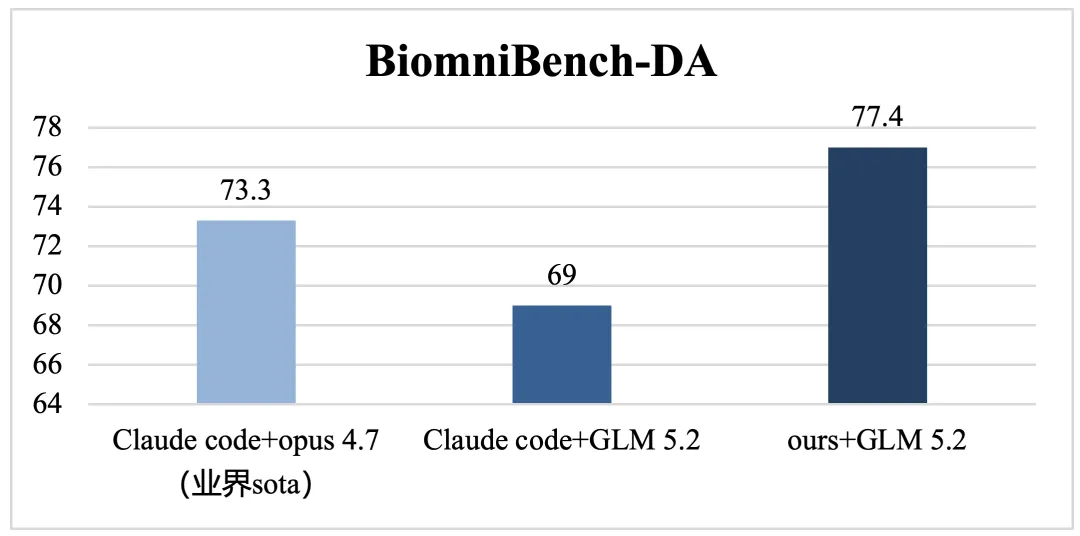
Figure 1 BiomniBench-DA ranking results
4 Applied practices
4.1 BiomniBench Model Case Analysis and Characterization of Cases of Lyme Disease
This case is exemplified by the question of case data analysis in patients with epilepsy in BiomniBench-DA:
Toxicity is a common terminal illness in ICU, and is a significant synaptic phenomenon. Based on multicore data from approximately 3,948 ICU and hospitalized toxicity patients, this case involved a correlation and layered aggregation analysis of the 38 immune characteristics scores derived from the six sub-type frameworks above, designed to explore potential correlations and identify synaptic variations in characteristics combinations.
ScienceDiscovery receives the above data and the core issues, independently analyzes the issues and assembles an agent team consisting of code-engineer, result-evaluator, report-writer (Figure 2), performing the following workflows:
Code-engineer calculates the characteristics and scores the two-to-two correlations between patients, performs layered clustering, identifies clustering groups, and generates heatmaps, tree diagrams, and cluster attribution files;
The result-evaluator assesses the results of multi-dimensional audits such as methodology, accuracy and robustness;
report-writer Comprehensive analysis of results and output of track files and result files as requested.
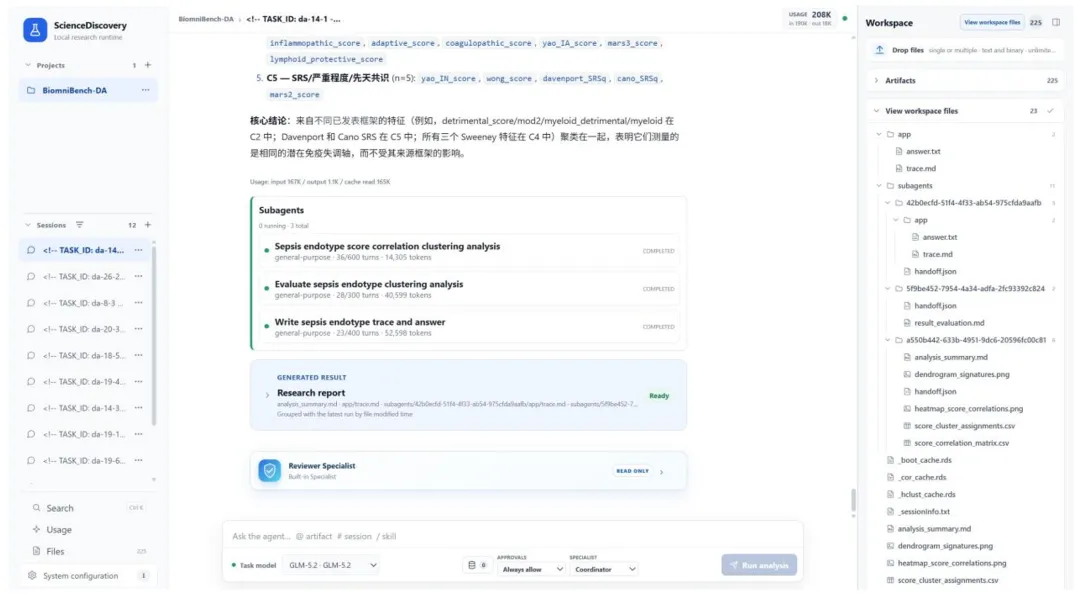
Figure 2 Execution of the Subagents
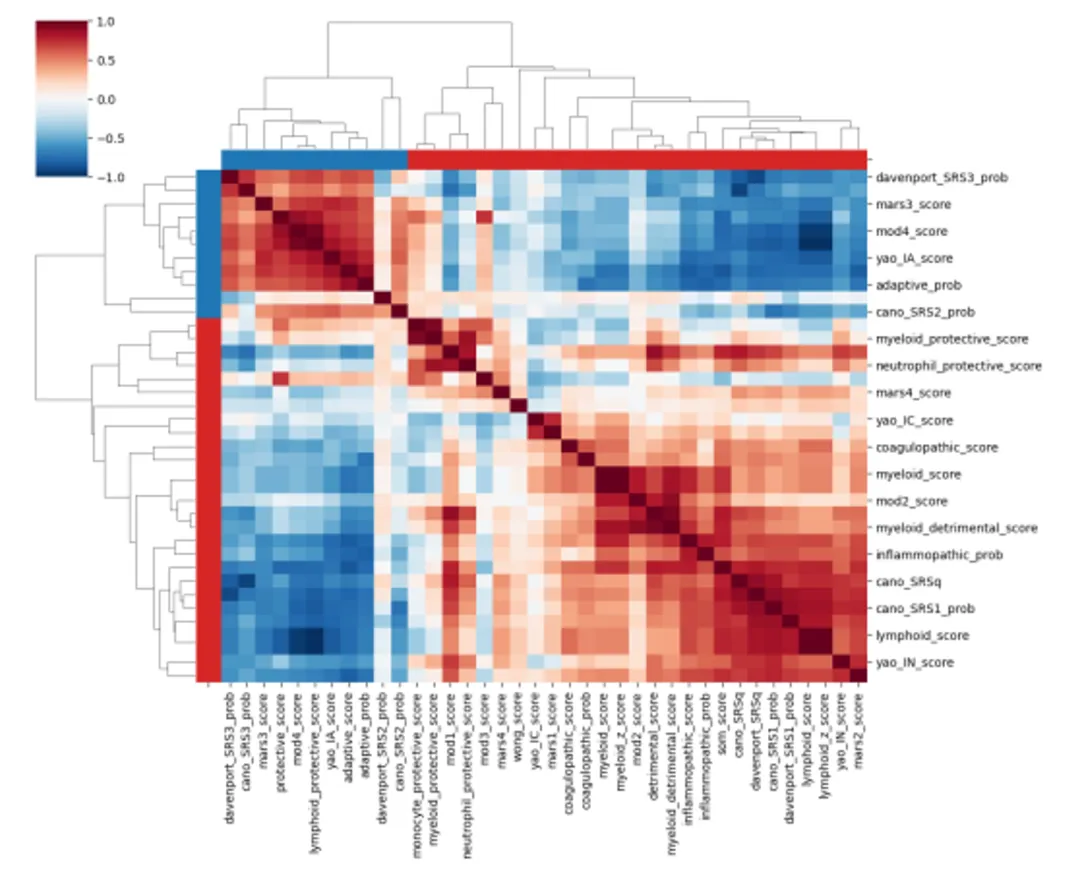
Figure 3 Characteristics related to heatmap
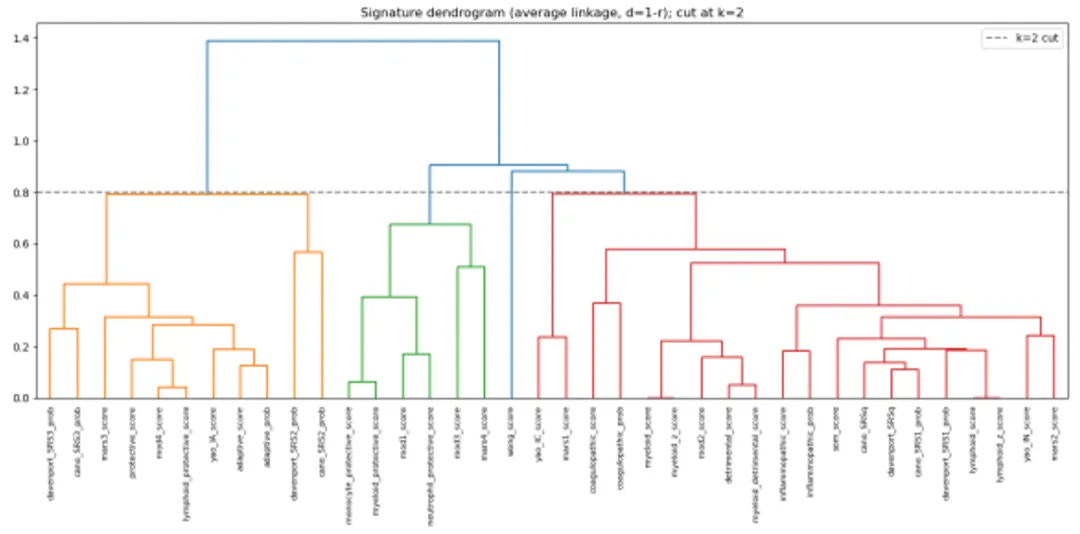
Figure 4 38 Immunity score indicators for the similarity of serum in 3948 patients
Ultimately, the intelligent organism divided 38 subtypes into two significantly counter-related clustering axes: Myocardial inflammation/disease severity and amniotic adaptive/lymphatic protective axes, and verified by a contour coefficient and an ARI indicator to reveal the core bi-axis structure of amniotic immune disorders.
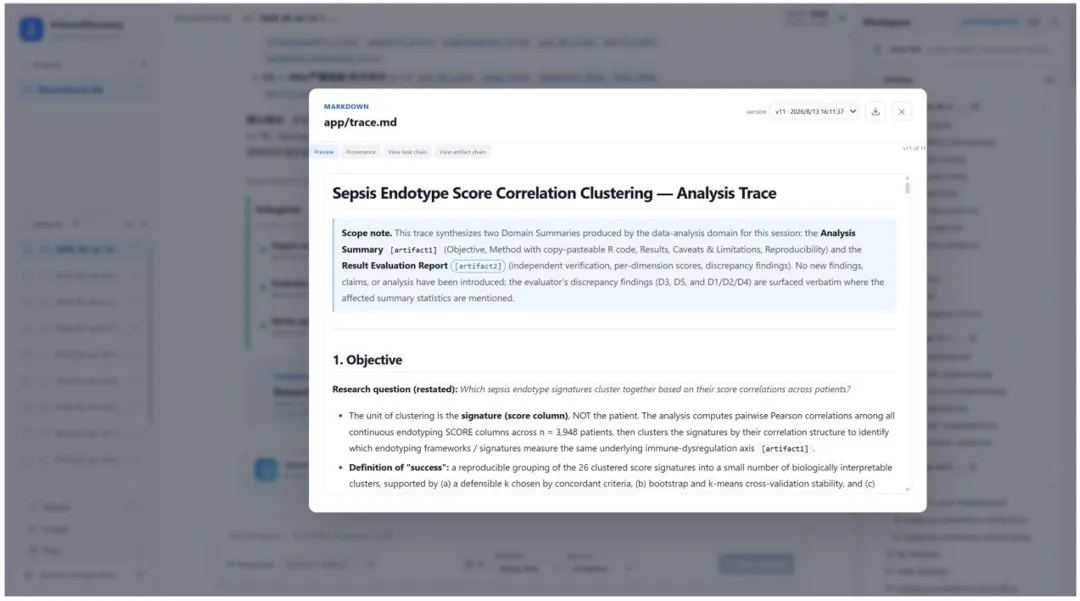
Figure 5 See the output report
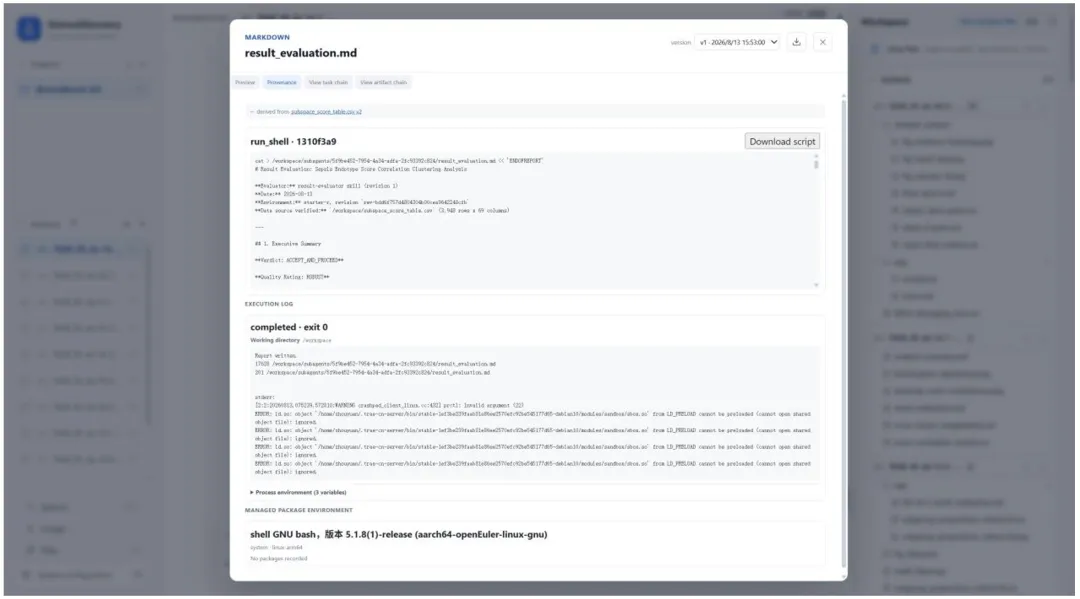
Figure 6 See product tracking codes, environment, logs
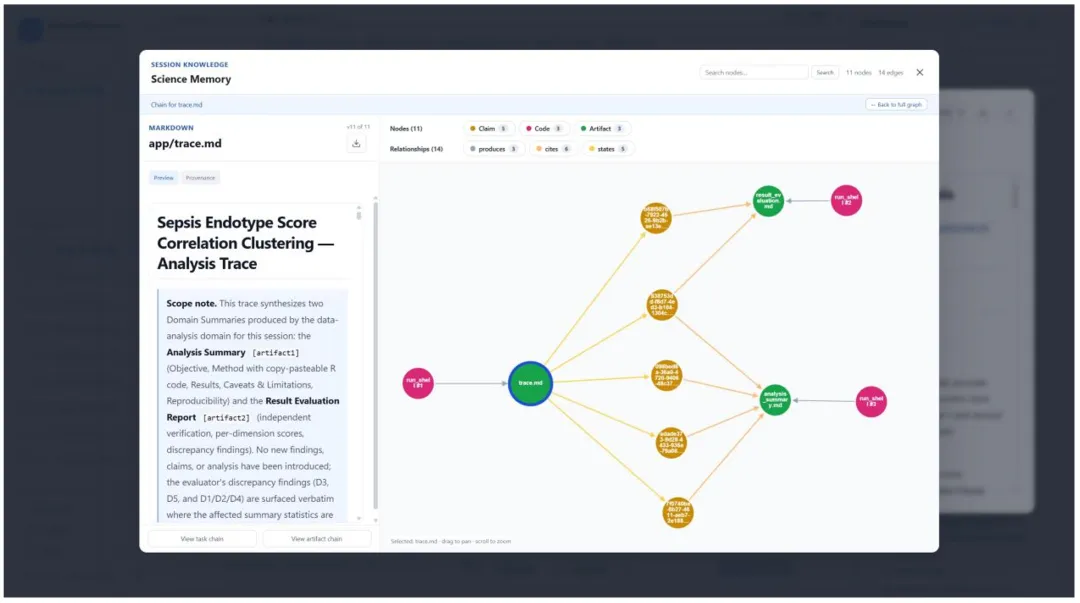
In Figure 7, see the product-related code, claim and other nodes.
To verify the effectiveness of multi-intelligent collaboration in the data science workflow, we have shown ScienceDiscovery execution trajectories and task charts in the analysis of tasks. Figure 5 links the various Agent products with trace.md, supporting traceability; Figure 6 records the bottom logs, ensuring that the process can be replicated; Figure 7 intuitively presents the tasks of the three Agents through node-side relationships, disassembly and collaboration.
4.2 Cases in biochemistry
4.2.1 Nano-antibody drug design + screening process
The potential for applications of nanoparticles due to their small molecule, high stability, ease of modification, and other characteristics is broad, but the traditional R&D cycle is long, and the cost is high. RFAntibody is a mainstream design process that can automatically design candidate nanoparticles and multi-dimensional screening, covering the antigen preparation and reporting of the seven links.
The RFDiffusion、ProteinMPNN、Protenix models provided by MindSpore Science automatically call ScienceDiscovery synchronizes complex computational workflows, ultimately producing filtering information and supporting decision reports with spatial structures, rather than fragmented files.
Figure 8 The process of designing nanoparticles
The complete nanoscale antibody design screening process is divided into five stages (Figure 8).
Environmental readiness: Tests run environmental, dependence and weighting documents to confirm the completion of anti-matter structures and design constraints.
Skeleton generation: Based on antigen and surface input, a candidate nanostructure skeleton is produced by RFDiffusion.
Sequence design: Using Protein MPNN to reverse fold the skeleton to design the corresponding amino acid sequence.
Compound prediction: Using Protenix to predict the structure of antigen-antibody complexes to assess the reliability of combined concepts.
Selection reports: Ranking of indicators such as integrated ipTM and multi-dimensional standards, selecting the best candidates and generating reports.
ScienceDiscovery is currently able to fully run the antibody design process of RFAntibody, input antigen, surface and corresponding number of designs, and Agent is able to automatically monitor and complete the design screening process, with a design success rate equivalent to running the RFAnitbody alone.
4.2.2 Research and pathway analysis on the expression of substantive cellular genes in the liver
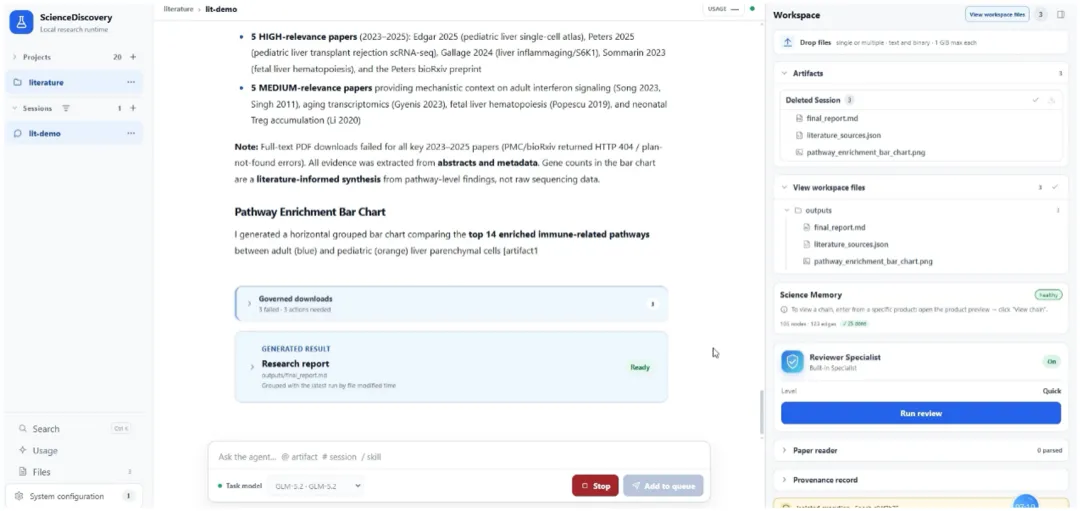
This case is used for a cross-laboratory literature research task: the Intelligent Body needs to retrieve PubMed and bioRxiv (2023-2025), a paper comparing the differences in the expression of adult and childhood liver-substantial cellular genes, focusing on the immune pathways, and generating the first 14 articles of the rich pathway gene counts versus column diagrams. This task usually takes several days and is easy to miss.
ScienceDiscovery implemented end-to-end automation through tool sorting: calling document search MCP tools for parallel queries, using large models to understand content and using code tools to complete rich analysis and mapping. The execution process is structured and recorded on memory charts, forming traceable task chains.
The final output is a report with a clickable reference label, which corresponds to the specific reference, source documentation and execution links, which users can verify by clicking on it.
4.3 General research assignment cases
The ScienceDiscovery team is working with scientists and industry experts to jointly advance general science mission building capabilities, covering chemical reactions, material simulation, fluid simulation, geological exploration, electromagnetic simulation, mathematical proofing, numerical computation, and deeper collaboration in areas such as mineral exploration, semiconductor design, civil aviation design, battery material development, nuclear fusion power generation, disease diagnostics, remote sensing, analysis, industrial control of sleep health and more.
In the fifth issue of IMO 2026 Day 2, the functional inequality functional equation tries to find the whole function so that the given inequality holds true for any given positive real number. ScienceDiscovery first makes assumptions about the candidate solution and replaces it with verification of the original, confirming that the assumed function satisfies the conditions; then simplifies the numerical transformation of the original inequality, deriving from it a more constrained functional equation.
5 The next step forward
In the future, ScienceDiscovery will continue to evolve into an interdisciplinary scientific research platform with the ability to evolve autonomously. The platform will continuously mutate its built-in RSI capabilities to drive intelligent life, and build a powerful inspirational search engine to solve complex scientific problems through multi-track searches. In addition, the system will gain deep access to knowledge graphs in many fields, such as biochemistry, to realize interdisciplinary exploration, to provide more efficient thought logic and knowledge retracement capabilities for scenarios such as drug design and new material design.
6 Community contribution
We welcome every developer, researcher and expert in the field to participate in co-creation, provide feedback or contribute content through issues, and we will continue to iteratively optimize.
This is the first time I've ever heard of this.
GitCode:
Github:
Together, we are creating a new paradigm for scientific research.