Mathematical research is undergoing a profound change as AI's reasoning capabilities take off, and the unresolved problems that have plagued humanity for decades are being accelerated with the help of AI.
No, there is a mathematical conjecture that has been around for about 70 years: Sandov's conjecture was proved by a startup technology company CEO named Lech Mazur with the help of AI.
In a proof paper entitled "A Computer-Assisted Proof of Sendov's Conjecture", author Lech Mazur states: "Sendov's conjecture for all n≥2 occurrences is proven to have been completed with the assistance of GPT-5.6 Pro, with about 90,000 lines of Lean 4 formalized code".
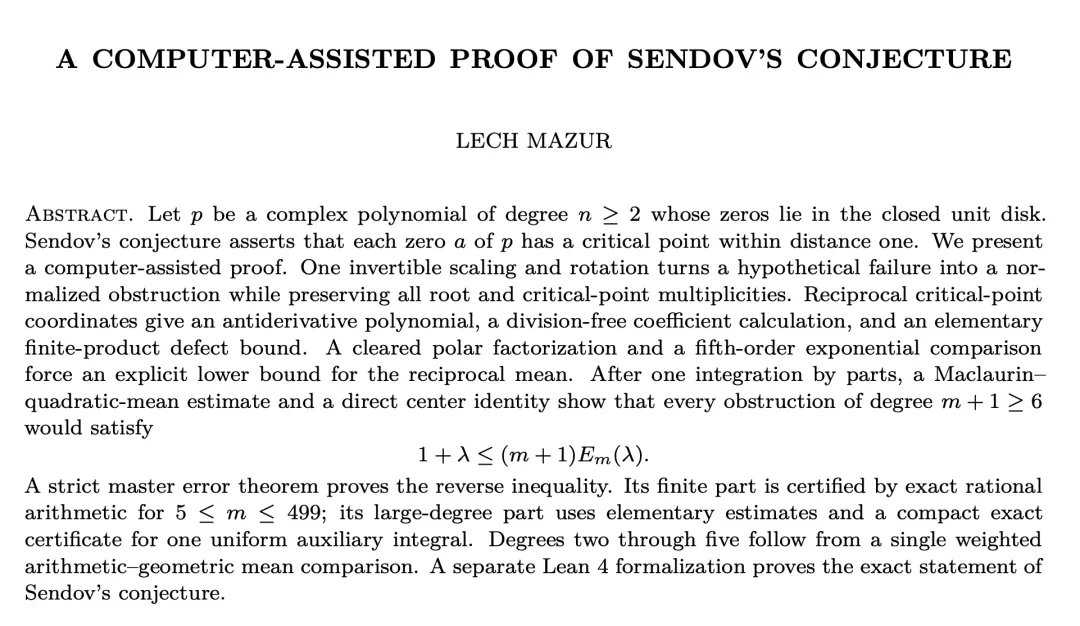
In a blog post on 12 August, Tao Zedong said that it took him several days - also with the help of a lot of AI - to digest, simplify and reformulate the proof, reducing the new version of Lean code to about 15,000 lines.

Link to the blog:
More importantly, he found that the consolidated arguments actually proved a stronger proposition, and the Phelps-Rodriguez conjecture put forward in 1972 was solved as well.
This means that one of the most famous public issues in the field of re-analysis is that AI's participation in the next iteration is drawn.
Sandov speculates:
This is an elegant to frustrating question.
Sandov's conjecture, proposed by the Bulgarian mathematician Blagovest Sendov sometime before 1958, is extremely concise:
If p (z) is an n-dimensional polynomial n ≥ 2 where all zeros are in a closed unit circle i.e. z ≠ 1) then for any zero point a of p, there exists at least one critical point w (i.e. the zero point of the conductor p' z), so that w - a ≠ 1.

In other words, if all the roots of a polynomial are within the unit circle, is there a critical point near each root that is not more than 1?
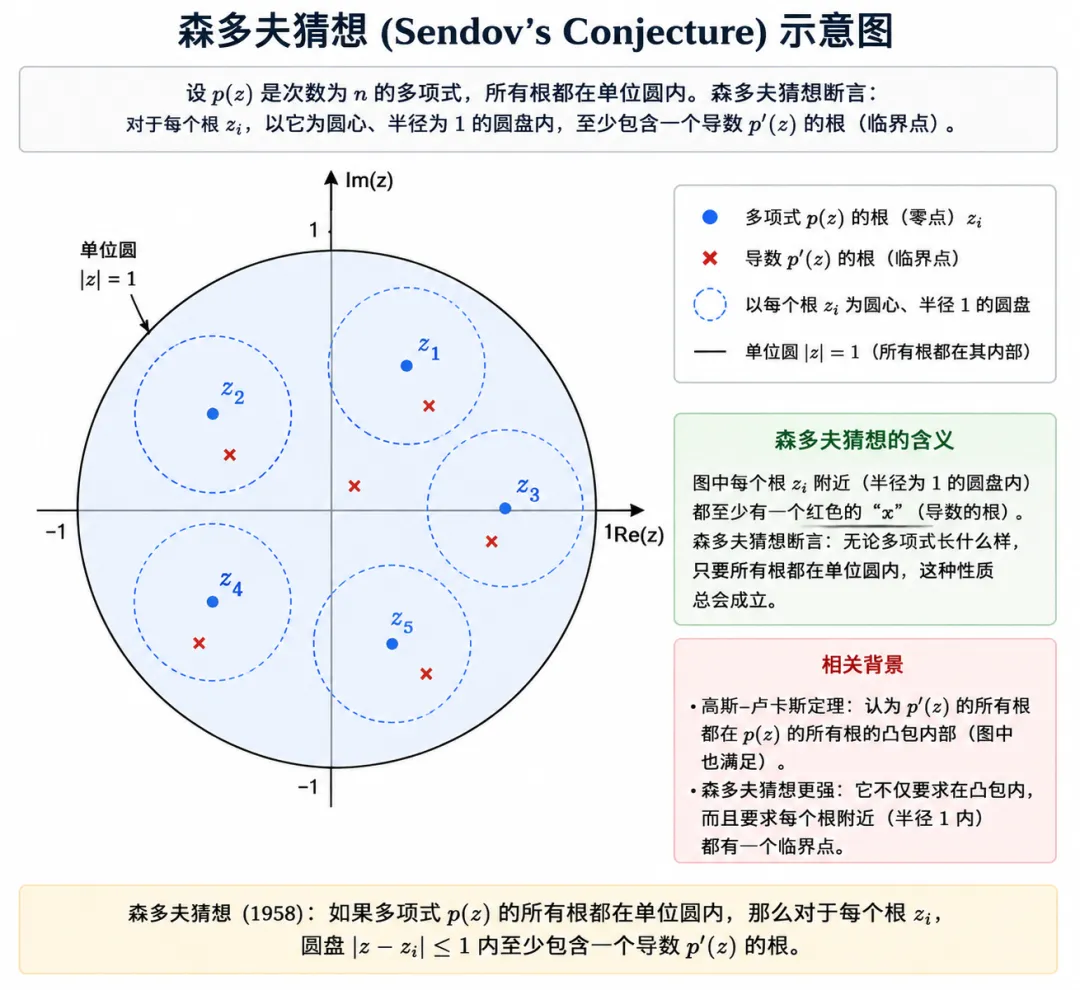
Intent generated by AI
This hypothesis is based on the classic Gauss-Lucas theorem, which states that all the critical points of a polynomial lie within the convex composition of its zeros. This is a holistic conclusion, and Sandoff's hypothesis is a localized version.
An intuitive physical image helps to understand: to imagine zero points as a plane charge, the critical points can be compared to the equilibrium points produced by these charges. The Gauss-Lucas theorem states that the equilibrium points do not run out of the area surrounded by the charge, while Sandoff conjectures that there must be equilibrium points "within a step" of each charge.
The constant 1 in the conjecture cannot be improved. Considering the polynomial p (z) = z^n - 1, whose zero point is n unit roots, the only critical point is the n-1 weighted origin, and the distance from each zero point to the nearest critical point is precisely equal to 1. In this example, the even stronger Phelps-Rodriguez conjecture must exclude the fact that a = 1 and p is a multiple of z^n - a^n.
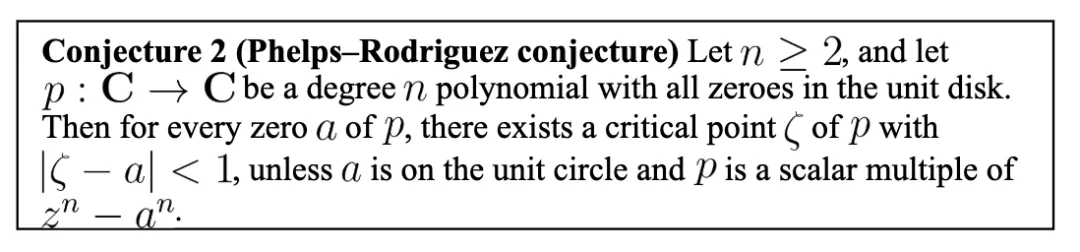
Both hypotheses have been confirmed in the case of a=1 and can therefore be limited to 0≤a≤1. Both hypotheses can be inferred from this:

Despite the brevity of the statement, the proof of Sandov's conjecture is extremely slow:
In 1969, Meir and Sharma proved the case of n<6.
In 1991, Brown moved to n<7.
In 1996, Borcea was pushed to n<8.
In 1999, Brown and Xiang advanced to n<9, and for the next 20 years, there was no lower rate of progress.
In 2020, Taoist philosophy proved the existence of "sufficiently large n" in Acta Mathematica, but argued that using qualitative tools such as analytic analysis, it was not possible to give an explicit numerical threshold.
At the beginning of 2026, Chinese mathematician Teng Zhang (one of the proponents of Tang-Zhang's conjecture) expressed the threshold of Tao Zedong to 10^200000.
Lech Mazur is not a professional mathematician in academia. He is the founder and CEO of a start-up company and the creator of the ProofAtlas platform, which is positioned as "AI-first formal mathematics" and combines visualized explanations, formalized statements, complete source code, dependency relationships, and rebuttal paths into a growing evidence graph.
According to the paper itself, the links to AI involvement include mathematical exploration, demonstration development, testing and review. The final output of Lean 4 is about 90,000 lines of formalized code.
It's a way of thinking and speculating.
In his blog, Taotzeev digested and rearranged the proof thoroughly. He said: "One result of this digestion is that the argument actually proves conjecture 3, thus solving Sendov's conjecture and Phelps-Rodriguez's conjecture in a completely universal sense".
The whole argument goes against the law of evidence.
Core setting: Assuming there is a counter-case. If n is a polynomial p, all zero points are in the closed unit circle, but there is a zero point a that has no critical point within the distance of 1.
Step 1: Integration. By rotating, transform a into a real number in the interval [0, 1]. Then transcribe the critical point w_j to the inverse coordinate q_j = 1/((a - w_j)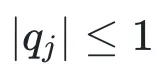 Thus, the counterexamples are packed into two sets of points in the circle: the remaining zero points z_j and the counterpoint critical point q_j.
Second step: Establish a "communication constant equation". Taoist philosophy calls four core relationships communication identities: the center of gravity constant equation (zero-point center = critical center of gravity), the polarization constant equation, the first elementary constant equation, the second elementary constant equation. These equations are derived by multiplying p and its derivatives at several natural locations.
An unexpected twist followed: the polynomial p itself ceased to appear. The contradiction was completely derived from "both sets of points are in the unit circle" plus these four equations.
Step 3: Branch points. Estimates of polarization equations with Möbius variations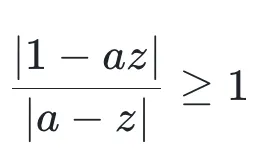 It's a great way to get to the bottom of the list.
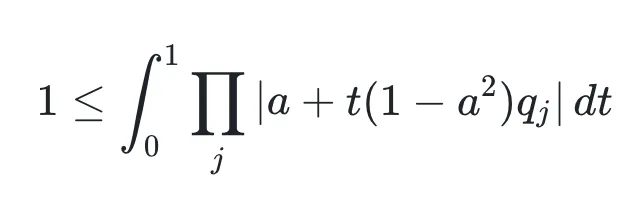
This is the only place where the whole argument uses a as a real number, and is the starting point for the subsequent fork argument.
Low frequency ((n ≤ 5) ends directly here: controls each item of the added function with the metric X (t) = a + (1-a^2) t, and the resulting points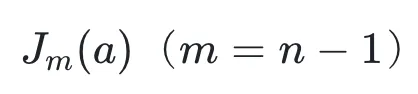 When 0 < a < 1, m ≤ 4 is strictly less than 1, it is in direct contradiction with the above lower bound.
A high number (n ≥ 5) requires the simultaneous establishment of two inequalities. One is a "polarization inequality" derived from the above points through the AM-GM inequalities loosening, and the other is a "original inequality" derived from the first and second prime equations combined with the center of gravity equations.
Two inequalities for the core parameters q_j equal to real parts x and the parameters In the case of n ≥ 101, it can be shown analytically that two inequalities cannot be created simultaneously; the intervals 5 ≤ n ≤ 100 complete numerical validation with precise rational Bernstein multivariate certificates, all of which are tested by Lean.
Although Rubinstein had already solved the boundary situation (a notion = 1), Taoist philosophers used the same framework to provide new proof.
At this point, the polarized constant equation decays (because 1-a^2=0) and is replaced by the Meir-Sharma constant equation. It's the same thing.
 This analysis accurately illustrates the conditions for the formation of the equation, which is the extreme case that needs to be excluded in the Phelps-Rodriguez conjecture.
Toulouse's assessment was: "proving surprisingly primitive. Apart from the fundamental theorem of algebra and the fundamental nature of the Möbius transformation, no reanalysis tools are used; the deepest inequality inputs are only Maclaurin inequalities (and only special cases that can be introduced by arithmetic - adjusting and adding average inequalities) ".
One of the key findings of Taotze's digestion was that the post-assembly arguments actually proved Bissendoff's conjecture of a stronger "internal form".
Phelps-Rodriguez conjecture (1972) based on Sandoff's conjecture that the distance is strictly less than 1, unless a is on the unit circle and p is a dimension multiple of z^n - a^n. This stronger conjecture is directly derived as a deduction because the proofed boundary situation analysis accurately outlines the conditions for establishing the equation.
Tao Te Ching reformulates the entire argument into about 150,000 lines of Lean code, which is open source on GitHub.
This is an open source link:github.com/teorth/sendov
The role of AI in mathematics is changing
First, as a proofreader. Lech Mazur is not a professional mathematician, but with AI tools he solves the problem that has plagued professional scholars for decades. As Teng Zhang, one of the originators of the Tang-Zhang conjecture, said: "Sendov conjecture was a topic during my PhD, it was solved with AI, and my youth was over".
Second, the model of human-machine collaboration. Mazur uses AI to produce proofs and formalize verification (90,000 lines of Lean), Taoiseach uses AI to aid digestion, simplification and reformulation (15,000 lines of Lean). AI is both an exploration tool and a validation tool, and the role of human mathematicians is to judge, refine and connect.
Third, the trust base for formalized validation. In traditional mathematics, the credibility of a proof depends on peer review. Lean formalization provides another trust path: if the type tester passes, every step in the proof is logically rigorous. This is especially important for proofs produced by AI.
Towards the end of the blog, Tautchen lists related speculations that remain open, including Borcea's speculation, Schmeisser's speculation and Smale's problem, and confesses, "I did try to attack these problems with AI tools, but with no significant success".
AI can prove theoretical, but it is far from over. Problems that are solved tend to open up more questions.