In the first half of the second half of the year, the pace of financing of the smart industry did not continue the growth trend of June.
Looking back at the data from the first half of the year, the pace of re-tuning after the typhoon is almost normal, after the peak of financing in March, the fall in April, the fall in May, the further plunge in June, and the rebound in June.
It's not hard to see that the industry's financing has shown a distinct "push-and-burn" characteristic, with one month peaking due to the explosion of large-scale financing events, and the next month falling back naturally due to the lack of an equal amount of transaction support, showing a phased weakness.
Following a heat recovery in June, the market needs time to digest and refurbish, rather than continuing to scale.
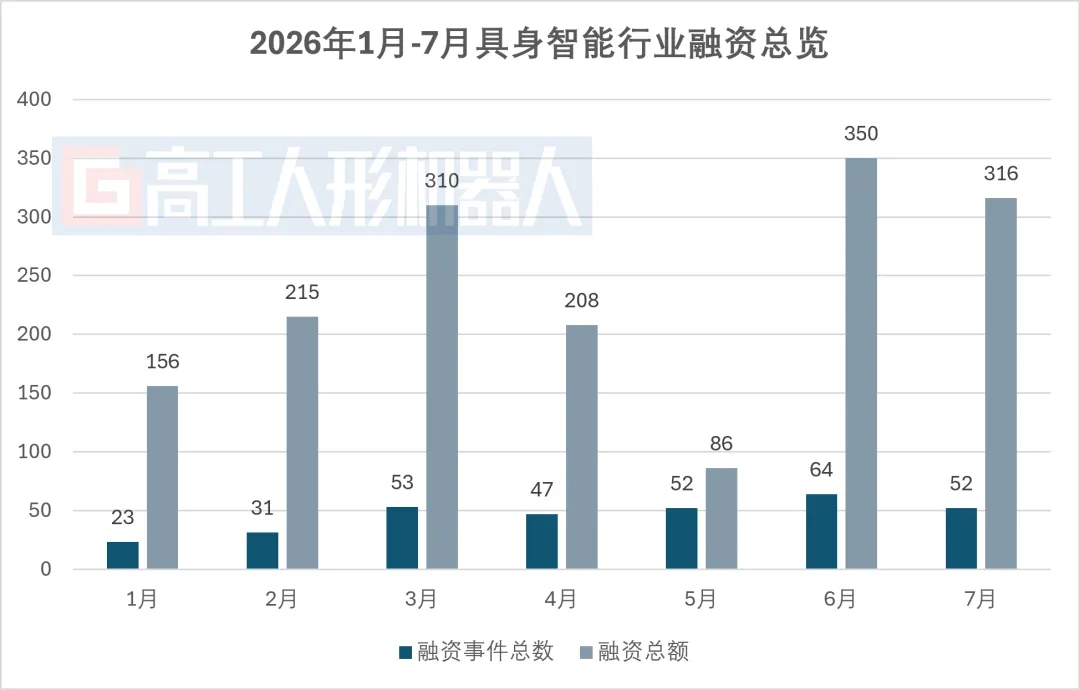
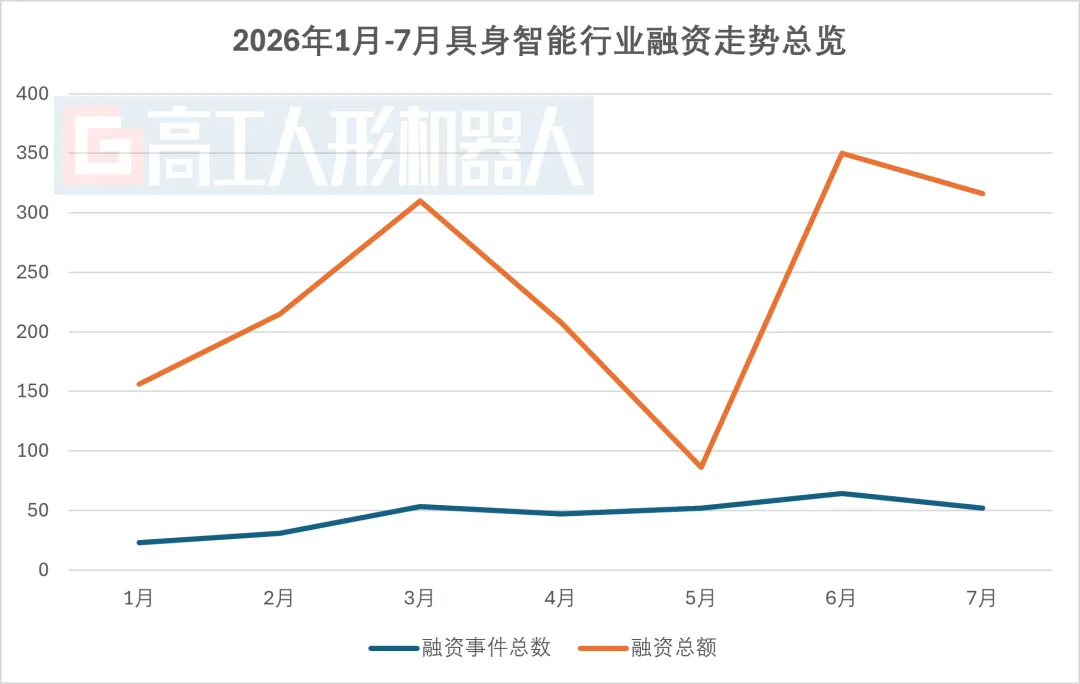
According to the incomplete statistics of AI robots, in July 2026, there were a total of 52 financing events in the body-smart industry, amounting to a cumulative amount of 316.6 billion yuan, an increase of 957.80%, a decrease of 9.54%.
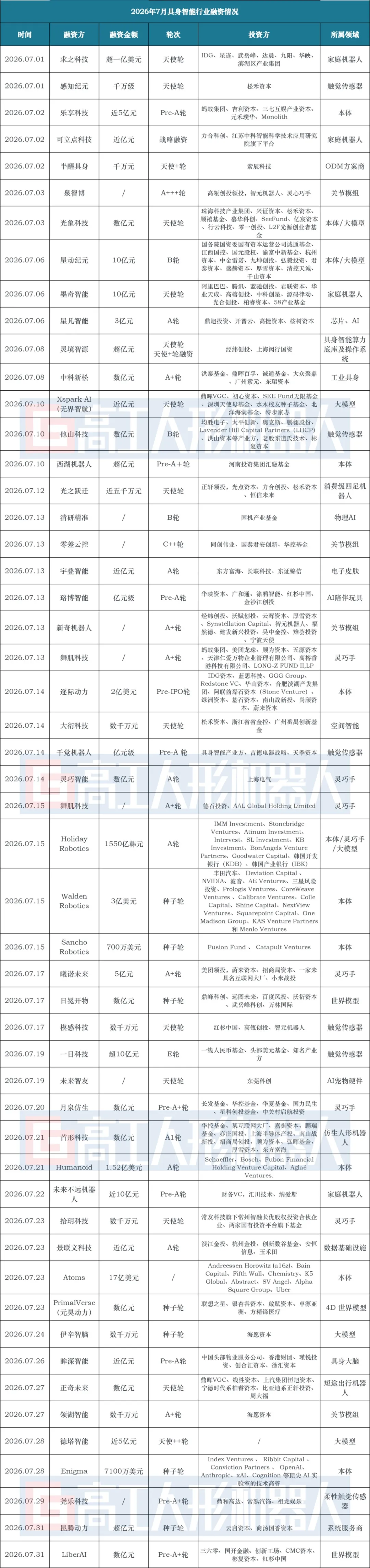
Financing for the smart industry in July 2026
(slide up and down to see)
In terms of valuation, a total of 7 furniture and smart enterprises have emerged as unicorns.
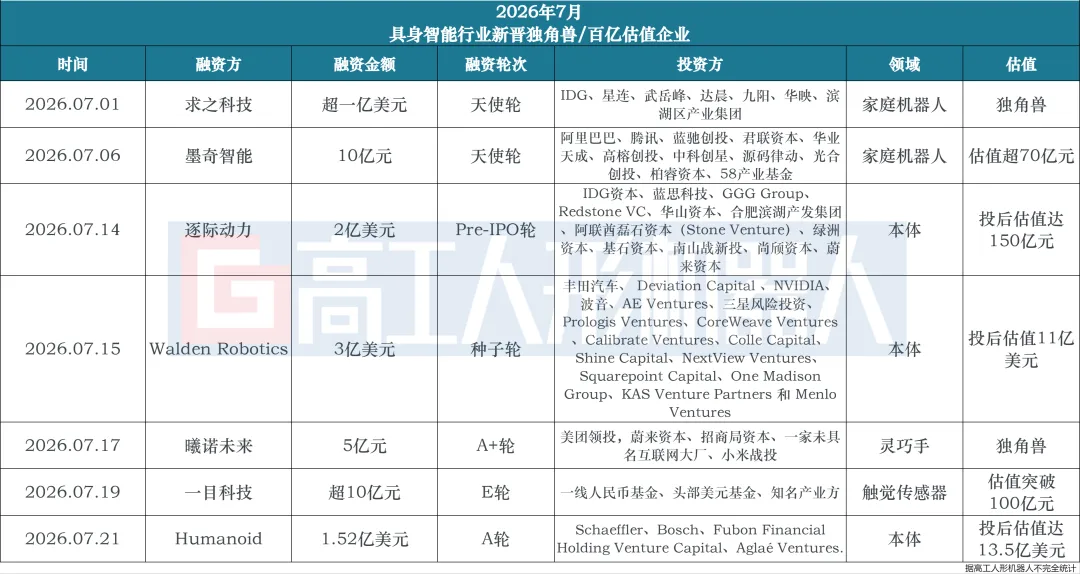
Humanoid is valued at US$1.35 billion, making it the first purely humanoid robot unicorn in Europe; Walden Robotics, founded by Uber co-founder and CEO Travis Kalanick, is valued at US$1.1 billion after the latest round of funding.
Domestically, the value of individual enterprises has exceeded 15 billion yuan, and the value of touch sensor enterprises has exceeded 10 billion yuan; the future of nanotechnology, demand technology, and mercury intelligence has become a new phenomenon.
By business area, there are 18 individual enterprises, including the home robotics trajectory of demanding technology, point-of-sale technology, Merch smart and the near future of robots.
However, in the past few months, the capital-hunting Grand Model/World Model Raceway, which has been financed this month by only eight star-crossed ages, infinite intelligence, coronation initials, commander-in-chief dynamics, Icing intelligence, deep intelligence, Deta intelligence, and LiberAI, has accumulated a cumulative amount of about 259 million yuan, and the heat has fallen significantly.
At the same time, four joint modules companies and five smart companies completed the financing in succession.
It is worth noting that the six touch sensor companies in the upstream segment, thanks to the volume of financing and market attention, made this segment of the race an unmissable chapter in July.
Touch sensors are at the forefront of high light
During the July financing event, the touch sensor track was significantly heated, with financing rising significantly more frequently than before, becoming one of the sub-directions of capital attention for the month.
According to high-profile robotics statistics, in the first seven months of 2026, there were a total of 15 financing events in the field of human robot industry sensors, totaling ¥3.1 billion. In July, the sector's financing became concentrated, with six transactions per month totaling ¥1.56 billion, more than half of the total for the previous seven months.
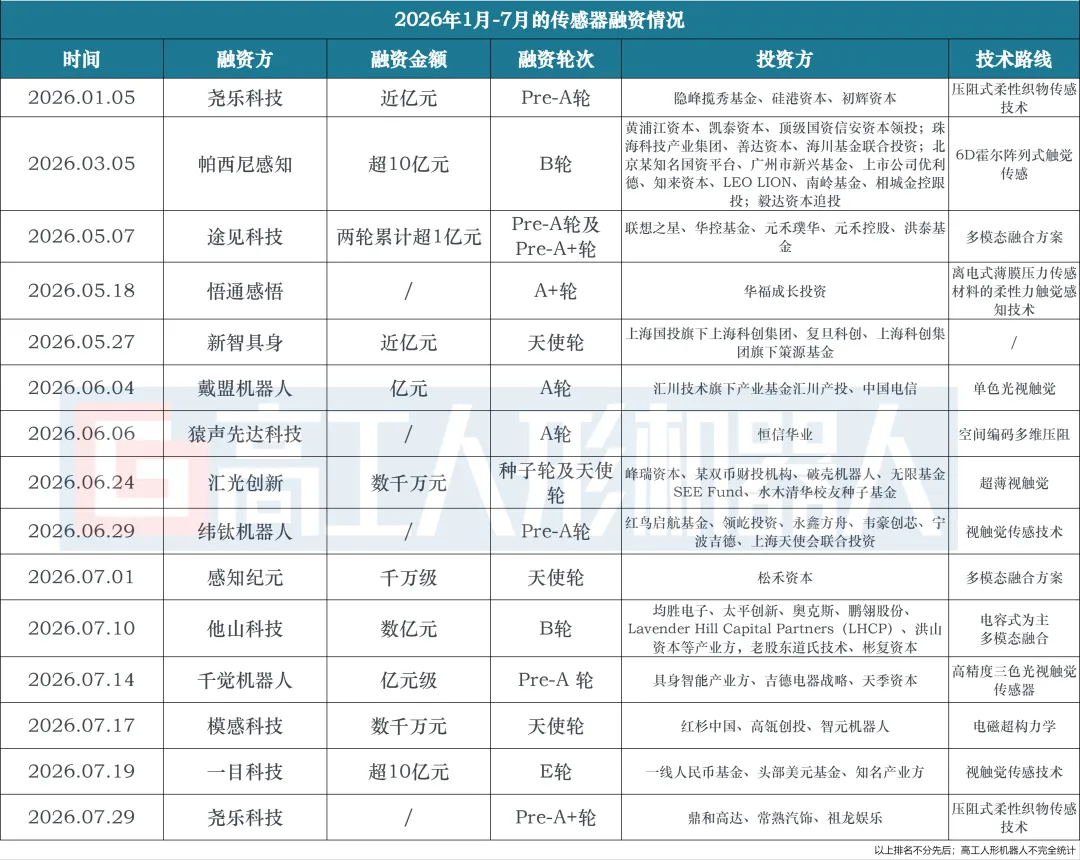
At the technical pathway level, mainstream routes in the industry include: magnetic sensing schemes based on the Hall principle, visual touch schemes, capacitive schemes, de-compression schemes, and multi-modal fusion schemes.
Different technology routes have advantages and disadvantages, adapting to different application scenarios and cost considerations.
As shown above, the technological distribution of the 15 sensor companies does not show a clear centralization, and the distribution of the five main routes is more or less uniform.
On the one hand, it means that sensor technology has not yet formed a unified standard and the industry is still in the multi-track exploration stage; on the other hand, it shows that when capital is betting on racetracks, it does not throw all the chips in a single technical direction, but tries to find the most potential breakthroughs in a multi-pronged approach.
This is not the first time that market enthusiasm has resonated with industry trends, and the most recent papers on touch have focused primarily on the T-Rex architecture, which focuses on the immediate feedback of touch, not on the need to re-process visual and linguistic information, but directly on the context of the previous two experts' caches.
Similarly, it published a paper published by the Joint Institute and University of Shijiazhuang, proposing a force-conditioned touch world model, which for the first time uses wrist force as a precursor signal for future touch states to predict short-term contact evolution and introduce predictive results into robotic motion generation processes.
Touch sensors are just the first step, and academia and industry are trying to embed them as an important puzzle for multimodal perception in the training loop of large models.
Perhaps that's one of the reasons why capital is so focused on touch sensors.
Smart overseas, warming up again
In July, the body-smart sector overseas was also seen by many.
As a reference, in July, the domestic smart industry completed a total of 46 financing, totalling 137.27 billion yuan.
Overseas, there were a total of six financing events during the same period, totalling 179.33 billion yuan, a monthly amount more than domestically. In the long run, overseas robotics have accumulated 18 financing in the first half of this year, totaling 596.82 billion yuan.
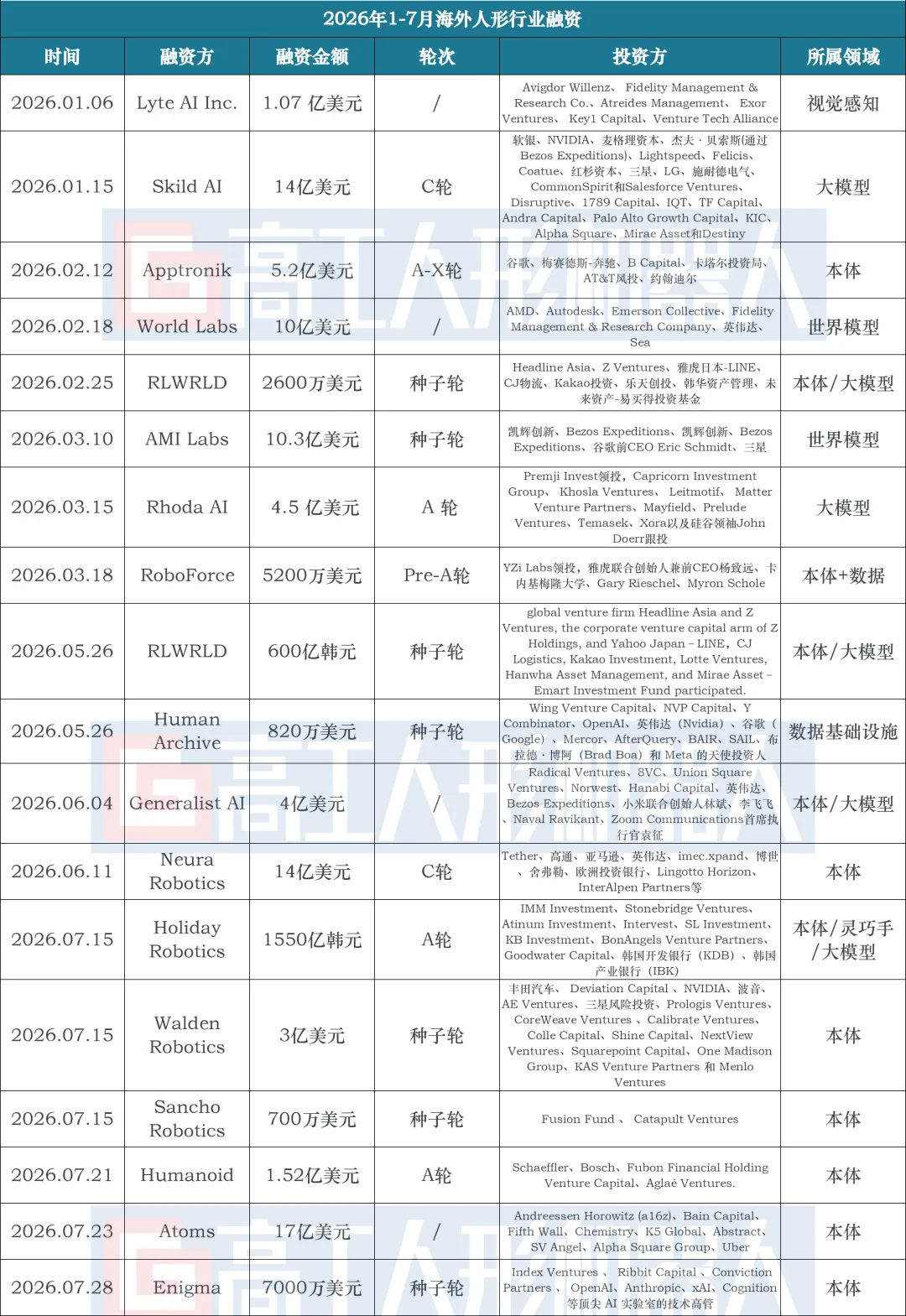
Overseas robotics firms have not received much funding this year, averaging just two per month for the past six months, although funding levels have been high, most of it has been concentrated in a handful of key firms such as Skild AI, Apptronik, Holiday Robotics, and Humanoid.
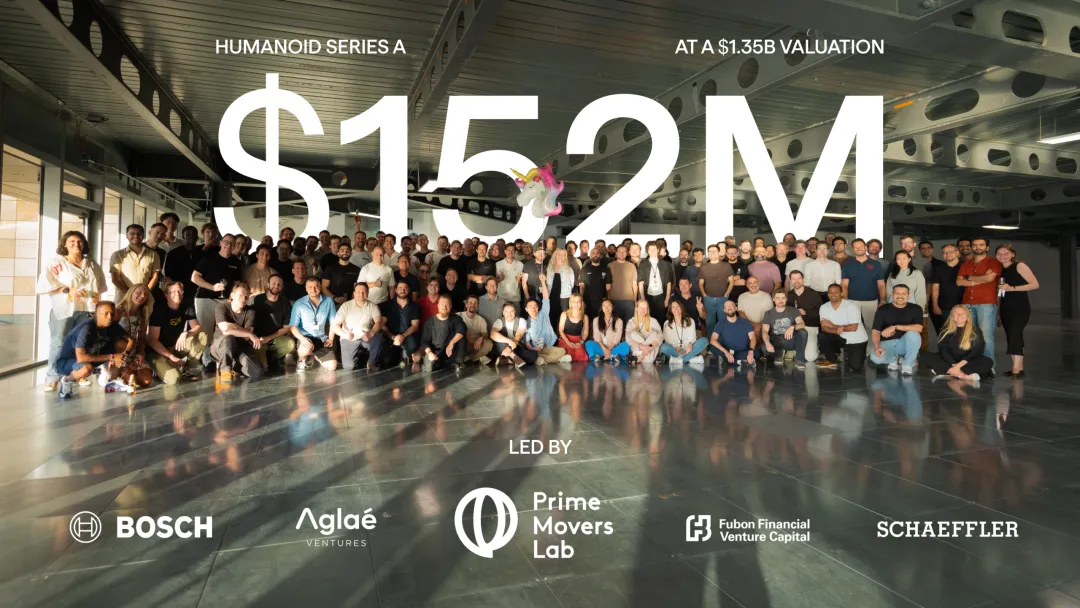
Humanoid financing celebration chart
The focus is on the rest of the invested enterprises, and the preference for overseas capital is clearly recognizable.
For example, Walden Robotics, which completed its high-profile financing in July, had in common the founding team of multinational giants, with a background history that encouraged them to gain far more than conventional capital support and even receive direct investment from the parent company.
This is due to the high cost of early development and mass production of humanoid robots, and capital tends to invest in mature projects that already have a product base or a large factory backlog to avoid the uncertainty of early technological routes.
For example, Walden Robotics, which became independent from the Toyota Research Institute in January 2026, has been doing useful work on a production line at a Toyota plant in North America since February, taking less than two months from the initial pilot phase to actual operation.
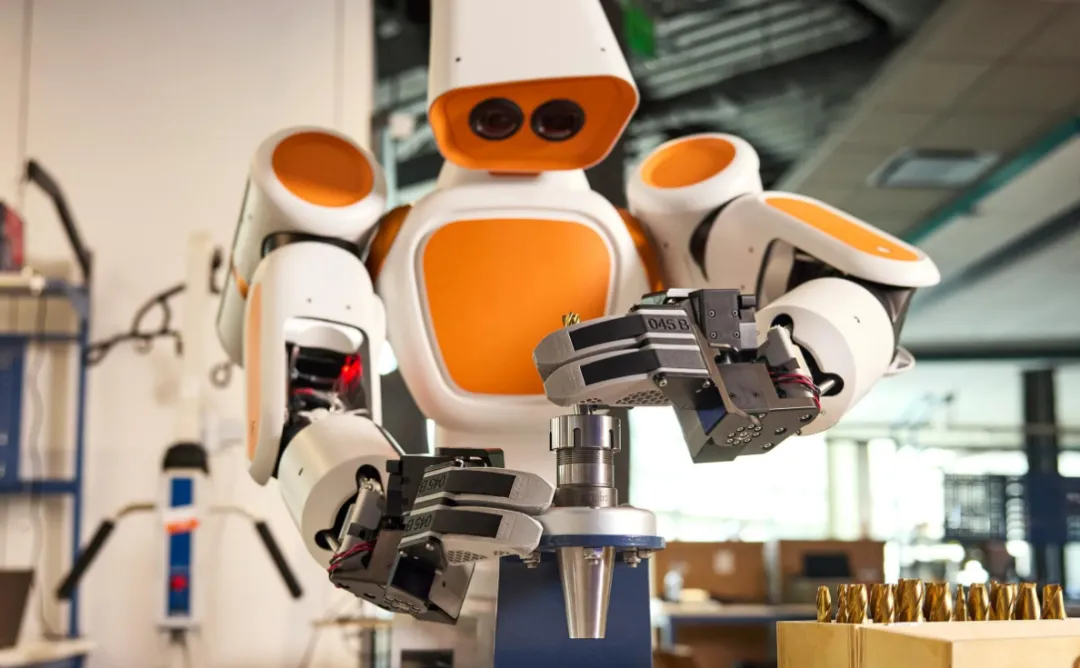
Walden Robotics
By July, Walden had completed a $300 million ($2.24 billion) financing, and the valuation had reached $1.1 billion ($7.42 billion) and was promoted to the rank of unicorn.
With a similar backdrop, ATOMS, a robotics technology startup founded by former Uber co-founder and CEO Travis Kalanick, has raised $1.7 billion in equity capital.
Atoms' predecessor, CloudKitchens' parent company City Storage Systems, has now increased its focus on robotics. Before that, in March, Atoms entered the mining industry with the acquisition of a startup company called Pronto AI Inc.
According to overseas reports, Travis Kalanick is preparing to launch a new robot and self-driving car company with Uber's support.
Compared to Walden, Travis Kalanick appears to be in the early stages of technical preparation, but the latter received 4.67 times more funding than Walden.
This reveals a playful industry phenomenon where physically intelligent players have long been exclusive to robots, and cross-border players can bypass long self-development cycles by strategic acquisitions and rapid revenue pockets of core technologies.
Or, depending on the founder's track record or past entrepreneurial record, borrowing popular track labels such as robotic kites and smart kites to raise large amounts of capital while the company is still in its early stages of technology.
In other words, in this race, the championship and the championship are competing for the right to speak against the accumulation of traditional technology.
Notes
Short-term fluctuations in financing data do not hinder the perception of the physically intelligent industry in July.
Although the foregoing introduces a sequence of touch sensors, it is equally noteworthy that there are also five smart hands enterprises that completed the financing at the same time. Both of them belong to different subdivisions, but share the same logical mainline, sensors and smart hands, which essentially constitute a single aspect of the end-to-end operational capability.
The combination of the two is much closer than other upstream and downstream links in the industry.
A re-examination of capital flows from this perspective reveals a deeper logic that investors are betting on, not an isolated class of sensors, but an overall improvement in end-to-end operational capability.
Whether it's tactile sensing refinement or sophisticated operation breakthroughs, all ultimately point to the same goal of making humanoid robots truly have the function of both hands, operating along this main line at the end, with capital betting on synchronizing perception and execution at both ends.
If you shift the perspective from domestic to overseas, you will find that the investment logic of the first-tier market presents a very different face.
When faced with startups or companies in the segregated technology sector, overseas investors tend to be more cautious and even more interested. For example, Sancho Robotics and Enigma, which completed their financing in July, received only $7 million and $70 million, respectively.
Clearly, the star-studded founding team, whether they have previously had a successful entrepreneurial experience or come from a multinational giant, will give capital a more positive attitude, valuing premiums and financing ratios as well.
This type of speculator focuses on the logic of racetrack speculation, which contrasts with domestic capital markets.
It is true that there is a huge amount of money flowing into the field of physical intelligence in the country, with a wide range of details and links, which makes it easy to leave the impression of a widespread network.
From the upstream core components of joint modules, sensors, smart hands, to institution building, system integration, and industry solutions, this also unconsciously forms an industrial chain mapping strategy.
The logic behind these two concepts reflects the different forecasts of the two markets for the path of industrial development.
Overseas people tend to believe that the right people can do the right thing, while domestic people tend to believe that the whole chain of things is mature and addictive. This difference in capital logic, which will ultimately affect the competitive landscape of the global humanoid robot industry, remains an open question.
—END—
GGII:2026 China Industrial Robot Accelerator Industry Research Report Robotic unicorn innovation, the world's first general-purpose industrial-grade human-powered control arm