On top of this baseline, intelligent is gradually changing the product structure of welding robots. From a physical standpoint, the current power of intelligent welding robots can still be divided into traditional industrial robots and collaborative robots, but the market demand for the two routes is further differentiated.
Traditional industrial robots are still the driving force behind continuous operations, large-scale structural parts and scenarios that require high levels of trajectory stability. In recent years, companies have begun to specialize in welding processes, ranging from robotic structures, control systems to welding power supplies.
For example, the new era revolves around the SA series of welding robots, extending further to the STEP-D digital welding power supply, welding process packages, offline programming and Smart Robot 2.0 smart welding systems, and combining the hard base pads of the core and control systems with the data layer of the smart manufacturing platforms, completing the self-built free demonstration and plug-in in the welding field.
In the market for large-scale structural parts such as steel structures, engineering machinery, ship segments, and the MB10W series of six-axis welding robots, the focus is on different arm-length products for different sizes of workpieces. Instead of simply pursuing universality, the development of its products emphasizes the matching between the core and welding processes and complex structural parts.
On the other hand, the presence of collaborative robots in the welding market is also increasing rapidly. Industries such as steel structure, machinery, engineering machinery have a large number of varieties, small-scale orders, production sites often face high-cost problems of rapid tool replacement, job decentralization, fixed production line change, which are more closely matched with the characteristics of collaborative robots flexible deployment, easy to move and relatively low usage thresholds.
The company has built its WM series of products around collaborative welding, and is further relying on the AIRLab platform to extend its products to different welding shapes such as mobile tracks, small parts mixing, and long doors. According to GGII statistics, the GGII China collaborative welding robot shipments are TOP1 in France in 2025.
Elite robots have evolved from a variety of workpieces and production organizations, forming a variety of welding workstations, such as desktops, minivans, shift machines, large-sized workpieces, and long rods, expanding through product form to cover the flexible production needs of previous fixed robot workstations that were difficult to meet.
It's easy to see that the divergence of routes between industrial robots and collaborative robots is merely a metaphor, essentially competing for the same thing: who can compress the complex uncertainty in the field of welding into a set of standardized, delivable, and replicable system capabilities.
40% of the value of the system is becoming a new industrial growth
If the robot itself determines the execution capability of intelligent welding, then the real gap between intelligent welding and traditional welding instruction comes more from perception, control and software.
From the cost structure of intelligent welding robot systems in 2025, the robot body accounted for 36.4%, visual/laser tracking systems accounted for 26%, intelligent welding control systems accounted for 9%, intelligent welding offline programming software accounted for 5%, welding power accounted for 4.6%, firearms accounted for 2.2%, and other support equipment accounted for 16.8%.
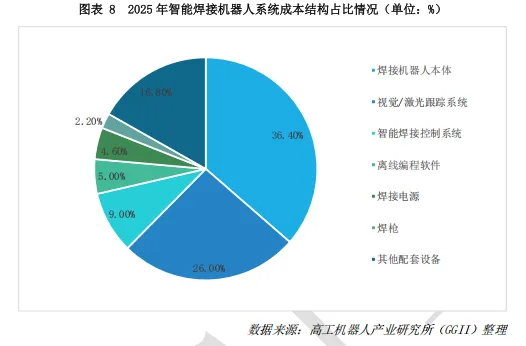
Of these, visual/laser tracking systems, intelligent welding control systems, and offline programming software account for 40% combined. This 40% is the current value of smart welding as opposed to traditional welding robots.
According to GGII data, China's smart welding robotic vision/laser tracking system market size in 2025 was 359 million yuan and is expected to reach 1380 million yuan by 2030; the smart welding control system market size will grow from 124 million yuan to 720 million yuan, with a compound growth rate of about 42 percent; the smart welding offline programming software market size will grow from 609 million yuan to 300 million yuan.
In the process, the comparatively clear product boundaries between enterprises are also changing, such as the integration of robotic entities, AI vision and welding processes. Its 3in1 smart welding system integrates process identification, welding extraction, path planning, process matching and welding into a set of systems, and further extends to fixed, railway, long-range and mobile workstations.
The significance of this change is that as more and more non-standard workpieces become available, improving the precision of the robot alone will no longer be enough to solve the problem. The device must first know where the workpiece is, where the pump is, then decide how to go, what parameters to use, and finally it is the robot's turn to execute.
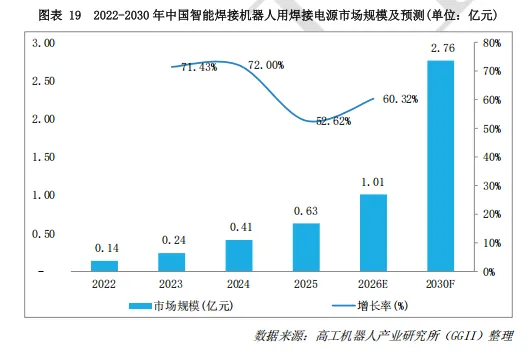
At the same time, welding power supplies remain an important supporting link in determining the ultimate welding quality. As welding robots' domestic production rate increases, the market share of domestic welding power supplies continues to grow. GGII data shows that in 2025, Magnet is the leading supplier in the domestic robot welding power supply market and is in the front row with imported brands such as Matsu, OTC, and Voivonnez.
GGII estimates that by 2025, the smart welding robot market for welding power is expected to grow to 276 million yuan by 2030, with a compound growth rate of more than 30%.
But as the industrial chain moves forward, smart welding faces more than merely integrating several core modules. As customers expand from a robot workstation to dozens of jobs, a production line or even an entire workshop, the demand for system integration and production management capabilities also increases.
It is this link that Nanjing Corporation represents in the manufacturing of heavy-duty equipment such as wind power, port machinery, ships, and engineering machinery, which further combines intelligent flexible welding equipment with robotic programming, welding process platforms, reloading logistics, and information systems.
It can be seen that the value chain of intelligent welding has since gradually expanded from the robot's own body to the embedded body + perception + control + process + production line.
Steel structures, ships to lead the way in scale-up
From the current market, steel structures and ships remain the two most important growth markets for intelligent welding robots. The reason is not complicated: both have huge welding workloads, but there is a large presence of non-standard workpieces, complex structures and artificial dependence, and the application boundaries of traditional fixed, demonstration automation equipment are relatively clear.
In 2025, the production of steel structures in the country reached 107 million tons, and the demand for steel structures industry was about 350,000. A large number of steel structures enterprises also have the order characteristics of small batches, multi-varieties and non-labelled chemicals. Once the specification of the workpiece changes, traditional robots need to be reinvented, the efficiency of the use of automated equipment is easily changed and the time of modeling is wasted.
The demand for smart welding in shipbuilding is equally urgent compared to steel structures. In 2025, China's shipbuilding completed 5369 million tons, newly ordered 10782 million tons, handled orders of 27442 million tons, and the three largest indicators continue to rank first in the world.
At the same time, boat ramps, shorelines, environmental protection and labor supply constraints have made it difficult for shipyards to rely entirely on new capacity-digesting orders to make improving existing capacity utilization a more realistic option.
In fact, welding is one of the most important parts of production, accounting for about 30 to 40 percent of the total workload of shipbuilding. According to the assumption that an intelligent welding robot can replace an average of two welders, and that the actual replacement ratio is about 65 percent, China's shipping sector has a potential capacity of about 61,000 intelligent welding robots.
In addition to steel structures and ships, smart welding has begun to penetrate fields such as engineering machinery, energy, electrical equipment, automotive parts, rail transport and metal processing. The industry is really waiting for more scenes from project verification to bulk replication.
The market reaches 6 billion yuan
In the past few years, the smart welding industry has first addressed the question of whether silicon robots will be able to complete non-standard welding. The next step is to answer the question of whether silicon cannot scale the use of silicon.
This means judging the standards of a set of smart welding products and moving from a single device parameter to a more specific production indicator: how long it takes for new workpieces to go online, how many people are involved, how many devices an operator can manage, whether the weld quality can be stable in the long run, and how long the equipment can recover from investment.
According to the GGII, the smart welding robot market is developing from general workstations to industry-specific solutions and further upgrading along the path of flexible production line welding along the standard workstations of single-engine welding equipment.
From 1.38 billion yuan to 6 billion yuan, the expansion of the market has given a relatively clear direction. But it is likely that the companies that will eventually be able to eat this round of growth dividends will not simply have a certain technology, but will be able to truly transform the robot body, perception, welding processes, software and on-site delivery capabilities into standardized products and continue to copy to more factories.
The next five years will also be a crucial stage in the real transition of smart welding robots from technical verification to large-scale applications.
GGII predicts that by 2030, global sales of smart welding robots are expected to exceed 50,000 units, with a market size exceeding 10 billion yuan; China sales will reach 375 million units, CAGR exceeding 40%, market size is expected to reach 6 billion yuan, CAGR exceeding 30%.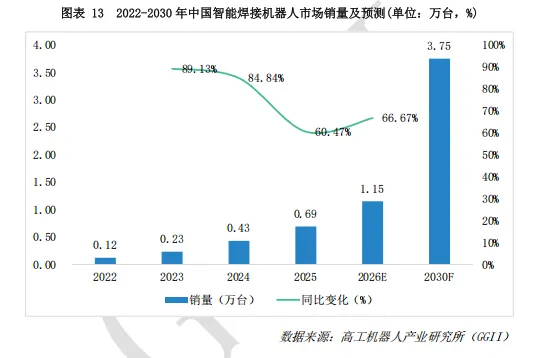
This is a list of books that have been translated into English.
I'm going to tell you a secret.
Fao robots build product matrices using silicon collaboration + man-made silicon, which covers a load of 3 to 35 kg, and form WM-series products for welding. Based on the AIRLab-equipped intelligent platform, Fao robots further open up 3D vision, offline programming, process packages and the robot itself, aiming to improve demonstration-free and flexible operating capabilities in complex welding scenarios.
Around the scenes of shipbuilding, port machinery, structural steel structures, engineering machinery, and others, FAO robots have developed mobile-track ship welding, small-piece mixing, long-gate welding, and mobile welding. In 2025, the company was ranked among the TOP1 shipments of GGII China collaborative welding robots.
It's the first time I've ever seen a robot.
Elite Robot is a leader in AI industrial chain intelligent operating robots, adhering to full-fledged self-development, deep-fledged integration of the PRIMO embroidery-sized model, adhering to a multi-brain embroidery, building a matrix of collaboration, complexity, and man-made three robots.
In the welding direction, Elite Robot introduced a full-featured welding process pack with a non-exhibition welding system that covers processes such as MAG welding, laser welding, plasma cutting, and has access point tracking and arc tracking capabilities; products include CWT desktop, CWC pickup, CWP variable machinery, and a series of welding workstations such as CWG, CWF, face-to-face, fixed-piece mobile welding, large-scale multi-angle welding, and large-scale structural parts site/long-span continuous welding requirements.
The New Era:
As one of the country's earliest deployments of industrial robot core technology, the company has attained a complete mastery of core technologies such as control systems, servo drives, motion controls and industrial software, focusing on the research, development, manufacture and application of industrial robots and intelligent manufacturing solutions.
New Era has introduced the SA series of high-performance welding robots, the STEP-D series of digital welding power supplies, the SRC4S Pro drive unit control cabinet, and the STEPStudio offline programming software, as well as the Smart Robot 2.0 smart welding system, covering a range of industries including automotive, engineering machinery, pressure vessels, orbital transportation, hardware furniture, and continuing to advance the deep integration of AI, visual and motion controls to achieve the user-defined intelligence to produce welds.
It's the first time I've seen this.
The company specializes in the development, manufacture and sale of intelligent robots, and currently has more than 36 2-480 kg industrial robots, 5 7-40 kg collaboration robots, and 2 industrial equipment intelligent robots.
The core products of the welding system are the MB10W series, which includes the MB10W-1500 with a load of 10 kg; arm length of 1500 mm, which weighs only 165 kg; MB10W-2050 arm length of 2050 mm, aimed at large structural parts. Product repositioning accuracy of ±0.03 mm, built-in welding process expert pool, support for gas insulation, arc welding, laser welding and multi-layer welding. In typical applications, the passing rate of welding is increased from about 92% to more than 99.2% of man-made, the overall welding efficiency is improved by 40%-60%, and the single platform can replace 2-3 advanced welding workers.He said:
The company focuses on the field of intelligent manufacturing robots, while mastering the three core technologies of robotic body, AI vision and process systems, and combining them deeply to form a few technical barriers in the industry. Based on this technology system and the accumulation of data from over 20,000 AI models, the company's new generation of intelligent industrial robots has been used on a large scale in welding, grinding, transportation, coding, etc.
The core product is a modern 3in1 body-smart welding robot, with a deep fusion of embedded body + AI vision + welding process, without the need for artificial demonstration, saving the import of numerical models, to truly realize autonomous perception, decision-making and execution. Around this capability, the company has developed fixed, track, suspension, locking doors, as well as wheeled, braced, multi-legged mobile welding workstation schemes, covering steel structures, bridges, ships, engineering machinery, etc.
What are you doing here?
Magnet is a pioneer of domestic replacement in China's high-end welding market, and has achieved large-scale replacements in the fields of automotive parts, engineering machinery, shipbuilding, rail transportation, steel structures, etc. As of the end of 2024, Magnet has accumulated nearly 200 industrial smart welding machine core patents.
Core technologies include RDT zero-flying high-speed servo arc welding, MIG switching, Sync Twin dual-wire synchronous welding, robotic laser welding systems, and SMARC smart welding information cloud platform; SMARC has accumulated nearly 50,000 industrial smart welding machine group control networks, service centers, three-way, XU works, construction steel structures, and pipeline steel structures.
Nanking correspondent:Nanjing Co., Ltd. is focused on the manufacturing of heavy-duty equipment, providing intelligent integrated solutions covering wind power new energy, port machinery, marine vessels, engineering machinery, special vehicles, and developing relevant capabilities around robotic external mobility, tool variations, advanced welding manufacturing processes, and intelligent flexible welding equipment.
On the software and systems side, the company's layout of IMS information systems, SCADA and industrial smart gateways, connectivity process expert cloud platforms, robotic intelligent programming software, and the combination of heavy-duty RGV, AGV logistics units and flexible assembly units, promotes connectivity with logistics, assembly, and information systems collaboration.
The Blue Book is obtainedTwo-dimensional code scanning is the only way to get a blue book
Please note:The copyright of this Blue Book is owned by GGII and the relevant consulting services are provided by GGII.
High Industrial Consulting (GGII) and all participating companies share the copyrights to this report. The report shall be made available to limited companies for a fee, and shall be limited to internal use by the company, for reference only in the analytical research process. If the company refers to the content of the report for external use, the resulting misunderstandings and litigation are the responsibility of the company itself, and the company is not liable.
For future commercial or other use, this report may not be borrowed, resold, rented, or published online in any packaging or form other than the original form of this report, without the consent of the Company. Users of this report are bound by these terms and by all relevant copyright provisions of this report.
* Cover for AI mapping