In tasks such as remote sensing imaging, traffic perception, scene text recognition, the detection targets are rarely aligned horizontally or vertically. The use of horizontal boundary frames, although capable of enclosing targets, often incorporates a large amount of unrelated context; although the modified rotary frames can be more attached to the contours of objects, the newly added angular dimensions will significantly improve the detector's training and navigation difficulty, and real-time reasoning on terminal devices is a greater challenge.
The advantages of the DETR framework are highlighted by the end-to-end formats of NMS post-processing; but once expanded from horizontal frames to rotational detection, heavy attention operations, angular cyclical differentiation problems, plus more complex matching search spaces, it is easy to lose real-time reasoning ability directly.
Recently, institutions such as Unicode and Qingdao have proposed RiO-DETR, which finally pushes end-to-end rotation detection to a real real-time range. In the DOTA-1.0 single-scale setting, the lightest RiO-DETR-n has only 4.0M parameters, end-to-end delay down to 2.7ms, while the AP50 can reach 78.4; while the strongest RiO-DETR-x runs 81.8 AP50 below 29.9ms. This work has been adopted by ECCV 2026 as Oral Spotlight.
The first author of the paper was Dr. Hu Zhang, a Ph.D. student at the University of Science and Technology of China, whose research focuses on general vision, video generation and world models. To date, several papers have been published at top conferences such as ICCV, ECCV, AAAI, ACM MM, and are important contributors to the current goal of detecting the leading model D-FINE. The paper was co-directed by Prof. Sun Xiaojing, Dr. Li and Dr. Pei and Dr. Liu Xiaoxun, and the team of authors also includes researchers from Huawei Technology Limited and Qingdao University.
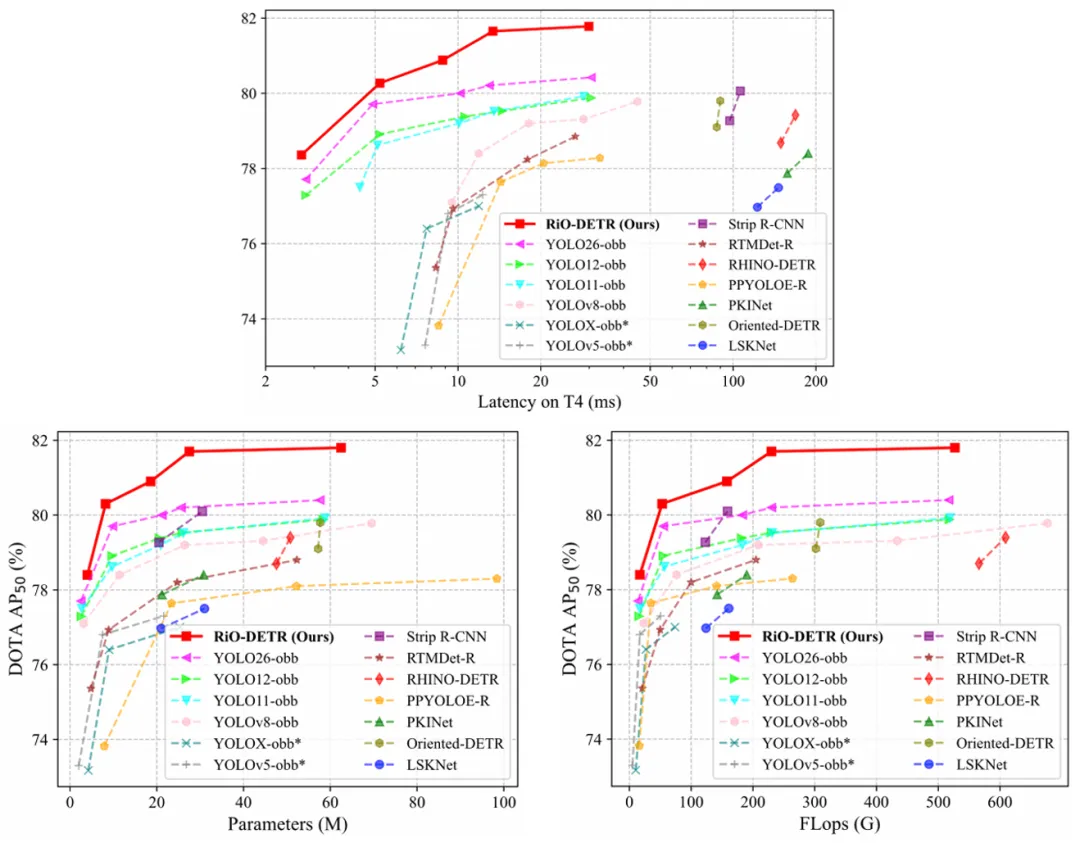
RiO-DETR parameters, delays, computational quantities and precision contrast on DOTA-1.0
This paper examines everything from model structure, training strategy, to deployment efficiency. Its goal is clear: not only to increase the accuracy of rotational detection to a new level, but also to make DETR-based rotational target detection models capable of real-time operation.
It is also worth noting that RiO-DETR is not simply a one-way return to RT-DETR. The authors re-examine a more fundamental question: should the angle be considered as a normal coordinate, or a variable determined by visual content and living in cyclic space?

RiO-DETR: DETR for Real-time Oriented Object Detection
Collaborative institutions: University of Science and Technology of China, Huawei Technology Limited, University of China, and the Institute of Artificial Intelligence at the National Center for Comprehensive Science in Co-operation
The following is a list of articles that have been translated into English.
Link to the paper:https://arxiv.org/abs/2603.09411
The main page of the project:https://github.com/RicePasteM/RiO-DETR
From horizontal frames to rotating frames, the difficulty is not just to bend more than one angle.
Standard DETR typically optimizes predictions through center-point coordinates, wide, high-dimensional boundary frames, and then layer-by-layer decoders. Intuitively, just adding an angle prediction parameter can extend the horizontal frame scheme into a rotating frame. However, existing research suggests that this change corresponds in essence to a completely different optimization problem.
In plane objective detection, the central coordinates and the width-altitude parameters are defined in a continuous Euclidean space: the position of the detection frame is adjusted from left to right, the size of the parameter shrinks inward, and the parameters are updated in a clear direction. The rotation frame faces multiple difficulties: angles are cyclic, and the same rectangle can also be expressed by exchanging width-altitude to generate polynomial parameters; especially when near the critical point of the cycle, the two sets differ greatly in angles, and the corresponding geometric frames are almost completely overlapping.
In addition, the direction of the target cannot be inferred solely from the position and size of the frame. The direction of the head of the aircraft, the direction of the ship's navigation, the direction of travel of the vehicle, all need to be judged based on the texture of the target, the structure of the components and even the contextual meaning of the context. If the model considers the angle as the center coordinates, the width and height of the same position parameters, the prediction of inaccurate angles at the beginning of training, it is very easy to interfere with the sampling area of the attention modules, causing training biases.
In the past, many rotation detection methods based on DETR modification have piled up more complex attention mechanisms and characteristic sampling modules to improve accuracy, and reasoning speeds are always difficult to keep up with with with CNN real-time detectors such as YOLO, RTMDet, etc. While RiO-DETR opted for another path: first, building high-performance rotation detection baselines based on RT-DETRv2, introducing D-FINE's general matching strategy with DEIM's Dense O2O training model, and then conducting systematic targeting optimization of network structures around three unique underlying pain points for rotation detection.
The challenge is to combine semantics with geometry: position and size are primarily determined by geometric relationships, but angles often need to be combined with textural direction, object orientation and component layout.
Challenge two, the angle is not a normal number axis: in the cyclic space, two directions close to 0° and close to 180° may be very close geometrically, but far apart numerically.
Challenge three, the search space expanded: the rotating frame increased the freedom, the two-dimensional chart matched with the angle prediction of the curve slower; the intensive supervision common in level detection, also not necessarily providing enough angular diversity.
The three core designs of RiO-DETR address these three issues one by one.
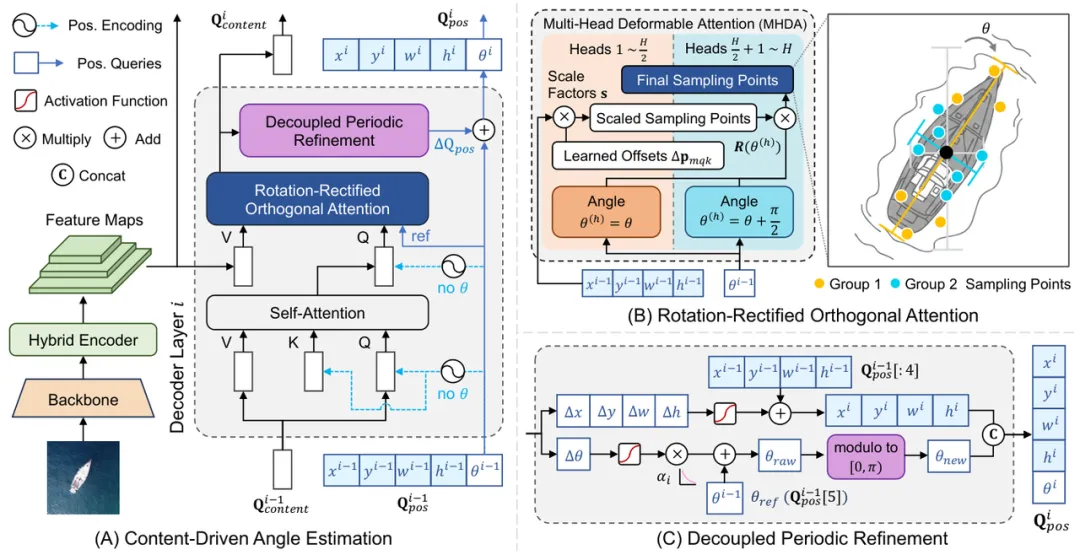
The overall architecture of RiO-DETR: content-driven angle estimation, rotational correction focusing on refinement and decomposition cycles. Image source: paper Figure 2
It's important to look at the content from an angle instead of writing dead in position.
Most existing rotating DETR schemes will encode five parameters of center point, width, height, and angle to location queries. This method implies a premise: these groups of parameters belong to the same type of geometric information. However, the angles have significant peculiarities.
For example, ships in remote sensing imaging: the outline of narrow targets, although capable of representing the direction of the main axis, cannot distinguish between the head and the stern of the ship; and targets such as storage tanks, sports fields, and near-square buildings can also generate multi-group rotational frame parameters due to wide and high interchangeability. In such scenarios, it is possible to determine the true direction based on visual content lines such as the contours of objects, textures, and component layers, rather than merely based on coordinate values.
Based on this observation, RiO-DETR proposed a Content-Driven Angle Estimation mechanism: Location queries are solely responsible for coding center coordinates and broad-altitude information, unraveling angles from rigid geometrical precedents, and handing over independent content queries, based on image characteristic autonomous learning predictions.
The corresponding paper formula: formula (1) uses only the central coordinate and the width-to-height construct position queries; formula (2) allocates attention heads, respectively, for the prediction of the main direction of the target and its intersection.
In the DIOR-R data set, the AP50 model is 72.56 when encoding only the center coordinates; the accuracy drops to 72.34 when encoding only the center coordinates and sizes, and decryption angles. The AP50 can be upgraded to 73.81 when encoding only the center coordinates and decryption angles.
However, it is not enough to separate the angle from the position query. Spinning targets often have both vertical and horizontal structures, and if all the attention heads are characterized by sampling along the main axis of the target, the model can be too focused on the characteristics of the length of the target, ignoring the width-dimensional information.
Using a 4:4 equilibrium allocation method, which neither introduces additional parameters nor increases the calculation quantity of FLOPs, the AP50 was raised from 73.81 to 74.18 compared to the eight attention heads that were all taken along a single directional baseline. The mechanism enabled the model to simultaneously capture the main axis of the target and the boundary characteristics of the side, preventing the attention expression from shrinking in a single direction.
An adaptive sampling process for a rotating target is shown by the formula: formula (3) scales the learning sample deviations according to the target scale; then a rotating matrix using the rotating model (4) aligns the sampling coordinates to the target direction.
The following visualization results illustrate more intuitively the role of the mechanism: the two sets of sampling points are not dispersed disorderly near the target center, but are covered respectively along the target longitudinal and horizontal structures. For long-width-ratio disparity targets such as ships, bridges, runways, this cross-sampling perspective can effectively compensate for the marginal characteristics that are easily lost in a single main axis sampling; at the same time, the scheme does not require the introduction of significantly larger features to extract modules, and does not result in computational expenses.
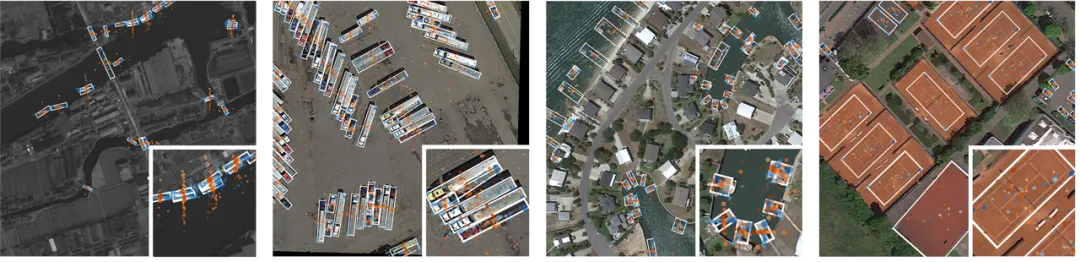
Attention is focused on sampling points in DOTA scenes: two sets of attention heads covering the main axis of the target and the direction of the positive axis respectively. Image source: paper Figure 4
If you live in a circle, optimize for the shortest possible path.
The core difficulty of angle prediction is the problem of angular cyclic boundary differentiation inherent in the angle. When the target is facing close to 180 degrees, and the model predicts close to 0 degrees, the two converge almost completely visually, but the standard L1 loss determines that the two errors are extreme, guiding the model to reverse the direction of the large deviation along the wrong deviation.
The problem can be understood by clock logic in general: 11:59 and 0:01 are at either end of the gradient on the numerical value, with only two minutes of actual time interval. If the loss of computation of the EUR linear distance is directly used, iterative optimization, in the vicinity of the boundary of the angular cycle, the gradient will instead constantly mislead the model parameters update, causing the angle prediction to fluctuate, jump back and forth, and the problem cannot be corrected.
At the same time, the DETR decoder uses a multi-layered decoded prediction mechanism, rather than a one-time output final detection. This results in small angular deviations generated by the network's shallow layers, which accumulate in successive layer-by-layer iterative optimizations, resulting in overall rotation prediction instability. For this pain point, RiO-DETR does not limit itself to optimizing the loss function of the final output, but instead systematically restructures the logic for updating the angles of each layer of the network, solving the problem of predicting the accumulation of deviations from the whole process perspective.
RiO-DETR proposes Decoupled Periodic Refinement, while rewriting the update rules and loss functions:
The first step is to define the boundaries from a rough to fine-tuned perspective: the early decoding layer allows for a more substantial correction of the direction, and the later layer-by-layer reduction of the update range to align the boundaries with more fine-tuned steps.
The second step is to perform cyclical unification: map the angles back to the specification area after each update to avoid drifting the angular value outside the boundary.
From rough to subtle cyclic updates: the model (5) controls the decoding steps of each decoding layer, the model (6) limits the amount of single-layer angle change, the model (7) then maps the results back to the specification angle range.
The third step is to use the shortest path cycle L1 loss: no longer compare the direct distance on the number axis, but compare the shortest angular distance on the circle, so that the gradient always points in the nearest direction.
The shortest path loss: formula 8) takes a smaller value between the difference in the direct angle and the distance across the boundary of the cycle, so that the gradient always moves along the short path around the circle.
This is not a patch on the loss function, but to make the angle refinement process of the DETR consistent with the rotational geometry itself. In experiments, it is unstable with only cycle updates or with only the shortest path loss; combined, the AP50 increases from 74.18 to 74.74.[3]
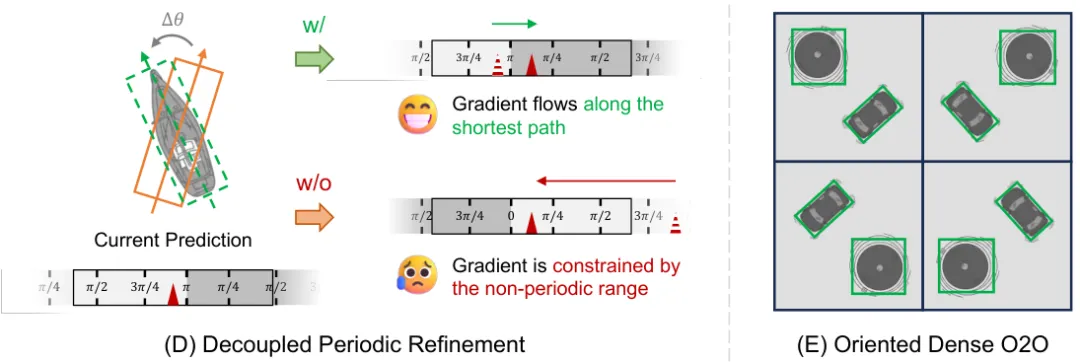
Left: Cyclic refinement allows angular gradients to flow along the shortest path of the circle; right: Oriented Dense O2O injecting multi-directional targets into a single training chart. Image source: paper Figure 3
Let a training chart have four directions at once.
Slow convergence is another big bottleneck in the rotational detection task. Horizontal-frame detection requires only the matching of the target location and scale, while rotational detection requires additional trajectory in the target direction, greatly expanding the candidate search space for binary chart matching. Not only that, but even if a single image contains a large number of targets, if the direction of most of the targets is consistent, effective monitoring signals can be obtained from the angular branch are still very scarce, severely dragging the convergence efficiency of the model.
The core idea of conventional Dense O2O is to collate four images into one large graph to increase the number of targets within the batch during a single training iteration, thereby strengthening the model learning effect. However, RiO-DETR, through experimental verification, simply increases the number of targets is far from sufficient, and the training core of spin detection is to allow the model to simultaneously access a rich variety of target directions. Based on this, this article improves on the original strategy: before image collation, the four pending collation graphs perform separate spin transformations, then integrate a high-density training into images.
Specifically, each subgraph randomly selects a rotation to complete the rotation independently from 0°, 90°, 180°, 270° at four angles. This method is both efficient at covering all types of differential target orientations, rich in angular monitoring signals, and avoids large amounts of particle noise on near-square objects, interfering with model learning. Within the same batch of training, the model needs to simultaneously process multi-directional targets, making the learning of angular branches faster and more stable.
The Oriented Dense O2O strategy proposed in this paper, without increasing the cost of reasoning, and with little to no improvement in the calculation of the training phase, can only drive the angle branch to finish characterization refinement and convergence to a stable state sooner by optimizing the angular distribution diversity within batches.
Relevant experimental data fully verified the effectiveness of the strategy: in the model's first stage of training, data-free baseline methods required 94 epochs to achieve optimal AP50, conventional enhancement schemes required 86 epochs, the original Dense O2O was shortened to 68 epochs, while Oriented Dense O2O only required 60 epochs to achieve a higher AP50 accuracy of 73.88.
The results of the experiment: from 2.7 ms to 29.9 ms.
The entire model family remains in real-time spaces.
This paper completed a comprehensive evaluation of the three mainstream rotation detection benchmarks in DOTA-1.0, DIOR-R, FAIR-1M-2.0. All reasoning delays were standardized based on single NVIDIA T4 graphics cards, TensorRT 10 frameworks and FP16 accuracy tests. In this, the end-to-end model statistics included no image pre-processing and post-processing links, while the rest of the comparison models incorporated NMS real-world engineering logic delays in Batched NMS Plugin statistics to match real-world landing scenarios.
From the real-time performance of the complete model family, the RiO-DETR covers n, s, m, l, x, five different parameterization specifications and, in the DOTA-1.0 single-scale test setting, reasoning delays of 2.7 ms, 5.2 ms, 8.8 ms, 13.4 ms and 29.9 ms, respectively, are essentially the same as the real-time reasoning advantages of the YOLO26 series models of the same class. This results show that the real-time reasoning advantages of the RiO-DETR are not specific to lightweight models, but to the general use of lightweight, high-precision and high-grade models.
The corresponding model ladder can also be adapted to the needs of different real-world tasks to achieve flexible weights of accuracy and quantity. For the edge-terminal deployment scenario, RiO-DETR-n with a parameter of only 4.0M can meet the requirements for lightweight, low-latency detection; for high-precision remote sensing, precision target detection tasks, RiO-DETR-l and RiO-DETR-x can provide superior detection accuracy. The overall speed and precision curve at the end of the current method is at the cutting edge of the current approach, with respect to a single display of the best precision indicators, and the complete model ladder performance better reflects the engineering value and generality of the method.
DOTA-1.0 single-scale main performance table: the table lists non-real-time CNN, non-real-time DETR, real-time detectors and the entire series of RiO-DETR; the key results are roughly highlighted in the paper.
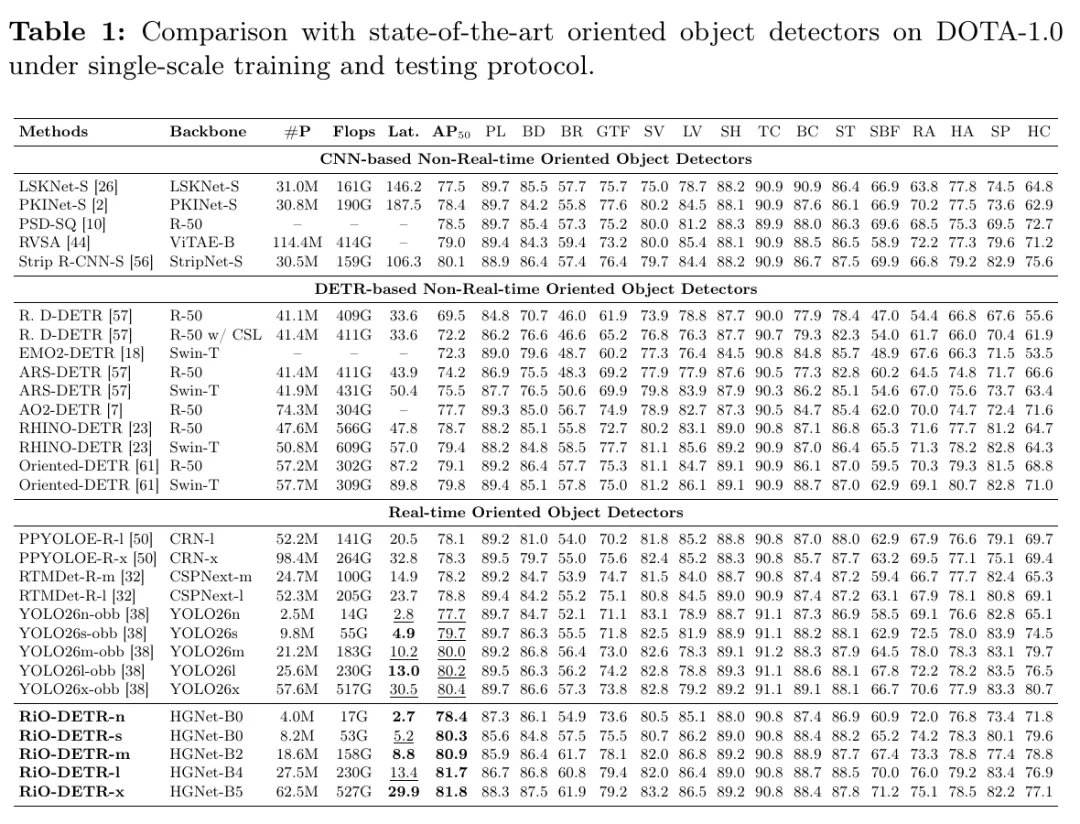
DOTA-1.0 The main performance contrast between single-scale training and testing. Source: Paper Table 1
In the DOTA-1.0 single-scale setting, the 81.8 AP50 of RiO-DETR-x is higher than the near-delayed YOLO26x-obb ((80.4 AP50,30.5 ms) and higher than the slower RHINO-DETR ((79.4 AP50,57.0 ms).
The main performance comparisons of DIOR-R and FAIR-1M-2.0 in single-scale training and testing. Source: Paper Table 3, Table 4.
On DIOR-R, RiO-DETR-x reached 77.43 AP50 at 17.31 ms, compared to YOLO26x-obb's 76.48 AP50 at 17.66 ms, continuing to maintain its precision advantage at relatively low speeds. With more than 1 million instances of FAIR-1M-2.0, RiO-DETR-x reached 47.4 AP50 in multi-scale settings, exceeding the YOLO26x-obb, LSKNet-S and ReDet listed in the paper.
The author first constructed a strong base line of 73.47 AP50, which was upgraded to 74.18 after adding the geometrical decomposition query code, showing that taking the angle out of the position prior to itself can improve optimization; then adding positive attention to 74.74, proving that longitudinal and lateral information truly complement each other.
On this basis, cyclical refinement and Oriented Dense O2O continued to push the results to 75.73 AP50.[6] Throughout the process, parameters, FLOPs, and delays remained virtually unchanged, i.e. these gains were largely not from larger backbone networks or higher computing budgets, but from the redesign of angular representations, angular updates, and angular monitoring methods.
This is in contrast to the final speed: the goal of the RiO-DETR is not to replace less precision with heavier structures, but to eliminate the loss of performance that is unique to the rotating DETR by maintaining the lightness of the baseline in real time.
The real breakthrough is not that the DETR can draw a rotating frame.
The real value of RiO-DETR is not that it squeezes more than a few APs, but that it devises a clear design idea for rotational detection tasks:
Singularly, the angle is determined by the visual content and direction of the object itself and cannot be treated as a normal coordinate;
In geometry, where angles live in cyclic spaces, the calculation of updates and losses must respect circular topologies;
In supervision, rotational detection requires explicitly introducing angular diversity, and data-enhancing suites for moving-level detection cannot be illuminated.
To sum up these three points, it's actually a judgment: to get the Transformer to actually run in real time in rotation detection, the key is not to stack the heavier modules, but to put the geometric constraints that are specific to the rotation task, to write in the representation, attention, refinement and supervision of each core link.
From an application perspective, this balance of speed and precision is directly related to satellite remote sensing, drone patrol, port monitoring, traffic perception, and scene text recognition, which require handling scenarios that are arbitrarily oriented toward targets. High-resolution images are often crowded with dense small targets, and detectors not only have to look accurate, but also operate on a limited storage and time delay budget.
Another engineering significance of RiO-DETR is that it retains DETR's end-to-end basic route without the need for NMS. Traditional density detectors typically rely on thresholds and post-processing to remove duplicate frames, increasing deployment complexity in multi-category, target-dense scenarios; end-to-end predictions allow for a more direct correlation between training goals and final output. The data in the paper on the delay is based on NVIDIA T4, TensorRT 10, FP16. Under the Unified Assessment Protocol, RiO-DETR demonstrates one thing: Transformers do not necessarily have a high natural cost of delay, but can also build competitiveness within the range of speeds approaching the YOLO series models.
Summary
RiO-DETR unravels three of the most tricky problems in spinning target detection: using content-driven estimates to solve semantic and geometrical conjugation, using decomposition cycles to fine-tune the wrong gradient at the boundary of angles, and using Oriented Dense O2O to accelerate the expansion of angles in the search space.
Eventually, it covered the lightweight end at 2.7 ms / 78.4 AP50 on DOTA-1.0, the high-precision end at 29.9 ms / 81.8 AP50 on DOTA-1.0, and displayed a consistent speed - precision advantage on DIOR-R and FAIR-1M-2.0.
At a deeper level, the implication of this work is that rotational detection is not a column of angular values that follows a horizontal detection, but a different set of semantic and geometric problems. When models truly respect the source, structure, and training laws of angles, end-to-end and real-time are no longer the secondary option.