The chain of scientific research is long. The literature is incomplete, the direction is unclear, the experiments take place one after another, the papers change into the night. In the last two years, large models have been able to read papers, write code, and change articles, but they are mostly scattered in the form of question-and-answer tools, saving researchers only a fraction of the time. Whether a study can be fully advanced by AI, from tracking the literature to forming ideas, from verifying the experiment to writing the paper, remains an open question.
This is exactly what the recent open source Polaris team at Zhejiang University is trying to solve. Polaris, which stands for Arctic Star, is a guide for people in the rigorous literature and long-term research. It combines six phases of literature research, idea generation, idea review, experimentation, paper writing, and paper review into a stream of flow, with the results of the first phase flowing naturally into the next phase: literature becomes ideas, ideas become experiences, and experiments become a review paper. AI autonomously advances, making decisions only at key nodes.
The following two-minute video shows how it works in its entirety.
Polaris is a two-minute full presentation.
Address of the project:https://github.com/ZJU-REAL/Polari
Product and documentation:
Every morning, AI has been looking at today's arXiv for you.
The day of opening the platform usually starts with a new paper every day. According to the direction you subscribe, the platform automatically crawls the latest submissions from arXiv every day, AI reads ahead, writes a conclusion for each sentence and a page of Chinese instructions, authoring bodies and concept labels are properly organized.
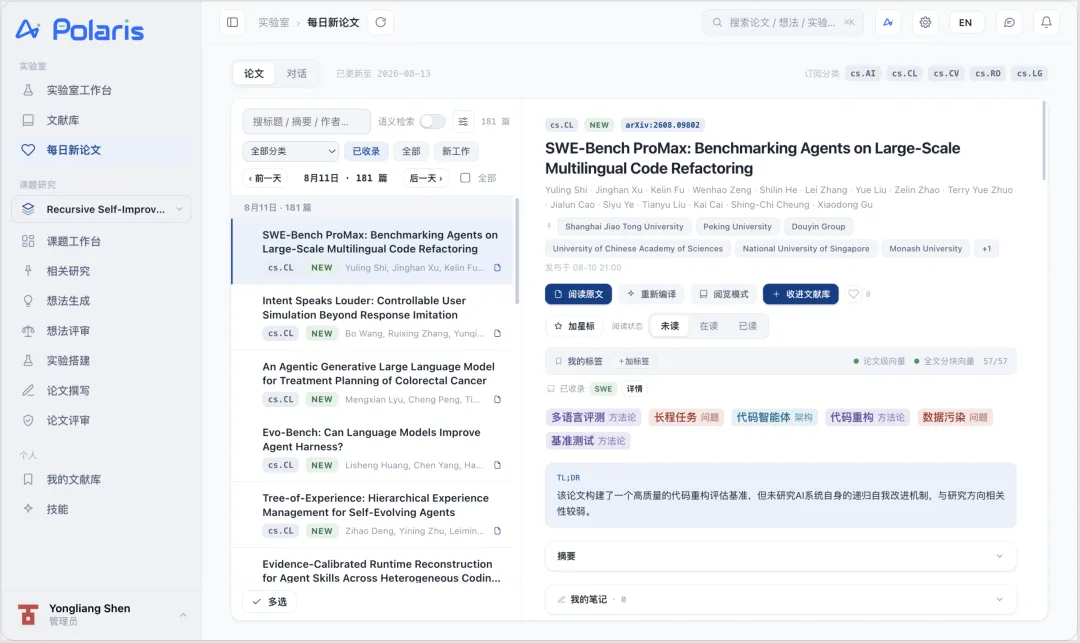
Every day, we send you new arXiv papers that AI reads over and over again.
The literature is not preserved.
Read it and give it to you.
The papers in the Revenue Library do not stop at archives. The team relies on Karpathy's LLM Wiki idea: once each paper is read in its entirety, it is compiled into a page of in-depth interpretation, explaining the motivations, methods, and locations for the work, and illustrations in the original text are automatically extracted alongside explanations. The concepts between the papers are interlinked, so that any concept can see all the work associated with it, and the evolution of the research topic can be viewed from a time dimension.
Each paper is rated for relevance, read status and your own label notes, and the entire library supports semantic retrieval and one-key export to Obsidian.
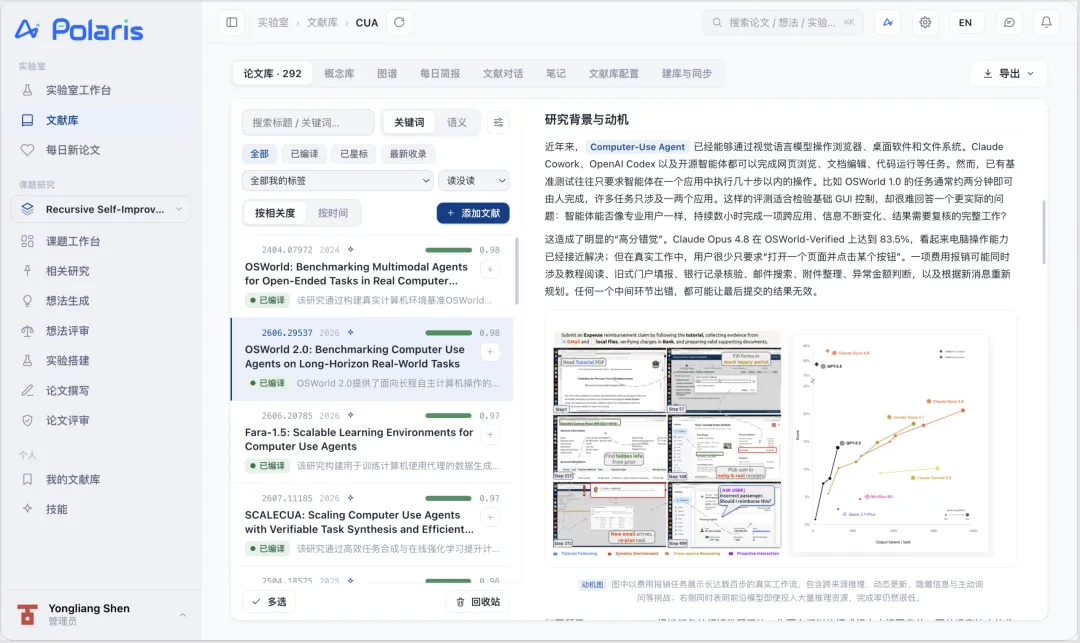
Each paper is compiled into one page of in-depth interpretation.
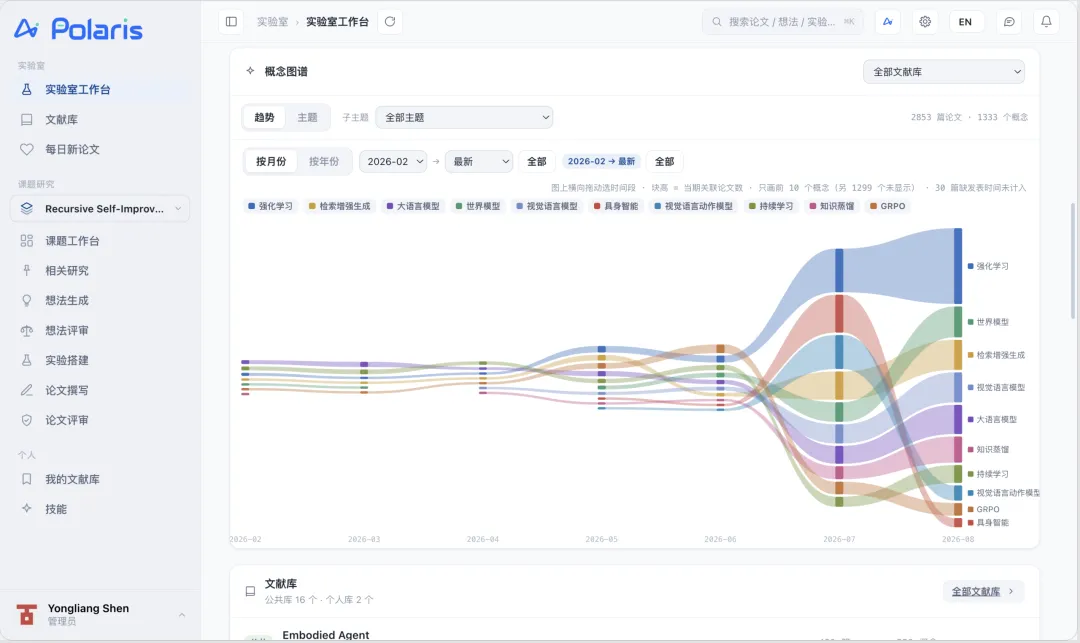
The subject of the study evolved over time
The good, the bad, the bad, the bad, the bad, the bad, the bad, the bad, and the bad.
With a knowledge base, the next step is to find the right direction. Polaris will dig for candidate ideas from a variety of signals, such as conceptual gaps, paper limitations, research trends, and scores them according to the dimensions of innovation and feasibility.
The review link introduces a debate mechanism: the platform arranges multiple AI reviewers from different positions to conduct positive and negative debates around each idea, then rank Elo according to the results of the debate, recording the number of positions and victory points for each idea. Whether the idea is promoted based on the ranking is decided by the researcher; it can be further deepened into a complete research program after the promotion, or it can directly launch experiments.
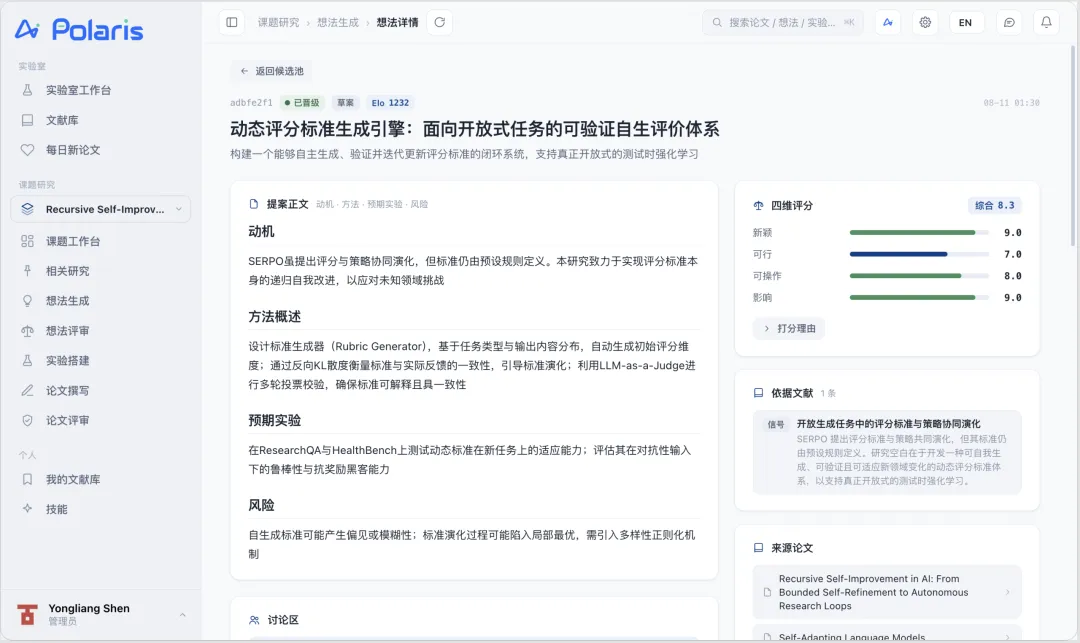
Each idea has a signal-based, source-based paper and a four-dimensional score.
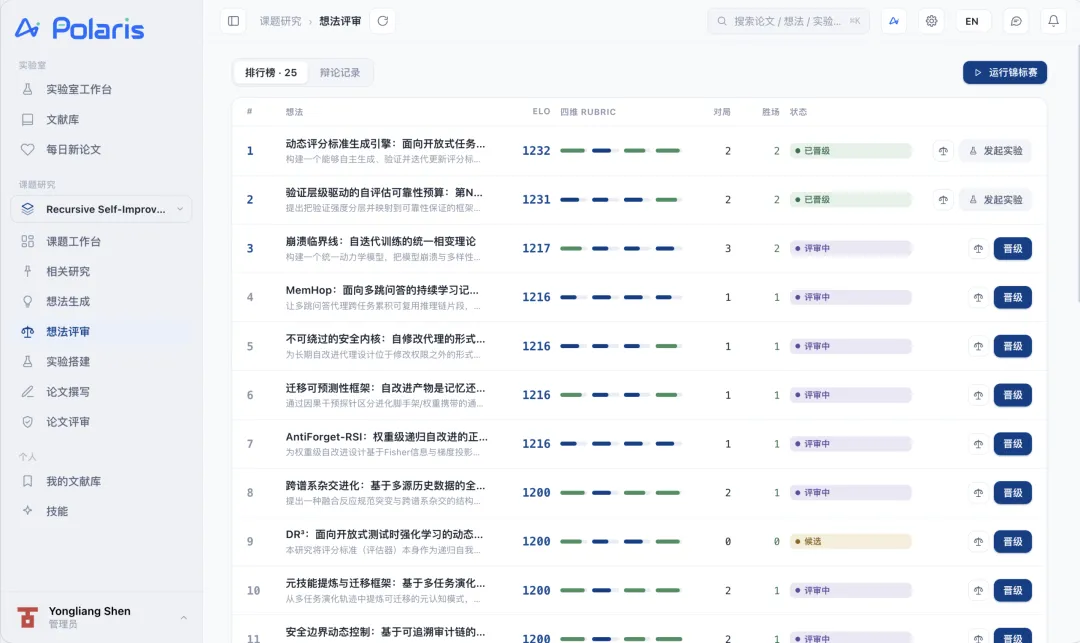
Elo rankings after two or three debates by AI reviewers, whether the ranking is determined by the researchers
Give the experiment to the AI, and you can do it anytime you want.
Once the idea is established, Polaris can connect to the lab's GPU servers, design experiments, write code, start training, automatically analyze results and iterate, and finally produce a full graphical experimental report.
This is driven by the experimental cycles of the platform: first planning, dismantling the experimental goals into a list of steps with acceptance standards; then executing, writing the code, deploying the environment, starting training; every step has to be checked, exit the code, product, indicator-by-item verification, pass the next step.
This cycle is not closed. When experiments are conducted to nodes that need to be replaced, AI pauses and asks the researcher, for example, if the differences between the groups on the current data are not significant, whether to replace the more difficult data sets or to replenish the measurement verification.
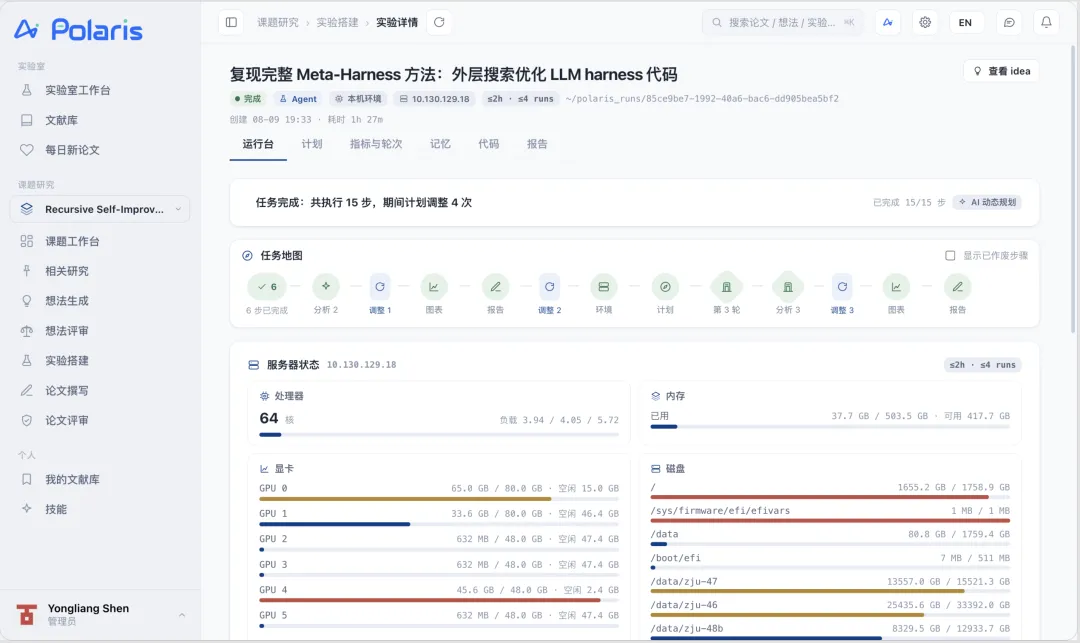
Experimental runway: AI's task map and server status, a single run of 15 steps, planned to be adjusted four times during the run.
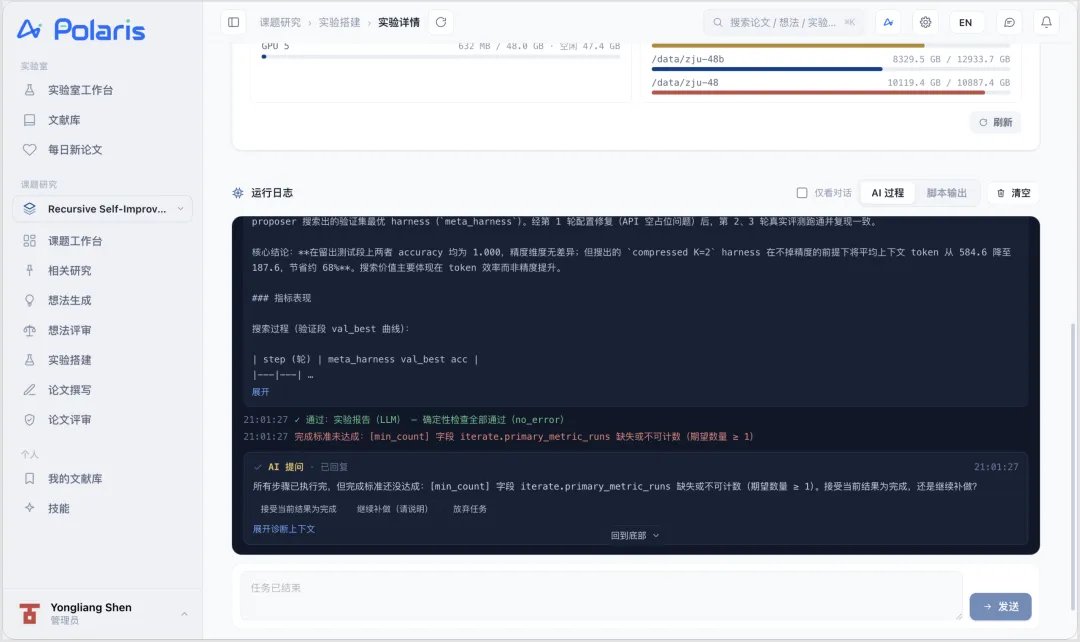
In the middle of the experiment, AI stopped asking questions, and users responded and suggested that they be adopted into the next round.
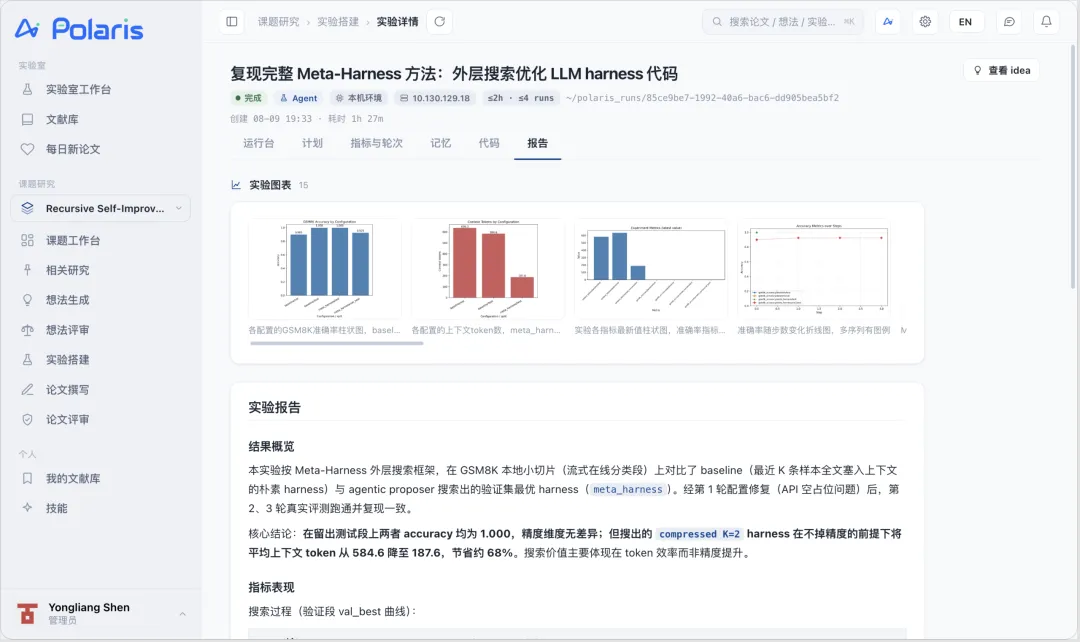
Automatically generate charts and reports after the experiment
Writing and reviewing papers, each number being accounted for
When writing papers, the platform provides online LaTeX workstations, multi-document engineering, real-time compilation, PDF previews, and AI-by-step drafting. The platform has a tough constraint here: every number in a paper can only come from a real experimental record, and every reference can only point to a document that actually exists.
After the draft, there is also a final item: AI peer review. The system checks the authenticity of the citations step by step, checks the numbers in the paper and the experimental records individually, and several reviewers give their opinions separately.
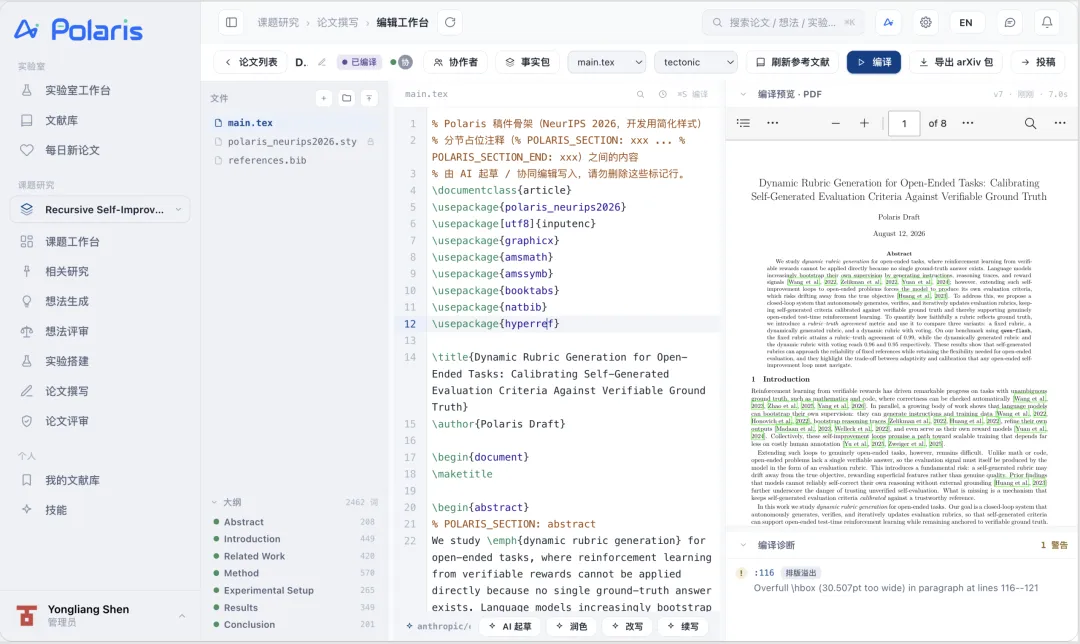
LaTeX workshops online, AI drawing up previews in real time
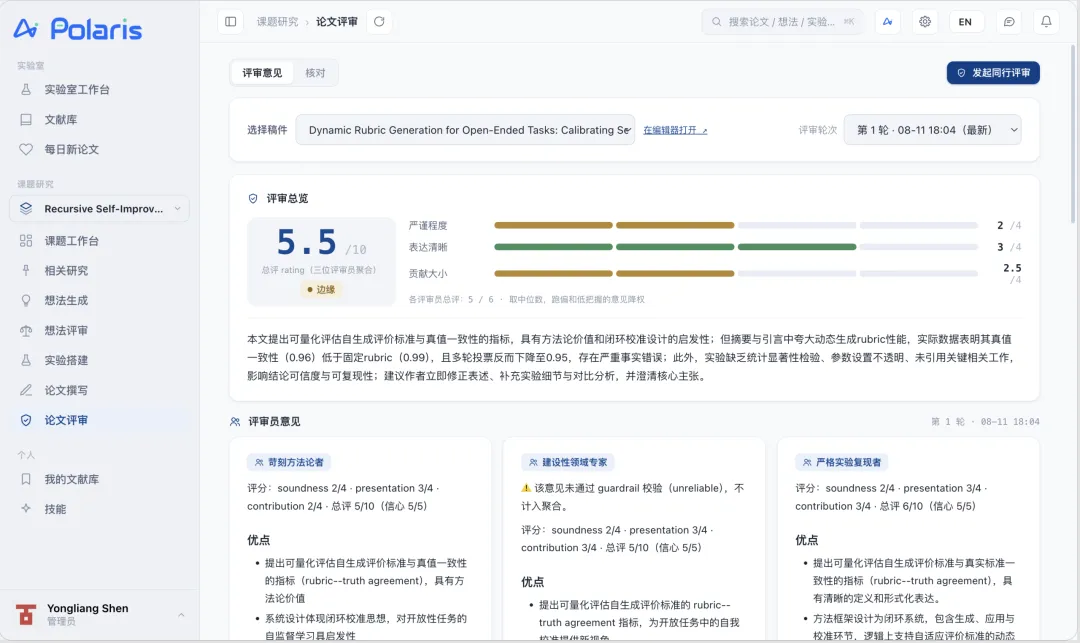
AI Peer Review: Three judges each give their opinions and put together a review summary
Your standards can be taught by the platform.
Different laboratories have different tastes and rules, and Polaris uses a system of skills to put these together. The criteria for evaluating, who to arrange for the debate, and what standards to follow experimental code can be made into a skill attached to the corresponding link. The platform incorporates a set of practical skills, such as literature summary summaries, experimental design specifications, and even the Rebuttal drafts that organize the review opinion into a step-by-step response to the draft; it can also customize skills or install others from the skill market to share them.
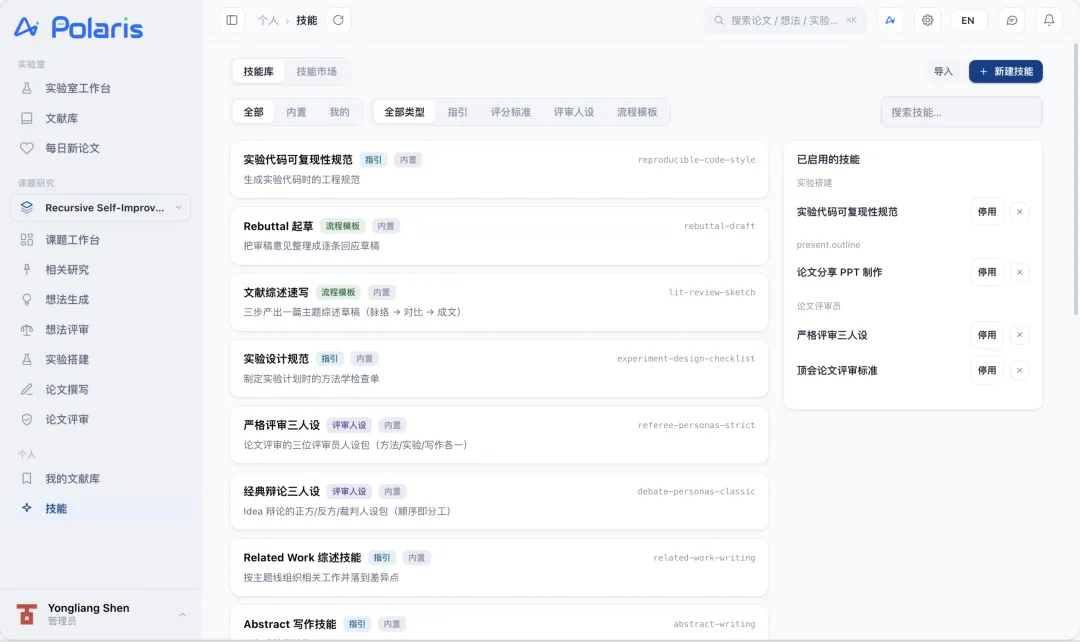
Built-in skill libraries with enabled skills attached by link
A research assistant is called upon to accompany.
In addition to the streamline, the platform is home to a global assistant, PolarisBuddy. On any page, press Command J, it will stop on the side of the work area, actively greet, and combine the current page to give instructions that can be directly clicked.
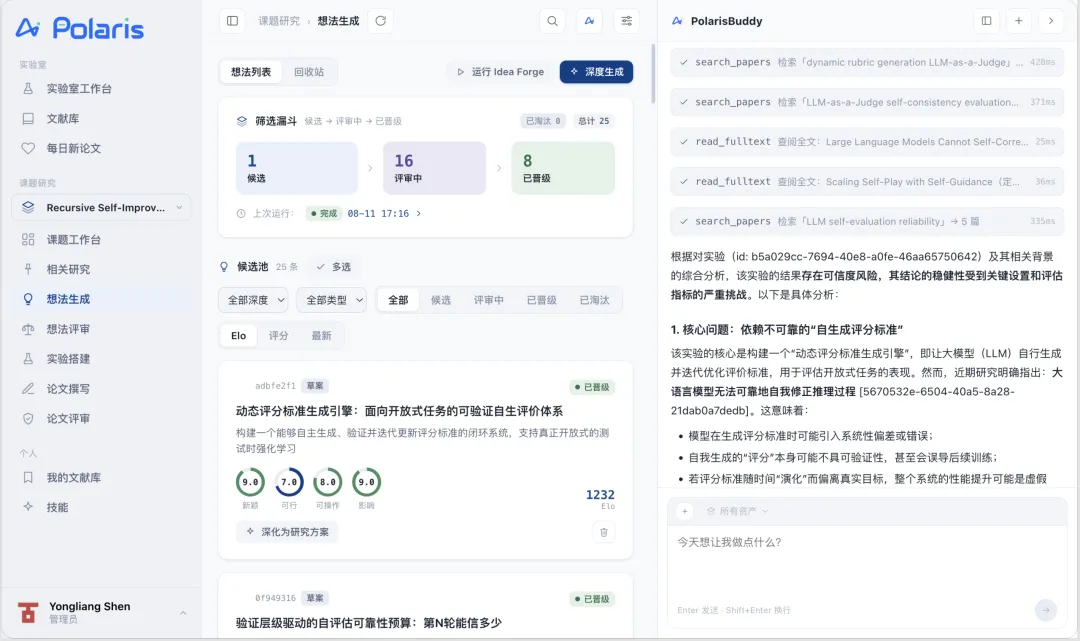
Polaris Buddy is parked next to the work area
The key decisions are always made by people.
On the whole flow line, all the key actions will stop, etc.: ideas don't be promoted, experiments don't move with the GPU budget, papers don't be posted. There is a list of next steps on the subject workstation that will be updated progressively, AI is done and it's up to you to decide.
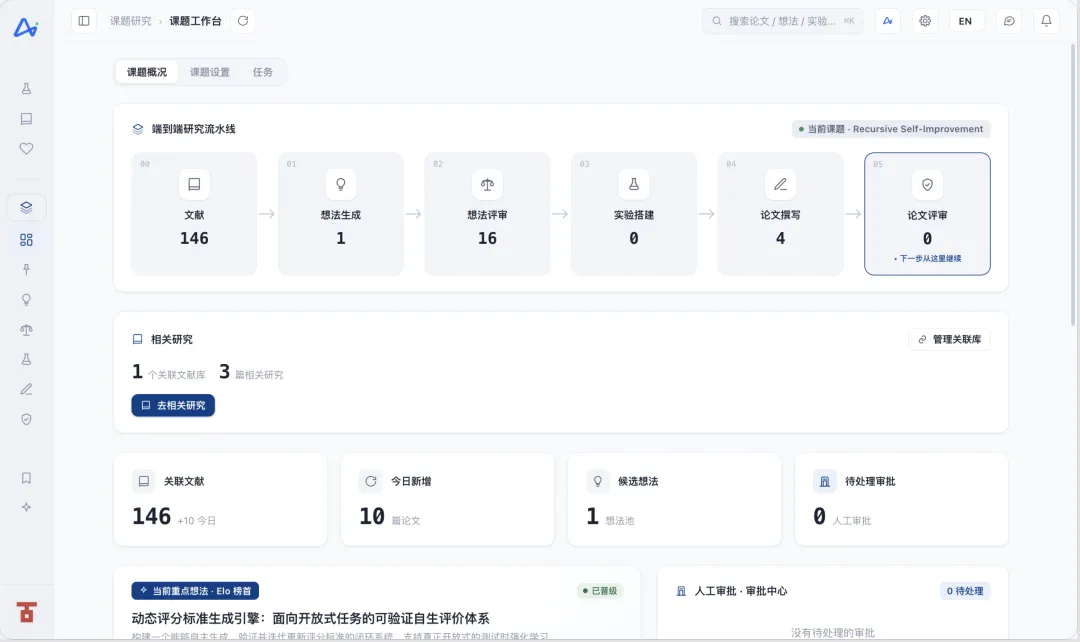
Workshop on the topic: progress of the flow line and list of next steps
The whole lab is working together.
From the beginning, Polaris was a multi-person platform designed for the laboratory. The directional library is maintained by a team, a paper is analyzed once, and the results are shared by everyone.
Lab workshops: volumes, members and knowledge overview
Open your toolchain to your abilities
Polaris' capabilities are also open to the outside world. Platform resources such as document management, experimental assets are provided externally through MCP and skill systems, and can be directly accessed in tools such as Claude Code, Codex, DeepSeek Harness; dozens of platform-built retrieval tools have clear instructions and can be run on a trial basis prior to access. In addition to web versions, desktop clients cover macOS, Windows, and Linux.
Open to external clients, the tool directory allows each tool to run first.
The project is open-source on GitHub and is currently undergoing rapid transformation.
Interested researchers are welcome to try and participate in co-creation.